Within Gabon
How Mademoiselle Turned Sorcery Fear into Politics
Travelling healers turned fear of hidden sorcery into a public movement shaped by elections, local rivalries and colonial power.
On this page
- How the travelling cleansing campaign worked
- Why villages welcomed and feared its healers
- Elections, chiefs and colonial support
Page outline Jump by section
Introduction
The Mademoiselle movement was one of the most striking anti-sorcery mobilisations in late colonial Gabon. Beginning in the mid-1950s, as constitutional reforms, elections and the approach of independence transformed political life, a travelling ritual campaign promised to expose hidden sorcery, destroy dangerous spiritual objects and cleanse entire communities. Far more than a local healing movement, it became a public spectacle that drew large crowds, reshaped village politics and linked fears about occult harm to anxieties about power, leadership and the country’s future. Rather than representing simple “mass hysteria”, historians now interpret Mademoiselle as an episode in which religious belief, colonial authority and electoral competition became deeply intertwined.[Cambridge University Press & Assessment]cambridge.orgCambridge University Press & AssessmentSPIRITS, POWER AND THE POLITICAL IMAGINATION IN LATE-COLONIAL GABON | Africa | Cambridge CoreMay 1…
How the travelling cleansing campaign worked
The movement centred on the Congolese ritual specialist Emane Boncoeur (also recorded as Emane Nyangone), who arrived in north-eastern Gabon around 1955 from what was then Moyen-Congo. According to contemporary accounts and later oral histories, he travelled with two powerful spirits known as Mademoiselle and Mimbare, believed to possess extraordinary abilities to identify hidden sorcerers and expose dangerous ritual objects.[Cambridge University Press & Assessment]cambridge.orgCambridge University Press & AssessmentSPIRITS, POWER AND THE POLITICAL IMAGINATION IN LATE-COLONIAL GABON | Africa | Cambridge CoreMay 1…
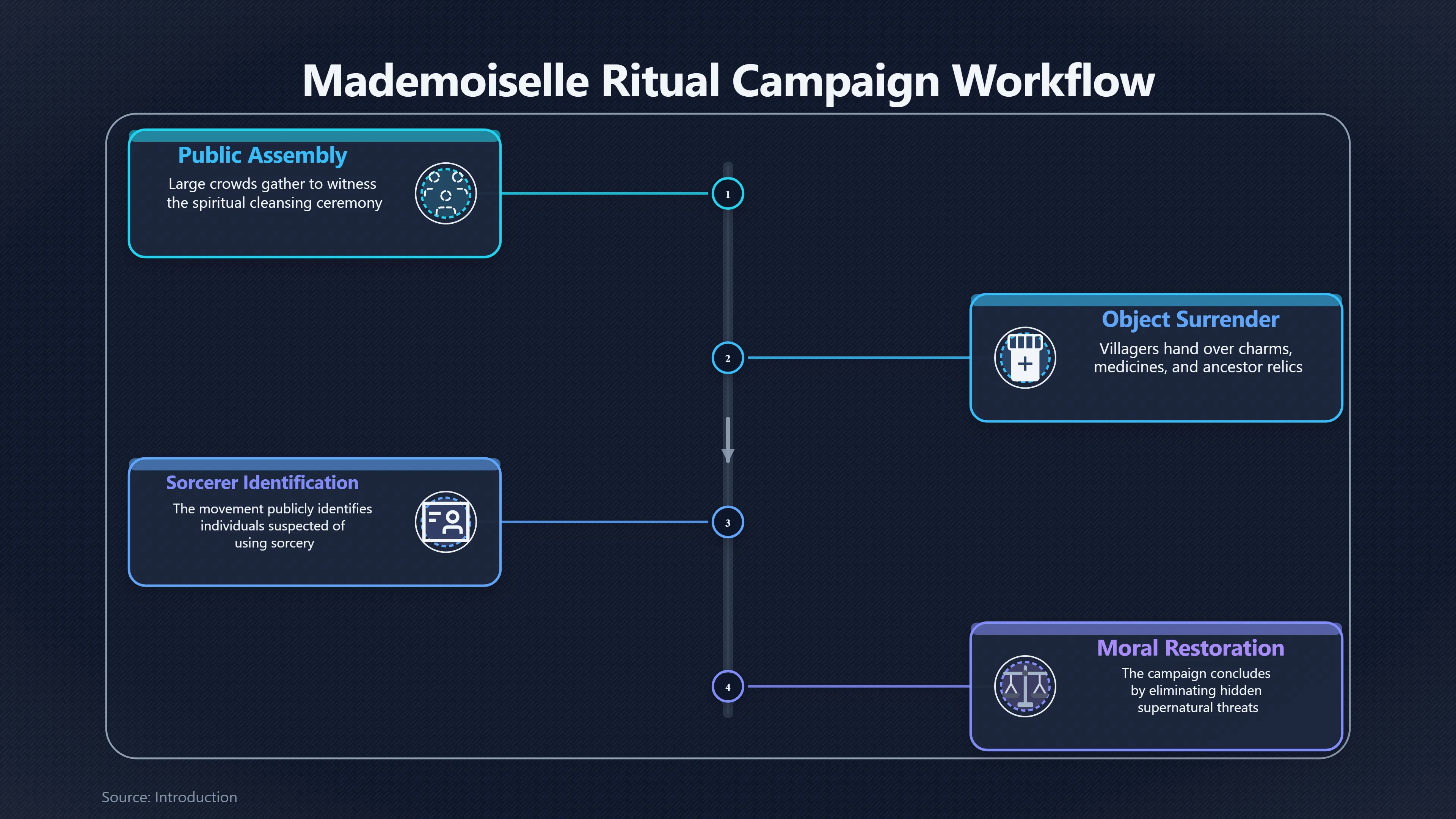
As Emane moved from village to village, ceremonies followed a recognisable pattern:
- large public gatherings assembled to witness the cleansing;
- villagers were encouraged or compelled to surrender charms, medicines, ancestor relics and other objects believed to contain occult power;
- individuals suspected of using sorcery were publicly identified;
- resistance itself could be interpreted as evidence that someone possessed dangerous supernatural force;
- the campaign presented itself as restoring moral order by eliminating hidden threats.[Cambridge University Press & Assessment]cambridge.orgCambridge University Press & AssessmentSPIRITS, POWER AND THE POLITICAL IMAGINATION IN LATE-COLONIAL GABON | Africa | Cambridge CoreMay 1…
Unlike private consultations with healers, these rituals were intensely public. Entire communities participated, making accusations, confessions and symbolic destruction visible to everyone. The movement therefore transformed fears that had often remained within families into collective events affecting whole villages.
Why villages welcomed and feared its healers
To many supporters, Mademoiselle offered protection against a very real source of suffering. Illness, repeated deaths, crop failure or unexplained misfortune were commonly interpreted through ideas about sorcery. A healer claiming the power to identify hidden attackers therefore promised justice where ordinary social mechanisms seemed unable to provide it.[Cambridge University Press & Assessment]cambridge.orgCambridge University Press & AssessmentSPIRITS, POWER AND THE POLITICAL IMAGINATION IN LATE-COLONIAL GABON | Africa | Cambridge CoreMay 1…
At the same time, the campaign generated new anxieties.
Once cleansing began, almost anyone could fall under suspicion. Objects previously regarded as protective medicines might suddenly be condemned as evidence of occult wrongdoing. Villagers later recalled fear that refusal to cooperate might itself attract supernatural punishment from Mademoiselle’s spirits. Oral traditions describe spirits visiting alleged sorcerers at night, causing illness, madness or death if they resisted the campaign. Whether understood literally or symbolically, these stories illustrate the atmosphere of intense social pressure surrounding the movement.[Cambridge University Press & Assessment]cambridge.orgCambridge University Press & AssessmentSPIRITS, POWER AND THE POLITICAL IMAGINATION IN LATE-COLONIAL GABON | Africa | Cambridge CoreMay 1…
This created a paradox. A campaign intended to eliminate fear of sorcery simultaneously reinforced belief that hidden sorcerers were everywhere. Every confiscated object appeared to confirm that dangerous occult forces had indeed infiltrated the community.
Elections, chiefs and colonial support
One reason historians consider Mademoiselle especially significant is that it unfolded during a period of profound political change rather than social isolation.
After the Second World War, France introduced limited electoral reforms across its African territories. New territorial assemblies, expanding political competition and debates over independence transformed local rivalries. In north-eastern Gabon, many Fang communities increasingly viewed themselves as losing influence within the emerging political order. John M. Cinnamon argues that memories of Mademoiselle became inseparable from these changing political fortunes.[Cambridge University Press & Assessment]cambridge.orgCambridge University Press & AssessmentSPIRITS, POWER AND THE POLITICAL IMAGINATION IN LATE-COLONIAL GABON | Africa | Cambridge CoreMay 1…
Rather than emerging entirely from below, the movement also received support from influential figures.
Evidence indicates that territorial councillor Paul Zembote helped invite Emane Boncoeur into the region. Colonial administrators authorised and monitored his tour, believing that suppressing alleged sorcery might reduce local conflict and strengthen public order. As a result, the mobilisation occupied an unusual position:
- villagers sought spiritual protection;
- politicians could use the campaign to reinforce their authority;
- colonial officials viewed it as a potentially useful instrument of control.
This combination makes Mademoiselle quite different from spontaneous rumours or uncontrolled witch panics. Political actors did not necessarily invent local fears, but they became deeply involved in directing and legitimising the movement.[Cambridge University Press & Assessment]cambridge.orgCambridge University Press & AssessmentSPIRITS, POWER AND THE POLITICAL IMAGINATION IN LATE-COLONIAL GABON | Africa | Cambridge CoreMay 1…

Why the movement became tied to political power
Many later oral histories do not separate the arrival of Mademoiselle from the birth of modern Gabonese politics.
Interviewees collected decades afterwards frequently connected three developments:
- the first competitive elections;
- the arrival of Emane Boncoeur’s cleansing campaign;
- the later political marginalisation of parts of north-eastern Gabon.
Some believed that by removing powerful ritual objects, Emane had also stripped communities of the spiritual strength needed to compete politically after independence. Others argued the opposite—that eliminating destructive sorcery protected society and allowed legitimate leadership to emerge. These contrasting memories reveal how the movement remained politically meaningful long after the ceremonies themselves ended.[Cambridge University Press & Assessment]cambridge.orgCambridge University Press & AssessmentSPIRITS, POWER AND THE POLITICAL IMAGINATION IN LATE-COLONIAL GABON | Africa | Cambridge CoreMay 1…
The symbolism of Mademoiselle
The figure known as Mademoiselle was remembered as a white female spirit associated with European power while simultaneously operating within Central African religious traditions. Different communities identified her in different ways. Some linked her with Christian figures such as the Virgin Mary or Mary Magdalene, others with wider regional spirit traditions, while still others treated her as a unique supernatural being attached specifically to Emane Boncoeur.[Cambridge University Press & Assessment]cambridge.orgCambridge University Press & AssessmentSPIRITS, POWER AND THE POLITICAL IMAGINATION IN LATE-COLONIAL GABON | Africa | Cambridge CoreMay 1…
For historians, this mixture is significant because it illustrates how colonialism reshaped religious imagination rather than simply replacing African beliefs with European ones. The movement combined Christian imagery, colonial authority, indigenous understandings of spirits and older anti-sorcery traditions into something new.
Was this a witch panic or a healing movement?
The evidence suggests that Mademoiselle cannot be reduced to a single category.
It shared characteristics with anti-witchcraft movements seen elsewhere in colonial Africa because it publicly identified alleged practitioners of harmful occult power. Yet participants generally understood themselves as engaging in purification rather than persecution. The primary goal was the removal of dangerous spiritual objects and the restoration of communal health, not formal criminal punishment.[Cambridge University Press & Assessment]cambridge.orgCambridge University Press & AssessmentSPIRITS, POWER AND THE POLITICAL IMAGINATION IN LATE-COLONIAL GABON | Africa | Cambridge CoreMay 1…
Modern scholarship therefore avoids describing the movement simply as irrational panic. Instead, it is interpreted as a response to multiple overlapping pressures:
- widespread belief in sorcery;
- rapid political change;
- competition between local leaders;
- uncertainty surrounding colonial reform and impending independence;
- changing relationships between Christianity and indigenous religious practice.[Cambridge University Press & Assessment]cambridge.orgCambridge University Press & AssessmentSPIRITS, POWER AND THE POLITICAL IMAGINATION IN LATE-COLONIAL GABON | Africa | Cambridge CoreMay 1…

Why Mademoiselle remains important
Although the travelling campaign itself belonged to the 1950s, its influence persisted. Mademoiselle and Mimbare were later incorporated into several healing and initiation traditions in northern Gabon and neighbouring Equatorial Guinea, demonstrating that the movement left a lasting religious legacy rather than disappearing after independence.[Cambridge University Press & Assessment]cambridge.orgCambridge University Press & AssessmentSPIRITS, POWER AND THE POLITICAL IMAGINATION IN LATE-COLONIAL GABON | Africa | Cambridge CoreMay 1…
For historians of collective belief, Mademoiselle provides an unusually rich example of how fear can become organised through public ritual without fitting neatly into the categories of mass hysteria or simple moral panic. It shows how deeply beliefs about invisible danger can become entangled with elections, colonial administration, regional identity and struggles over political legitimacy. In Gabon’s history, the movement stands as a reminder that anti-sorcery campaigns were not merely reactions to supernatural fears: they also became ways of negotiating who possessed authority in a rapidly changing society.[Cambridge University Press & Assessment]cambridge.orgCambridge University Press & AssessmentSPIRITS, POWER AND THE POLITICAL IMAGINATION IN LATE-COLONIAL GABON | Africa | Cambridge CoreMay 1…
Amazon book picks
Further Reading
Books and field guides related to How Mademoiselle Turned Sorcery Fear into Politics. Use these as the next step if you want deeper reading beyond the article.
African Religions A Very Short Introduction
Explains indigenous belief systems often misunderstood by colonial authorities.


African traditional religions in contemporary society
First published 1991. Subjects: Religion, Study and teaching, Congresses, Étude et enseignement, PRO Shaw, Gwendolyn Dubois, 1968- (donor).
Endnotes
1.
Source: cambridge.org
Link:https://www.cambridge.org/core/journals/africa/article/spirits-power-and-the-political-imagination-in-latecolonial-gabon/51C136E4EEB332571E60C16B1F1C22CA
Source snippet
Cambridge University Press & AssessmentSPIRITS, POWER AND THE POLITICAL IMAGINATION IN LATE-COLONIAL GABON | Africa | Cambridge CoreMay 1...
2.
Source: cambridge.org
Title: Cinnamon Show author details *
Link:https://www.cambridge.org/core/journals/history-in-africa/article/abs/missionary-expertise-social-science-and-the-uses-of-ethnographic-knowledge-in-colonial-gabon/EC5DD98282A41152D29A20464E5BA7DC
Source snippet
Missionary Expertise, Social Science, and the uses of Ethnographic Knowledge in Colonial Gabon | History in Africa | Cambridge CoreMay 9...
3.
Source: cambridge.org
Title: Africa: Volume 82
Link:https://www.cambridge.org/core/journals/africa/issue/074A8AD8E5DB797FCDC5A4829961DE53
Source snippet
Issue 2 | Cambridge CoreMay 1, 2012 — VOLUME 82 - ISSUE 2 - MAY 2012 [Select] Contents * * * Page 1 of 2 * First * « Prev * 1 * 2 * Next...
Published: May 1, 2012
4.
Source: cambridge.org
Link:https://www.cambridge.org/core/journals/social-anthropology/article/abs/voir-par-derriere-sorcellerie-initiation-et-perception-au-gabon/8FEE503CBB72886269D709F6E594837F
Additional References
5.
Source: tandfonline.com
Title: However, Garner described how he engaged with local occult beliefs
Link:https://www.tandfonline.com/doi/abs/10.1080/17532520902793270
Source snippet
An American Sorcerer in Colonial Gabon: Politics and the Occult in Richard Lynch Garner's Gabonese Narratives, 1905–1908: African Histori...
6.
Source: africabib.org
Link:https://www.africabib.org/rec.php?RID=P00012289
Source snippet
AfricaBib | Ambivalent Power: Anti-Sorcery and Occult Subjugation in Late Colonial Gabon...
7.
Source: africabib.org
Title: Africa Bib | Spirits, power and the political imagination in late-colonial Gabon
Link:https://www.africabib.org/rec.php?RID=345865316
Source snippet
AfricaBib | Spirits, power and the political imagination in late-colonial Gabon...
8.
Source: fr.scribd.com
Title: Anthropologie religieuse 2006
Link:https://fr.scribd.com/document/616713921/Anthropologie-religieuse-2006
Source snippet
Le travail symbolique de la religion d’éboga (Gabon) (Paris: EHESS, 1999); John Cinnamon, « Ambivalent Power: Anti-Sorcery and Occult Su...
9.
Source: fr.scribd.com
Title: CGA 17
Link:https://fr.scribd.com/document/167297376/CGA-17
Source snippet
religieuse au Gabon | PDF | Afrique | RéincarnationJanuary 1, 2006 — Loin de sy opposer, elle redoubla le triomphe du paradigme de la mod...
Published: January 1, 2006
10.
Source: africabib.org
Link:https://www.africabib.org/rec.php?RID=315255943
11.
Source: dukeupress.edu
Link:https://dukeupress.edu/colonial-transactions
12.
Source: dokumen.pub
Title: colonial transactions imaginaries bodies and histories in gabon 9781478002666
Link:https://dokumen.pub/colonial-transactions-imaginaries-bodies-and-histories-in-gabon-9781478002666.html
13.
Source: youtube.com
Title: The Entire History of Gabon
Link:https://www.youtube.com/watch?v=mIGPVZFvGxk
Source snippet
Gabon: A Historical and Geographical Overview...
14.
Source: africabib.org
Link:https://www.africabib.org/query_a.php?au=%21305655965%21
Topic Tree