Within Kuwait
How the Incubator Story Helped Shape a War
The incubator story shows how an unverified atrocity claim can spread through testimony, media and politics during a genuine national crisis.
On this page
- The occupation and the conditions for rumour
- Nayirah's testimony and its political reach
- What later investigations found
Page outline Jump by section
Introduction
The so-called Incubator Story is one of the best-known examples of how a dramatic wartime rumour can shape international opinion before its accuracy has been properly tested. During Iraq’s occupation of Kuwait in 1990, reports of killings, torture and disappearances emerged alongside many claims that could not immediately be verified because journalists and independent investigators had little access to the occupied country. In that atmosphere of fear and uncertainty, an emotional account that Iraqi soldiers had removed premature babies from hospital incubators and left them to die spread rapidly through the media and political debate. The story became an influential symbol of Iraqi brutality, but later investigations found that its central claim was unsupported. The episode remains an important case study in wartime propaganda, the dangers of relying on unverified testimony during crises, and the difficulty of separating genuine atrocities from false or exaggerated reports.
The occupation and the conditions for rumour
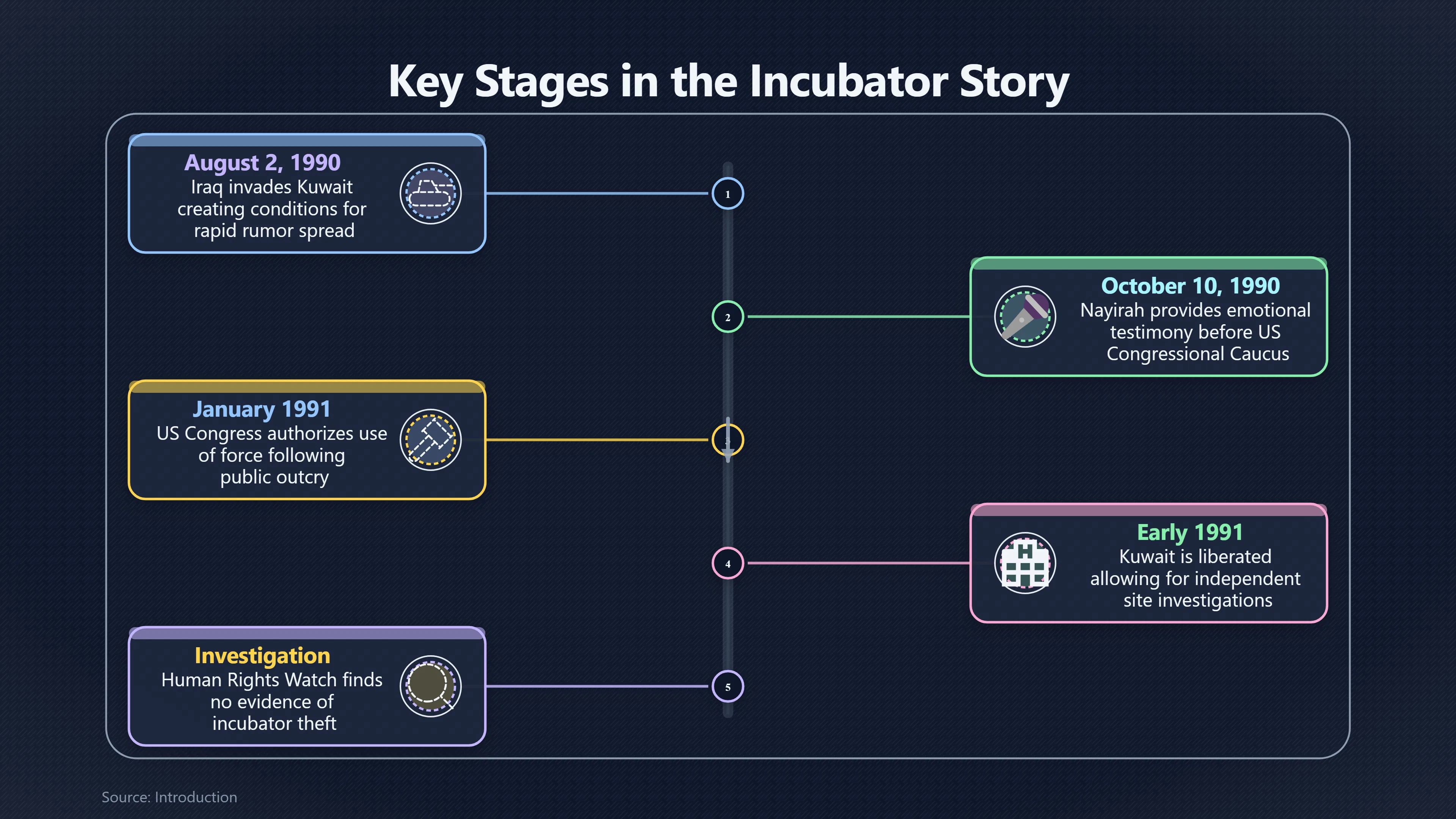
Iraq’s invasion of Kuwait on 2 August 1990 created precisely the conditions in which rumours often flourish. Communications from inside occupied Kuwait were severely restricted, foreign journalists had limited access, and refugees arriving in neighbouring countries carried accounts of violence that were difficult to verify independently. At the same time, Iraqi forces were responsible for documented human rights abuses, including arbitrary arrests, torture, executions and widespread intimidation of civilians. Those genuine crimes made additional atrocity stories seem plausible to many audiences.[Amnesty International]amnesty.orgInternational Iraq/Occupied Kuwait: Human rights violations since 2 AugustAmnesty InternationalIraq/Occupied Kuwait: Human rights violations since 2 August - Amnesty InternationalDecember 1, 1990…
Rumours during war rarely emerge from nowhere. They often develop from fragments of truth, misunderstandings, repeated second-hand accounts or deliberate attempts to influence public opinion. In Kuwait’s case, hospitals were affected by the occupation, medical services were disrupted and there were real reports of suffering among patients. Against that background, a vivid claim about newborn babies became especially powerful because it combined vulnerable victims with an image that was easy to understand and difficult to forget.
The speed with which the story spread also reflected the information environment of 1990. Before widespread internet access, television news, newspapers and official testimony played an even greater role in shaping public understanding of distant conflicts. Once respected political figures repeated the allegation, many journalists treated it as credible.
Nayirah’s testimony and its political reach
The story reached a global audience on 10 October 1990 when a 15-year-old Kuwaiti girl identified only as Nayirah gave emotional testimony before the United States Congressional Human Rights Caucus. She said she had volunteered at a Kuwaiti hospital and had personally witnessed Iraqi soldiers entering the maternity ward, removing premature babies from incubators and leaving them to die on the floor while stealing the equipment.[Wikipedia]WikipediaNayirah testimonyNayirah testimony
Her account was broadcast widely and reproduced by newspapers and television networks around the world. It was repeatedly cited by politicians arguing for stronger international action against Iraq. US President George H. W. Bush referred to the incubator story in speeches supporting military intervention, and several senators mentioned it during debates before the vote authorising the use of force in January 1991. Although the decision to liberate Kuwait rested on many strategic and legal considerations, the testimony became one of the conflict’s most memorable emotional appeals.[Wikipedia]WikipediaNayirah testimonyNayirah testimony
The testimony was not simply an isolated personal statement. It formed part of a broader public relations campaign organised by Citizens for a Free Kuwait, an organisation supported by the Kuwaiti government-in-exile. The campaign was managed by the public relations firm Hill & Knowlton, which helped arrange witnesses and media outreach intended to strengthen international backing for Kuwait. The firm’s role later became a major focus of criticism, particularly after questions arose about the accuracy of the incubator story.[Wikipedia]WikipediaNayirah testimonyNayirah testimony
What later investigations found
After Kuwait was liberated in early 1991, journalists and human rights investigators were finally able to examine many wartime claims more closely. The incubator story did not withstand that scrutiny.
In 1992, investigators from Human Rights Watch’s Middle East Watch interviewed doctors and hospital staff at the facility where the incident was said to have occurred. They found no evidence that Iraqi soldiers had removed babies from incubators and left them to die. Doctors confirmed that Iraqi forces had entered hospitals and that medical services suffered during the occupation, but they rejected the central allegation that incubators had been stolen after infants were removed from them.[Wikipedia]WikipediaNayirah testimonyNayirah testimony
Further investigation also revealed that “Nayirah” was not an anonymous hospital volunteer but the daughter of Kuwait’s ambassador to the United States. Her family connection had not been disclosed during the congressional hearing, raising questions about transparency and the presentation of her testimony.[Wikipedia]WikipediaNayirah testimonyNayirah testimony
The Kuwaiti government later commissioned an inquiry by Kroll Associates. According to published accounts of that investigation, Nayirah no longer claimed to have directly witnessed the dramatic scene described in her original testimony. Instead, her recollection became much more limited, differing substantially from the account that had reached international audiences.[Wikipedia]WikipediaNayirah testimonyNayirah testimony
Amnesty International provides another illustration of how difficult wartime verification can be. During the occupation it included reports of babies allegedly removed from incubators in its documentation, based on witness accounts available at the time. As more evidence emerged after the war, the organisation withdrew its support for the specific incubator allegation, stating that it had found no reliable evidence that Iraqi forces had deliberately removed infants from incubators or ordered their removal.[Wikipedia]WikipediaNayirah testimonyNayirah testimony
Why the story was so persuasive
The incubator story demonstrates several features common to influential wartime rumours.
First, it appeared during a period when independent verification was exceptionally difficult. Genuine atrocities were occurring, making additional reports easier to believe.
Second, the allegation focused on premature babies, among the most emotionally compelling possible victims. Stories involving children often spread rapidly because they evoke strong moral reactions before careful fact-checking can occur.
Third, the claim came through what appeared to be an authoritative setting: testimony before members of the US Congress. Many journalists and politicians assumed that such testimony had already been rigorously checked, even though the Congressional Human Rights Caucus was not a formal congressional committee conducting sworn evidence.
Finally, the story was repeated by influential political leaders and major news organisations. Repetition across multiple trusted sources gave the impression of independent confirmation even when many reports ultimately traced back to the same original testimony.

The wider historical significance
The exposure of the incubator story has sometimes been misused to suggest that Iraqi crimes during the occupation were generally fabricated. That conclusion is not supported by the historical record. Independent investigations documented numerous genuine human rights violations by Iraqi occupation forces, including unlawful killings, torture, disappearances and widespread abuses against Kuwaiti civilians. The failure of one prominent atrocity claim does not erase the reality of those documented crimes.[Amnesty International]amnesty.orgInternational Iraq/Occupied Kuwait: Human rights violations since 2 AugustAmnesty InternationalIraq/Occupied Kuwait: Human rights violations since 2 August - Amnesty InternationalDecember 1, 1990…
Instead, historians and media scholars usually treat the incubator episode as a warning about the need to distinguish between verified evidence and emotionally powerful but insufficiently tested claims. It illustrates how governments, public relations campaigns, news organisations and political institutions can unintentionally amplify inaccurate information during periods of genuine crisis.
Within Kuwait’s history of collective belief and wartime fear, the incubator story is therefore significant not because it represents mass hysteria in the clinical sense, but because it shows how uncertainty, restricted information, authentic violence and persuasive testimony combined to produce one of the most influential wartime rumours of the late twentieth century. Its legacy continues to shape debates about war reporting, humanitarian advocacy, propaganda and the standards of evidence required before atrocity stories become part of public policy.
Amazon book picks
Further Reading
Books and field guides related to How the Incubator Story Helped Shape a War. Use these as the next step if you want deeper reading beyond the article.
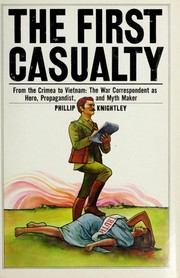
The First Casualty
Examines how wartime misinformation and atrocity stories influence public opinion.
Manufacturing Consent
Explores media, political messaging and the shaping of public narratives.
Thinking, Fast and Slow
Explains why emotionally powerful stories can override careful evaluation.
Endnotes
1.
Source: amnesty.org
Title: International Iraq/Occupied Kuwait: Human rights violations since 2 August
Link:https://www.amnesty.org/en/documents/mde14/016/1990/en/
Source snippet
Amnesty InternationalIraq/Occupied Kuwait: Human rights violations since 2 August - Amnesty InternationalDecember 1, 1990...
Published: December 1, 1990
2.
Source: Wikipedia
Title: Nayirah testimony
Link:https://en.wikipedia.org/wiki/Nayirah_testimony
3.
Source: amnesty.org
Link:https://www.amnesty.org/en/documents/MDE17/002/1991/en/
4.
Source: amnesty.org
Link:https://www.amnesty.org/en/documents/MDE14/019/1990/en/
5.
Source: washingtonpost.com
Title: Opinion | THE KUWAITI INCUBATOR HOAX
Link:https://www.washingtonpost.com/archive/opinions/1994/02/26/the-kuwaiti-incubator-hoax/35b1e882-f796-4acb-a106-9280a7dda521/
6.
Source: washingtonpost.com
Title: Opinion | CAPITOL HILL KNOWLTON
Link:https://www.washingtonpost.com/archive/opinions/1992/01/12/capitol-hill-knowlton/da2f7a94-8fca-497c-8da8-d6b7ff17da4e/
Additional References
7.
Source: piercingthematrix.blogspot.com
Title: Congress that she had seen Iraqi soldiers pulling Kuwaiti babies from inc
Link:https://piercingthematrix.blogspot.com/2013/04/testimony-of-nayirah.html
Source snippet
Piercing the Matrix: Testimony of NayirahApril 22, 2013 — PIERCING THE MATRIX MONDAY, 22 APRIL 2013 TESTIMONY OF NAYIRAH A 15-year-old gi...
Published: April 22, 2013
8.
Source: legalclarity.org
Title: Legal Clarity Nayirah Testimony: The PR Campaign, Exposure, and Legacy
Link:https://legalclarity.org/nayirah-testimony-the-pr-campaign-exposure-and-legacy/
Source snippet
Nayirah Testimony: The PR Campaign, Exposure, and Legacy - LegalClarityJuly 4, 2026 — NAYIRAH TESTIMONY: THE PR CAMPAIGN, EXPOSURE, AND L...
Published: July 4, 2026
9.
Source: legalclarity.org
Title: congressional human rights caucus to tom lantos commission
Link:https://legalclarity.org/congressional-human-rights-caucus-to-tom-lantos-commission/
Source snippet
June 29, 2026 — Dalai Lama THE NAYIRAH TESTIMONY CONTROVERSY The caucus became the center of a major controversy during the r...
Published: June 29, 2026
10.
Source: washingtonpost.com
Title: The Washington Post AMNESTY INTERNATIONAL ACCUSES IRAQ OF ATROCITIES IN KUWAIT
Link:https://www.washingtonpost.com/archive/politics/1990/12/19/amnesty-international-accuses-iraq-of-atrocities-in-kuwait/78f4f740-dc16-4386-976e-21f54007e7ee/
Source snippet
The Washington PostAMNESTY INTERNATIONAL ACCUSES IRAQ OF ATROCITIES IN KUWAIT - The Washington Post...
11.
Source: democracynow.org
Title: How False Testimony and a Massive U.S
Link:https://www.democracynow.org/2018/12/5/how_false_testimony_and_a_massive
Source snippet
Propaganda Machine Bolstered George H.W. Bush’s War on Iraq | Democracy Now!December 5, 2018 — Well, we continue now to look back at the...
Published: December 5, 2018
12.
Source: conflictedhistory.com
Title: the gulf war 1991 part 2 the storm
Link:https://www.conflictedhistory.com/the-gulf-war-1991-part-2-the-storm/
Source snippet
They took the babies out of the incubators, took the incubators and left the children to die on the cold floor. It was hor...
13.
Source: youtube.com
Link:https://www.youtube.com/watch?v=WkRylMGLPMU
Source snippet
John MacArthur - 10-15-92 - Original air date...
14.
Source: whatreallyhappened.com
Link:https://whatreallyhappened.com/RANCHO/LIE/HK/HK2.html
15.
Source: prwatch.org
Link:https://www.prwatch.org/node/25
16.
Source: cavac.at
Link:https://cavac.at/cavacopedia/Nayirah%20testimony
Topic Tree