Within Iceland Panics
Why Doubt Disappears So Quickly
Ambiguous events can harden into accepted explanations when trusted institutions and close social networks reinforce one another.
On this page
- From uncertainty to a dominant explanation
- How authorities reinforce belief cascades
- Why small social networks can intensify pressure
Page outline Jump by section
Introduction
One of the striking features of Iceland’s history is not the sheer scale of its panics or miscarriages of justice, but the speed with which uncertain explanations could become accepted truths. In a small, closely connected society, rumours, suspicions and official conclusions often travelled through overlapping networks of families, clergy, officials and neighbours. Once respected authorities endorsed a particular explanation, challenging it became increasingly difficult. This helps explain both the seventeenth-century witch trials and, centuries later, the false-confession scandal surrounding the Guðmundur and Geirfinnur investigation. Although these episodes differed enormously in context, they illustrate a common mechanism: uncertainty narrowed into apparent certainty because social and institutional pressures reinforced one another rather than testing competing explanations.[Galdrasyning]galdrasyning.isThe Witch-hunts in Iceland – Galdrasýning á StröndumThe Witch-hunts in Iceland – Galdrasýning á Ströndum…
From uncertainty to a dominant explanation
Collective certainty rarely begins with overwhelming evidence. It usually starts with ambiguity.
In Iceland’s witch trials, unexplained illness, livestock losses or personal misfortune did not automatically produce accusations of sorcery. Many possible explanations existed. Yet once influential figures framed an event as the work of harmful magic, later information tended to be interpreted through that lens. Court records show accusations accumulating around particular individuals as previous suspicions made new allegations seem more credible. European demonological ideas imported through educated clergy and officials provided a ready-made framework into which local disputes could be fitted.[Galdrasyning]galdrasyning.isThe Witch-hunts in Iceland – Galdrasýning á StröndumThe Witch-hunts in Iceland – Galdrasýning á Ströndum…
A remarkably similar pattern appeared during the Guðmundur and Geirfinnur investigation in the 1970s. Police initially faced two disappearances with almost no physical evidence. As investigators became convinced that murder had occurred and that particular suspects were responsible, interviews increasingly sought confirmation rather than alternative explanations. Contradictions were absorbed into the preferred narrative instead of undermining it. What began as uncertainty gradually hardened into a coherent story that eventually produced convictions despite the absence of bodies, forensic evidence or independent eyewitnesses.[wikipedia.org]WikipediaGuðmundur and Geirfinnur caseGuðmundur and Geirfinnur case
The important lesson is not that Icelanders were uniquely gullible. Rather, once a plausible explanation gained institutional backing, each new decision made reversing course psychologically and socially more difficult.
How authorities reinforce belief cascades
Authority gives uncertain claims extra weight.
During the witch trials, local gossip alone could not impose capital punishment. Sheriffs, clergy and judges decided which accusations deserved prosecution. Their decisions transformed neighbourhood suspicions into legal facts. The influence of Danish law and Lutheran religious teaching meant that what might once have remained a local quarrel could become a criminal prosecution carrying the death penalty. The authority of courts encouraged communities to treat accusations as increasingly credible.[Galdrasyning]galdrasyning.isThe Witch-hunts in Iceland – Galdrasýning á StröndumThe Witch-hunts in Iceland – Galdrasýning á Ströndum…
The Reykjavík confessions reveal the same mechanism operating through modern institutions rather than religious courts. Investigators used prolonged interrogation, solitary confinement and repeated questioning while working from an assumption of guilt. Psychological research suggests that these methods can undermine confidence in one’s own memory, making some suspects increasingly reliant on investigators’ interpretations instead of their own recollections. Once confessions emerged, they reinforced investigators’ confidence, even when the confessions were inconsistent or changed repeatedly.[IRIS]iris.landsbokasafn.isIRISThe role of memory distrust in cases of internalised false confessionRannsóknargáttin IRIS / The Iceland Research Information System…
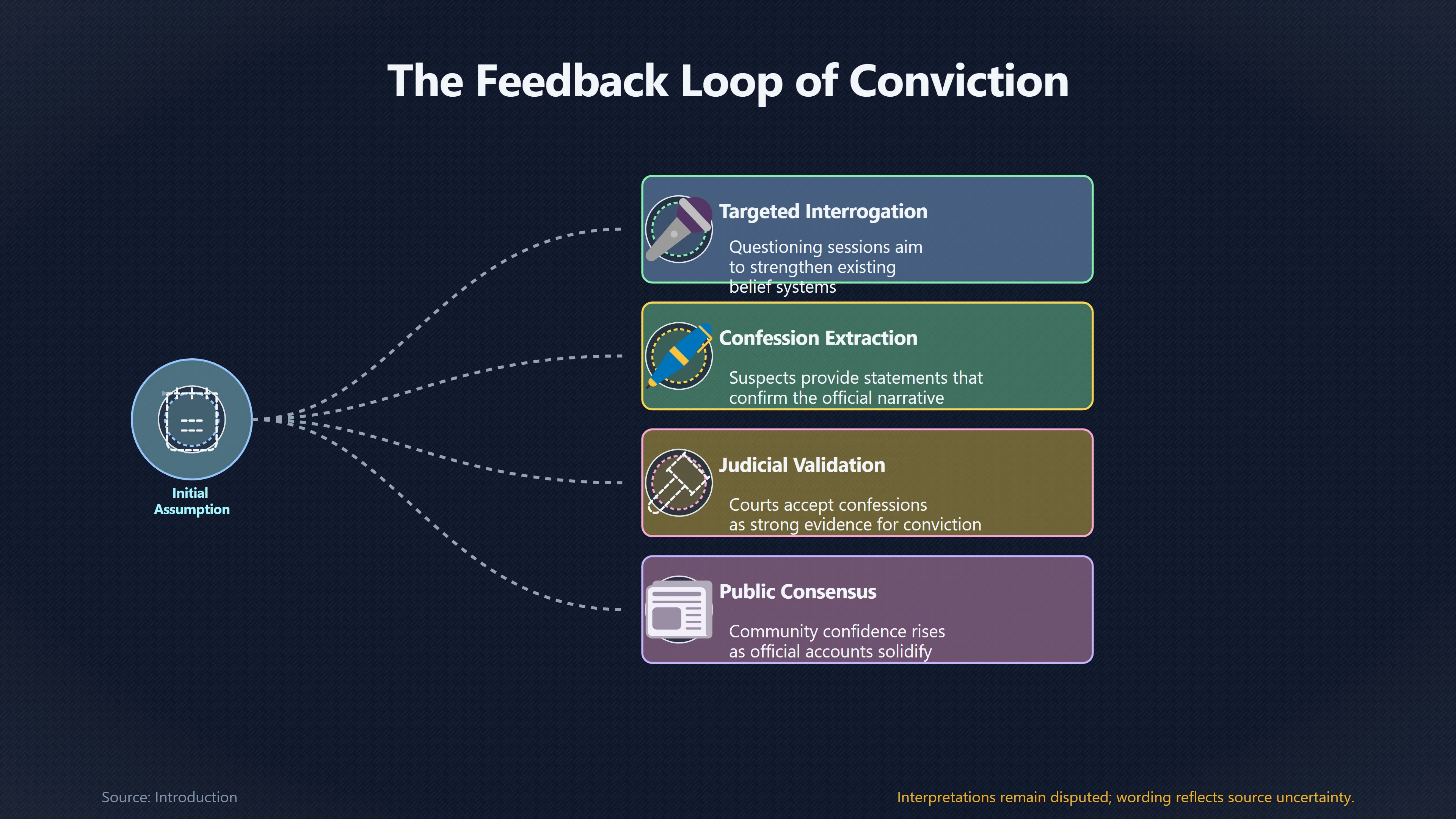
This created a feedback loop:
- Investigators believed they had identified the correct suspects.
- Interrogations were conducted to strengthen that belief.
- Confessions appeared to confirm the investigation.
- Courts treated the confessions as strong evidence.
- Public confidence in the official account increased.
Each stage appeared to validate the previous one, even though the underlying evidence remained weak.

Why small social networks can intensify pressure
Small societies have important strengths, including high levels of trust and close cooperation. Those same characteristics can also accelerate belief cascades.
Historically, Iceland’s population was tiny and geographically scattered, with communities linked by family relationships, churches and local officials. Information often travelled through personal acquaintance rather than anonymous institutions. Reputations therefore mattered enormously. If respected community members accepted a particular explanation, resisting it could carry significant social costs.[Galdrasyning]galdrasyning.isThe Witch-hunts in Iceland – Galdrasýning á StröndumThe Witch-hunts in Iceland – Galdrasýning á Ströndum…
By the 1970s Iceland had become a modern democracy, but it was still a relatively small country where police, lawyers, journalists and politicians frequently knew one another personally or professionally. Psychologist Gísli H. Guðjónsson argues that this social setting, combined with public anxiety over unsolved disappearances and limited experience of homicide investigations, helped create pressure for a decisive solution. Media attention and political expectations reinforced the desire to resolve the case, making institutional consensus increasingly difficult to challenge.[Wiley Online Library]onlinelibrary.wiley.comWiley Online LibraryIcelandic Society in the 1970s - The Psychology of False Confessions - Wiley Online Library…
Small networks can therefore amplify certainty in several ways:
- Trusted individuals influence many overlapping relationships.
- Alternative explanations circulate less widely than the dominant narrative.
- Social disagreement carries higher reputational costs.
- Institutions may share similar assumptions because their members move within the same social circles.
None of these factors guarantee error, but together they can reduce the diversity of viewpoints that helps larger systems detect mistakes.
Why doubt becomes difficult
Once a dominant explanation has formed, people often begin interpreting new information in ways that preserve it.
In witchcraft prosecutions, fresh accusations, rumours or apparent misfortunes could all be read as additional confirmation of sorcery. The original assumption shaped the meaning of later events rather than the other way around.[Galdrasyning]galdrasyning.isThe Witch-hunts in Iceland – Galdrasýning á StröndumThe Witch-hunts in Iceland – Galdrasýning á Ströndum…
In the Guðmundur and Geirfinnur investigation, later psychological research identified a comparable process at the individual level. Some suspects developed what researchers describe as memory distrust: after lengthy isolation and repeated questioning, they became uncertain about their own recollections and increasingly accepted investigators’ versions of events. False confessions then strengthened institutional confidence, making doubts appear less credible precisely because confessions existed.[IRIS]iris.landsbokasafn.isIRISThe role of memory distrust in cases of internalised false confessionRannsóknargáttin IRIS / The Iceland Research Information System…
This illustrates an important distinction. Collective certainty does not necessarily arise because everyone independently reaches the same conclusion. It can emerge because individuals place increasing trust in shared institutional judgments while becoming less confident in their own uncertainty.

What these episodes reveal about Iceland
The Icelandic cases are valuable precisely because they occurred in very different centuries under very different legal systems. One belonged to early modern religious courts; the other to a twentieth-century criminal investigation. Yet both demonstrate that collective certainty is often produced socially rather than simply discovered.
Historians do not treat the witch trials as evidence of irrational crowds acting alone, just as psychologists do not explain the Reykjavík confessions simply through individual weakness. Instead, both episodes show how authority, social trust, repeated reinforcement and limited opportunities for dissent can transform uncertain events into apparently unquestionable truths.[galdrasyning.is]galdrasyning.isThe Witch-hunts in Iceland – Galdrasýning á StröndumThe Witch-hunts in Iceland – Galdrasýning á Ströndum…
For modern readers, the broader lesson extends beyond Iceland. Close-knit societies often possess strong reserves of trust and cooperation, but those same qualities can sometimes make official narratives spread rapidly. The challenge is not eliminating trust, but preserving enough independent scrutiny that uncertainty remains visible until the evidence genuinely justifies certainty.
Amazon book picks
Further Reading
Books and field guides related to Why Doubt Disappears So Quickly. Use these as the next step if you want deeper reading beyond the article.
Extraordinary Popular Delusions and the Madness of Crowds
Rating: 4.0/5 from 5 Google Books ratings
Historical examples of collective certainty.

Mistakes Were Made (But Not by Me)
Directly addresses self-justification and certainty.
Mistakes Were Made (but Not by Me) Third Edition
Renowned social psychologists Carol Tavris and Elliot Aronson take a compelling look into how the brain is wired for self-justification....
Endnotes
1.
Source: galdrasyning.is
Title: The [Witch-hunts]({{ ‘witch-hunts-e12170/’ | relative_url }}) in Iceland – Galdrasýning á Ströndum
Link:https://galdrasyning.is/en/the-witch-hunts-in-iceland/
Source snippet
The Witch-hunts in Iceland – Galdrasýning á Ströndum...
2.
Source: onlinelibrary.wiley.com
Link:https://onlinelibrary.wiley.com/doi/10.1002/9781119315636.ch6
Source snippet
Wiley Online LibraryIcelandic Society in the 1970s - The Psychology of False Confessions - Wiley Online Library...
3.
Source: Wikipedia
Title: Guðmundur and Geirfinnur case
Link:https://en.wikipedia.org/wiki/Gu%C3%B0mundur_and_Geirfinnur_case
4.
Source: iris.landsbokasafn.is
Title: IRISThe role of memory distrust in cases of internalised false confession
Link:https://iris.landsbokasafn.is/en/publications/the-role-of-memory-distrust-in-cases-of-internalised-false-confes/
Source snippet
Rannsóknargáttin IRIS / The Iceland Research Information System...
5.
Source: onlinelibrary.wiley.com
Title: Online Library The Psychology of False Confessions | Wiley Online Books
Link:https://onlinelibrary.wiley.com/doi/book/10.1002/9781119315636
Source snippet
Wiley Online LibraryThe Psychology of False Confessions | Wiley Online Books...
6.
Source: onlinelibrary.wiley.com
Link:https://onlinelibrary.wiley.com/doi/abs/10.1002/9781119315636
7.
Source: galdrasyning.is
Link:https://galdrasyning.is/en/um-okkur/
8.
Source: galdrasyning.is
Link:https://galdrasyning.is/en/viskubrunnur/
9.
Source: galdrasyning.is
Link:https://galdrasyning.is/en/galdramal-og-galdrabrennur/
10.
Source: galdrasyning.is
Link:https://galdrasyning.is/en/galdrasteinar/
11.
Source: frontiersin.org
Link:https://www.frontiersin.org/journals/psychology/articles/10.3389/fpsyg.2021.633936/full
Source snippet
Frontiers | The Science-Based Pathways to Understanding False Confessions and Wrongful ConvictionsFebruary 22, 2021 — SPECULATIVE [UNFOUN...
Published: February 22, 2021
13.
Source: academic.oup.com
Link:https://academic.oup.com/book/55964/chapter/439453498
Source snippet
Landscape, Religion, and the Supernatural: Nordic Perspectives on Landscape Theory | Oxford AcademicFebruary 22, 2024 — Image: The foun...
Published: February 22, 2024
14.
Source: guidetoiceland.is
Title: Witchcraft and Magic in Iceland | Guide to Iceland
Link:https://guidetoiceland.is/history-culture/witchcraft-in-iceland
Source snippet
May 12, 2026 — ICELANDIC WITCHCRAFT: HISTORY OF THE AGE OF FIRE & WITCH TRIALS Last updated: May 12, 2026 Image: Xiaochen Tian By Xiaoche...
Published: May 12, 2026
15.
Source: youtube.com
Title: Dr Kate Lister On ‘The Witch Men Of Iceland’
Link:https://www.youtube.com/watch?v=ZjT_8KOgGAM
Source snippet
Iceland's Most Infamous Criminal Investigation - Interview with Tryggvi Rúnar Brynjarsson...
16.
Source: youtube.com
Title: The Reykjavik Confessions: A case of false memories
Link:https://www.youtube.com/watch?v=dfipCqxa210
Source snippet
Witchmen: Witch Trials in the Land of Fire & Ice...
17.
Source: researchgate.net
Link:https://www.researchgate.net/publication/332415031_Out_of_the_Icelandic_cold_murder_they_wrote_The_Gudmundur_and_Geirfinnur_criminal_case_of_1974
18.
Source: sciencedirect.com
Link:https://www.sciencedirect.com/science/article/pii/S0191886906000432
19.
Source: youtube.com
Title: The Suspicious Case Of The Reykjavik Confessions
Link:https://www.youtube.com/watch?v=nR7XoejxsGo
Source snippet
The Reykjavik Confessions: A case of false memories...
20.
Source: youtube.com
Title: Witchmen: Witch Trials in the Land of Fire & Ice
Link:https://www.youtube.com/watch?v=cc7IvQ1i9gY
Source snippet
Dr Kate Lister On 'The Witch Men Of Iceland'...
21.
Source: iris.hi.is
Title: is False confessions in the Nordic countries: Background and current landscape
Link:https://iris.hi.is/en/publications/false-confessions-in-the-nordic-countries-background-and-current-/
22.
Source: iris.hi.is
Title: is The role of memory distrust in cases of internalised false confession
Link:https://iris.hi.is/en/publications/the-role-of-memory-distrust-in-cases-of-internalised-false-confes/
Topic Tree