Within Tonga
Why Tonga Tried to Shut Out Mormon Missionaries
Tonga barred Latter-day Saint entrants after claims about polygamy, political disloyalty and foreign influence hardened into state policy.
On this page
- How the church gained converts and opponents
- Polygamy, foreign influence and political suspicion
- The ban's unintended effect on local leadership
Page outline Jump by section
Introduction
In 1922, Tonga introduced one of the most unusual immigration restrictions in its modern history: a law preventing members of the Church of Jesus Christ of Latter-day Saints (LDS Church) from entering the kingdom as missionaries. The measure did not arise because of proven criminal activity or a documented conspiracy. Instead, it reflected a mixture of religious rivalry, lingering international suspicions about Mormonism, and fears that a rapidly growing foreign-backed movement might undermine established churches and political authority.[BYU ScholarsArchive]scholarsarchive.byu.eduBYU ScholarsArchive"Mormon Intruders in Tonga: The Passport Act of 1922" by R. Lanier Britsch…
Although later LDS histories often describe the episode as persecution, historians generally place it within a broader pattern of early twentieth-century moral and political anxieties. The controversy centred on allegations that Mormon missionaries promoted polygamy, encouraged divided loyalties, and represented an unwelcome foreign influence. Most of these claims rested on older international stereotypes about Mormonism rather than evidence of those practices in Tonga itself. The exclusion policy ultimately produced an unintended consequence: it accelerated the development of an indigenous Tongan LDS leadership that proved more resilient than officials had expected.[BYU ScholarsArchive]scholarsarchive.byu.eduBYU ScholarsArchive"Mormon Intruders in Tonga: The Passport Act of 1922" by R. Lanier Britsch…
How the church gained converts and opponents
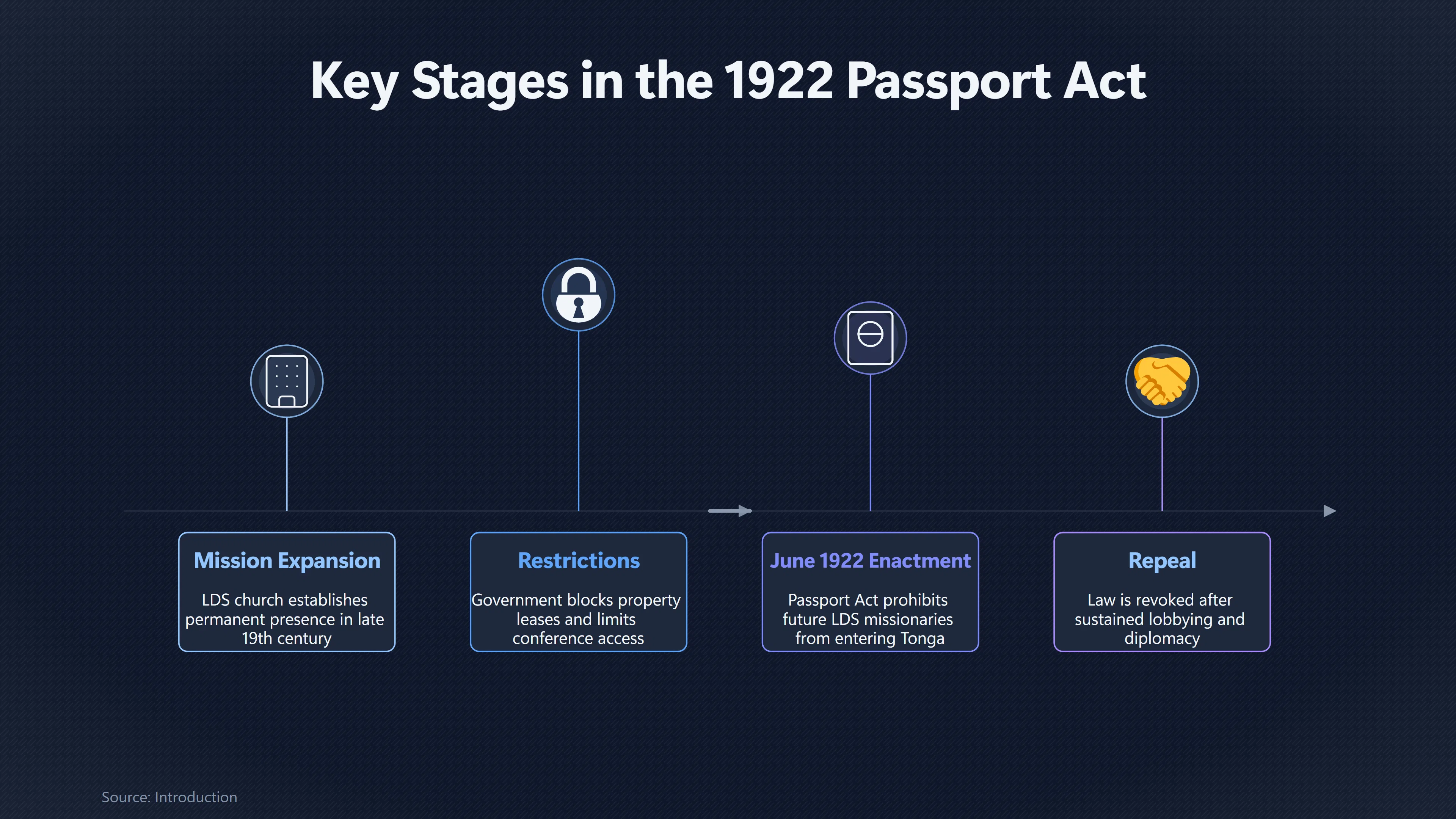
The LDS Church first established a permanent presence in Tonga during the late nineteenth and early twentieth centuries. After reopening its mission in 1907, missionaries expanded steadily through preaching, schools and local congregations. By the early 1920s the church had attracted thousands of converts despite competition from the long-established Wesleyan and Free Church traditions that had played major roles in shaping the modern Tongan state. Church-operated schools were particularly successful, giving the missionaries influence beyond Sunday worship.[Religious Studies Center]rsc.byu.eduReligious Studies Center Church Growth in Tonga | Religious Studies CenterReligious Studies Center Church Growth in Tonga | Religious Studies Center
Rapid growth also created opposition. Religious leaders from established denominations viewed the newcomers as competitors for members and social influence. Their objections were not solely theological. In a country where Christianity had become closely tied to national identity and government, the arrival of another expanding denomination raised questions about social cohesion, education and political loyalty.[BYU ScholarsArchive]scholarsarchive.byu.eduBYU ScholarsArchive"Mormon Intruders in Tonga: The Passport Act of 1922" by R. Lanier Britsch…
Tensions increased during 1921. LDS conferences faced restrictions that other churches did not, proposed church property leases were blocked, and missionaries began hearing that the government was considering legislation to prevent further Mormon immigration. These measures preceded the formal exclusion law and demonstrated that official concern had been building for several years.[archive.dev-bookofmormoncentral.org]archive.dev-bookofmormoncentral.orgmormon intruders tonga passport act 1922Mormon Intruders in Tonga: The Passport Act of 1922 | Book of Mormon Central…
Why officials believed Mormonism posed a threat
The Passport Act, enacted on 29 June 1922, prohibited future LDS missionaries from entering Tonga while allowing those already resident to remain. Violators could face fines or deportation. The legislation followed discussions involving Tongan ministers, British colonial authorities and diplomatic officials, reflecting Tonga’s position within Britain’s sphere of influence rather than an entirely isolated domestic decision.[BYU ScholarsArchive]scholarsarchive.byu.eduBYU ScholarsArchive"Mormon Intruders in Tonga: The Passport Act of 1922" by R. Lanier Britsch…
Several distinct fears combined to produce the policy.
Polygamy as a moral panic
The accusation most frequently raised was that Mormonism promoted polygamy. By 1922, however, the LDS Church had officially abandoned the practice more than thirty years earlier, following its 1890 Manifesto. Historians examining the Tongan debate have found no evidence that missionaries in Tonga were teaching or practising plural marriage. Nevertheless, international publicity surrounding nineteenth-century Mormon polygamy had left a powerful reputation that continued to shape official thinking across the English-speaking world.[archive.dev-bookofmormoncentral.org]archive.dev-bookofmormoncentral.orgmormon intruders tonga passport act 1922Mormon Intruders in Tonga: The Passport Act of 1922 | Book of Mormon Central…
When LDS mission president M. Vernon Coombs eventually obtained a transcript of the legislative debates, he found that polygamy remained the principal justification offered by supporters of exclusion. Other accusations included claims that the missionaries caused social discord and that their doctrines conflicted with churches already established in the kingdom.[archive.dev-bookofmormoncentral.org]archive.dev-bookofmormoncentral.orgmormon intruders tonga passport act 1922Mormon Intruders in Tonga: The Passport Act of 1922 | Book of Mormon Central…

Fear of foreign influence
Political concerns extended beyond theology. Most foreign LDS missionaries serving in Tonga were Americans. At a time when imperial powers exercised considerable influence across the Pacific, officials worried that a growing American-led religious movement might become an unwanted external influence within the kingdom. Some historians also argue that internal political tensions surrounding Queen Sālote Tupou III and Prince Tungi made established political leaders especially cautious about new foreign networks operating independently of existing institutions.[Wikipedia]WikipediaThe Church of Jesus Christ of Latter-day Saints in TongaThe Church of Jesus Christ of Latter-day Saints in Tonga
These fears should not be understood as evidence of an actual political conspiracy. Rather, they reflected a broader atmosphere in which foreign religious movements were easily interpreted through the language of national security and sovereignty.
Why this qualifies as a social scare rather than simple religious disagreement
The 1922 episode illustrates several features commonly associated with a moral or exclusionary panic.
First, genuine competition between churches became intertwined with exaggerated beliefs about an outsider group. Historical stereotypes developed elsewhere—notably around nineteenth-century American polygamy—were treated as though they described contemporary missionaries in Tonga.[archive.dev-bookofmormoncentral.org]archive.dev-bookofmormoncentral.orgmormon intruders tonga passport act 1922Mormon Intruders in Tonga: The Passport Act of 1922 | Book of Mormon Central…
Second, rumours and inherited reputations carried more weight than local experience. Although officials claimed Mormonism threatened social order, researchers have found little evidence that the specific accusations driving the legislation reflected missionary behaviour within Tonga itself. Instead, concerns imported from Britain, the United States and other parts of the Pacific heavily influenced policy.[BYU ScholarsArchive]scholarsarchive.byu.eduBYU ScholarsArchive"Mormon Intruders in Tonga: The Passport Act of 1922" by R. Lanier Britsch…
Third, the response took the form of immigration control rather than criminal prosecution. The government did not outlaw the religion among Tongans who had already joined it. Instead, it attempted to halt future growth by preventing additional foreign missionaries from entering the country. That distinction is important because it shows that the perceived threat centred on outside influence rather than existing local believers.[BYU ScholarsArchive]scholarsarchive.byu.eduBYU ScholarsArchive"Mormon Intruders in Tonga: The Passport Act of 1922" by R. Lanier Britsch…
The ban’s unintended effect on local leadership
The exclusion policy created a serious practical problem for the LDS Church. Its missionary system depended on a continuous rotation of foreign volunteers, and the inability to replace departing missionaries threatened the mission’s survival. Foreign staff numbers steadily declined after the law took effect.[archive.dev-bookofmormoncentral.org]archive.dev-bookofmormoncentral.orgmormon intruders tonga passport act 1922Mormon Intruders in Tonga: The Passport Act of 1922 | Book of Mormon Central…
Instead of collapsing, however, the church increasingly relied on Tongan members. Mission president M. Vernon Coombs called dozens of local full-time missionaries between 1922 and 1924, many serving with their families, while additional part-time “home missionaries” supported congregations across the islands. Local leadership became the foundation of church life rather than a temporary substitute for foreign personnel.[Religious Studies Center]rsc.byu.eduReligious Studies Center Church Growth in Tonga | Religious Studies CenterReligious Studies Center Church Growth in Tonga | Religious Studies Center
The exclusion law was repealed in 1924 after sustained lobbying and diplomatic efforts, but its effects endured. Even after foreign missionaries returned, the mission continued depending heavily on Tongan leaders because the number of overseas visas remained limited for decades. Historians of the LDS Church frequently identify this period as a turning point in the emergence of a genuinely indigenous Tongan church.[Religious Studies Center]rsc.byu.eduReligious Studies Center Church Growth in Tonga | Religious Studies CenterReligious Studies Center Church Growth in Tonga | Religious Studies Center

Why the episode remains historically important
The 1922 Passport Act occupies an unusual place in Tongan history because it illustrates how fears about religion can become entangled with concerns about national sovereignty, foreign influence and cultural identity.
The episode should not be understood simply as irrational hostility or, conversely, as evidence that all official concerns were fabricated. Tonga had legitimate reasons to guard its independence during an era of intense imperial competition. At the same time, the principal public justifications for excluding Mormon missionaries—especially allegations concerning polygamy—were largely based on outdated international perceptions rather than contemporary conditions within Tonga.[byu.edu]scholarsarchive.byu.eduBYU ScholarsArchive"Mormon Intruders in Tonga: The Passport Act of 1922" by R. Lanier Britsch…
For historians of collective fear, the 1922 exclusion demonstrates how moral panics need not involve dramatic public disorder. They can instead operate through legislation, immigration controls and administrative decisions when political authorities become convinced that an outside religious movement threatens the moral or political order. Ironically, the attempt to halt Mormon growth strengthened local leadership and contributed to the long-term establishment of one of Tonga’s largest Christian communities.[Religious Studies Center]rsc.byu.eduReligious Studies Center Church Growth in Tonga | Religious Studies CenterReligious Studies Center Church Growth in Tonga | Religious Studies Center
Amazon book picks
Further Reading
Books and field guides related to Why Tonga Tried to Shut Out Mormon Missionaries. Use these as the next step if you want deeper reading beyond the article.


Friendly Islands
First published 1977. Subjects: History, Tonga, Tongan language, Texts.
Massacre at Mountain Meadows
Provides historical context for international perceptions of Mormonism.
Endnotes
1.
Source: scholarsarchive.byu.edu
Link:https://scholarsarchive.byu.edu/mphs/vol37/iss1/12/
Source snippet
BYU ScholarsArchive"Mormon Intruders in Tonga: The Passport Act of 1922" by R. Lanier Britsch...
2.
Source: archive.dev-bookofmormoncentral.org
Title: mormon intruders tonga passport act 1922
Link:https://archive.dev-bookofmormoncentral.org/content/mormon-intruders-tonga-passport-act-1922
Source snippet
Mormon Intruders in Tonga: The Passport Act of 1922 | Book of Mormon Central...
3.
Source: rsc.byu.edu
Title: Religious Studies Center Church Growth in Tonga | Religious Studies Center
Link:https://rsc.byu.edu/regional-studies-latter-day-saint-church-history-pacific-isles/church-growth-tonga
4.
Source: Wikipedia
Title: The Church of Jesus Christ of Latter-day Saints in Tonga
Link:https://en.wikipedia.org/wiki/The_Church_of_Jesus_Christ_of_Latter-day_Saints_in_Tonga
5.
Source: rsc.byu.edu
Title: struggling create firm foundation 1920 29
Link:https://rsc.byu.edu/saints-tonga/struggling-create-firm-foundation
6.
Source: rsc.byu.edu
Title: reflections legacy faith tongan saints fakaapaapa foaki mateaki
Link:https://rsc.byu.edu/pioneers-pacific/reflections-legacy-faith-tongan-saints-fakaapaapa-foaki-mateaki
7.
Source: rsc.byu.edu
Title: challenging times 1930 39
Link:https://rsc.byu.edu/saints-tonga/challenging-times
Additional References
8.
Source: familysearch.org
Link:https://www.familysearch.org/en/memories/memory/71532569
Source snippet
Mission President Vernon Coombs Changes the History of the LDS Church in Tonga | Memories on FamilySearchNovember 25, 2018 — MISSION PRES...
Published: November 25, 2018
9.
Source: thechurchnews.com
Title: Country information: Tonga – Church News
Link:https://www.thechurchnews.com/2010/2/1/23228942/country-information-tonga/
Source snippet
Facer and Heber J. McKay under the direction of the Samoan Mission. They opened a school in Nieafu on the island of Vava'u, and by 1908...
10.
Source: churchofjesuschrist.fandom.com
Title: LDS Church in Tonga
Link:https://churchofjesuschrist.fandom.com/wiki/LDS_Church_in_Tonga
Source snippet
McKay under the direction of the Samoan Mission. They opened a school in Nieafu on the island of Vava’u, and by 1908, there were 28 day s...
11.
Source: refworld.org
Link:https://www.refworld.org/reference/annualreport/usdos/2002/29538
Source snippet
Department of State Annual Report on International Religious Freedom for 2002 - Tonga | RefworldOctober 7, 2002 — SECTION I. RELIGIOUS DE...
Published: October 7, 2002
12.
Source: youtube.com
Title: Memories of Mission: South Pacific
Link:https://www.youtube.com/watch?v=2vdU_buBXnM
Source snippet
"Tonga is 60% MORMON???[https://www.youtube.com/watch?v=F4_n0FqXTD0..."](https://www.youtube.com/watch?v=F4_n0FqXTD0...")...
13.
Source: youtube.com
Title: This Tiny Island Has More Mormons Than Utah — Here’s Why
Link:https://www.youtube.com/watch?v=eEk4l0s5I_8
Source snippet
Memories of Mission: South Pacific...
14.
Source: churchofjesuschrist.org
Title: The Church of Jesus Christ Tonga—a Land Dedicated to God
Link:https://www.churchofjesuschrist.org/study/ensign/2014/08/tonga-a-land-dedicated-to-god?lang=eng
15.
Source: everything.explained.today
Title: The Church of Jesus Christ of Latter day Saints in Tonga
Link:https://everything.explained.today/The_Church_of_Jesus_Christ_of_Latter-day_Saints_in_Tonga/
16.
Source: youtube.com
Title: How a Small Island Became One of the Most Mormon Places on Earth
Link:https://www.youtube.com/watch?v=zDQA46eaNME
Source snippet
TUKU FONUA...
17.
Source: thechurchnews.com
Title: Faith, service paved way for growth – Church News
Link:https://www.thechurchnews.com/1991/8/31/23260311/faith-service-paved-way-for-growth/
Topic Tree