When Fear and Belief Gripped Mexico
Mexico’s history of collective fear and contagious belief is not one continuous story of “mass hysteria”.
Page outline Jump by section
Introduction
Some involved real crimes or coercion. Others centred on sincere but contested religious beliefs. In several, people experienced genuine physical symptoms without an identified infectious or toxic cause. Still others became dangerous because frightened communities treated rumours as established facts. The common thread is not irrationality unique to Mexico, but the way uncertainty interacts with inequality, institutional distrust, religious conflict, violent crime and rapidly circulating media. Studied carefully, these episodes show why labels such as “cult”, “witch”, “Satanist” and “hysterical” can illuminate one part of a story while seriously distorting another.
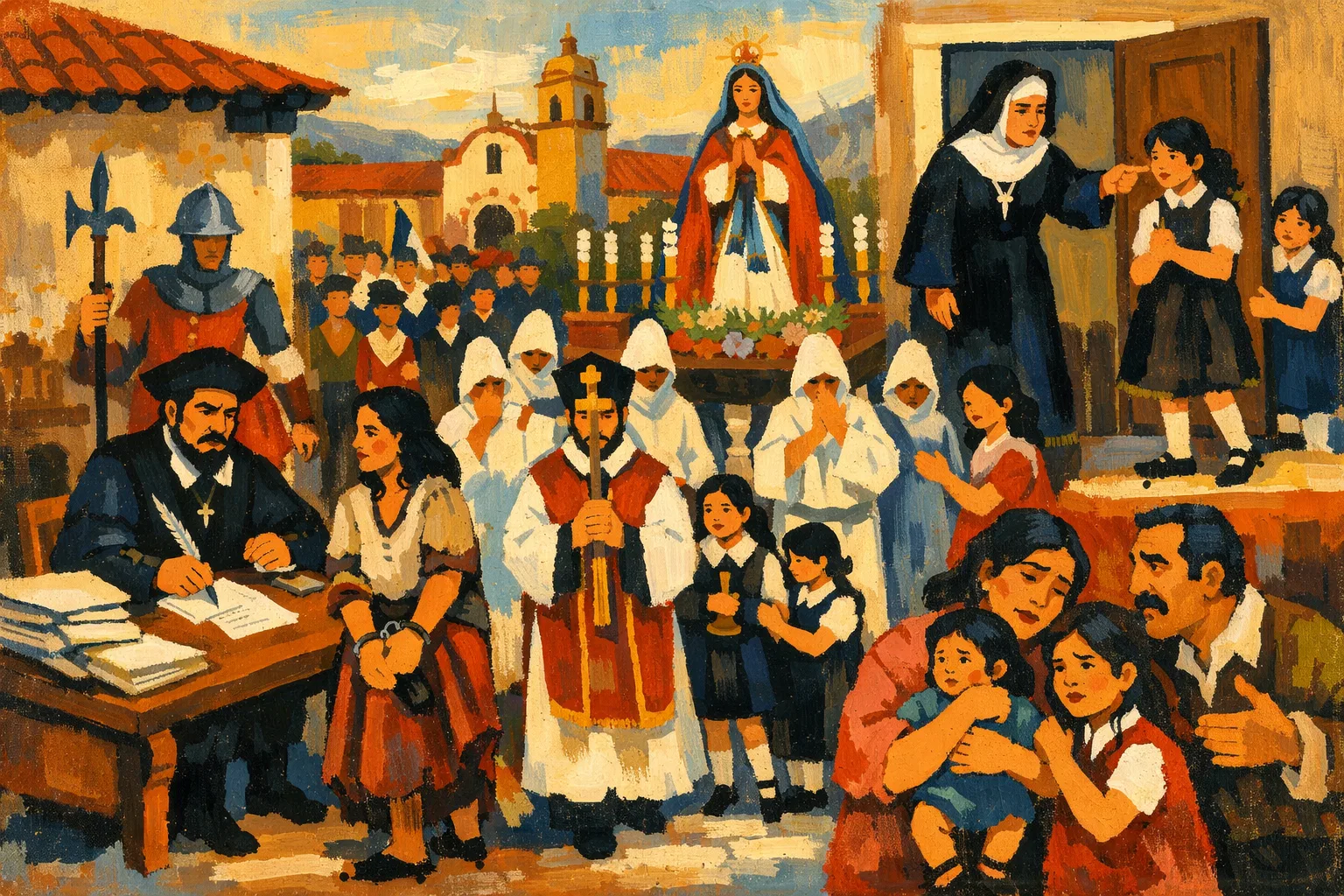
Witchcraft accusations after the conquest
Colonial Mexico did not experience witch hunts on the scale seen in parts of seventeenth-century Europe. Nevertheless, accusations of sorcery became an important tool of religious and political control after the Spanish conquest. Early inquisitorial investigations were episodic rather than continuous, with a notable cluster of more than a dozen cases between 1536 and 1540 under Mexico’s first bishop, Juan de Zumárraga. A centralised tribunal of the Holy Office was not established in Mexico until 1571; before then, bishops and other local authorities conducted inquisitorial proceedings under changing rules.[Cambridge University Press & Assessment]cambridge.orgThere is a cluster of more than a dozen trials between 1536 and 1540 under Zumárraga's Inquisition.Read more…
The category of “witchcraft” itself is misleading when applied without qualification. Colonial investigators grouped together practices that could include Indigenous ritual knowledge, African spiritual traditions, European folk healing, divination, love magic and ordinary attempts to explain illness or misfortune. Modern historians therefore treat trial records not as straightforward evidence that organised groups of witches existed, but as documents created through translation, interrogation and unequal power. Officials often imposed European ideas about demons and heresy on beliefs that had very different meanings to the people practising them.[OUP Academic]academic.oup.comOUP AcademicWitchcraft in Colonial Latin America | Oxford Academic22 Dec 2021 — Colonial witchcraft was a European misinterpretation and…
Gender mattered, although not always in the same way as in European witch panics. Women appeared frequently in accusations involving healing, food, household relationships, sexuality and attempts to influence husbands or lovers. Recent scholarship has also emphasised interaction rather than simple cultural survival: Indigenous, African and Spanish women exchanged remedies and magical techniques in kitchens, markets and neighbourhood networks. What inquisitors described as dangerous superstition could therefore be part of an emerging colonial popular culture.[Not Even Past]notevenpast.orgNot Even PastReview of The Women Who Threw Corn: Witchcraft and…20 Sept 2025 — Chloe Foor reviews The Women Who Threw Corn: Witchcraft…
These prosecutions were persecution and social conflict, not mass psychogenic illness. Their relevance to the history of panic lies in the way authorities converted local disputes into suspicions of hidden spiritual danger. A neighbour’s accusation, an unexplained illness or an unconventional healer could acquire greater significance once interpreted through the legal language of apostasy, demonic influence or religious disorder.
Apocalypse and authority in Nueva Jerusalén
One of Mexico’s clearest modern examples of an organised millenarian community is Nueva Jerusalén in Michoacán. The settlement was founded in the 1970s after reported messages from the Virgin Mary were relayed to a Catholic priest. Followers came to regard the community as a place of divine protection, with its own religious leadership, strict moral expectations and a hostile relationship with secular institutions. Scholars commonly describe it as an apocalyptic Marian movement, although its members understand it as a faithful Catholic refuge rather than a “cult”.[JSTOR]jstor.orgSchism and Organizational Transformationby MC Leatham · 2003 · Cited by 18 — The apocalyptic Marian colony of Nueva JerusalMn, Mexic…
Apocalyptic belief was not merely an abstract doctrine. It helped organise daily life and legitimise authority. The movement’s leadership regulated dress, entertainment, sexual conduct and contact with outside society. The settlement also experienced internal schism: a violent division in 1982 altered its organisation, demonstrating that supposedly unified high-control groups can contain competing factions, succession disputes and different interpretations of revelation.[JSTOR]jstor.orgSchism and Organizational Transformationby MC Leatham · 2003 · Cited by 18 — The apocalyptic Marian colony of Nueva JerusalMn, Mexic…
The conflict became a national story in 2012 after followers destroyed school buildings that provided state-recognised secular education. Participants said the action had religious sanction and portrayed the schools as spiritually corrupting. Families who wanted conventional schooling faced intimidation and exclusion, while the authorities struggled to enforce children’s educational rights without provoking wider confrontation.[EL PAÍS English]english.elpais.comEL PAÍS EnglishMexican apocalyptic sect defies the government on children's…6 Sept 2012 — Nueva Jerusalén residents believe the Virgin…
Nueva Jerusalén is best understood as a case of millenarian community-building, religious authoritarianism and conflict over state jurisdiction. Calling it a “doomsday cult” captures the importance of apocalyptic expectation but can obscure the movement’s long history, internal divisions and the fact that followers did not simply spend every day awaiting an immediate catastrophe. Its greater significance lies in the practical question it poses: how far should a religious community be allowed to govern education and private conduct when members, including children and dissenters, do not freely accept its rules?

Matamoros and the making of a Satanic scare
The Matamoros murders of 1989 were neither imaginary nor merely a media panic. Investigators uncovered human remains at a ranch near the United States border used by a criminal group associated with drug trafficking and ritual violence. The group was led by Adolfo Constanzo, and the investigation intensified after the disappearance of American university student Mark Kilroy. The case involved abduction, torture and killing, making it fundamentally different from unsubstantiated allegations of vast secret Satanic networks.[HISTORY]history.comCult commits murder at Rancho Santa ElenaCult commits murder at Rancho Santa Elena
The distortion came in the language used to explain the crimes. Newspapers and broadcasters widely described Constanzo’s circle as “narco-Satanists”. Yet its practices drew selectively and violently on Afro-Caribbean religious traditions, folk magic and Constanzo’s personal claims to supernatural power. Equating this mixture with Satanism encouraged audiences to interpret the murders through an already familiar North American panic about devil-worshipping conspiracies. It also risked stigmatising legitimate religious traditions that had no connection to the killings.
The case arrived during the international Satanic panic of the 1980s and early 1990s, when police, therapists, clergy and media outlets promoted claims about hidden ritual-abuse networks. Many of those wider allegations were unsupported, but Matamoros offered a rare instance of documented ritualised murder. Because a real crime existed, it could be repeatedly cited as apparent confirmation of far broader conspiracy theories for which there was no comparable evidence.[De Gruyter Brill]degruyterbrill.comOpen source on degruyterbrill.com.
This distinction remains important. Denying an imagined international Satanic conspiracy does not require denying what happened at the ranch. Equally, acknowledging ritual elements in a criminal gang does not prove that unconventional religions are inherently violent. Matamoros shows how an exceptional crime can become the emotional centre of a much larger moral panic.
The school outbreak at Villa de las Niñas
Between late 2006 and 2007, hundreds of pupils at Villa de las Niñas, a Catholic boarding school in Chalco, developed symptoms including nausea, feverish sensations, pain, weakness and difficulty walking. Environmental and medical investigations tested possible explanations involving food, water, infection and toxins but did not find a cause that accounted for the pattern. Mexican health specialists ultimately described the outbreak as mass psychogenic illness, sometimes still called “mass hysteria”.[scielo.org.mx]scielo.org.mxOpen source on scielo.org.mx.
Mass psychogenic illness does not mean that people are pretending or that symptoms are “all in the mind”. It describes the spread of real physical distress through a group when no sufficient infectious, toxic or structural cause has been identified. Anxiety can produce pain, dizziness, fainting, weakness, nausea and altered movement. Symptoms may then spread through observation, conversation, expectation and shared interpretation, particularly in enclosed communities under sustained strain.[SciELO]scielo.org.mxOpen source on scielo.org.mx.
The social setting at Chalco was crucial. Many pupils came from poor or marginalised communities and lived far from their families. The institution was highly disciplined and offered limited outside communication. Contemporary health officials identified the closed environment and accumulated emotional pressure as important factors. Later social research placed greater emphasis on the girls’ experiences of poverty, separation, institutional control and, in some accounts, allegations of mistreatment.[edu.co]revistas.udistrital.edu.coOpen source on edu.co.
That wider context prevents the diagnosis from becoming a convenient way to dismiss the pupils. Even where symptoms spread psychogenically, the underlying stress can be rooted in material hardship and genuine institutional problems. A medical label explains a possible mechanism of contagion; it does not settle every question about why the community was vulnerable or whether complaints about conditions deserved independent investigation.
Mexico has recorded other smaller outbreaks with similar features. A 2023 clinical review noted, for example, an incident in southern Sonora in which adolescent pupils developed fainting, nausea, headaches and unexplained laughter after using a Ouija board. Competing interpretations included infection, poisoning, punishment and stress before specialists identified a collective conversion-type reaction. Such supernatural triggers matter not because a board causes disease, but because shared expectations can shape how alarming bodily sensations are noticed and interpreted.[SciELO]scielo.org.mxOpen source on scielo.org.mx.
Monsters, saints and moral outsiders
The chupacabra scare
Reports of the chupacabra reached Mexico in 1996 after first becoming prominent in Puerto Rico. Stories blamed a mysterious blood-drinking creature for dead goats, sheep, chickens and other animals. Mexican newspapers and television programmes carried alleged sightings across the country, while residents organised searches and interpreted unfamiliar animal injuries as evidence that the creature was moving from place to place. Contemporary reporting described a nationwide atmosphere of anxiety around the attacks.[Princeton University]princeton.eduOpen source on princeton.edu.
The scare prospered because it joined an ancient narrative form—the livestock-killing monster—to modern mass media. Every new carcass could be folded into the same story before veterinary causes were established. Drought, predators, scavenging, disease and ordinary livestock losses created a supply of ambiguous incidents, while repeated coverage gave those incidents a recognisable culprit.[Wikipedia]WikipediaOpen source on wikipedia.org.
The chupacabra episode was largely a folklore and media phenomenon rather than a single crowd panic. There was no one moment when the whole country fled in terror. Instead, belief accumulated through repetition: photographs, rumours, eyewitness reports, jokes, commercial imagery and official denials. Its cultural durability shows that a scare can survive after immediate fear fades, becoming a shared monster story that people may recount with belief, scepticism or deliberate humour.
The fear surrounding Santa Muerte
Devotion to Santa Muerte, a skeletal female folk saint associated with protection, healing, justice and safe passage, has often been described by officials, clergy and journalists as a criminal or Satanic “cult”. Some offenders do invoke the figure, and shrines have appeared in environments shaped by the drug trade. Yet researchers have repeatedly shown that devotees also include market traders, migrants, prisoners, police officers, working-class families and LGBTQ people seeking protection in dangerous or precarious circumstances.[hemisphericinstitute.org]hemisphericinstitute.orgOpen source on hemisphericinstitute.org.
The moral panic arises when visible cases involving criminals are treated as representative of all worshippers. This circular reasoning makes the devotion appear criminal because authorities search for it in criminal settings, then treats each discovery as proof of an essentially criminal religion. Mexican state agencies have demolished some roadside shrines, while Catholic leaders have condemned the devotion as incompatible with Christian teaching.[Religion Dispatches]religiondispatches.orgReligion Dispatches Mexico's War on Saint DeathReligion Dispatches Mexico's War on Saint Death
Santa Muerte is therefore not best presented as evidence of a violent cult spreading across Mexico. It is a contested popular religious movement whose imagery is unsettling to many observers and whose flexible promises appeal to people living close to danger, illegality or social exclusion. The distinction does not excuse crimes committed by individual devotees. It prevents guilt by religious association from replacing evidence.
Rumours that produced real violence
In August 2011, social-media messages claimed that gunmen were attacking schools in Veracruz. Alarmed parents rushed to collect their children, traffic was disrupted and accidents followed. Two social-media users were charged under terrorism provisions, potentially facing decades in prison, before the most serious charges were dropped. The episode revealed both the speed of online panic during Mexico’s drug war and the danger of treating rumour-spreading as terrorism without proportionate legal safeguards.[Wikipedia]Wikipedia2011 Mexican drug gang attack Twitter hoax2011 Mexican drug gang attack Twitter hoax
The false warnings were believable because they entered an information environment already shaped by real violence. In areas where cartels had attacked civilians and authorities were distrusted, a report about danger near a school did not sound impossible. Social media filled gaps left by weak or slow official communication, but the same networks that warned communities about genuine threats also circulated unverified claims.
A still more destructive pattern emerged in 2018, when online rumours alleged that travelling child kidnappers were operating in Mexican towns. In Acatlán de Osorio, Puebla, a crowd seized two men and burned them to death after false accusations spread through WhatsApp. Similar rumours were linked to further attacks, leading authorities in several states to warn the public that the messages were untrue.[psmag.com]psmag.comPacific Standard The Spread of Fake News Has Had Deadly ConsequencesPacific Standard The Spread of Fake News Has Had Deadly Consequences
These events were not cases of mass psychogenic illness. Nor were they wholly imaginary fears, because child disappearance and violent crime are genuine concerns in Mexico. They were rumour panics: real anxieties were attached to particular innocent people without reliable evidence. Closed messaging systems intensified the problem because claims arrived from relatives and neighbours rather than obviously anonymous broadcasters. Repetition inside trusted groups made warnings feel locally verified even when every person was passing along the same unsupported message.
The killings also reflected conditions that technology alone cannot explain. Distrust of police, frustration with impunity and traditions of informal community justice made immediate collective punishment appear legitimate to some participants. Social media accelerated identification of supposed enemies, but institutional weakness helped turn suspicion into lethal action. A later study of violence-inducing WhatsApp rumours in Mexico examined how such messages interact with anti-government sentiment and willingness to support vigilantism, reinforcing the view that digital misinformation works through existing political emotions rather than mechanically controlling crowds.[preprints.apsanet.org]preprints.apsanet.orgRumors, Anti-Government Appeals, and ViolenceRumors, Anti-Government Appeals, and Violence
What Mexico’s cases actually show
Mexico’s history resists a single theory of contagious belief. The colonial witchcraft cases involved authorities translating cultural difference into religious deviance. Nueva Jerusalén shows how prophecy can create durable institutions and conflicts over education. Matamoros demonstrates how real ritualised violence can be enlarged into a misleading Satanic narrative. Villa de las Niñas illustrates the physical reality of group stress reactions. Chupacabra reports show folklore being amplified by commercial media, while kidnapping rumours reveal how fear can identify innocent people as immediate threats.
Several recurring pressures nevertheless connect these episodes:
- Uncertainty creates space for familiar explanations. Unexplained illness may be attributed to poison, punishment or spirits; dead livestock to a monster; insecurity to hidden abductors.
- Closed communities intensify social transmission. Boarding schools, religious settlements and private messaging groups allow emotion and interpretation to circulate rapidly.
- Real hardship makes alarming stories credible. Poverty, violence, family separation, corruption and weak public services are not imaginary, even when a specific rumour is false.
- Authorities can calm or worsen a crisis. Careful medical investigation and prompt factual communication may reduce fear. Stigmatising labels, excessive prosecution or dismissive diagnoses can deepen mistrust.
- Media attention selects the most dramatic interpretation. “Satanic cult”, “mystery disease” and “monster attack” are more memorable than mixed evidence, institutional stress or an unidentified animal predator.
The central lesson is that belief spreads through meaning, not simple imitation. People accept a frightening interpretation when it fits what they already know about danger, morality and authority. Preventing harm therefore requires more than debunking an individual claim. It requires trustworthy institutions, rapid communication, protection for minorities and dissenters, proportionate investigation, and an awareness that people experiencing fear or unexplained symptoms are not helped by ridicule.
Amazon book picks
Further Reading
Books and field guides related to When Fear and Belief Gripped Mexico. Use these as the next step if you want deeper reading beyond the article.

God's Middle Finger
Offers accessible insight into regional beliefs and social realities.
The devil in the shape of a woman
Useful comparative framework for colonial accusations.

Endnotes
1.
Source: cambridge.org
Link:https://www.cambridge.org/core/books/women-who-threw-corn/inquisitions-sorcery-investigations-and-the-law-in-mexico-15211571/0C4E0CFC955FBEB9144D53567A353606
Source snippet
There is a cluster of more than a dozen trials between 1536 and 1540 under Zumárraga's Inquisition.Read more...
2.
Source: academic.oup.com
Link:https://academic.oup.com/edited-volume/61800/chapter/546381806?searchresult=1
Source snippet
OUP AcademicWitchcraft in Colonial Latin America | Oxford Academic22 Dec 2021 — Colonial witchcraft was a European misinterpretation and...
3.
Source: jstor.org
Link:https://www.jstor.org/stable/1387835
Source snippet
Schism and Organizational Transformationby MC Leatham · 2003 · Cited by 18 — The apocalyptic Marian colony of Nueva JerusalMn, Mexic...
4.
Source: Wikipedia
Title: Conflicto religioso en Nueva Jerusalén de 2012
Link:https://es.wikipedia.org/wiki/Conflicto_religioso_en_Nueva_Jerusal%C3%A9n_de_2012
5.
Source: history.com
Title: Cult commits murder at Rancho Santa Elena
Link:https://www.history.com/this-day-in-history/march-14/black-magic-voodoo-and-murder-occurs-at-rancho-santa-elena
6.
Source: vox.com
Title: The haunting of Girlstown
Link:https://www.vox.com/the-highlight/21242299/outbreak-girlstown-chalco-world-villages-villa-de-las-ninas
7.
Source: revistas.udistrital.edu.co
Link:https://revistas.udistrital.edu.co/index.php/CORPO/article/view/15516/16922
8.
Source: revistas.inah.gob.mx
Link:https://revistas.inah.gob.mx/index.php/diariodecampo/article/download/13327/14438/26624
9.
Source: princeton.edu
Link:https://www.princeton.edu/~accion/chupa22.html
10.
Source: Wikipedia
Link:https://en.wikipedia.org/wiki/Chupacabra
11.
Source: jstor.org
Link:https://www.jstor.org/stable/26406443
12.
Source: Wikipedia
Title: 2011 Mexican drug gang attack Twitter hoax
Link:https://en.wikipedia.org/wiki/2011_Mexican_drug_gang_attack_Twitter_hoax
13.
Source: preprints.apsanet.org
Title: Rumors, Anti-Government Appeals, and Violence
Link:https://preprints.apsanet.org/engage/api-gateway/apsa/assets/orp/resource/item/5f57ac59e437ef00129630de/original/the-political-psychology-of-lynching-whats-app-rumors-anti-government-appeals-and-violence.pdf
14.
Source: Wikipedia
Title: Satanic panic
Link:https://en.wikipedia.org/wiki/Satanic_panic
15.
Source: Wikipedia
Title: Heaven’s Gate (religious group)
Link:https://en.wikipedia.org/wiki/Heaven%27s_Gate_%28religious_group%29
16.
Source: Wikipedia
Title: List of mass panic cases
Link:https://en.wikipedia.org/wiki/List_of_mass_panic_cases
17.
Source: Wikipedia
Title: UFO religion
Link:https://en.wikipedia.org/wiki/UFO_religion
18.
Source: Wikipedia
Title: Adolfo Constanzo
Link:https://en.wikipedia.org/wiki/Adolfo_Constanzo
19.
Source: Wikipedia
Title: Indian Whats App lynchings
Link:https://en.wikipedia.org/wiki/Indian_WhatsApp_lynchings
20.
Source: history.com
Title: what was satanic panic 1980s
Link:https://www.history.com/articles/what-was-satanic-panic-1980s
21.
Source: jstor.org
Link:https://www.jstor.org/stable/45204032
22.
Source: notevenpast.org
Link:https://notevenpast.org/review-of-the-women-who-threw-corn-witchcraft-and-inquisition-in-sixteenth-century-mexico-2025/
Source snippet
Not Even PastReview of The Women Who Threw Corn: Witchcraft and...20 Sept 2025 — Chloe Foor reviews The Women Who Threw Corn: Witchcraft...
23.
Source: english.elpais.com
Link:https://english.elpais.com/elpais/2012/09/06/inenglish/1346933882_165555.html
Source snippet
EL PAÍS EnglishMexican apocalyptic sect defies the government on children's...6 Sept 2012 — Nueva Jerusalén residents believe the Virgin...
24.
Source: religiondispatches.org
Title: mexicos own satanic panic
Link:https://religiondispatches.org/2012/04/12/mexicos-own-satanic-panic
25.
Source: degruyterbrill.com
Link:https://www.degruyterbrill.com/document/doi/10.9783/9780812201253.120/html?srsltid=AfmBOoodPgEnG74MvlotRDWyqKSnMJP_0mXt3VhDqlImjvCtOnWHd588
26.
Source: historymatters.sites.sheffield.ac.uk
Title: Satanic Cults and Ritual Abuse
Link:https://historymatters.sites.sheffield.ac.uk/blog-archive/2016/satanic-cults-and-ritual-abuse
27.
Source: scielo.org.mx
Link:https://www.scielo.org.mx/scielo.php?pid=S1665-11462023000500320&script=sci_arttext
28.
Source: latimes.com
Title: la xpm 1996 05 19 mn 5916 story
Link:https://www.latimes.com/archives/la-xpm-1996-05-19-mn-5916-story.html
29.
Source: hemisphericinstitute.org
Link:https://hemisphericinstitute.org/en/emisferica-13-1-states-of-devotion/13-1-essays/santa-muerte-saint-of-the-dispossessed-enemy-of-church-and-state.html
30.
Source: revista.drclas.harvard.edu
Link:https://revista.drclas.harvard.edu/making-queerness-ordinary-santa-muerte-and-queer-religious-leadership/
31.
Source: religiondispatches.org
Title: Religion Dispatches Mexico’s War on Saint Death
Link:https://religiondispatches.org/2009/06/23/mexicos-war-saint-death
32.
Source: psmag.com
Title: Pacific Standard The Spread of Fake News Has Had Deadly Consequences
Link:https://psmag.com/social-justice/the-spread-of-fake-news-has-had-deadly-consequences-in-mexico/
33.
Source: latimes.com
Title: la fg mexico vigilantes 20180921 story
Link:https://www.latimes.com/world/la-fg-mexico-vigilantes-20180921-story.html
34.
Source: digpodcast.org
Link:https://digpodcast.org/2025/09/28/inquisition/
35.
Source: talkdeath.com
Title: history of salem witch trials history mass hysteria
Link:https://www.talkdeath.com/history-of-salem-witch-trials-history-mass-hysteria/
36.
Source: zeroninemagazine.com
Link:https://www.zeroninemagazine.com/stories/chupacabra
37.
Source: ebsco.com
Title: satanic panic
Link:https://www.ebsco.com/research-starters/communication-and-mass-media/satanic-panic
38.
Source: historyonthenet.com
Link:https://www.historyonthenet.com/moral-panics-mass-hysteria-dancing-plague-salem-witch-trials-tulip-market-bubble
39.
Source: senate.mo.gov
Link:https://www.senate.mo.gov/LegislativeLibrary/Panic.html
Additional References
40.
Source: aboutwitchhunts.com
Link:https://aboutwitchhunts.com/episode/the-women-who-threw-corn-witchcraft-and-inquisition-in-sixteenth-century-mexico-with-martin-nesvig/
Source snippet
where cultural exchange happened in kitchens between women of different backgrounds.Read more...
41.
Source: jhiblog.org
Title: assessing supernatural belief in colonial mexican inquisition records
Link:https://www.jhiblog.org/2021/10/18/assessing-supernatural-belief-in-colonial-mexican-inquisition-records/
Source snippet
Lisa Sousa has analyzed criminal records in Oaxaca to investigate belief in magic and witchcraft.Read more...
42.
Source: youtube.com
Title: Lynching in Puebla: The full story of the Juan Felipe case
Link:https://www.youtube.com/watch?v=Ny4CSHVLDds
Source snippet
The Mexican Inquistion in Early Eighteenth-Century New Mexico...
43.
Source: youtube.com
Title: The Mexican Inquistion in Early Eighteenth-Century New Mexico
Link:https://www.youtube.com/watch?v=G2nVdbxg2UU
Source snippet
Canoa: A Shameful Memory (1976) Original Trailer [FHD]...
44.
Source: youtube.com
Title: MEXICO: MURDERER VILLAREAL WRITES BOOK IN PRISON
Link:https://www.youtube.com/watch?v=lB1Exd4tF7o
Source snippet
Lynching in Puebla: The full story of the Juan Felipe case...
45.
Source: academia.edu
Link:https://www.academia.edu/4593752/Of_Women_and_Witches_A_Case_Study_in_Moral_Panics
46.
Source: academia.edu
Link:https://www.academia.edu/143660851/Satanism_and_crime_in_Mexico
47.
Source: csw.org.uk
Link:https://www.csw.org.uk/2020-mexico-report
48.
Source: reddit.com
Link:https://www.reddit.com/r/AskHistorians/comments/1mzs0ck/are_witches_real_im_dr_martin_nesvig_author_of/
49.
Source: facebook.com
Link:https://www.facebook.com/brief.nepall/posts/students-in-naubahini-rural-municipality-pyuthan-who-experienced-fainting-trembl/122175067520903506/
Topic Tree
Follow this branch
Related pages 192
- Antigua and Barbuda
- Argentina Belief Scares
- Azerbaijan Belief
- Bahrain Beliefs
- North Korea
- +187 more in sidebar