Within Costa Rica Panics
How Ten Hippies Alarmed a Nation
About ten visiting hippies became symbols of drugs, sexual freedom and foreign disorder far beyond any danger they posed.
On this page
- The visitors and the press reaction
- Cold War fears about youth and drugs
- Police restrictions and attempted expulsion
Page outline Jump by section
Introduction
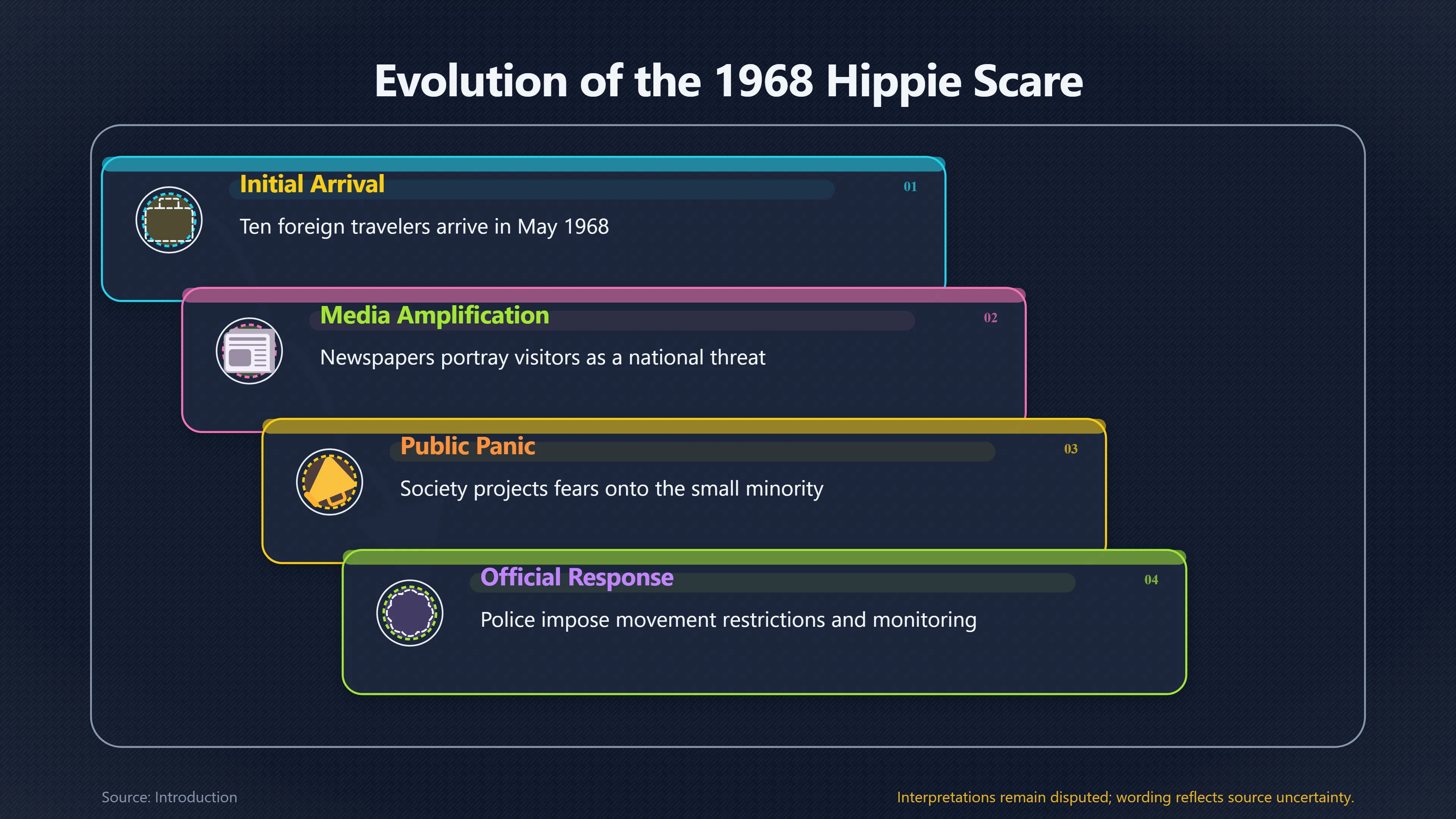
In May 1968, the arrival of around ten young foreign travellers who identified with the international hippie movement triggered one of the clearest examples of a modern moral panic in Costa Rican history. Their actual numbers were tiny and there was little evidence that they posed any organised threat. Yet newspapers, politicians, police and many members of the public rapidly turned them into symbols of drugs, sexual permissiveness, political unrest and foreign influence. The episode became a national debate about youth, morality and Costa Rican identity at a moment when Cold War anxieties and the global upheavals of 1968 were dominating international headlines. Rather than exposing a genuine conspiracy, the scare revealed how a handful of outsiders could become convenient stand-ins for much broader social fears.[Redalyc.org]redalyc.org¡No más hippies! Identidad juvenil, memoria y pánico en la Guerra Fría: el mayo de 1968 en Costa RicaJune 20, 2020…
How ten hippies alarmed a nation
The immediate trigger was the arrival of a small group of foreign visitors, generally described in the press as hippies, during May 1968. Costa Rica had little direct experience with the counterculture that had become highly visible in the United States and Western Europe. Long hair, unconventional clothing and open rejection of social conventions were therefore interpreted by many observers not simply as unusual fashions but as signs of moral and political danger.[Redalyc.org]redalyc.org¡No más hippies! Identidad juvenil, memoria y pánico en la Guerra Fría: el mayo de 1968 en Costa RicaJune 20, 2020…
Coverage quickly expanded far beyond the visitors themselves. Newspapers treated the group as evidence that undesirable international trends were reaching Costa Rica. Instead of discussing individual behaviour, reports increasingly portrayed “the hippie” as a type: foreign, rootless, associated with drugs, sexual freedom and disrespect for authority. The distinction between a few travellers and a wider cultural movement largely disappeared in public discussion.[Redalyc.org]redalyc.org¡No más hippies! Identidad juvenil, memoria y pánico en la Guerra Fría: el mayo de 1968 en Costa RicaJune 20, 2020…
Historian Randall Chaves Zamora argues that this transformation is precisely what makes the episode significant. The visitors became what sociologists describe as “folk devils” in a moral panic: a small, visible minority onto which a society projected much larger anxieties about social change.[Redalyc.org]redalyc.org¡No más hippies! Identidad juvenil, memoria y pánico en la Guerra Fría: el mayo de 1968 en Costa RicaJune 20, 2020…
Why the scare resonated in 1968
The panic cannot be understood simply as a reaction to unusual tourists. It unfolded during one of the most turbulent years of the Cold War.
Across the world, 1968 saw student protests, anti-war demonstrations, civil rights activism and generational conflict. International news carried images from Paris, Berkeley, Mexico City and elsewhere, where youthful protest appeared to challenge established authority. Although Costa Rica was politically more stable than many neighbouring countries, these events shaped how local audiences interpreted unfamiliar youth culture.[Redalyc.org]redalyc.org¡No más hippies! Identidad juvenil, memoria y pánico en la Guerra Fría: el mayo de 1968 en Costa RicaJune 20, 2020…
Within Costa Rica, many commentators linked hippies with several perceived threats at once:
- illegal drug use;
- sexual permissiveness;
- rejection of work and family responsibilities;
- communist agitation or foreign ideological influence;
- corruption of Costa Rican youth.
Little evidence connected the visiting travellers to organised political subversion. Nevertheless, Cold War thinking encouraged many officials and journalists to treat unconventional appearance as a possible sign of deeper ideological danger. The fear was less about what the visitors had done than about what they supposedly represented.[Redalyc.org]redalyc.org¡No más hippies! Identidad juvenil, memoria y pánico en la Guerra Fría: el mayo de 1968 en Costa RicaJune 20, 2020…
The press helped turn travellers into a national threat
Contemporary reporting amplified the sense of crisis by presenting the visitors as an invading social force despite their extremely small numbers. Headlines and editorials warned about the arrival of undesirable foreign customs and questioned whether Costa Rica should tolerate such people within its borders. The discussion extended beyond crime or immigration into arguments about national character and the protection of traditional values.[Redalyc.org]redalyc.org¡No más hippies! Identidad juvenil, memoria y pánico en la Guerra Fría: el mayo de 1968 en Costa RicaJune 20, 2020…
This pattern closely matches the classic features of a moral panic:
- a highly visible but numerically tiny group;
- exaggerated claims about the danger it posed;
- rapid media attention;
- demands for firm government action;
- lasting public memories that exceeded the actual scale of events.
The media did not invent every concern from nothing—drug use and generational change were genuine issues being debated internationally—but the perceived scale of the threat became disconnected from the evidence surrounding the handful of visitors themselves.[Redalyc.org]redalyc.org¡No más hippies! Identidad juvenil, memoria y pánico en la Guerra Fría: el mayo de 1968 en Costa RicaJune 20, 2020…
Police restrictions and attempts to remove the visitors
Official responses reflected the atmosphere created by the press and public debate. Police closely monitored the visitors, imposed restrictions on their movements and explored ways to remove them from the country. Immigration controls became a central tool for responding to what was framed as a moral rather than primarily criminal problem.[Redalyc.org]redalyc.org¡No más hippies! Identidad juvenil, memoria y pánico en la Guerra Fría: el mayo de 1968 en Costa RicaJune 20, 2020…
The authorities’ actions were intended not only to deal with the individuals involved but also to send a wider message that Costa Rica would resist imported forms of social disorder. Chaves Zamora’s research shows that official measures formed part of a broader effort to defend a particular vision of respectable youth during the Cold War rather than simply enforcing ordinary immigration rules.[Redalyc.org]redalyc.org¡No más hippies! Identidad juvenil, memoria y pánico en la Guerra Fría: el mayo de 1968 en Costa RicaJune 20, 2020…
Foreign subversion or symbolic threat?
Modern historians generally reject the idea that the visitors represented a genuine campaign of foreign subversion. Instead, they see the episode as revealing how Cold War politics blurred together cultural difference and political suspicion.
Several factors made the travellers easy targets:
- they were foreigners;
- their appearance immediately marked them as outsiders;
- the international hippie movement already carried strong associations with protest and anti-establishment politics;
- Costa Rican society was debating how much foreign cultural influence should be accepted.
The resulting panic therefore said more about Costa Rican fears than about the intentions of the visitors themselves. A few travellers became symbols of wider concerns over modernisation, global youth culture and changing social norms.[Redalyc.org]redalyc.org¡No más hippies! Identidad juvenil, memoria y pánico en la Guerra Fría: el mayo de 1968 en Costa RicaJune 20, 2020…
Why the episode still matters
The 1968 hippie scare occupies an important place in Costa Rican social history because it demonstrates how collective fears can develop without requiring a large movement or widespread disorder. Around ten foreign visitors generated a national controversy that far exceeded their numbers or documented activities.[Redalyc.org]redalyc.org¡No más hippies! Identidad juvenil, memoria y pánico en la Guerra Fría: el mayo de 1968 en Costa RicaJune 20, 2020…
The case also provides an early example of a pattern that would reappear in later Costa Rican moral panics. In different decades, new “outsider” groups—including people living with HIV, gay men during the AIDS crisis and heavy-metal fans—would likewise become symbols onto which broader social anxieties were projected. Although the targets changed, the underlying mechanism remained similar: visible minorities were treated as embodiments of perceived threats to morality, public order or national identity.[Redalyc.org]redalyc.org¡No más hippies! Identidad juvenil, memoria y pánico en la Guerra Fría: el mayo de 1968 en Costa RicaJune 20, 2020…
Today, historians interpret the events of May 1968 less as evidence of an organised foreign danger than as an instructive example of how media narratives, Cold War politics and concerns about youth identity combined to produce a disproportionate moral panic. The lasting importance of the episode lies not in what the visitors actually did, but in what many Costa Ricans feared they might represent.[Redalyc.org]redalyc.org¡No más hippies! Identidad juvenil, memoria y pánico en la Guerra Fría: el mayo de 1968 en Costa RicaJune 20, 2020…
Amazon book picks
Further Reading
Books and field guides related to How Ten Hippies Alarmed a Nation. Use these as the next step if you want deeper reading beyond the article.
Folk Devils and Moral Panics the Creation of the Mods and Roc...
First published 1972. Subjects: Youth, great britain, Deviant behavior, Case studies, Subculture, Young adults.
1968 The Year That Rocked The World
Places the Costa Rican episode in international context.
Endnotes
1.
Source: redalyc.org
Link:https://www.redalyc.org/journal/152/15264516025/html/
Source snippet
¡No más hippies! Identidad juvenil, memoria y pánico en la Guerra Fría: el mayo de 1968 en Costa RicaJune 20, 2020...
Published: June 20, 2020
Additional References
2.
Source: repositorio.una.ac.cr
Link:https://repositorio.una.ac.cr/items/83fdee2c-ad8b-4bed-8c44-6d57420800ce
Source snippet
hippies como metáfora de la ambigüedad o del por qué se los responsabiliza por el surgimiento de la “ideología de género” en Costa Ricaos...
3.
Source: archivo.revistas.ucr.ac.cr
Title: Cuadro 1. Distribución de las noticias revisa
Link:https://archivo.revistas.ucr.ac.cr/index.php/intercambio/article/download/43520/44008?inline=1
Source snippet
10, 2020 — Los verdaderos problemas con los hippies En relación con las noticias de prensa revisadas, se puede ver el desglose de esta in...
4.
Source: semanariouniversidad.com
Title: el mayo hippie de 1968 en costa rica
Link:https://semanariouniversidad.com/suplementos/el-mayo-hippie-de-1968-en-costa-rica/
Source snippet
• Semanario UniversidadMay 9, 2023 — EL MAYO HIPPIE DE 1968 EN COSTA RICA Por Randall Chaves Zamora | [email protected] 9 mayo, 2023 Aunq...
Published: May 9, 2023
5.
Source: kerwa.ucr.ac.cr
Title: ucr.ac.cr¡No más hippies!
Link:https://www.kerwa.ucr.ac.cr/items/5d56f5d7-c94c-4fed-9763-20ba3c6f45ba
Source snippet
Identidad juvenil, memoria y pánico en la Guerra Fría: el mayo de 1968 en Costa RicaJanuary 1, 2020 — ¡NO MÁS HIPPIES! IDENTIDAD JUVENIL...
Published: January 1, 2020
6.
Source: youtube.com
Link:https://www.youtube.com/watch?v=-hBh5gxiAKk
Source snippet
History of the Mennonites in Central America (1968-2026) - Phil Yoder...
7.
Source: youtube.com
Link:https://www.youtube.com/watch?v=Z38q3iKieXI
Source snippet
Revolution (1968) - Documentary 1968 (Gonzo) Summer of Love...
8.
Source: youtube.com
Link:https://www.youtube.com/watch?v=8mWukk4BHoo
Source snippet
Cold War: Not For Conquest - Facing Communist Aggression...
9.
Source: archivo.revistas.ucr.ac.cr
Link:https://archivo.revistas.ucr.ac.cr/index.php/dialogos/article/download/46334/46876
Source snippet
Según la organización estudiantil, en días anteriores algunos compañeros y compañeras conocidos por “tener una ideología diferente a la d...
10.
Source: youtube.com
Link:https://www.youtube.com/watch?v=MDnXegDnTtk
Source snippet
1968 ARCHIVE: "The LSD Panic, Hippie CULTS, and the WAR ON ACID (Uncut)"...
11.
Source: researchgate.net
Link:https://www.researchgate.net/publication/344194491_No_mas_hippies_Identidad_juvenil_memoria_y_panico_en_la_Guerra_Fria_el_mayo_de_1968_en_Costa_Rica
Topic Tree