Within Montenegro
Who Stopped Montenegro's Witch Accusations?
Witch fears could turn illness and misfortune into attacks on vulnerable people, prompting Petar I to condemn the accusations.
On this page
- How misfortune produced suspicion
- Women, accusation and community harm
- Petar I's religious and political response
Page outline Jump by section
Introduction
Witch accusations in Montenegro never developed into the large, state-organised witch trials seen in parts of Central and Western Europe. Instead, they tended to arise within villages, where unexplained illness, livestock losses or sudden deaths could provoke suspicion against vulnerable members of the community, especially women. What makes Montenegro distinctive is that one of its most influential rulers, Petar I Petrović-Njegoš (Prince-Bishop of Montenegro from 1782 to 1830), actively tried to suppress these accusations rather than encourage them. His intervention illustrates how religious and political authority could be used to reduce a cycle of fear instead of reinforcing it.[Wikipedia]WikipediaOpen source on wikipedia.org.
Rather than treating alleged witches as a genuine threat, Petar I argued that belief in witches was based on ignorance and contradicted Christian teaching. His response provides one of the clearest historical examples in Montenegro of an authority figure attempting to halt a local moral panic before it escalated into violence.[Wikipedia]WikipediaOpen source on wikipedia.org.
How misfortune produced suspicion
Late eighteenth- and early nineteenth-century Montenegro was a mountainous society organised around clans and small rural communities. Daily life was precarious. Disease, poor harvests, animal epidemics and violent conflict were common, while medical knowledge remained limited. When misfortune struck without an obvious explanation, communities often searched for a human cause rather than accepting chance.
Within this setting, accusations of witchcraft could emerge from existing tensions. Elderly women, widows, social outsiders or people already viewed with suspicion were especially vulnerable. Rather than reflecting evidence of supernatural activity, accusations often expressed deeper anxieties about illness, death and social conflict. This pattern resembles many other European witch scares, although Montenegro experienced them on a much smaller and more localised scale than regions that conducted formal witch trials.[Reddit]reddit.comWhere there witch hunts in the Balkan region?Where there witch hunts in the Balkan region?June 30, 2021…
Montenegrin folklore also included beliefs in other supernatural beings, including figures thought to battle storms or cause harm through invisible powers. Such beliefs formed part of everyday popular culture and sometimes blurred the distinction between folklore and accusations against real individuals.[Wikipedia]WikipediaOpen source on wikipedia.org.
Women, accusation and community harm
Historical evidence suggests that women were the principal targets of witch accusations. Like elsewhere in Europe, allegations were rarely based on observable crimes. Instead, ordinary events were retrospectively interpreted as proof that someone possessed harmful supernatural powers.
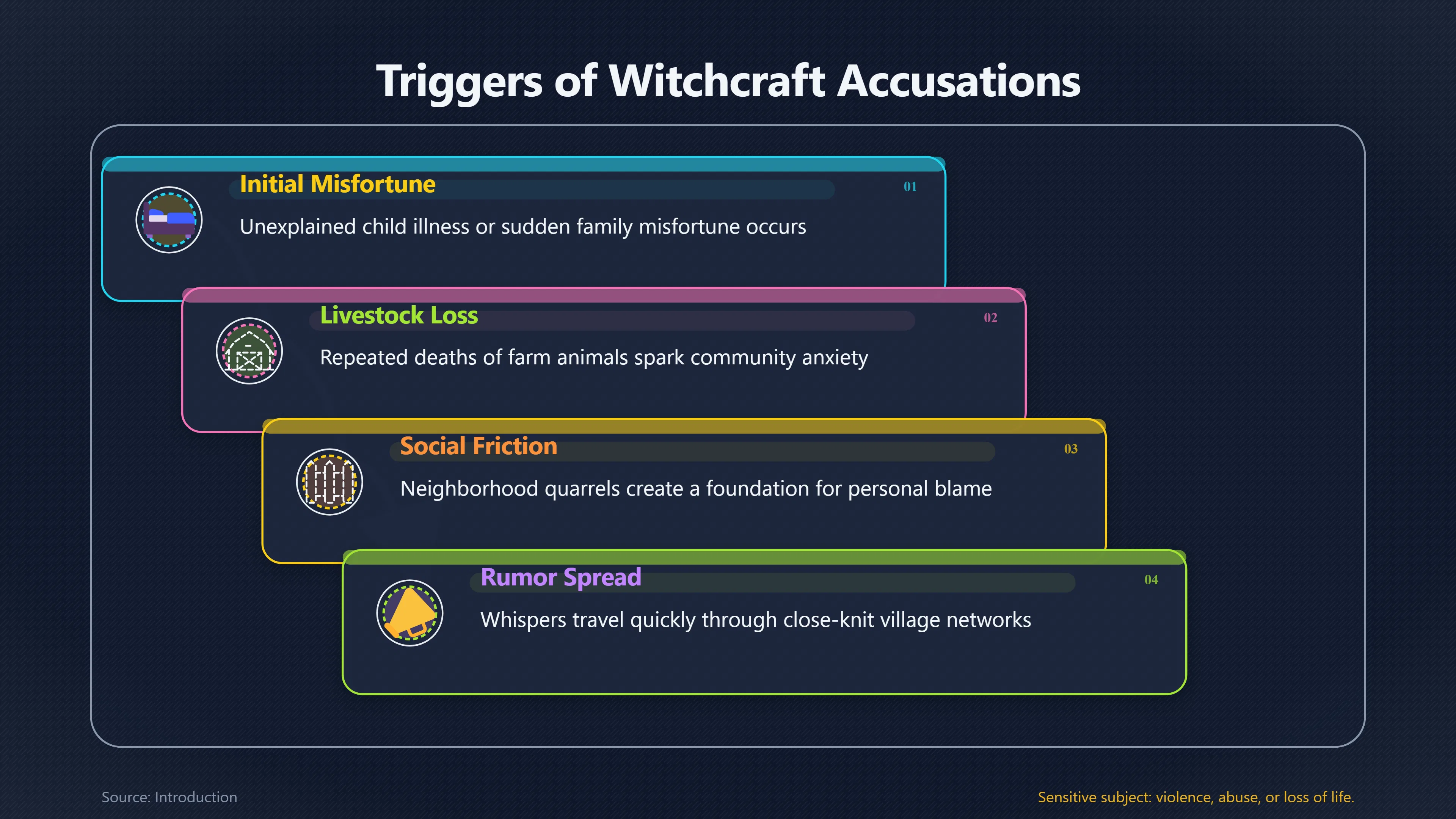
Typical triggers included:
- a child’s unexplained illness;
- repeated livestock deaths;
- sudden family misfortune;
- neighbourhood quarrels followed by bad luck;
- rumours passed through close-knit communities.
Because these accusations depended largely on reputation and fear rather than verifiable evidence, they could spread rapidly within villages. Even without formal judicial proceedings, they risked public humiliation, social exclusion and physical violence against those accused. The danger lay less in organised legal persecution than in collective suspicion within small communities.[Reddit]reddit.comWhat exactly were the historical and sociological reasons that caused the European witch hysteria to kick off when did it?…

Petar I’s religious and political response
Petar I Petrović-Njegoš regarded these accusations as both spiritually mistaken and socially destructive. As Prince-Bishop, he combined political leadership with the highest religious authority in Montenegro, allowing him to challenge popular superstition directly.
A well-known episode occurred in 1830, after accusations against an alleged witch in southern Montenegro. Petar I issued an epistle condemning the persecution. He rejected not only witches but related supernatural figures from local folklore, declaring that neither he nor any trustworthy person had found evidence that such beings existed. Instead, he argued that belief in them reflected ignorance and contradicted the teachings of Christ.[Wikipedia]WikipediaOpen source on wikipedia.org.
His intervention was remarkable because it did not simply call for moderation. It challenged the underlying belief itself. Rather than accepting witchcraft as real but urging restraint, Petar I denied that the accusations had any factual foundation.
This stance differed from many earlier European authorities who accepted the existence of witches while attempting to regulate prosecutions. Petar I instead portrayed the accusations as false beliefs that harmed innocent people and disrupted Christian society.[Wikipedia]WikipediaOpen source on wikipedia.org.
Why stopping the accusations mattered
Petar I’s response had practical as well as religious purposes.
His intervention helped to:
- discourage retaliation against innocent individuals;
- reinforce the authority of church teaching over village rumours;
- strengthen central leadership by limiting private acts of persecution;
- reduce conflicts that could deepen divisions within already fragmented communities.
These objectives fitted his broader programme of consolidating law and political order in Montenegro. Throughout his rule he attempted to reduce blood feuds, strengthen institutions and replace arbitrary local justice with more consistent authority. Opposing witch accusations formed part of the same effort to restrain violence driven by custom and rumour.[epub.ius.bg.ac.rs]epub.ius.bg.ac.rsOpen source on bg.ac.rs.
What historians make of the episode
Modern historians do not regard Montenegro as a centre of large-scale witch hunting. Instead, the surviving evidence points to scattered local accusations embedded within wider systems of folk belief. The significance of Petar I’s intervention therefore lies less in ending a nationwide panic than in demonstrating that respected leaders sometimes resisted collective fear rather than exploiting it.
The episode also challenges a common assumption that religious authorities always encouraged witch persecutions. In Montenegro, the country’s leading Orthodox ruler publicly argued that belief in witches lacked credibility and conflicted with Christian doctrine. His position anticipated a more sceptical approach to supernatural accusations and offered official protection to people who might otherwise have become victims of community suspicion.[Wikipedia]WikipediaOpen source on wikipedia.org.
Why the episode remains important
The story of witch accusations and Petar I’s intervention illustrates how collective fear can arise from ordinary hardship rather than extraordinary events. Illness, death and uncertainty encouraged communities to seek human explanations for misfortune, placing vulnerable individuals at risk.
Equally important, it shows that moral panics are not inevitable. In Montenegro’s case, political and religious authority could interrupt the spread of rumour by insisting on evidence, rejecting superstition and reminding communities that persecution itself caused real harm. Within Montenegro’s broader history of collective belief, this episode stands as an example of leadership used to calm fear rather than inflame it.
Amazon book picks
Further Reading
Books and field guides related to Who Stopped Montenegro's Witch Accusations?. Use these as the next step if you want deeper reading beyond the article.
The witch-hunt in early modern Europe
Provides essential context for why Montenegro differed from other regions.

The Witch: A History of Fear, from Ancient Times to the Present
Places local witch accusations within wider European history.

Witchcraft: A History in Thirteen Trials
Shows how witch accusations evolved across cultures.
Endnotes
1.
Source: Wikipedia
Link:https://en.wikipedia.org/wiki/Zduha%C4%87
2.
Source: epub.ius.bg.ac.rs
Link:https://epub.ius.bg.ac.rs/index.php/Vesnik/article/view/85
3.
Source: reddit.com
Title: Where there witch hunts in the Balkan region?
Link:https://www.reddit.com/r/AskHistorians/comments/ob8aj8
Source snippet
Where there witch hunts in the Balkan region?June 30, 2021...
Published: June 30, 2021
4.
Source: reddit.com
Link:https://www.reddit.com/r/AskHistorians/comments/1u4khfc/what_exactly_were_the_historical_and_sociological/
Source snippet
What exactly were the historical and sociological reasons that caused the European witch hysteria to kick off when did it?...
5.
Source: reddit.com
Link:https://www.reddit.com/r/AskHistorians/comments/ur8zyw
Source snippet
How was witchcraft viewed in the Orthodox Christian realm in the medieval and early modern period?...
Additional References
6.
Source: dergipark.org.tr
Title: Karadağ’da Küçük Stepan (Sahte Rus Çarı III
Link:https://dergipark.org.tr/tr/pub/vakanuvis/article/1336135
Source snippet
Petro) Dönemi (1767-1773) - Vakanüvis - Uluslararası Tarih Araştırmaları DergisiMarch 30, 2024 — KARADAĞ’DA KÜÇÜK STEPAN (SAHTE RUS ÇARI...
Published: March 30, 2024
7.
Source: srpskaenciklopedija.org
Title: Петар I Петровић Његош [Српска енциклопедија]
Link:https://srpskaenciklopedija.org/doku.php?id=%D0%BF%D0%B5%D1%82%D0%B0%D1%80i%D0%BF%D0%B5%D1%82%D1%80%D0%BE%D0%B2%D0%B8%D1%9B_%D1%9A%D0%B5%D0%B3%D0%BE%D1%88
Source snippet
септембар 1748. Његуши, Црна Гора Смрт: 30. октобар 1830. Цетиње, Црна Гора Познат као: владика Петар I Петровић Његош или Свети Петар...
8.
Source: youtube.com
Title: Zduhaci The Forgotten Celestial Heroes From Western Serbian Villages
Link:https://www.youtube.com/watch?v=-X090EUXBRQ
Source snippet
Imogen Edwards-Jones introduces The Witches of St Petersburg...
9.
Source: youtube.com
Title: Imogen Edwards-Jones introduces The Witches of St Petersburg
Link:https://www.youtube.com/watch?v=qqPzuRICC0A
Source snippet
4/7. Dinastija Petrović Njegoš - Mitropolit Petar I Petrović Njegoš...
10.
Source: youtube.com
Title: Crnogorska Dinastija Petrović Njegoš – Mitropolit Petar I
Link:https://www.youtube.com/watch?v=RgGbcPp7ZOE
Source snippet
Zduhaci The Forgotten Celestial Heroes From Western Serbian Villages...
11.
Source: youtube.com
Title: Petar I Petrović Njegoš, vladika i gospodar Crne Gore
Link:https://www.youtube.com/watch?v=o28vsbwMnqc
Source snippet
Crnogorska Dinastija Petrović Njegoš – Mitropolit Petar I...
12.
Source: gutenberg.org
Title: It cont
Link:https://gutenberg.org/ebooks/77145
Source snippet
The history of witchcraft and demonology by Montague Summers | Project GutenbergOctober 28, 2025 — THE HISTORY OF WITCHCRAFT AND DEMONOLO...
Published: October 28, 2025
14.
Source: cambridge.org
Link:https://www.cambridge.org/core/journals/american-slavic-and-east-european-review/article/catherine-ii-and-a-false-peter-iii-in-montenegro/FC8FC66AD4E24B597D3475F6E51D8CF7
15.
Source: cambridge.org
Link:https://www.cambridge.org/core/services/aop-cambridge-core/content/view/FC8FC66AD4E24B597D3475F6E51D8CF7/S1049754400101440a.pdf/div-class-title-catherine-ii-and-a-false-peter-iii-in-montenegro-div.pdf
Topic Tree