Within Nauru
Was Nauru's Ancestral Religion Really Superstition?
Nauruan spirit traditions were coherent religious practices, not evidence of a cult or contagious collective delusion.
On this page
- Creators, ancestors and sacred places
- How colonial writers classified Nauruan belief
- Why trance and spirit practice were not mass hysteria
Page outline Jump by section
Introduction
Nauru’s ancestral religion was not a cult, nor is there evidence that it produced an episode of mass hysteria. Before Christianity became the island’s dominant faith, Nauruans practised a coherent Indigenous spiritual tradition centred on creator stories, ancestral spirits, sacred places and relationships between living communities and the dead. Much of what is known today comes from ethnographic records compiled during the German colonial period and from later studies of Micronesian religions. Those sources must be read carefully because they were often filtered through missionary assumptions that classified Indigenous beliefs as “superstition”, “magic” or “primitive religion”. Modern historians and anthropologists instead treat these traditions as an established religious system embedded in everyday social life rather than as evidence of irrational collective behaviour.[oup.com]academic.oup.comOUP AcademicThe Religion of Kiribati and Nauru | Summoning the Powers Beyond: Traditional Religions in Micronesia | Hawai'i Scholarship O…
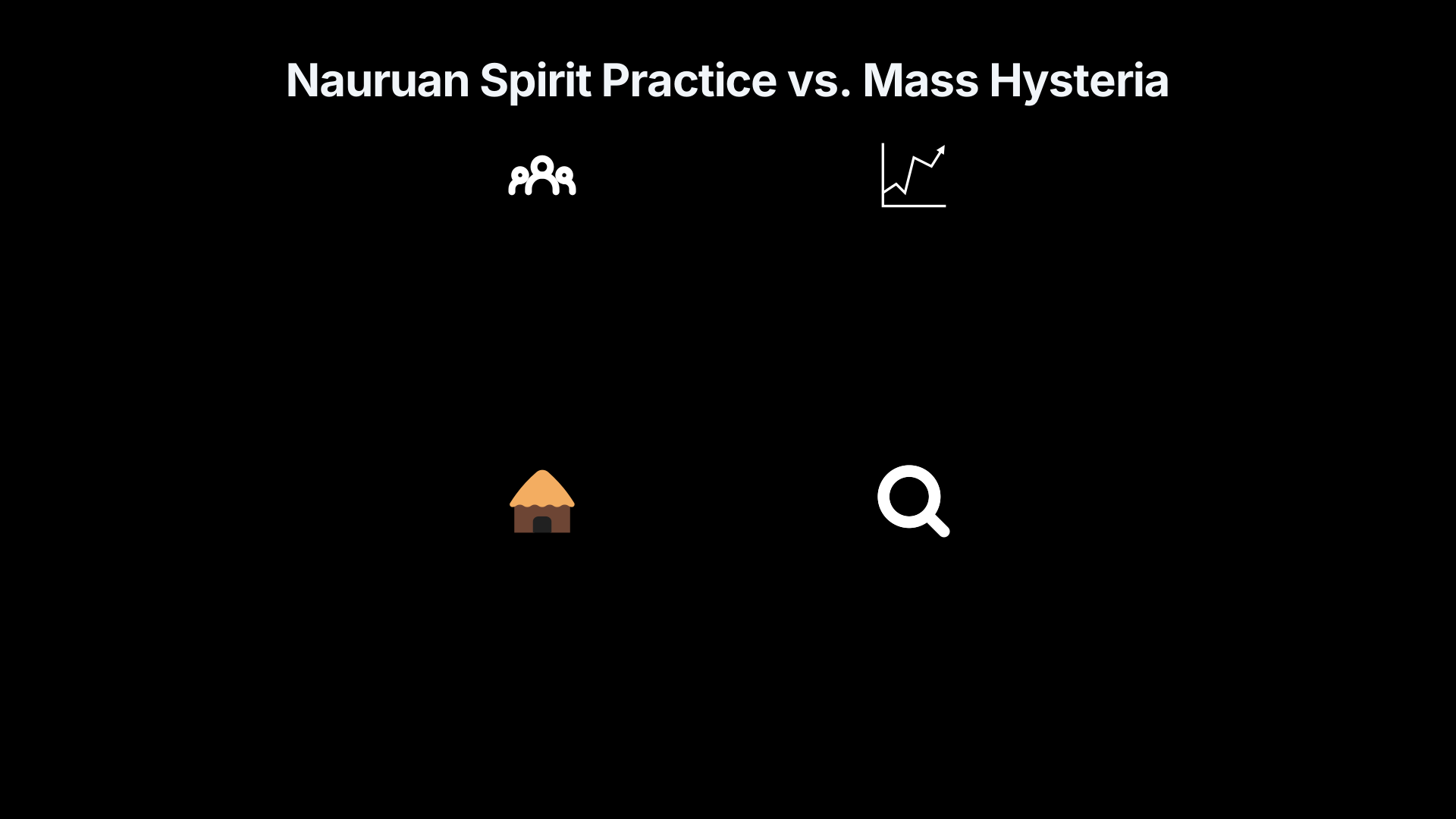
Understanding this distinction matters because dramatic descriptions of spirit possession or trance can easily be mistaken by modern readers for examples of mass hysteria. The historical record from Nauru does not support that interpretation. Instead, it shows culturally recognised religious practices that occurred within accepted social rules and had specific ritual purposes.
Was Nauru’s ancestral religion really superstition?
Before sustained European contact, Nauru possessed its own religious worldview explaining the origins of the island, the relationship between people and the natural world, and the continuing influence of ancestors. Creation traditions centred on the spider creator Areop-Enap, while other figures explained aspects of the sea, sky and human existence. Rather than existing as isolated myths, these stories formed part of a wider cosmology linking morality, genealogy and place.[Wikipedia]WikipediaOpen source on wikipedia.org.
Like many Indigenous Pacific religions, Nauruan spirituality was not organised around written scriptures or permanent priesthoods comparable to European churches. Religious authority instead rested in community knowledge, ritual specialists and inherited traditions. Ancestors were understood as continuing participants in community life, capable of offering guidance, protection or warnings through accepted ceremonial practices.[micsem.org]micsem.orgOpen source on micsem.org.
From a modern anthropological perspective, these beliefs represent a stable Indigenous religious tradition rather than an unusual or pathological phenomenon. Comparable ancestor-centred cosmologies were widespread across Micronesia and Oceania, although each island developed its own distinctive traditions.[OUP Academic]academic.oup.comOUP AcademicThe Religion of Kiribati and Nauru | Summoning the Powers Beyond: Traditional Religions in Micronesia | Hawai'i Scholarship O…
Creators, ancestors and sacred places
Several recurring elements appear across the surviving descriptions of traditional Nauruan belief.
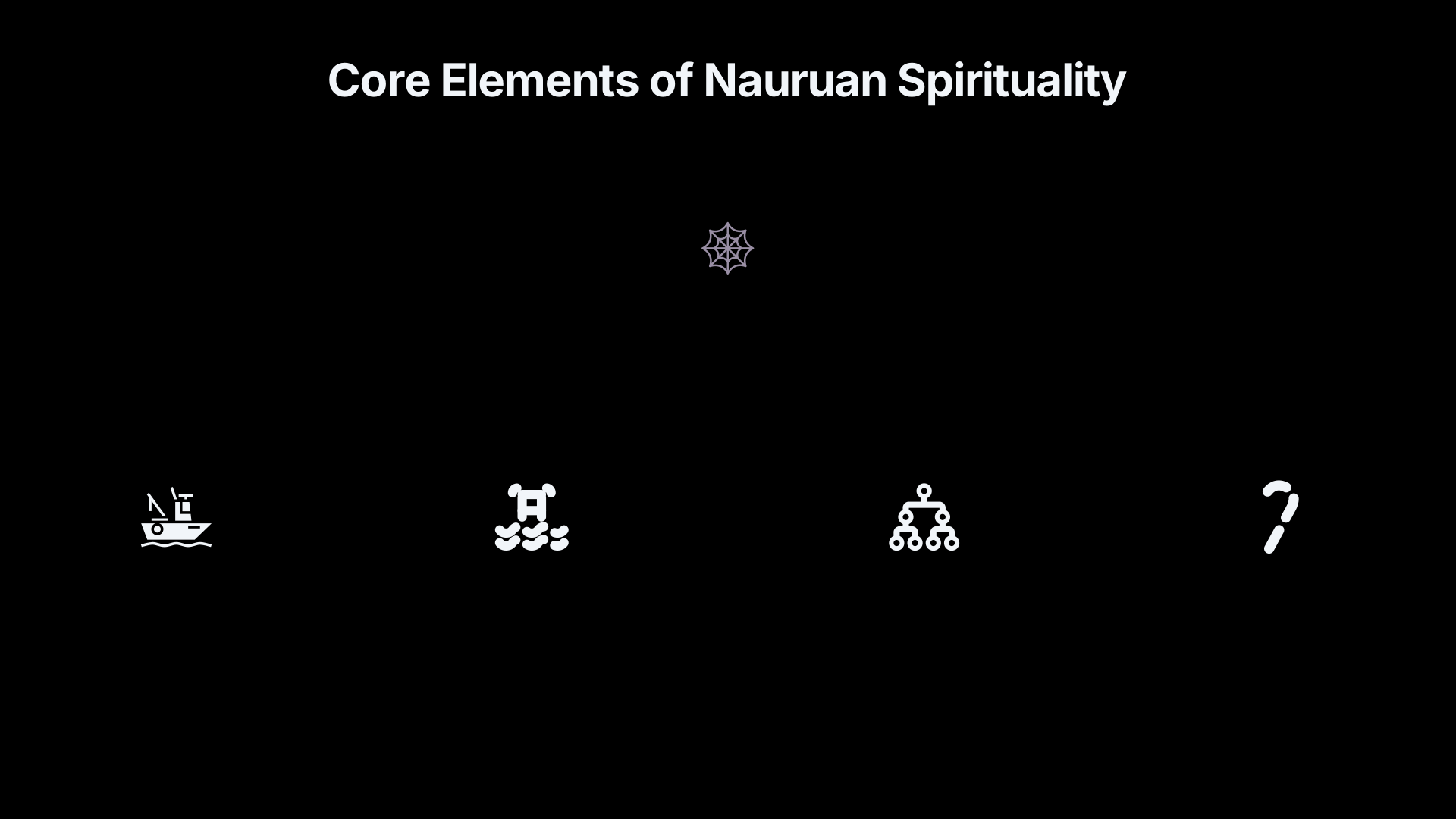
- Creator traditions: The creation of the world was attributed to Areop-Enap, whose actions explained the emergence of the heavens, earth and living beings through a complex mythic narrative.[Wikipedia]WikipediaOpen source on wikipedia.org.
- Ancestral spirits: The dead were believed to remain active and could be approached through recognised spiritual intermediaries. Ancestors were consulted about practical matters including illness, fishing, conflict and community welfare rather than only abstract religious questions.[micsem.org]micsem.orgOpen source on micsem.org.
- Sacred locations: Places such as Buada Lagoon and the spirit land known as Buitani carried religious importance because they connected the physical landscape with ancestral presence and cosmological stories. Sacred geography reinforced communal identity rather than encouraging withdrawal from society.[Wikipedia]WikipediaNauruan indigenous religionNauruan indigenous religion
- Community identity: Religious belief was closely connected with Nauru’s traditional clan structure and matrilineal inheritance. Spiritual traditions therefore helped define social relationships instead of existing separately from them.[Wikipedia]WikipediaOpen source on wikipedia.org.
These features resemble many Indigenous religious systems in which spirituality, land, ancestry and everyday life are inseparable.
How colonial writers classified Nauruan belief
Most surviving written descriptions of traditional Nauruan religion were produced after European colonisation had already begun. This creates an important historical problem.
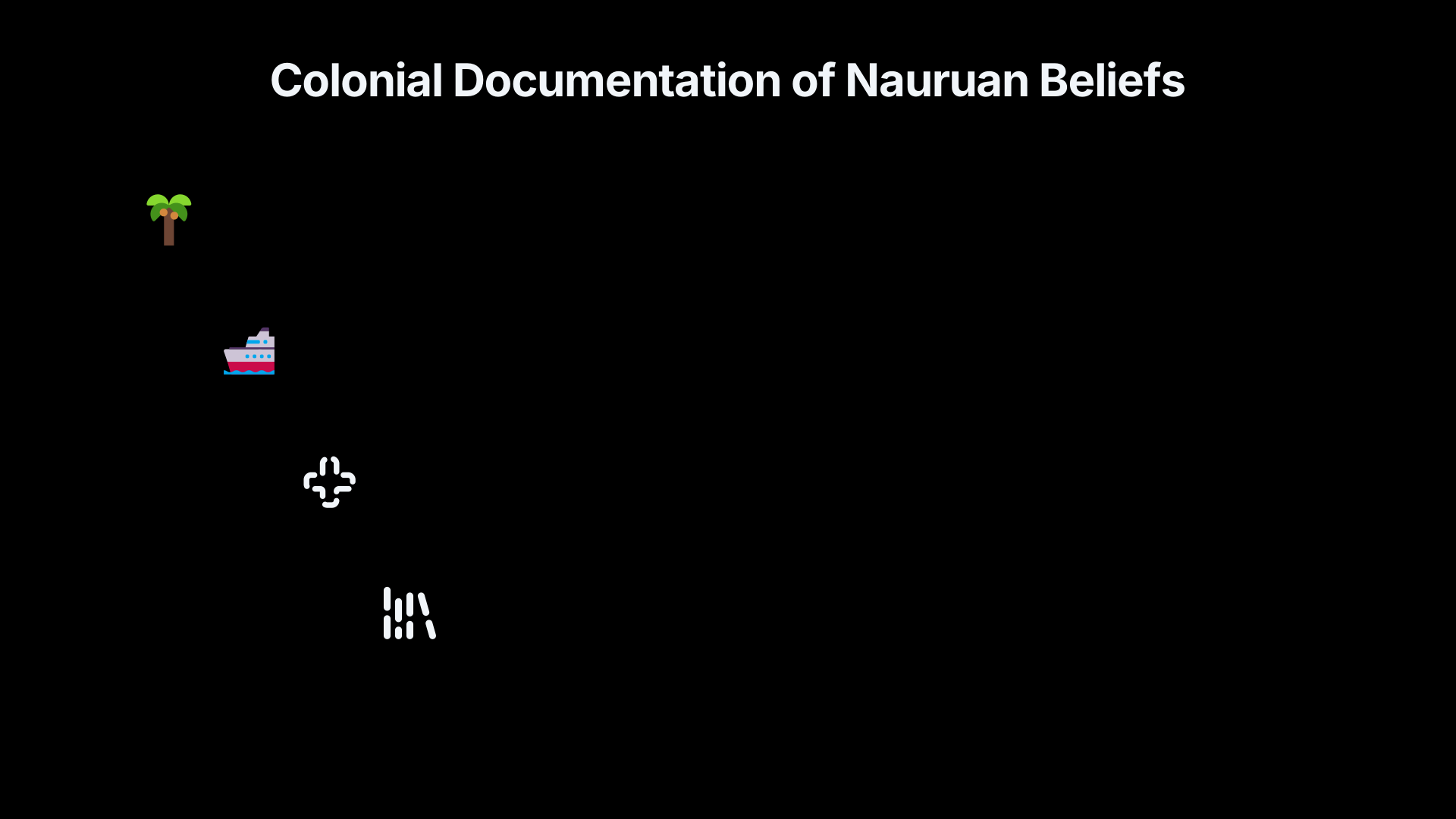
The German ethnographer Paul Hambruch documented Nauruan customs during the South Seas Expedition of 1908–1910, publishing his work in 1914–1915. His books remain indispensable because relatively little earlier documentation survives. However, Hambruch himself depended heavily on information from a small number of informants, including one principal source recalling practices that were already disappearing under missionary influence. Later scholars therefore treat his work as valuable but incomplete rather than a perfect record of pre-contact religion.[micsem.org]micsem.orgOpen source on micsem.org.
Missionaries often interpreted Indigenous ceremonies through Christian categories. Practices involving spirit communication could be labelled as sorcery, magic or pagan superstition, while religious specialists might be described as “wizards” or “sorcerers”. Such terminology reflected European religious assumptions as much as it described Nauruan beliefs themselves.[micsem.org]micsem.orgOpen source on micsem.org.
Modern scholarship generally adopts more neutral language, recognising that these traditions formed an internally coherent religious system. Instead of asking whether Nauruans genuinely contacted spirits, historians examine how those beliefs functioned socially, how they organised communal life and how they changed under colonial rule.[OUP Academic]academic.oup.comOUP AcademicThe Religion of Kiribati and Nauru | Summoning the Powers Beyond: Traditional Religions in Micronesia | Hawai'i Scholarship O…
Why trance and spirit practice were not mass hysteria
Descriptions of spirit possession are among the most easily misunderstood parts of the historical record.
Hambruch recorded occasions when recognised mediums or other individuals entered possession states after calling upon ancestral spirits. Witnesses reported shouting, altered behaviour and communication believed to originate from ancestors, who might advise on illness, fishing prospects or other practical concerns. These episodes occurred within recognised religious settings and involved socially understood roles.[micsem.org]micsem.orgOpen source on micsem.org.
This differs fundamentally from what psychologists today describe as mass psychogenic illness, sometimes popularly called mass hysteria. Modern definitions involve groups of people developing genuine physical symptoms through psychological and social mechanisms after medical causes have been excluded. Such outbreaks typically spread rapidly through schools, workplaces or communities without forming part of an established religious tradition.
The Nauruan evidence does not fit that pattern because:
- the practices were expected within Indigenous religion rather than sudden outbreaks;[Wikipedia]WikipediaNauruan indigenous religionNauruan indigenous religion
- participation was generally associated with recognised ritual specialists or accepted ceremonies;
- the experiences reinforced existing cultural beliefs instead of spreading through panic or fear;
- there is no historical record of island-wide contagious illness, uncontrolled possession epidemic or collective delusion resembling documented cases of mass psychogenic illness elsewhere.[micsem.org]micsem.orgOpen source on micsem.org.
Interpreting these practices as mass hysteria therefore confuses culturally meaningful religious experience with a specific psychological phenomenon.
Why the misunderstanding persists
Several factors encourage modern readers to misinterpret Nauruan spirituality.
First, nearly all early written evidence passed through colonial observers who used European religious vocabulary. Words such as “magic”, “wizard” and “superstition” can imply irrationality even when describing ordinary Indigenous religious practice.[micsem.org]micsem.orgOpen source on micsem.org.
Second, much traditional knowledge was lost or transformed following Christian conversion. Because only fragments of the earlier religion survive, dramatic rituals often receive disproportionate attention while their broader cultural context disappears.[Wikipedia]WikipediaNauruan indigenous religionNauruan indigenous religion
Finally, popular discussions sometimes apply modern psychological labels retrospectively without considering historical context. Behaviour that appears unusual to outside observers is not automatically evidence of mental illness, collective delusion or social panic. Anthropologists instead emphasise understanding religious practices within the cultural systems that gave them meaning.
Why this distinction matters for understanding Nauru
Treating Nauruan ancestral religion as a form of mass hysteria obscures both the island’s history and the nature of Indigenous spirituality.
The available evidence points to a long-established religious tradition that linked people, ancestors and landscape into a shared moral and social order. Spirit communication, sacred places and creation stories were not exceptional eruptions of irrational behaviour but accepted parts of community life before large-scale Christian conversion. While colonial observers often dismissed these beliefs as superstition, modern scholarship views them as expressions of an Indigenous worldview that deserves interpretation on its own terms rather than through the language of panic, cults or collective delusion.[oup.com]academic.oup.comOUP AcademicThe Religion of Kiribati and Nauru | Summoning the Powers Beyond: Traditional Religions in Micronesia | Hawai'i Scholarship O…
Amazon book picks
Further Reading
Books and field guides related to Was Nauru's Ancestral Religion Really Superstition?. Use these as the next step if you want deeper reading beyond the article.

The anthropology of religion, magic, and witchcraft
Helps readers distinguish culturally recognised ritual and spirit practice from misconceptions such as mass hysteria or superstition.
We, the navigators
Explores Indigenous Pacific worldviews and knowledge systems that help contextualise ancestral belief traditions.
Religion Explained
Provides readers with modern frameworks for understanding religious belief without reducing Indigenous traditions to superstition.

Undesirables
Takes readers inside Australia's Nauru detention centre and documents daily conditions, distress, self-harm, unrest and the human consequ...
Endnotes
1.
Source: academic.oup.com
Link:https://academic.oup.com/hawaii-scholarship-online/book/18329/chapter/176369213
Source snippet
OUP AcademicThe Religion of Kiribati and Nauru | Summoning the Powers Beyond: Traditional Religions in Micronesia | Hawai'i Scholarship O...
2.
Source: micsem.org
Link:https://micsem.org/print/?id=2076
3.
Source: glottolog.org
Link:https://glottolog.org/resource/reference/id/549258
Source snippet
Glottolog 5.3 - Hambruch, Paul 1915...
4.
Source: Wikipedia
Link:https://en.wikipedia.org/wiki/Areop-Enap
5.
Source: Wikipedia
Title: Nauruan indigenous religion
Link:https://en.wikipedia.org/wiki/Nauruan_indigenous_religion
6.
Source: Wikipedia
Title: Buada Lagoon
Link:https://en.wikipedia.org/wiki/Buada_Lagoon
7.
Source: Wikipedia
Link:https://en.wikipedia.org/wiki/Nauru
8.
Source: Wikipedia
Title: History of Nauru
Link:https://en.wikipedia.org/wiki/History_of_Nauru
9.
Source: academic.oup.com
Link:https://academic.oup.com/edinburgh-scholarship-online/book/44576/chapter/376677147
Source snippet
and Becoming: Warlpiri Rituals and Myths | Indigenising Anthropology with Guattari and Deleuze | Edinburgh Scholarship Online | Oxford Ac...
10.
Source: academic.oup.com
Link:https://academic.oup.com/edinburgh-scholarship-online/book/44576/chapter-abstract/376677147
11.
Source: academic.oup.com
Link:https://academic.oup.com/jsh/article-abstract/49/1/100/948329
12.
Source: micsem.org
Link:https://micsem.org/article/distribution-of-spirit-possession-and-trance-in-micronesia/
13.
Source: geognos.com
Link:https://www.geognos.com/en/place/nauru/history
Additional References
14.
Source: researchportalplus.anu.edu.au
Title: new books network podcast haunted houses and ghostly encounters e
Link:https://researchportalplus.anu.edu.au/en/publications/new-books-network-podcast-haunted-houses-and-ghostly-encounters-e/
Source snippet
Shepherd: Hosted by Patrick Jory - The Australian National UniversityFebruary 18, 2020 — NEW BOOKS NETWORK PODCAST: HAUNTED HOUSES AND GH...
Published: February 18, 2020
15.
Source: openresearch-repository.anu.edu.au
Link:https://openresearch-repository.anu.edu.au/items/aea675be-d7f8-4d06-8db1-1790d9143114
Source snippet
and Crow: Aboriginal knowledges, imperial networks and the evolution of religionJanuary 1, 2020 — EAGLEHAWK AND CROW: ABORIGINAL KNOWLEDG...
Published: January 1, 2020
16.
Source: youtube.com
Title: Nahn Sapwe: The Lord of Thunder Who Defied an Empire
Link:https://www.youtube.com/watch?v=D76JPwYDHOo
Source snippet
Why you, why now, why this topic? - Fa'alogo Jacoba Matapo | Breaking Waves w/ Hana Schmidt...
17.
Source: youtube.com
Title: Monsters and Mythical Creatures of Polynesian Mythology
Link:https://www.youtube.com/watch?v=JhtNxQg3HTg
Source snippet
Nahn Sapwe: The Lord of Thunder Who Defied an Empire...
18.
Source: youtube.com
Title: Why you, why now, why this topic?
Link:https://www.youtube.com/watch?v=_Th5zPg22jQ
Source snippet
Anja Kanngieser – Listening to Ecocide...
19.
Source: researchgate.net
Link:https://www.researchgate.net/publication/231941514_Historicizing_the_Spiritual_Bu_Shell_Arrangements_on_the_Island_of_Badu_Torres_Strait
20.
Source: researchgate.net
Link:https://www.researchgate.net/publication/247768784_Myths_and_the_formation_of_Niue_Island_central_South_Pacific
21.
Source: cambridge.org
Link:https://www.cambridge.org/core/books/abs/melanesian-religion/dream-vision-and-trance-in-traditional-and-changing-melanesia-with-remi-dembari/C20B4041D39ED60C91AAEF1C31185FCB
22.
Source: fr-academic.com
Link:https://fr-academic.com/dic.nsf/frwiki/608616/
23.
Source: cambridge.org
Link:https://www.cambridge.org/core/journals/journal-of-ecclesiastical-history/article/abs/going-native-converting-narratives-in-tiwi-histories-of-twentiethcentury-missions/E65068C986A217320763EA95BA44F5A0
Topic Tree