Within Grenada
How Colonial Law Turned Obeah Into a Threat
Grenada's anti-obeah laws turned varied African-derived practices into a broad category of danger, crime and suspicion.
On this page
- What Obeah Meant in Colonial Grenada
- The 1825 Slave Act and Official Fear
- Why This Was Not a Grenadian Witch Trial
Page outline Jump by section
Introduction
Colonial Grenada did not experience a classic witch trial in which large numbers of people were accused, tried and executed for sorcery. Instead, the colonial state created something different: a legal system that treated the broad and often loosely defined category of “obeah” as an inherent public danger. Through laws, court proceedings and official rhetoric, spiritual practices associated with enslaved Africans were transformed into signs of criminality, rebellion and social disorder.
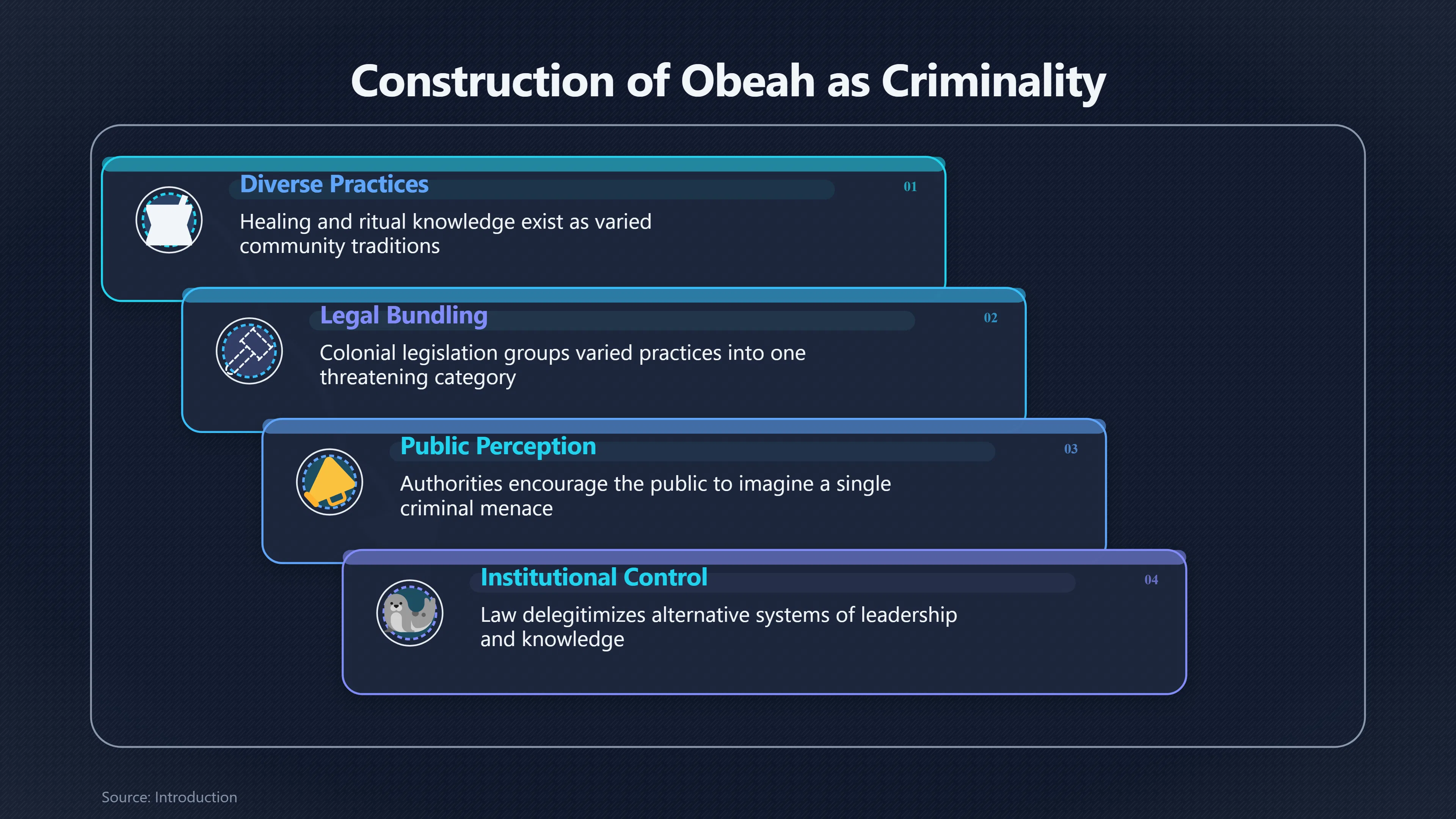
This mattered because “obeah” was never a single organised religion or unified belief system. It encompassed healing, protection, divination, ritual knowledge and, in some cases, accusations of harmful magic. Colonial legislation nevertheless bundled these varied practices into one threatening legal category. In Grenada, the result was a lasting association between African-derived spiritual authority and danger—an association that shaped public attitudes long after slavery itself ended.[Obeah Histories]obeahhistories.orgObeah Histories1825 Grenada Consolidated Slave Act | Obeah HistoriesNovember 12, 2012…
What Obeah Meant in Colonial Grenada
To colonial officials, obeah represented far more than individual acts of superstition. It symbolised a source of authority that existed outside plantation owners, churches and colonial courts.
For many enslaved people, spiritual specialists could provide healing, protection, advice and explanations for misfortune. They occupied respected positions within their communities because they offered services that colonial institutions either ignored or actively suppressed. Modern historians therefore argue that obeah should not be understood simply as “witchcraft”. Instead, it formed part of a wider body of African-derived knowledge that blended religious belief, herbal medicine, ritual practice and community leadership.[ECDA]ecda.northeastern.eduECDAObeah: “Magical Art of Resistance” – ECDAECDAObeah: “Magical Art of Resistance” – ECDA
This distinction is important because colonial officials rarely attempted to define obeah precisely. Instead, they described it through its supposed dangers. The lack of a clear definition allowed almost any unfamiliar African-derived spiritual practice to be treated with suspicion.
Rather than regulating one identifiable religion, the law created an elastic category that could absorb many different practices whenever officials believed they threatened public order.
The 1825 Slave Act and Official Fear
Grenada’s 1825 Consolidated Slave Act demonstrates how colonial law actively constructed obeah as a social threat rather than merely responding to one.
Clause 35 declared that it was necessary to prevent the “many mischiefs” caused by people described as “Obeah men and women”. The legislation accused practitioners of pretending to communicate with evil spirits, deceiving “the weak and superstitious”, preparing poisons and participating in dangerous secret gatherings. The penalties were severe, including transportation, death or other punishments determined by the courts.[Obeah Histories]obeahhistories.orgObeah Histories1825 Grenada Consolidated Slave Act | Obeah HistoriesNovember 12, 2012…
Several features of the law reveal its broader purpose.
- Religious authority became suspicious in itself. The offence was not limited to proven physical harm. Claiming supernatural power could itself become evidence of criminality.
- The law mixed different fears together. Poisoning, rebellion, secret oaths, ritual objects and spiritual practice appeared within the same legal provision, encouraging officials to treat them as parts of one larger menace.
- The wording was deliberately broad. References to items “used in the practice of Obeah or witchcraft” allowed authorities considerable discretion when interpreting evidence.[Obeah Histories]obeahhistories.orgObeah Histories1825 Grenada Consolidated Slave Act | Obeah HistoriesNovember 12, 2012…
Historians note that much of this language echoed earlier Jamaican legislation, showing that colonial governments circulated legal ideas across the British Caribbean. Grenada therefore inherited an established model that portrayed obeah as a threat to both political stability and public safety.[Obeah Histories]obeahhistories.orgObeah Histories1825 Grenada Consolidated Slave Act | Obeah HistoriesNovember 12, 2012…
Why Colonial Governments Feared Obeah
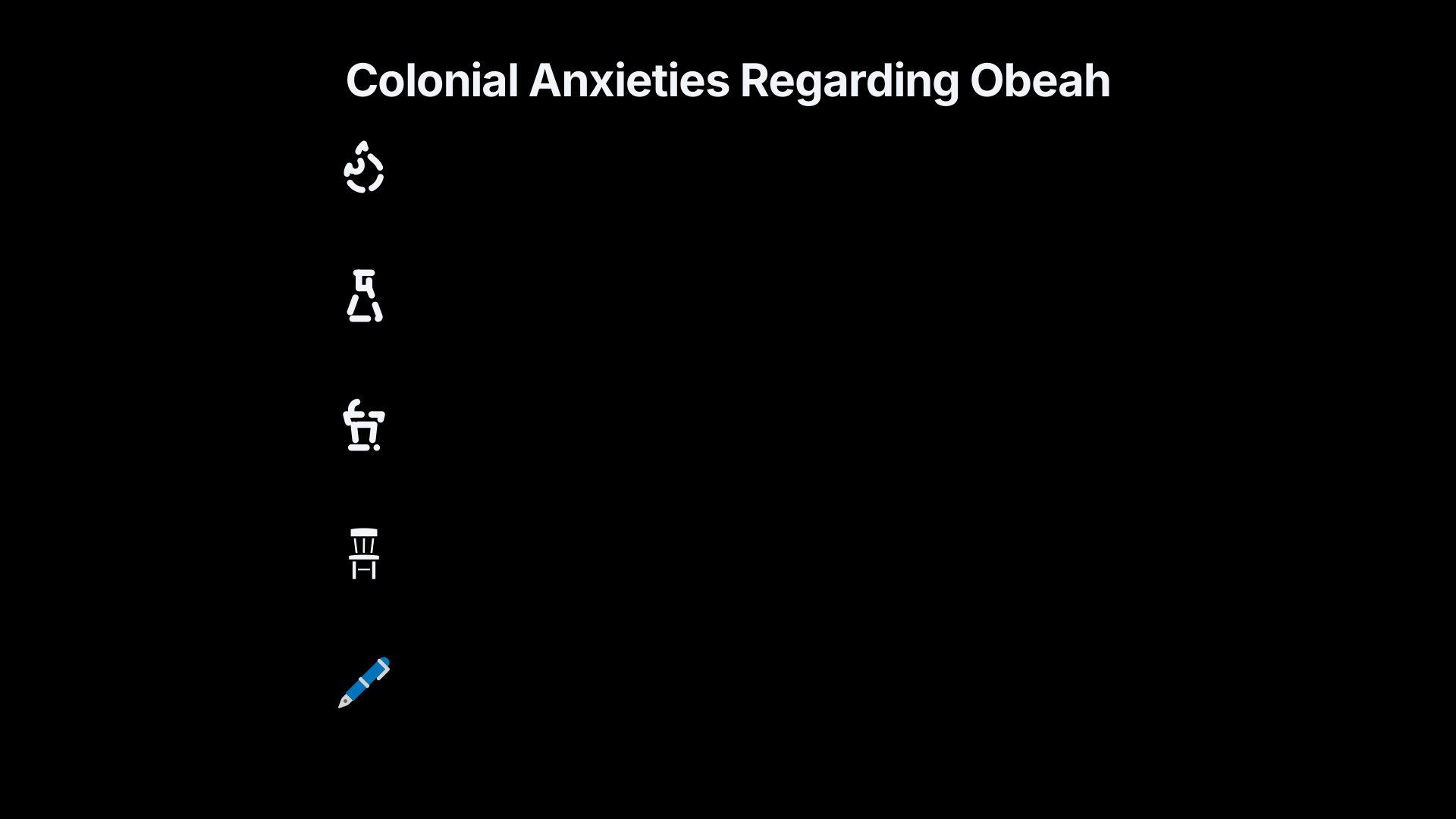
The fear embedded in anti-obeah laws reflected several overlapping colonial anxieties rather than a single concern.
First, plantation societies feared rebellion. The memory of slave resistance across the Caribbean—including Grenada’s own Fedon Rebellion in the 1790s and later uprisings elsewhere in the British Caribbean—made colonial governments suspicious of any independent networks that could mobilise trust or loyalty outside official institutions. Spiritual practitioners often held exactly that kind of influence.[Obeah Histories]obeahhistories.orgObeah Histories Timeline | Obeah HistoriesObeah HistoriesTimeline | Obeah HistoriesSeptember 18, 2012…
Second, colonial authorities associated obeah with poisoning. European officials frequently believed that ritual specialists possessed dangerous knowledge of herbs and toxic substances. Whether individual accusations were true or false, the fear itself became politically significant. Anti-obeah laws therefore linked spiritual practice with alleged attempts to injure people through poison, even when evidence was weak or ambiguous.[Obeah Histories]obeahhistories.orgObeah Histories1825 Grenada Consolidated Slave Act | Obeah HistoriesNovember 12, 2012…
Third, Christian missionaries increasingly portrayed African-derived spiritual traditions as incompatible with Christian belief. Religious condemnation reinforced legal suspicion, helping transform cultural differences into perceived moral and criminal threats.[ECDA]ecda.northeastern.eduECDAObeah and the Law – ECDAECDAObeah and the Law – ECDA
Together these concerns produced a powerful narrative: that obeah endangered both souls and society.

How the Law Helped Create the Threat
Modern scholarship increasingly argues that colonial governments did not simply discover a dangerous practice called obeah—they helped create the public idea of obeah as a coherent menace.
Before criminalisation, many healing and ritual traditions varied considerably between communities. By placing them under one legal label, colonial authorities encouraged both officials and the wider public to imagine them as parts of a single criminal phenomenon.
This had several lasting consequences.
- Diverse African-derived practices became identified with secrecy and criminality.
- Community healers could be viewed as potential conspirators rather than respected specialists.
- Ordinary disputes or unexplained illness could more easily generate accusations linked to obeah.
- Colonial courts acquired authority to define which forms of spirituality were legitimate and which were dangerous.[ECDA]ecda.northeastern.eduECDAObeah: “Magical Art of Resistance” – ECDAECDAObeah: “Magical Art of Resistance” – ECDA
In this sense, anti-obeah legislation functioned as a form of social control. It strengthened colonial authority by delegitimising alternative systems of knowledge and leadership among enslaved and later free Black communities.
Why This Was Not a Grenadian Witch Trial
Although anti-obeah laws shared some features with European witchcraft legislation, Grenada did not experience a concentrated witch panic comparable to the Salem trials or the early modern European witch hunts.
Several important differences stand out.
The colonial state targeted a continuing legal category rather than responding to a temporary outbreak of accusations. Enforcement occurred over many years through legislation, prosecutions and administrative control instead of a single episode of collective hysteria.
The central concern was also different. European witch trials often revolved around fears of diabolical conspiracies harming Christian communities. Grenada’s anti-obeah laws focused more heavily on maintaining plantation order, preventing rebellion, policing African cultural practices and suppressing alternative sources of authority.[obeahhistories.org]obeahhistories.orgObeah Histories1825 Grenada Consolidated Slave Act | Obeah HistoriesNovember 12, 2012…
The result was a long-lasting system of institutional suspicion rather than a brief explosion of mass accusations.
Why the Legacy Still Matters
The legal construction of obeah as a public danger outlived slavery itself. Throughout much of the British Caribbean, anti-obeah legislation remained in force well into the twentieth century, while related laws continued to regulate religious healing and independent spiritual movements. In Grenada, later restrictions were also applied against groups such as the Spiritual Baptists, illustrating how colonial governments repeatedly treated unofficial religious authority as a potential threat to public order.[Obeah Histories]obeahhistories.orgOpen source on obeahhistories.org.
Today, historians generally interpret these laws less as objective responses to a clearly defined danger than as instruments through which colonial power classified acceptable and unacceptable belief. Rather than revealing a uniquely dangerous religious tradition, Grenada’s anti-obeah legislation reveals how law, fear and empire combined to transform diverse African-derived spiritual practices into a lasting social threat in the colonial imagination.[northeastern.edu]ecda.northeastern.eduECDAObeah: “Magical Art of Resistance” – ECDAECDAObeah: “Magical Art of Resistance” – ECDA
Amazon book picks
Further Reading
Books and field guides related to How Colonial Law Turned Obeah Into a Threat. Use these as the next step if you want deeper reading beyond the article.
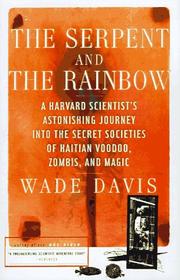
The Serpent and the Rainbow
Introduces readers to Caribbean belief systems often labelled as obeah.

The Caribbean: A History of the Region and Its Peoples
Provides historical background for colonial law and slavery.
Endnotes
1.
Source: ecda.northeastern.edu
Title: ECDAObeah: “Magical Art of Resistance” – ECDA
Link:https://ecda.northeastern.edu/home/about-exhibits/obeah-narratives-exhibit/
2.
Source: ecda.northeastern.edu
Title: ECDAWhat is Obeah? – ECDA
Link:https://ecda.northeastern.edu/home/about-exhibits/obeah-narratives-exhibit/what-is-obeah/
3.
Source: ecda.northeastern.edu
Title: ECDAObeah and the Law – ECDA
Link:https://ecda.northeastern.edu/home/about-exhibits/obeah-narratives-exhibit/obeah-and-the-law/
4.
Source: obeahhistories.org
Link:https://obeahhistories.org/grenada1825/
Source snippet
Obeah Histories1825 Grenada Consolidated Slave Act | Obeah HistoriesNovember 12, 2012...
Published: November 12, 2012
5.
Source: obeahhistories.org
Title: Obeah Histories Legislation | Obeah Histories
Link:https://obeahhistories.org/law/
Source snippet
Legislation | Obeah HistoriesSeptember 18, 2012 — LEGISLATION This section presents extracts and transcripts of several Acts and Ordinanc...
Published: September 18, 2012
6.
Source: obeahhistories.org
Title: Obeah Histories Timeline | Obeah Histories
Link:https://obeahhistories.org/about/
Source snippet
Obeah HistoriesTimeline | Obeah HistoriesSeptember 18, 2012...
Published: September 18, 2012
7.
Source: obeahhistories.org
Link:https://obeahhistories.org/
8.
Source: obeahhistories.org
Title: The ‘Act to Remedy the Evils arisi
Link:https://obeahhistories.org/1760-jamaica-law/
Source snippet
An Act to Remedy the Evils arising from Irregular Assemblies of Slaves, Jamaica 1760 | Obeah HistoriesNovember 12, 2012 — The Jamaican pl...
Published: November 12, 2012
9.
Source: obeahhistories.org
Title: pierre grenada 1833 34
Link:https://obeahhistories.org/pierre-grenada-1833-34/
Source snippet
Their trials took place in special ‘slave courts’, which only tried slaves. Few records remain of these trials...
10.
Source: obeahhistories.org
Title: Case Histories | Obeah Histories
Link:https://obeahhistories.org/casehistories/
11.
Source: ecda.northeastern.edu
Title: a true and exact history
Link:https://ecda.northeastern.edu/home/about-exhibits/obeah-narratives-exhibit/a-true-and-exact-history/
12.
Source: ecda.northeastern.edu
Title: the cultural politics of obeah
Link:https://ecda.northeastern.edu/home/about-exhibits/obeah-narratives-exhibit/the-cultural-politics-of-obeah/
13.
Source: ecda.northeastern.edu
Title: is obeah a religion science or cultural practice
Link:https://ecda.northeastern.edu/home/about-exhibits/obeah-narratives-exhibit/is-obeah-a-religion-science-or-cultural-practice/
Additional References
14.
Source: youtube.com
Title: Archival Irruptions: Moravians, Obeah, and Hidden Caribbean Histories
Link:https://www.youtube.com/watch?v=crP-n_zfkZc
Source snippet
Land, Law & Legacy: The Maroon Struggle in Jamaica...
15.
Source: youtube.com
Title: Enslaved People and Religion
Link:https://www.youtube.com/watch?v=t-d3jsMf5Aw
Source snippet
Archival Irruptions: Moravians, Obeah, and Hidden Caribbean Histories...
16.
Source: youtube.com
Title: Land, Law & Legacy: The Maroon Struggle in Jamaica
Link:https://www.youtube.com/watch?v=5J6IwpXd6tA
Source snippet
The Suppression of African Diaspora Religions (Full session)...
17.
Source: slaveryandfreedomlaws.lib.unb.ca
Link:https://slaveryandfreedomlaws.lib.unb.ca/laws/barbados-1806
18.
Source: slaveryandfreedomlaws.lib.unb.ca
Link:https://slaveryandfreedomlaws.lib.unb.ca/laws/grenada-1796
19.
Source: slaveryandfreedomlaws.lib.unb.ca
Link:https://slaveryandfreedomlaws.lib.unb.ca/laws/grenada-1825
20.
Source: youtube.com
Title: The Suppression of African Diaspora Religions (Full session)
Link:https://www.youtube.com/watch?v=t2SXhBQbiss
Source snippet
The History of Obeah in Jamaica...
21.
Source: research.ed.ac.uk
Title: ed.ac.uk Witchcraft, poison, law and Atlantic slavery
Link:https://www.research.ed.ac.uk/en/publications/witchcraft-poison-law-and-atlantic-slavery/
22.
Source: youtube.com
Title: The History of Obeah in Jamaica
Link:https://www.youtube.com/watch?v=a9TgKJgcUcA
23.
Source: journals.uchicago.edu
Link:https://www.journals.uchicago.edu/doi/abs/10.1086/713926
Topic Tree