Within Cuba's Collective Fears
How One Murder Fuelled a Racial Witch Panic
The murder of a toddler became the centre of a wider panic that treated Afro-Cuban religion as evidence of hidden violence.
On this page
- The disappearance and murder of Zoila Diaz
- How newspapers and police framed Afro Cuban religion
- Trials, acquittals and the panic's lasting stereotype
Page outline Jump by section
Introduction
The murder of the toddler Zoila Díaz in 1904 became one of the defining episodes in Cuba’s history of racialised moral panic. Although the case centred on a real and shocking crime, public discussion quickly expanded far beyond the search for the killer. Newspapers, police investigators and prominent intellectuals increasingly portrayed Afro-Cuban religious practitioners as members of secret criminal networks that kidnapped and sacrificed white children. These claims rested on a mixture of rumour, racial prejudice, sensational reporting and speculative theories about African-derived religions rather than on clear evidence that such practices were widespread.[researchgate.net]researchgate.net332105501 Libertad religiosa brujeria y asesinato de ninos en CubaResearchGate(PDF) Libertad religiosa, brujería y asesinato de niños en Cuba, 1898-1933.June 1, 2017…
Modern historians regard the Zoila Díaz case as far more than a murder investigation. It became a turning point in the early Cuban Republic, helping to create enduring stereotypes that linked Black religious traditions with ritual violence. The episode illustrates how fear can become attached to existing racial anxieties, allowing a single crime to be interpreted as proof of a hidden social menace rather than an isolated event.[Periódicos CAPES]periodicos.capes.gov.brPeriódicos CAPES“En Plena Libertad y Democracia”: Negros Brujos and the Social Question, 1904-1919…
The disappearance and murder of Zoila Díaz
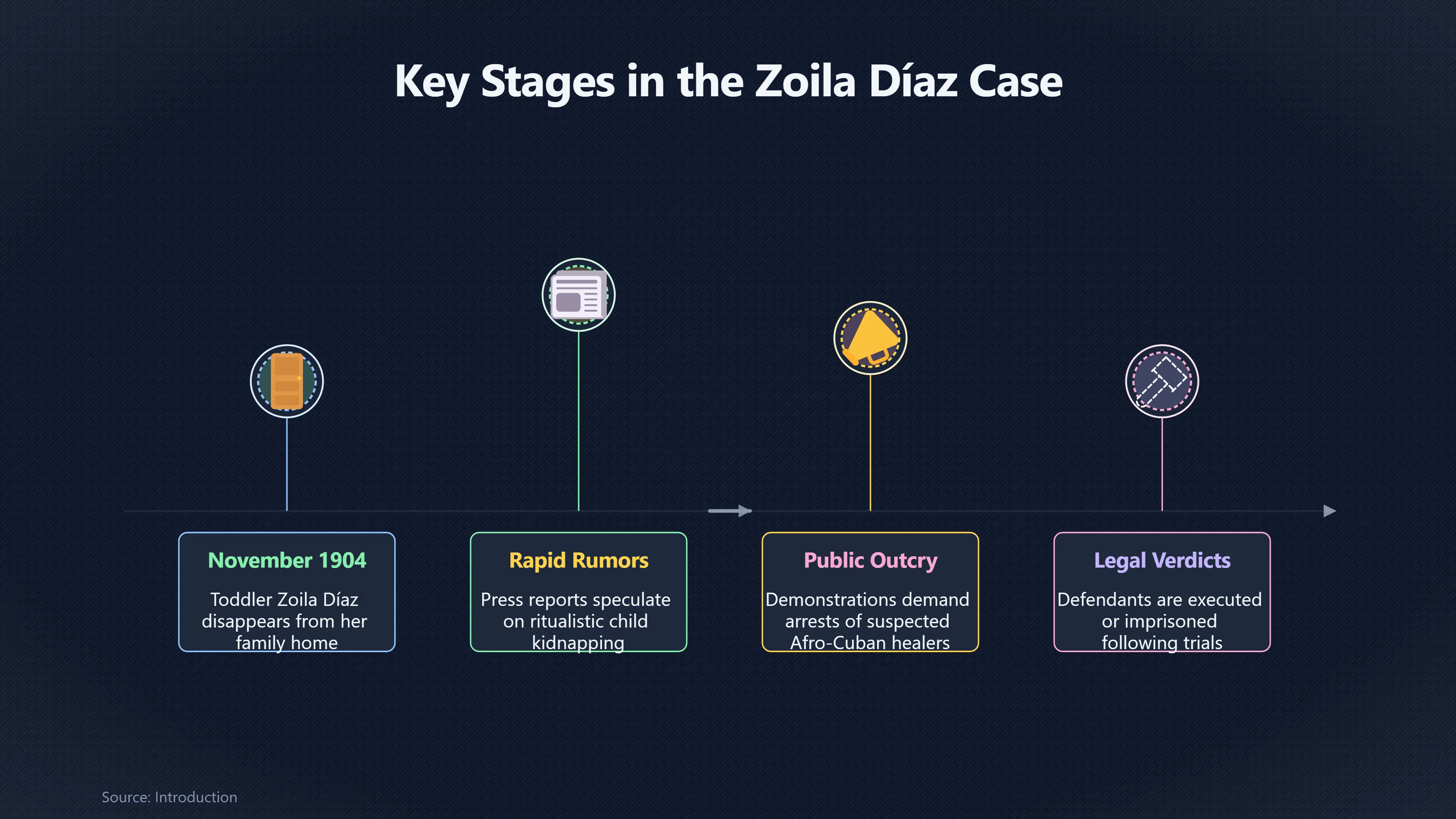
Zoila Díaz was a white child of around twenty months old who disappeared from her family’s home near Havana in November 1904. Her disappearance immediately attracted intense press attention. Early newspaper reports speculated about kidnapping, but within days rumours began circulating that she had been murdered by practitioners of Afro-Cuban religion who supposedly required children’s organs or blood for magical healing or protective rituals. At that stage investigators had uncovered no concrete evidence supporting these claims, yet the rumours rapidly gained public acceptance.[ResearchGate]researchgate.net332105501 Libertad religiosa brujeria y asesinato de ninos en CubaResearchGate(PDF) Libertad religiosa, brujería y asesinato de niños en Cuba, 1898-1933.June 1, 2017…
The investigation soon shifted from finding an unknown murderer towards identifying supposed “witches” or brujos. Public demonstrations demanded arrests, searches and harsh punishment. Afro-Cuban healers and members of Black mutual aid societies came under immediate suspicion because many Cubans already associated African-derived religious practices with superstition and criminality.[Periódicos CAPES]periodicos.capes.gov.brPeriódicos CAPES“En Plena Libertad y Democracia”: Negros Brujos and the Social Question, 1904-1919…
The eventual prosecution focused on several Afro-Cuban defendants. Domingo Bocourt and Víctor Molina were convicted and executed, while other defendants received prison sentences and several were acquitted. The mixed verdicts are important because they demonstrate that the courts did not simply convict everyone accused of practising Afro-Cuban religion. Nevertheless, historians argue that racial assumptions strongly influenced both the investigation and the interpretation of evidence.[researchgate.net]researchgate.net332105501 Libertad religiosa brujeria y asesinato de ninos en CubaResearchGate(PDF) Libertad religiosa, brujería y asesinato de niños en Cuba, 1898-1933.June 1, 2017…
Why Afro-Cuban religion became the target
The panic cannot be understood without considering Cuba’s racial politics after independence.
The new republic officially recognised freedom of religion, yet many educated elites continued to describe African-derived religious traditions as signs of backwardness inherited from slavery. Criminologists, physicians and anthropologists increasingly classified Afro-Cuban beliefs as social problems requiring surveillance rather than legitimate religious practices. These ideas blended easily with newspaper sensationalism.[Periódicos CAPES]periodicos.capes.gov.brPeriódicos CAPES“En Plena Libertad y Democracia”: Negros Brujos and the Social Question, 1904-1919…
Rather than distinguishing between different traditions such as Palo, Santería or other African-derived practices, journalists frequently collapsed them into the broad and hostile label of “witchcraft”. Religious objects became presented as criminal evidence, while ritual specialists were portrayed as dangerous conspirators instead of healers or community leaders.[DOI]doi.orgGoverning Witchcraft: Journalists and Brujos in Republican Cuba | Governing Spirits: Religion, Miracles, and Spectacles in Cuba and Pu…
This framing reflected wider fears about race in the early republic. Slavery had ended only a few decades earlier, and many white Cubans worried about social change, Black political participation and the visibility of African cultural traditions. The Zoila case appeared to confirm existing prejudices, allowing older colonial stereotypes to acquire new authority under the language of modern criminal investigation.[Periódicos CAPES]periodicos.capes.gov.brPeriódicos CAPES“En Plena Libertad y Democracia”: Negros Brujos and the Social Question, 1904-1919…

How newspapers and police turned one crime into a national scare
The press played a decisive role in transforming the murder into a broader witchcraft panic.
Instead of treating ritual murder as one possible line of inquiry, influential newspapers repeatedly presented rumours as increasingly plausible explanations. Reports mixed factual developments with speculation about hidden religious societies, creating a narrative in which ordinary readers could imagine an organised network of child killers operating throughout Cuba.[Periódicos CAPES]periodicos.capes.gov.brPeriódicos CAPES“En Plena Libertad y Democracia”: Negros Brujos and the Social Question, 1904-1919…
The reporting also encouraged readers to see unrelated events as connected. Once the image of the “negro brujo” as a ritual murderer entered public discussion, later disappearances or suspicious deaths were more easily interpreted through the same lens. Fear became self-reinforcing: each rumour appeared to validate previous rumours, even when evidence remained weak.[DOI]doi.orgGoverning Witchcraft: Journalists and Brujos in Republican Cuba | Governing Spirits: Religion, Miracles, and Spectacles in Cuba and Pu…
Police investigations often reflected these assumptions. Rather than relying solely on physical evidence, investigators gave weight to gossip, local suspicions and ideas about supposed ritual practices. Historians studying the legal record argue that investigative weaknesses were frequently masked by increasingly elaborate theories about occult motives.[ResearchGate]researchgate.net332105501 Libertad religiosa brujeria y asesinato de ninos en CubaResearchGate(PDF) Libertad religiosa, brujería y asesinato de niños en Cuba, 1898-1933.June 1, 2017…
Trials, acquittals and the limits of the evidence
The Zoila Díaz prosecution has remained controversial because the murder itself was real, but the wider claims made around it were far less securely established.
Modern scholarship does not suggest that every defendant was necessarily innocent of every offence. Instead, historians emphasise that the investigation expanded into sweeping claims about Afro-Cuban religion without demonstrating that ritual child murder represented a genuine feature of those religious traditions. The distinction matters because public discussion often treated an individual prosecution as proof that an entire religious community posed a threat.[DOI]doi.orgGoverning Witchcraft: Journalists and Brujos in Republican Cuba | Governing Spirits: Religion, Miracles, and Spectacles in Cuba and Pu…
Several defendants were acquitted despite the intense public atmosphere. That outcome illustrates that even contemporary courts did not uniformly accept every accusation. At the same time, the convictions of others became powerful symbols that newspapers and later writers repeatedly cited as confirmation of broader fears about Black religious practitioners.[Wikipedia]WikipediaPalo (religionPalo (religion
Lasting stereotypes and historical reassessment
The importance of the Zoila Díaz case lies less in the individual murder than in its long cultural afterlife.
The panic helped establish the image of the brujo as a hidden predator threatening white families. During the following years, accusations against Afro-Cuban practitioners continued to appear in newspapers, and episodes of mob violence, police raids and prosecutions were justified by reference to fears first amplified during the Zoila affair.[DOI]doi.orgGoverning Witchcraft: Journalists and Brujos in Republican Cuba | Governing Spirits: Religion, Miracles, and Spectacles in Cuba and Pu…
Scholars such as Stephan Palmié, Alejandra Bronfman and Reinaldo Román have argued that the episode should be understood as an intersection of race, journalism, policing and state-building rather than as evidence that Afro-Cuban religions encouraged ritual murder. Their work places the panic alongside other episodes in which minority religious groups became convenient symbols of wider social anxieties.[doi.org]doi.orgGoverning Witchcraft: Journalists and Brujos in Republican Cuba | Governing Spirits: Religion, Miracles, and Spectacles in Cuba and Pu…
Today, historians generally treat the Zoila Díaz case as one of the clearest examples of how a genuine crime became transformed into a racialised witchcraft scare. It demonstrates how fear can spread through repeated media narratives, official assumptions and existing prejudice until an entire religious community is viewed through the lens of a single, exceptional event rather than on the basis of its everyday beliefs and practices.[wikipedia.org]WikipediaPalo (religionPalo (religion
Amazon book picks
Further Reading
Books and field guides related to How One Murder Fuelled a Racial Witch Panic. Use these as the next step if you want deeper reading beyond the article.
Extraordinary Popular Delusions and the Madness of Crowds
Rating: 4.0/5 from 5 Google Books ratings
Frames moral panic and rumor dynamics.
The Serpent and the Rainbow
First published 1985. Subjects: Social life and customs, Description and travel, Zombiism, Bizango (Cult), Religious life and customs.
Cuba What Everyone Needs to Know Paper
First published 2012. Subjects: Cuba, history, Cuba, politics and government, Politics and government, History, Foreign relations.
Santería
First published 1988. Subjects: Religion, Santeria, Santeria (Culte), General, Ethnic & Tribal.
Endnotes
1.
Source: researchgate.net
Title: 332105501 Libertad religiosa brujeria y asesinato de ninos en Cuba 1898 1933
Link:https://www.researchgate.net/publication/332105501_Libertad_religiosa_brujeria_y_asesinato_de_ninos_en_Cuba
Source snippet
ResearchGate(PDF) Libertad religiosa, brujería y asesinato de niños en Cuba, 1898-1933.June 1, 2017...
Published: June 1, 2017
2.
Source: doi.org
Link:https://doi.org/10.5149/9780807888940_roman.7
Source snippet
Governing Witchcraft: Journalists and Brujos in Republican Cuba | Governing Spirits: Religion, Miracles, and Spectacles in Cuba and Pu...
3.
Source: Wikipedia
Title: Palo (religion)
Link:https://en.wikipedia.org/wiki/Palo_%28religion%29
4.
Source: researchgate.net
Link:https://www.researchgate.net/publication/328783312_Passages_and_Afterworlds_Anthropological_Perspectives_on_Death_in_the_Caribbean
5.
Source: researchgate.net
Link:https://www.researchgate.net/publication/31350095_En_Plena_Libertad_y_Democracia_Negros_Brujos_and_the_Social_Question
6.
Source: researchgate.net
Link:https://www.researchgate.net/publication/231909246_Black_Men_Racial_Stereotyping_and_Violence_in_the_US_South_and_Cuba_at_the_Turn_of_the_Century
7.
Source: researchgate.net
Link:https://www.researchgate.net/publication/250372683_El_retrato_de_los_negros_brujos_Los_archivos_visuales_de_la_antropologia_afrocubana
8.
Source: periodicos.capes.gov.br
Link:https://www.periodicos.capes.gov.br/index.php/acervo/buscador.html?id=W1964181437&source=all&task=detalhes
Source snippet
Periódicos CAPES“En Plena Libertad y Democracia”: Negros Brujos and the Social Question, 1904-1919...
Additional References
9.
Source: es.scribd.com
Title: Revista Cubana de Ciencias Sociales No 54
Link:https://es.scribd.com/document/554482810/Revista-Cubana-de-Ciencias-Sociales-No-54
Source snippet
54 | PDF | marxismo | SociologíaJanuary 1, 2021 — EL ESTIGMA HACIA LA «RAZA NEGRA» Y LA BRUJERÍA, REFORZADO TRAS LOS SUCESOS DE 1904, por...
Published: January 1, 2021
10.
Source: publicaciones.americana.edu.co
Title: americana.edu.co Crimes and delinquents
Link:https://publicaciones.americana.edu.co/index.php/pensamientoamericano/article/view/43
Source snippet
Cuba in the late nineteenth and early twentieth centuries | Pensamiento AmericanoJanuary 25, 2017 — CRIMES AND DELINQUENTS. CUBA IN THE L...
Published: January 25, 2017
11.
Source: afrocubaweb.com
Title: El cadáver de la niña fue hallado
Link:https://www.afrocubaweb.com/coneg/desdelaceiba26sep12.htm
Source snippet
Cofradía de la Negritud - CONEGSeptember 26, 2012 — Especial relevancia tuvo, en 1904, el caso de Zoila Díaz, una niña blanca de 22 meses...
Published: September 26, 2012
12.
Source: youtube.com
Link:https://www.youtube.com/watch?v=axXZ84LvzpU
Source snippet
Negros brujos Cuba MEMORIA HAB 130 NEGROS BRUJOS RamonFernandezLarreacanal...
13.
Source: youtube.com
Link:https://www.youtube.com/watch?v=dqvv4rRAA7I
Source snippet
Santería’s Journey in Cuba: From Forbidden to Celebrated...
14.
Source: books.openedition.org
Title: Esclavage, religions et politique en Haïti
Link:https://books.openedition.org/pul/49467?lang=en
Source snippet
La criminalisation du religieux en Haïti et dans la Caraïbe - Presses universitaires de Lyon...
15.
Source: youtube.com
Title: What is Lukumi? Exploring Afro-Cuban Spirituality
Link:https://www.youtube.com/watch?v=HqLJP4O15s4
Source snippet
The Origins of Palo Mayombe | The Mpungo, Ancestral Power & Secrets of the Spirits...
16.
Source: youtube.com
Title: Cuban Santeria: The Way of the Saints
Link:https://www.youtube.com/watch?v=JAEv4XLU16s
Source snippet
The Orishas: Yoruba Deities and Their Global Power in Cuba, Brazil, Haiti, the U.S, and Beyond...
17.
Source: youtube.com
Title: Santería’s Journey in Cuba: From Forbidden to Celebrated
Link:https://www.youtube.com/watch?v=irIMU4tTZro
Source snippet
What is Lukumi? Exploring Afro-Cuban Spirituality...
18.
Source: afrocubanet.com
Link:https://www.afrocubanet.com/?page_id=1188
Topic Tree