Within Angola Belief and Fear
What Happened at Mount Sumi in 2015?
The Mount Sumi confrontation became a disputed national tragedy in which religious suspicion, police force and conflicting death accounts collided.
On this page
- Kalupeteka's followers and the road to confrontation
- Police action and disputed accounts of the deaths
- Why Mount Sumi remains politically and religiously contested
Page outline Jump by section
Introduction
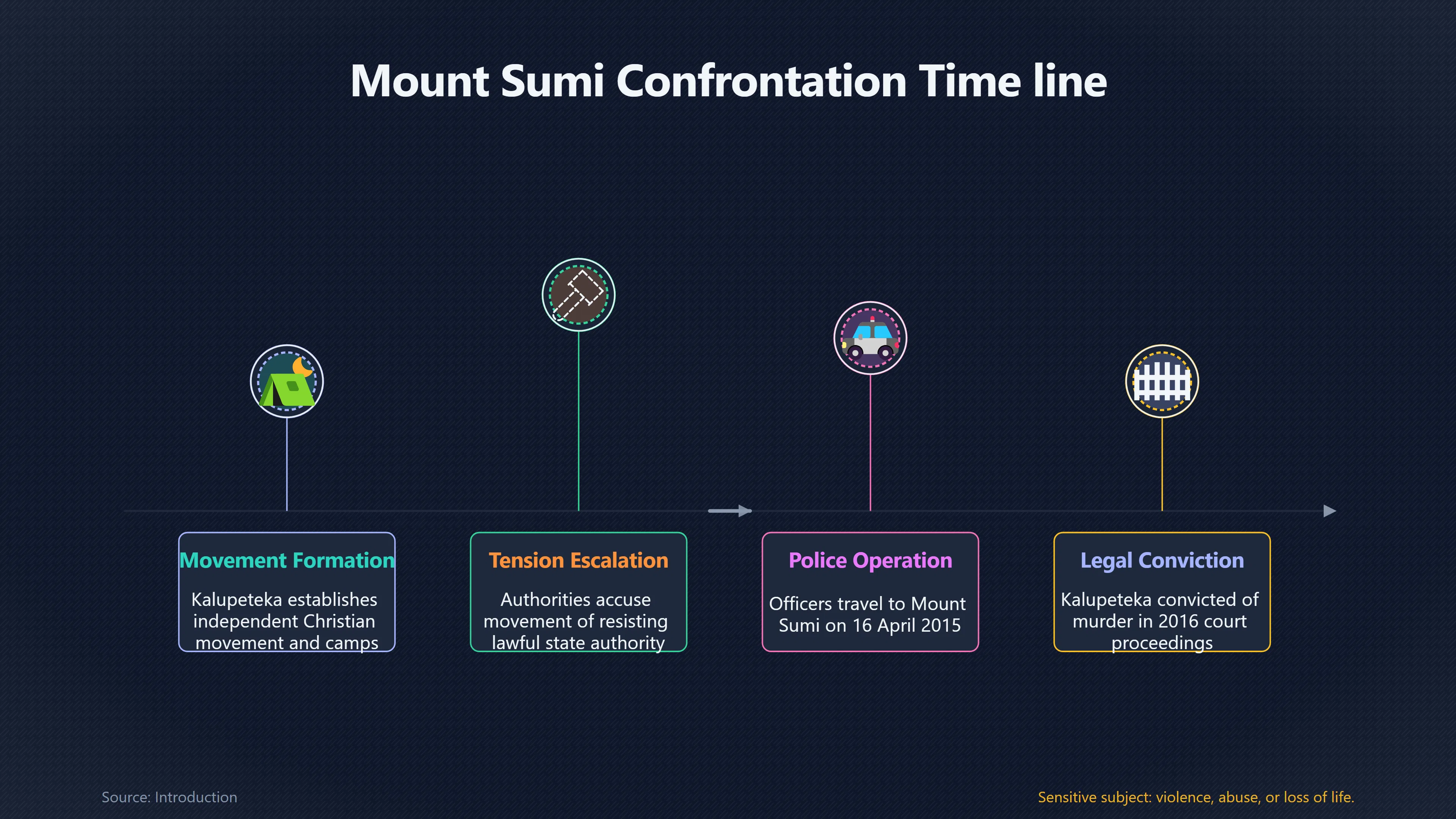
The confrontation at Mount Sumi in Angola’s Huambo Province on 16 April 2015 remains one of the country’s most disputed modern tragedies. What began as a police operation to arrest the leader of an isolated religious movement ended with the confirmed deaths of police officers, the deaths of followers, and years of argument over how many civilians were actually killed. The event is significant not only because of the violence itself but because it sits at the intersection of religious dissent, state security, and contested truth. Competing narratives have persisted ever since: the Angolan government maintains that officers acted in response to an armed attack, while opposition politicians, survivors and human rights organisations have questioned the official account and called for an independent investigation into allegations of a much larger massacre.[Human Rights Watch]hrw.orgHuman Rights WatchDispatches: Was There a Massacre in Huambo, Angola? | Human Rights WatchJanuary 19, 2016…
Kalupeteka’s followers and the road to confrontation
The group at the centre of the crisis was A Luz do Mundo (“The Light of the World”), an independent Christian movement led by Jos Julino Kalupeteka, a former member of the Seventh-day Adventist Church. Kalupeteka preached that the end of the world was imminent and urged followers to separate themselves from wider society. Many believers gathered in camps around Mount Sumi, where they were encouraged to reject state institutions including elections, censuses, some vaccination programmes and aspects of formal education. These positions increasingly alarmed provincial authorities, who regarded the movement as both socially disruptive and politically defiant.[Human Rights Watch]hrw.orgHuman Rights WatchDispatches: Was There a Massacre in Huambo, Angola? | Human Rights WatchJanuary 19, 2016…
Public discussion often described A Luz do Mundo as a “cult”, particularly in official statements and media reports. That label reflected the movement’s isolation, strict leadership and apocalyptic teaching, but it is also contested. Religious scholars and human rights observers caution that using the term too casually can obscure the distinction between unconventional religious beliefs and criminal conduct. The central issue in the Mount Sumi case is therefore not simply whether the movement held unusual beliefs, but how those beliefs shaped confrontation with the state and how the authorities chose to respond.[CMI - Chr. Michelsen Institute]cmi.noChr. Michelsen Institute Angola: Religion and repressionChr. Michelsen InstituteAngola: Religion and repression…
By early 2015 relations had deteriorated sharply. Officials accused Kalupeteka of encouraging followers to resist lawful authority, while members believed they were being persecuted for their faith. Previous attempts to regulate the movement had failed, creating an atmosphere in which both sides increasingly expected confrontation rather than negotiation.[CMI - Chr. Michelsen Institute]cmi.noChr. Michelsen Institute Angola: Religion and repressionChr. Michelsen InstituteAngola: Religion and repression…
Police action and the disputed accounts of the deaths
On 16 April 2015 police travelled to Mount Sumi intending to detain Kalupeteka. There is broad agreement on only a few basic facts. Nine police officers died during the initial confrontation, making it one of the deadliest incidents for Angola’s police since the civil war. After that, however, the narratives diverge dramatically.[Human Rights Watch]hrw.orgHuman Rights WatchDispatches: Was There a Massacre in Huambo, Angola? | Human Rights WatchJanuary 19, 2016…
The government’s account states that Kalupeteka’s armed guards attacked officers with firearms and machetes. According to official figures, police then returned fire, killing thirteen members of the movement who had participated in the attack. Authorities rejected allegations of a wider massacre and presented the operation as a legitimate response to deadly resistance.[Human Rights Watch]hrw.orgHuman Rights WatchDispatches: Was There a Massacre in Huambo, Angola? | Human Rights WatchJanuary 19, 2016…
Opposition parties, local activists and surviving relatives offered a profoundly different version. They argued that after the initial clash, security forces launched a far broader assault on followers gathered at the camp, many of whom they said were unarmed civilians, including women and children. Estimates of civilian deaths ranged from dozens to several hundred, while Angola’s main opposition party, UNITA, alleged that more than one thousand people had been killed. These higher estimates have never been independently verified, but neither have they been conclusively disproved because investigators lacked unrestricted access to the site.[Human Rights Watch]hrw.orgHuman Rights WatchDispatches: Was There a Massacre in Huambo, Angola? | Human Rights WatchJanuary 19, 2016…
The enormous gap between the official death toll and opposition claims is one reason the incident remains so controversial. Rather than representing a normal disagreement over casualty figures, it reflects a broader struggle over trust in state institutions, access to evidence and political legitimacy.
Why the casualty dispute has never been resolved
Several factors prevented a definitive reconstruction of events.
First, the authorities quickly secured the area around Mount Sumi, limiting access for journalists, opposition representatives and independent investigators. Human rights organisations argued that this made it impossible to establish an authoritative casualty count or examine allegations of mass graves.[Human Rights Watch]hrw.orgHuman Rights WatchDispatches: Was There a Massacre in Huambo, Angola? | Human Rights WatchJanuary 19, 2016…
Second, the available witnesses were deeply polarised. Government officials described an armed confrontation with dangerous extremists, while survivors and relatives described indiscriminate killings after the police operation had already succeeded in capturing Kalupeteka. Each side questioned the credibility of the other’s evidence.[Human Rights Watch]hrw.orgHuman Rights WatchDispatches: Was There a Massacre in Huambo, Angola? | Human Rights WatchJanuary 19, 2016…
Third, no fully independent public inquiry with broad investigative powers was conducted. Human Rights Watch and the Office of the United Nations High Commissioner for Human Rights called for transparent investigation and publication of official findings, arguing that justice required answers both for the families of the dead police officers and for the relatives of followers whose fate remained uncertain.[Human Rights Watch]hrw.orgHuman Rights WatchDispatches: Was There a Massacre in Huambo, Angola? | Human Rights WatchJanuary 19, 2016…
Because of these unresolved questions, historians and human rights researchers generally distinguish between confirmed deaths, official claims, and unverified allegations rather than presenting a single casualty figure as established fact.
The trial and its continuing controversy
Kalupeteka and several followers were prosecuted for the deaths of the police officers. He denied ordering violence and argued that both he and his movement were victims of political persecution. In 2016 he was convicted of murder and other offences and initially sentenced to 28 years’ imprisonment, although Angola’s Supreme Court later reduced the sentence while upholding the conviction.[Human Rights Watch]hrw.orgHuman Rights WatchDispatches: Was There a Massacre in Huambo, Angola? | Human Rights WatchJanuary 19, 2016…
The legal proceedings did little to settle public debate. The trial concentrated primarily on responsibility for the deaths of the officers rather than providing a comprehensive public accounting of all those killed during the operation. Human rights groups argued that accountability required investigation of police conduct as well as prosecution of those responsible for killing officers.[Human Rights Watch]hrw.orgHuman Rights WatchDispatches: Was There a Massacre in Huambo, Angola? | Human Rights WatchJanuary 19, 2016…
Why Mount Sumi remains politically and religiously contested
Mount Sumi has become a symbol of wider tensions in Angola over religious freedom, state authority and the treatment of minority religious movements.
For the government, the episode demonstrated the dangers posed by a movement that rejected public authority and allegedly used violence against police. From this perspective, firm intervention was necessary to restore public order.[CMI - Chr. Michelsen Institute]cmi.noChr. Michelsen Institute Angola: Religion and repressionChr. Michelsen InstituteAngola: Religion and repression…
Critics see a different lesson. They argue that the authorities framed an isolated religious community primarily as a security threat, used excessive force, and then failed to provide sufficient transparency about what followed. Whether or not the highest casualty estimates are accurate, the refusal to permit a fully independent investigation has allowed suspicion to persist and has made the event a lasting symbol of official secrecy.[Human Rights Watch]hrw.orgHuman Rights WatchDispatches: Was There a Massacre in Huambo, Angola? | Human Rights WatchJanuary 19, 2016…
Within Angola’s broader history of contested belief, Mount Sumi therefore differs from episodes such as child witchcraft accusations. It was not a case of mass psychogenic illness or a moral panic in the classic sense. Instead, it illustrates how apocalyptic religious belief, political distrust and coercive state responses can reinforce one another, producing violence whose full human cost remains disputed years later.

Amazon book picks
Further Reading
Books and field guides related to What Happened at Mount Sumi in 2015?. Use these as the next step if you want deeper reading beyond the article.

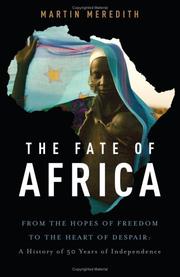
The fortunes of Africa
Explains Angola's postwar conditions that shaped these accusations.
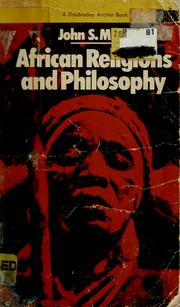
African religions and philosophy
Helps explain religious movements outside mainstream churches.
Endnotes
1.
Source: cmi.no
Title: Chr. Michelsen Institute Angola: Religion and repression
Link:https://www.cmi.no/publications/8283-angola-religion-and-repression
Source snippet
Chr. Michelsen InstituteAngola: Religion and repression...
2.
Source: news.trust.org
Title: 20161129131605 58jdc
Link:https://news.trust.org/item/20161129131605-58jdc
Source snippet
rejects Amnesty's accusation of extra-judicial killingsNovember 29, 2016 UGANDA REJECTS AMNESTY'S ACCUSATION OF EXTRA-JUDICIAL KILLINGS...
Published: November 29, 2016
3.
Source: news.trust.org
Title: 20161128101204 jvuc3
Link:https://news.trust.org/item/20161128101204-jvuc3
Source snippet
warns over extrajudicial killings after Uganda clashesNovember 28, 2016 AMNESTY WARNS OVER EXTRAJUDICIAL KILLINGS AFTER DEADLY UGANDA C...
Published: November 28, 2016
4.
Source: independent.ie
Title: Angola demands apology from UN over Christian sect killings | Irish Independent
Link:https://www.independent.ie/world-news/africa/angola-demands-apology-from-un-over-christian-sect-killings/31228151.html
5.
Source: hrw.org
Link:https://www.hrw.org/news/2016/01/19/dispatches-was-there-massacre-huambo-angola
Source snippet
Human Rights WatchDispatches: Was There a Massacre in Huambo, Angola? | Human Rights WatchJanuary 19, 2016...
Published: January 19, 2016
6.
Source: hrw.org
Title: India: Investigate Police Killing of 8 Escapees | Human Rights Watch
Link:https://www.hrw.org/news/2016/11/04/india-investigate-police-killing-8-escapees
7.
Source: hrw.org
Link:https://www.hrw.org/news/2015/11/16/dispatches-start-ending-indonesian-military-injustice-papua
8.
Source: hrw.org
Title: Nepal: Investigate Deaths During Terai Protests | Human Rights Watch
Link:https://www.hrw.org/news/2015/10/16/nepal-investigate-deaths-during-terai-protests
9.
Source: hrw.org
Title: Peru: Police Open Fire on Protesters | Human Rights Watch
Link:https://www.hrw.org/news/2015/10/06/peru-police-open-fire-protesters
10.
Source: hrw.org
Title: 2014 lamu and tana river attacks and kenyas abusive response
Link:https://www.hrw.org/report/2015/06/15/insult-injury/2014-lamu-and-tana-river-attacks-and-kenyas-abusive-response
Additional References
11.
Source: ecoi.net
Link:https://www.ecoi.net/en/document/2021293.html
12.
Source: radioangola.org
Title: Cidados classificam como massacre mortes no monte Sumi
Link:https://radioangola.org/cidadaos-classificam-como-massacre-mortes-no-monte-sumi/
Source snippet
Radio AngolaMarch 15, 2017 CIDADOS CLASSIFICAM COMO MASSACRE MORTES NO MONTE SUMI March 15, 2017March 15, 2017 Radio Angola 9720 Views...
Published: March 15, 2017
13.
Source: radioangola.org
Title: POPUL AO SAQUEIA RIQUEZA DE KALUPETEKA
Link:https://radioangola.org/populacao-saqueia-riqueza-de-kalupeteka/
Source snippet
POPULAO SAQUEIA RIQUEZA DE KALUPETEKA - Radio AngolaDecember 16, 2018 POPULAO SAQUEIA RIQUEZA DE KALUPETEKA December 16, 2018 a...
Published: December 16, 2018
14.
Source: theguardian.com
Link:https://www.theguardian.com/global-development/2015/may/01/angolan-sect-police-shootings-world-press-freedom-day
15.
Source: m.redeangola.info
Link:https://m.redeangola.info/sic-conclui-processo-do-caso-kalupeteka-mas-defesa-desconhece-a-argumentacao/
16.
Source: youtube.com
Title: Mount Sumi (Interlude)
Link:https://www.youtube.com/watch?v=krMp7gGZpw0
Source snippet
Julino Tito Kamoli fala do julgamento do pai Jos Kalupeteca...
17.
Source: youtube.com
Title: Kalupeteka esta vivo
Link:https://www.youtube.com/watch?v=0IcYmmIsnIg
Source snippet
Declarada improcedente queixa de David Mendes contra Repblica de Angola...
18.
Source: amnesty.org.uk
Title: Egyptian authorities accused of ‘covering up’ 23-26 January protester deaths
Link:https://www.amnesty.org.uk/knowledge-hub/all-resources/egyptian-authorities-accused-covering-23-26-january-protester-deaths-new-evidence/
19.
Source: youtube.com
Title: Declarada improcedente queixa de David Mendes contra Repblica de Angola
Link:https://www.youtube.com/watch?v=cQoipjzp7Io
Source snippet
You stopped this response...
20.
Source: yahoo.com
Title: Christian sect killings in Angola shrouded in fear and mystery
Link:https://www.yahoo.com/news/christian-sect-killings-angola-shrouded-fear-mystery-114321449.html
Topic Tree