When Fear and Belief Reshaped Madagascar
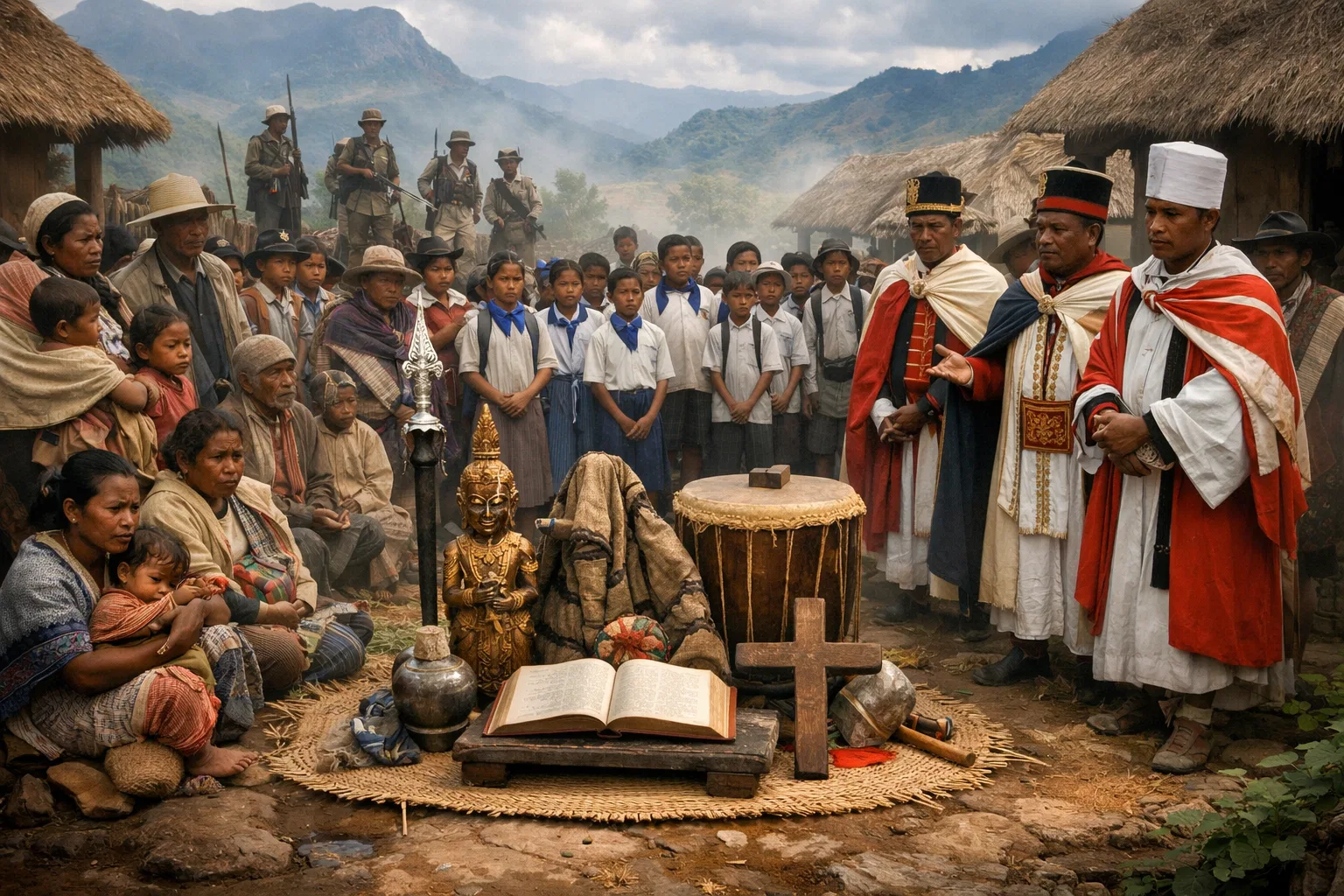
Madagascar’s history of collective fear is not dominated by one neat “mass hysteria” episode.
Page outline Jump by section
Introduction
The evidence is uneven. Colonial missionaries, officials and later historians often described unfamiliar Malagasy beliefs as superstition or fanaticism, while modern news reports tend to focus on the most violent moments. A careful account therefore asks not only what people believed, but who recorded it, who benefited from the accusation and what real pressures made the belief persuasive.
The poison ordeal that became a witch-hunt
The most lethal documented episode was the expansion of witchcraft prosecution in the central highland kingdom during the reign of Queen Ranavalona I, from 1828 to 1861. Suspected witches, thieves, Christians and political enemies could be subjected to a poison ordeal made from a highly toxic local plant. The accused swallowed the preparation after eating pieces of chicken skin. Survival and the successful vomiting of the skin signified innocence; death or failure to expel it indicated guilt. The plant contains compounds that disrupt the heartbeat, so the ritual was not a symbolic test but an unpredictable and frequently fatal poisoning.[Friedrich Ebert Stiftung Library]library.fes.deFriedrich Ebert Stiftung Library
It would be misleading to treat this simply as a popular panic imposed on an unwilling government. The ordeal formed part of royal justice and was used to identify people believed to threaten the moral and political order. Historian Stephen Ellis argues that accusations of mystical wrongdoing were bound up with the centralising state’s effort to control sacred objects, rival sources of authority and supposedly antisocial behaviour. At times, officials ordered tests across whole communities, turning suspicion into a method of administration.[Friedrich Ebert Stiftung Library]library.fes.deFriedrich Ebert Stiftung LibraryFriedrich Ebert Stiftung Library
The system also gave accusers material incentives. Property belonging to a condemned person could be divided between the government and the informant, while earlier safeguards against unsuccessful accusations weakened. Travellers and Malagasy observers consequently noted that personal grudges, enrichment and official ambition could hide behind charges of witchcraft. This is one reason “witch-hunt” is more accurate than “mass hysteria”: the persecution was organised, legally sanctioned and useful to powerful people, even though widespread belief in the ordeal’s supernatural justice helped sustain it.[Friedrich Ebert Stiftung Library]library.fes.deFriedrich Ebert Stiftung Library
Estimates of the death toll vary sharply and some spectacular nineteenth-century figures are difficult to verify. What is secure is that the ordeal was used on a very large scale, caused many deaths and touched families throughout the highlands. Later accounts sometimes present Ranavalona as an isolated, irrational tyrant, but Ellis places the persecutions within a broader struggle over monarchy, Christianity, trade, military power and foreign influence. Ranavalona restricted Christian conversion while adopting selected European technologies, and persecution intensified as religious allegiance became inseparable from political loyalty.[Friedrich Ebert Stiftung Library]library.fes.deFriedrich Ebert Stiftung Library
The ordeal was formally abolished in the 1860s, and people who had died under it were permitted to be reburied with honour. Yet abolition did not instantly erase the underlying logic of accusation. Poison ordeals reportedly continued secretly in some areas, while fears of harmful hidden power remained part of disputes far beyond the royal court. The important reform was therefore both legal and moral: a verdict once presented as sacred truth was reclassified as an injustice committed against the accused.[Wikipedia]WikipediaOpen source on wikipedia.org.

When possession spread through schools
One of Madagascar’s strongest candidates for comparison with mass psychogenic illness comes from Ambanja in the north-west. Anthropologist Lesley Sharp documented episodes in which adolescent schoolgirls were said to be possessed by volatile spirits. The behaviour was not merely an individual trance: outbreaks could involve groups of pupils, making possession a familiar enough feature of school life that administrators developed ways of responding to it.[springer.com]link.springer.comIn the town of Ambanja, possession by volatile and dangerous Njarini…
Sharp distinguished these troubling school spirits from the more established possession traditions through which ancestral or royal spirits spoke through predominantly female mediums. The school phenomenon appeared comparatively recent and affected a distinctive group: young women negotiating education, migration, sexuality, pregnancy, family expectations and an institution governed by adult authority. In some cases the outbreaks made visible problems that girls had little power to express directly.[cdlib.org]publishing.cdlib.orgOpen source on cdlib.org.
From a psychiatric viewpoint, rapid clusters of fainting, shaking, altered behaviour or trance in a close group may resemble mass psychogenic illness: real physical and emotional symptoms that spread without a single infectious or toxic cause. That description can be useful, but it is incomplete unless it accounts for why symptoms took the form of spirit possession and why they appeared in that particular social setting. Research on school outbreaks elsewhere shows that stress, strict discipline, uncertainty and observation of other affected pupils can all contribute, but the cultural meaning of an episode shapes how it is experienced and communicated.[PMC]pmc.ncbi.nlm.nih.govOpen source on nih.gov.
Calling the pupils hysterical would therefore obscure more than it explains. There is no reason to assume that they were pretending, nor does a psychological interpretation prove that local religious explanations were insincere. The possession idiom offered a recognised language for distress, conflict and identity. It could also transfer authority temporarily from teachers and families to the affected girl, whose words and behaviour now demanded attention.
The response mattered. Treating every case as demonic could intensify fear or delay medical assessment; dismissing it as nonsense could deepen mistrust and ignore the pupils’ social circumstances. The most responsible approach is to exclude physical causes, reduce alarm, protect affected children and investigate pressures inside and outside school. Madagascar’s cases are valuable precisely because they show that collective symptoms are never culturally blank.
Religion, conquest and expectations of transformation
The upheavals surrounding French conquest in 1895 produced movements that colonial authorities and missionaries often described in the language of fanaticism, superstition or brigandage. The Menalamba revolt of 1895–97 was a decentralised uprising against French rule, the existing state apparatus, compulsory labour, Christian institutions and local elites associated with exploitation. Religious ideas were part of the rebellion, but it was not simply a millenarian cult or an outbreak of irrational violence.[researchgate.net]researchgate.netOpen source on researchgate.net.
Historian Gwyn Campbell interprets the rebellion partly as a response to a wider crisis of confidence in the social and cosmic order. Years of famine, disease, economic strain and political disruption had weakened faith in institutions that claimed to guarantee collective security. French conquest then preserved or intensified some burdens while overturning the monarchy. In such circumstances, attacks on churches and officials could express religious restoration, class resentment, anti-colonial resistance and opposition to forced labour at the same time.[Persée]persee.frcea 0008 0055 1992 numcea 0008 0055 1992 num
This complexity matters because colonial accounts often reduced rebels to savage traditionalists manipulated by sorcery. Some fighters reportedly trusted protective objects or claims of magical invulnerability, beliefs found in several African resistance movements. Such confidence may have influenced conduct in battle, but it does not explain why the revolt began or why it attracted support. Political grievances remain visible beneath the religious language.[Brill]brill.comarticle p3 2article p3 2
The uprising also became a struggle over narrative. French authorities presented repression as the restoration of order, while later nationalist histories could portray an exceptionally varied revolt as a unified liberation movement. Historians now stress its local centres, mixed motives and lack of a single command. It belongs in a history of contagious belief because rumours, prophecies, sacred protection and hopes of sudden reversal helped people interpret a collapsing world—but it belongs equally to the histories of labour, colonial violence and rural rebellion.
A different response to the same era was the indigenous Protestant revival commonly known as the Awakening movement, which began in the 1890s. It developed traditions of preaching, communal healing, practical service and exorcism, eventually becoming deeply embedded in Malagasy Protestant life. Scholars describe it as an indigenous Christian revival rather than a marginal “cult”, and its healing communities have sometimes provided care where formal mental-health services are scarce.[euppublishing.com]euppublishing.comOpen source on euppublishing.com.
Its history demonstrates why the word “cult” requires caution. Exorcism and claims of spiritual healing may invite criticism, especially where vulnerable people need medical treatment, but unusual ritual practice alone does not establish coercion, isolation or systematic abuse. The movement has also offered community, work, dignity and long-term support to people excluded elsewhere. Any assessment should examine what happens in specific institutions rather than applying a hostile label to an entire religious tradition.
Rumours that turned into mob violence
Madagascar’s most stark modern rumour panic occurred on the tourist island of Nosy Be in October 2013. After the body of an eight-year-old boy was found, residents accused two European men and a Malagasy man of child murder and organ trafficking. A crowd beat and burned the three men to death. Police reporting at the time described the organ-trafficking allegation as a suspicion circulating among residents, not as an established finding. Later coverage referred to the victims as having been wrongly accused.[reuters.com]reuters.comMadagascar crowd burn two Europeans to death overMadagascar crowd burn two Europeans to death over
This was not a case in which fear emerged from nothing. A child had died, and Madagascar has genuine problems involving child exploitation, insecurity and weak trust in law enforcement. Rumours become powerful when they attach themselves to such real vulnerabilities. The false leap was from an unresolved death to certainty that particular outsiders belonged to a hidden organ-trafficking network—and from that certainty to immediate collective punishment.
The violence followed a recognisable pattern. A disturbing discovery created an information vacuum; an emotionally compelling explanation circulated faster than verified evidence; supposed confession or hearsay was treated as proof; and the gathering crowd produced pressure to act. Once the accused had been cast as secret predators, ordinary legal restraints could be interpreted as protection for evil rather than safeguards against error.
Subsequent arrests and trials showed the state attempting to reassert legal authority, but punishment after the event could not address the conditions that made the rumour credible. These included distrust of police, fear for children, inequality between local residents and foreigners, and a broader climate of stories about hidden trafficking and ritual crime. Anthropological work notes that rumours concerning stolen organs, abducted children and disturbed ancestral remains have circulated in Madagascar for years and can connect everyday insecurity with suspicions of concealed elite power.[MPG.PuRe]pure.mpg.dePu Re Hidden schemes and suspicious constructions. InversivePu Re Hidden schemes and suspicious constructions. Inversive
A related but importantly different crisis unfolded in Ikongo in August 2022. A crowd attempted to seize four detainees suspected of abducting a child with albinism and murdering the child’s mother. Police opened fire, killing 19 people according to the police account reported by Reuters. Here the underlying threat was not merely imaginary: UNICEF had already warned of reported abductions, attacks and murders targeting children with albinism in Madagascar.[reuters.com]reuters.comMadagascar police shooting leaves 19 dead, police sayMadagascar police shooting leaves 19 dead, police say
The Ikongo episode should not be reduced to “mass hysteria”. There was a credible pattern of grave violence against people with albinism, suspects were in custody and public anger had an identifiable cause. The panic-like element lay in the crowd’s demand for immediate vengeance and its refusal to allow investigation and trial to determine responsibility. The result was a second disaster layered on top of the original crime: people seeking justice were killed by security forces, while the suspects’ guilt had not yet been tested in court.
Together, Nosy Be and Ikongo show the difference between a baseless scare and a fear that grows around a real danger. Both can produce lynch-mob dynamics when institutional trust collapses. Effective prevention therefore requires more than debunking rumours. It also requires credible investigations, rapid public communication, protection for vulnerable children, accountable policing and courts that communities believe will act.
What these episodes reveal
Madagascar’s record does not support a simple story in which old supernatural beliefs gradually gave way to modern reason. Witchcraft accusations, Christian exorcism, ancestral possession, trafficking rumours and political conspiracy stories have existed alongside courts, schools, hospitals, newspapers and state administration. Modern institutions can weaken panics, but they can also create the secrecy, inequality or mistrust in which panics thrive.
Several distinctions help make sense of the evidence:
- Persecution is not the same as psychogenic illness. The poison ordeal punished accused people through state power; school-possession outbreaks involved distress spreading among the affected themselves.
- Religious practice is not automatically a cult. Ancestral possession and Christian revivalism are established social traditions with internal diversity, not proof of coercive control.
- A rumour may attach itself to a real crime without becoming true. Genuine child abduction or exploitation does not validate every allegation of organ theft or ritual murder.
- Collective belief can be politically useful. Royal officials, colonial authorities, rebels, religious leaders and modern crowds have all used claims about hidden forces to define enemies or justify action.
- Symptoms and beliefs have local meaning. A trance in a school, a protective charm in a rebellion and an accusation on social media cannot be understood through one universal theory of “hysteria”.
The enduring importance of these cases lies in the relationship between uncertainty and authority. The poison ordeal claimed to make invisible guilt visible. Possession allowed otherwise marginalised girls to communicate distress in a recognised form. Rebellious religious ideas promised order during conquest. Organ-trafficking rumours supplied an immediate culprit when institutions could not provide trusted answers.
Madagascar’s history therefore offers a warning against two opposite mistakes. One is to accept frightening collective claims without evidence. The other is to dismiss the people who believe them as primitive, gullible or mad. The better question is what combination of danger, memory, inequality, religious language and institutional failure made a particular explanation feel true—and what happened when that explanation acquired the power to punish.

Amazon book picks
Further Reading
Books and field guides related to When Fear and Belief Reshaped Madagascar. Use these as the next step if you want deeper reading beyond the article.

The anthropology of religion, magic, and witchcraft
Provides comparative context for Malagasy belief systems.
Endnotes
1.
Source: library.fes.de
Title: Friedrich Ebert Stiftung Library
Link:https://library.fes.de/libalt/journals/swetsfulltext/15991032.pdf
2.
Source: Wikipedia
Link:https://en.wikipedia.org/wiki/Tangena
3.
Source: link.springer.com
Link:https://link.springer.com/article/10.1007/BF00117560
Source snippet
In the town of Ambanja, possession by volatile and dangerous Njarini...
4.
Source: dokumen.pub
Link:https://dokumen.pub/the-possessed-and-the-dispossessed-spirits-identity-and-power-in-a-madagascar-migrant-town-reprint-2020nbsped-9780520918450.html
5.
Source: pmc.ncbi.nlm.nih.gov
Link:https://pmc.ncbi.nlm.nih.gov/articles/PMC7396040/
6.
Source: researchgate.net
Link:https://www.researchgate.net/publication/271821666_Missionaries_Fanompoana_and_the_Menalamba_Revolt_in_late_nineteenth_century_Madagascar
7.
Source: africabib.org
Link:https://www.africabib.org/rec.php?RID=091716527
8.
Source: brill.com
Title: article p3 2
Link:https://brill.com/view/journals/afoc/12/1-3/article-p3_2.pdf?srsltid=AfmBOor036e7HIaeHUrpSvPsjcl6pz7l675JaNAYYHy1CRtunJVZG_76
9.
Source: researchgate.net
Link:https://www.researchgate.net/publication/270404116_The_Menalamba_Revolt_and_Brigandry_in_Imperial_Madagascar
10.
Source: cambriapress.com
Link:https://www.cambriapress.com/pub.cfm?bid=282
11.
Source: reuters.com
Title: Madagascar crowd burn two Europeans to death over
Link:https://www.reuters.com/article/world/madagascar-crowd-burn-two-europeans-to-death-over-organ-trafficking-idUSBRE9920X8/
12.
Source: pure.mpg.de
Title: Pu Re Hidden schemes and suspicious constructions. Inversive
Link:https://pure.mpg.de/rest/items/item_3595637_2/component/file_3608050/content?download=true
13.
Source: reuters.com
Title: Madagascar police shooting leaves 19 dead, police say
Link:https://www.reuters.com/world/africa/madagascar-police-shooting-leaves-19-dead-police-say-2022-08-30/
14.
Source: unicef.org
Link:https://www.unicef.org/madagascar/en/press-releases/madagascar-unicef-condemns-crimes-committed-against-people-albinism-and-committed
15.
Source: researchgate.net
Title: 240524129 Witchcraft or Madness The Amandiki of Zululand 1894 1914
Link:https://www.researchgate.net/publication/240524129_Witchcraft_or_Madness_The_Amandiki_of_Zululand
16.
Source: researchgate.net
Link:https://www.researchgate.net/publication/271759288_Mass_hysteria_among_South_African_primary_school_learners_in_Kwa-Dukuza_KwaZulu-Natal
17.
Source: researchgate.net
Title: 406400184 The Ancestral Possession The Tromba Cult on the Island of Saint Marie
Link:https://www.researchgate.net/publication/406400184_The_Ancestral_Possession_The_Tromba_Cult_on_the_Island_of_Saint-Marie
18.
Source: researchgate.net
Title: 240580863 WitchHunting in Central Madagascar 1828 1861
Link:https://www.researchgate.net/publication/240580863_WitchHunting_in_Central_Madagascar
19.
Source: researchgate.net
Link:https://www.researchgate.net/publication/6760030_Knowledge_attitudes_and_public_health_response_towards_plague_in_Petauke_Zambia
20.
Source: researchgate.net
Link:https://www.researchgate.net/publication/389888863_2006_Magical_Practices_Witchcraft_and_Warfare_in_the_African_Continent_XIX-XX_century
21.
Source: researchgate.net
Title: 274499718 Christian Revivalism and Political Imagination in Madagascar
Link:https://www.researchgate.net/publication/274499718_Christian_Revivalism_and_Political_Imagination_in_Madagascar
22.
Source: researchgate.net
Title: 229657292 Inner iconoclasm Forms of reflexivity in Loma rituals of sacrifice
Link:https://www.researchgate.net/publication/229657292_Inner_iconoclasm_Forms_of_reflexivity_in_Loma_rituals_of_sacrifice
23.
Source: researchgate.net
Link:https://www.researchgate.net/publication/347502023_Indigenous_Christianity_in_Madagascar
24.
Source: Wikipedia
Title: Millenarianism in colonial societies
Link:https://en.wikipedia.org/wiki/Millenarianism_in_colonial_societies
25.
Source: Wikipedia
Title: Mass psychogenic illness
Link:https://en.wikipedia.org/wiki/Mass_psychogenic_illness
26.
Source: Wikipedia
Title: List of mass panic cases
Link:https://en.wikipedia.org/wiki/List_of_mass_panic_cases
27.
Source: Wikipedia
Title: Menalamba rebellion
Link:https://en.wikipedia.org/wiki/Menalamba_rebellion
28.
Source: Wikipedia
Title: Trial by ordeal
Link:https://en.wikipedia.org/wiki/Trial_by_ordeal
29.
Source: Wikipedia
Title: Malagasy Uprising
Link:https://en.wikipedia.org/wiki/Malagasy_Uprising
30.
Source: brill.com
Link:https://brill.com/downloadpdf/display/title/7605.pdf?srsltid=AfmBOopgNvmKsuPjrpinsvdkWKUlbKZymuKpnE3MFEl6ZQzZcz2s0aNt
31.
Source: brill.com
Title: article p405 3.xml
Link:https://brill.com/view/journals/jra/55/3/article-p405_3.xml?language=en&srsltid=AfmBOoorll_PeGgEiQZe-Ub0pSQgkrOXrNgxjHP_gWEUGkG6zKVLiw6F
32.
Source: brill.com
Link:https://brill.com/downloadpdf/display/title/17243.pdf?srsltid=AfmBOooKt38qdNI6QWJOukoCb6ZTGBbPCpvYRn0kWVekD4kkThs792Ne
33.
Source: brill.com
Title: article p135 4.xml
Link:https://brill.com/view/journals/exch/54/2/article-p135_4.xml?language=en&srsltid=AfmBOooxBhcc8jB3ZeHWInOPsFAZfEHXbMH00rgZFQixSGjtWaS7oeMp
34.
Source: brill.com
Title: article p135 4.xml
Link:https://brill.com/view/journals/exch/54/2/article-p135_4.xml?language=en&srsltid=AfmBOooaUCP9fgZdxj8t9mYef_49sehfmbh2TzmG6QfUvrMMNAPd9V0P
35.
Source: dokumen.pub
Link:https://dokumen.pub/the-rising-of-the-red-shawls-a-revolt-in-madagascar-1895-1899-0521262879-9780521262873.html
36.
Source: dokumen.pub
Link:https://dokumen.pub/encyclopedia-of-plague-and-pestilence-from-ancient-times-to-the-present-3nbsped-9780816069354-0816069352-2006041296.html
37.
Source: dokumen.pub
Link:https://dokumen.pub/religious-movements-in-contemporary-america-9781400868841.html
38.
Source: state.gov
Title: 2017 trafficking in persons report
Link:https://www.state.gov/reports/2017-trafficking-in-persons-report
39.
Source: state.gov
Link:https://www.state.gov/wp-content/uploads/2019/02/271339.pdf
40.
Source: state.gov
Link:https://www.state.gov/report/custom/c002f95daa
41.
Source: state.gov
Title: 528267 MADAGASCAR 2023 HUMAN RIGHTS REPORT
Link:https://www.state.gov/wp-content/uploads/2024/02/528267_MADAGASCAR-2023-HUMAN-RIGHTS-REPORT.pdf
42.
Source: state.gov
Link:https://www.state.gov/report/custom/995ed38fb4
43.
Source: pubmed.ncbi.nlm.nih.gov
Link:https://pubmed.ncbi.nlm.nih.gov/2245639/
Source snippet
spirit possession of school children in northwest Madagascarby LA Sharp · 1990 · Cited by 55 — In the town of Ambanja, possession b...
44.
Source: publishing.cdlib.org
Link:https://publishing.cdlib.org/ucpressebooks/view?brand=eschol&chunk.id=s2.9.2&docId=ft6t1nb4hz&toc.id=ch08
Source snippet
UC Press E-Books CollectionThe Possessed and the DispossessedWithin the last decade, possession in Ambanja's junior and senior high schoo...
45.
Source: publishing.cdlib.org
Link:https://publishing.cdlib.org/ucpressebooks/public/book/the-possessed-and-the-dispossessed-spirits-identity-and-power-in-a-madagascar-migrant-town.html
46.
Source: sajp.org.za
Link:https://sajp.org.za/index.php/sajp/article/view/1671/2648
47.
Source: persee.fr
Title: cea 0008 0055 1992 num 32 127 1543
Link:https://www.persee.fr/doc/cea_0008-0055_1992_num
48.
Source: euppublishing.com
Link:https://www.euppublishing.com/doi/10.3366/swc.2014.0069
49.
Source: theguardian.com
Title: 37 people trial lynching three men madagascar
Link:https://www.theguardian.com/world/2015/sep/08/37-people-trial-lynching-three-men-madagascar
50.
Source: journal.equinoxpub.com
Link:https://journal.equinoxpub.com/AISDC/article/view/25023
51.
Source: journal.equinoxpub.com
Link:https://journal.equinoxpub.com/BSOR/article/view/14530
52.
Source: publishing.cdlib.org
Link:https://publishing.cdlib.org/ucpressebooks/view?docId=ft6t1nb4hz%3Bchunk.id%3Ds2.9.4%3Bdoc.view%3Dprint
53.
Source: publishing.cdlib.org
Link:https://publishing.cdlib.org/ucpressebooks/view?brand=eschol&chunk.id=s1.10.3&docId=ft6t1nb4hz&toc.depth=1&toc.id=s1.10.3
54.
Source: theguardian.com
Title: was ripon school gripped by mass psychogenic illness
Link:https://www.theguardian.com/science/2015/nov/14/was-ripon-school-gripped-by-mass-psychogenic-illness
55.
Source: bactra.org
Link:https://bactra.org/notebooks/millenarian.html
56.
Source: pressto.amu.edu.pl
Link:https://pressto.amu.edu.pl/index.php/ism/article/view/54372
57.
Source: books.google.bi
Link:https://books.google.bi/books?hl=fr&id=LMMjORk3uIcC&printsec=frontcover
58.
Source: assets.publishing.service.gov.uk
Link:https://assets.publishing.service.gov.uk/media/5a8035d0e5274a2e87db87fa/human-rights-06.pdf
Additional References
59.
Source: ascleiden.nl
Title: witch hunting central madagascar 1828 1861
Link:https://www.ascleiden.nl/publications/witch-hunting-central-madagascar
Source snippet
Special attention is paid to the application of the poison ordeal under Queen Ranavalona (1828-1861).Read more...
60.
Source: kew.org
Title: the tanglin ordeal
Link:https://www.kew.org/read-and-watch/the-tanglin-ordeal
Source snippet
Kew GardensThe 'tanghin ordeal' | Kew23 Nov 2014 — Read about the toxic plant used in poison ordeals in Madagascar as... poison ordeal f...
61.
Source: youtube.com
Title: The Most Cruel And Evil Female Dictator in African History
Link:https://www.youtube.com/watch?v=_nviTMcXBe0
Source snippet
The Horrific Reign of Ranavalona I of Madagascar...
62.
Source: youtube.com
Title: Ranavalona Madagascar’s Forgotten Evil Queen
Link:https://www.youtube.com/watch?v=BkGzdY_q5fI
Source snippet
The Most Cruel And Evil Female Dictator in African History - Queen Ranavalona I of Madagascar...
63.
Source: govinfo.gov
Link:https://www.govinfo.gov/content/pkg/CPRT-113JPRT85287/html/CPRT-113JPRT85287.htm
64.
Source: facebook.com
Link:https://www.facebook.com/61583630231611/posts/authorities-in-madagascar-have-linked-the-recent-surge-in-kidnappings-and-disapp/122182533027121007/
65.
Source: facebook.com
Link:https://www.facebook.com/KhaosodEnglish/posts/bangna-church-claims-to-cast-out-evil-spirits-scams-for-donations-victims-lose-2/1287802956725543/
66.
Source: ificantdance.studio
Link:https://ificantdance.studio/Stories%20of%20Wounds%20and%20Wonder/downloads/chapter-1/Nils-Bubandt-The-Empty-Seashell_-Witchcraft-and-Doubt-on-an-Indonesian-Island-Cornell-University-Press-2014.pdf
67.
Source: lausanne.org
Link:https://lausanne.org/occasional-paper/lop-11
68.
Source: mondediplo.com
Link:https://mondediplo.com/1997/03/02madagascar
Topic Tree
Follow this branch
Related pages 192
- Antigua and Barbuda
- Argentina Belief Scares
- Azerbaijan Belief
- Bahrain Beliefs
- North Korea
- +187 more in sidebar