Within Mauritius
How Smallpox Turned Fear Into Political Conflict
A real epidemic became a struggle over inoculation, consent, slavery and who could impose risk on others.
On this page
- How smallpox reached Ile de France
- Why inoculation divided colonists
- Consent, slavery and competing medical knowledge
Page outline Jump by section
Introduction
The 1792 smallpox crisis in the French colony of Île de France (now Mauritius) was far more than a deadly epidemic. It became a political struggle over who had the right to decide how disease should be controlled, whose lives counted, and whether slave owners, doctors or colonial authorities should determine medical policy. Fear spread because the danger was real: smallpox was one of the world’s most lethal infectious diseases. Yet the epidemic also exposed deep disagreements about inoculation, property rights, consent and competing medical traditions. Rather than representing a case of mass hysteria, the crisis shows how genuine public fear can become entangled with political conflict and unequal power.[OUP Academic]academic.oup.comOUP AcademicSlavery, Smallpox, and Revolution: 1792 in Île de France (Mauritius) | Social History of Medicine | Oxford AcademicDecember 1…
How smallpox reached Île de France
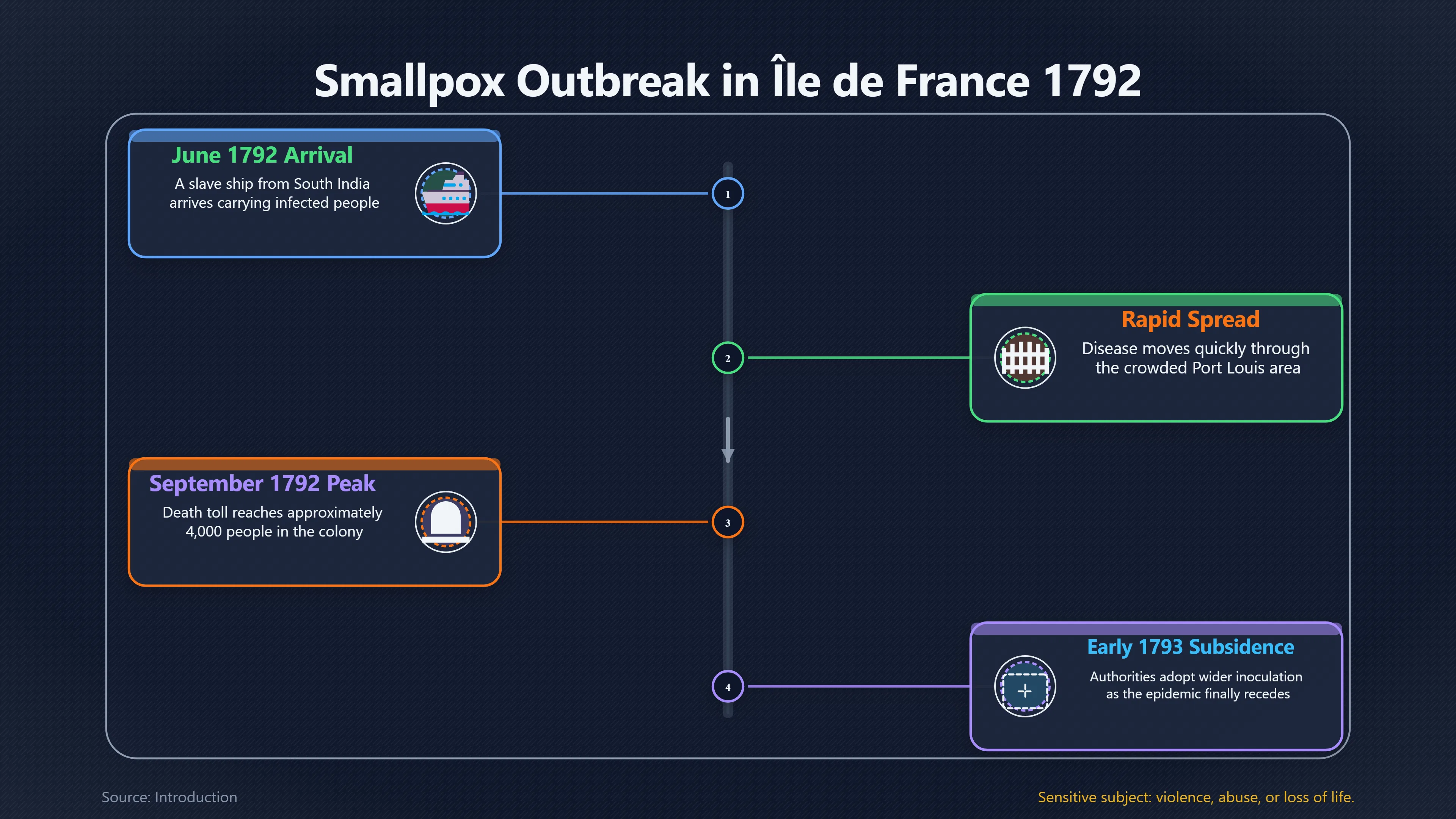
The epidemic began in June 1792 when a slave ship arriving from South India reached Port Louis carrying people infected with smallpox. At the time, Île de France was a rapidly growing French plantation colony whose economy depended heavily on enslaved labour from Africa, Madagascar and the Indian subcontinent. The arrival of an infectious disease on a crowded slave ship created ideal conditions for transmission.[OUP Academic]academic.oup.comOUP AcademicSlavery, Smallpox, and Revolution: 1792 in Île de France (Mauritius) | Social History of Medicine | Oxford AcademicDecember 1…
Smallpox inspired exceptional fear because contemporaries understood its destructive potential. Survivors were often permanently scarred or blinded, while many infected people died. Earlier outbreaks had already demonstrated how vulnerable the island was to epidemic disease, so colonists recognised the threat immediately rather than dismissing it as rumour.[reparations.qub.ac.uk]reparations.qub.ac.ukVOLUM E 1: REPORT OF THE TRUTH AND JUSTICE COMMISSIONVOLUM E 1: REPORT OF THE TRUTH AND JUSTICE COMMISSION
The disease spread rapidly through Port Louis and beyond. By September 1792, contemporary estimates placed the death toll at roughly 4,000 people, an enormous loss for a colony with fewer than 100,000 inhabitants. Although precise eighteenth-century figures remain uncertain, historians agree that the epidemic was among the most serious public health emergencies in the island’s colonial history.[reparations.qub.ac.uk]reparations.qub.ac.ukVOLUM E 1: REPORT OF THE TRUTH AND JUSTICE COMMISSIONVOLUM E 1: REPORT OF THE TRUTH AND JUSTICE COMMISSION
Why inoculation divided colonists
The most bitter controversy centred on inoculation, known today as variolation. Long before the invention of modern vaccination, physicians and other practitioners deliberately infected healthy people with material taken from mild cases of smallpox in the hope of producing lasting immunity. The procedure could save lives but also carried genuine risks because inoculated people could develop severe disease and infect others.[OUP Academic]academic.oup.comOUP AcademicSlavery, Smallpox, and Revolution: 1792 in Île de France (Mauritius) | Social History of Medicine | Oxford AcademicDecember 1…
These risks produced fierce disagreement.
Some colonists argued that:
- immediate inoculation offered the best chance of preventing catastrophic losses;
- delaying action would allow uncontrolled infection to spread;
- plantation owners had the right to decide medical treatment for enslaved workers whom they legally regarded as property.
Others insisted that:
- inoculation itself introduced new infections into communities;
- owners had no right to expose neighbouring plantations to additional risk;
- compulsory inoculation endangered both enslaved people and the wider population.
The debate therefore extended well beyond medical science. It became a dispute over individual liberty, public safety and the limits of private authority during an emergency.[OUP Academic]academic.oup.comOUP AcademicSlavery, Smallpox, and Revolution: 1792 in Île de France (Mauritius) | Social History of Medicine | Oxford AcademicDecember 1…
Consent, slavery and competing medical knowledge
The most revealing feature of the crisis was that its arguments were fought largely over the bodies of enslaved people rather than between free patients making their own medical choices.
French revolutionary politics had recently introduced new language about citizenship and rights among the white colonial population. Those ideas, however, rarely extended to enslaved Africans and other enslaved labourers. Instead, slave owners argued over whether they possessed the legal authority to inoculate those they owned, while opponents claimed the same property rights justified refusing inoculation in order to protect valuable labour from its dangers. In both cases, enslaved people themselves had almost no recognised legal voice.[OUP Academic]academic.oup.comOUP AcademicSlavery, Smallpox, and Revolution: 1792 in Île de France (Mauritius) | Social History of Medicine | Oxford AcademicDecember 1…
The crisis also challenges the assumption that European medicine was the colony’s only source of medical expertise. Many enslaved people came from regions of Africa, Madagascar and South Asia where forms of smallpox inoculation had already been practised for generations. Although surviving records rarely preserve enslaved people’s own testimony, historians argue that colonial society contained multiple medical traditions rather than a simple division between European science and local superstition. Knowledge circulated through enslaved communities as well as through officially trained physicians.[OUP Academic]academic.oup.comOUP AcademicSlavery, Smallpox, and Revolution: 1792 in Île de France (Mauritius) | Social History of Medicine | Oxford AcademicDecember 1…
This makes the epidemic especially important in the history of Mauritius. It reveals that colonial medicine operated within a complex landscape of competing expertise instead of a straightforward system in which European doctors imposed uncontested authority.
Why fear became political conflict
Public fear during the epidemic was rooted in observable danger rather than irrational panic. Nevertheless, uncertainty about how best to respond magnified existing political tensions.
Several pressures reinforced one another:
- the colony depended economically on enslaved labour, making disease an immediate financial threat;
- French Revolutionary ideas about rights and authority were reshaping colonial politics;
- medical opinion remained divided because variolation could both prevent and spread disease;
- plantation owners feared both labour shortages and government interference.
As a result, arguments about infection became arguments about governance. Every proposed medical intervention also implied a particular balance between private rights and public authority.[OUP Academic]academic.oup.comOUP AcademicSlavery, Smallpox, and Revolution: 1792 in Île de France (Mauritius) | Social History of Medicine | Oxford AcademicDecember 1…
Eventually the colonial authorities adopted wider inoculation measures among the enslaved population as deaths mounted, and by early 1793 the epidemic had largely subsided. The decision reflected both the growing severity of the outbreak and the administration’s determination to preserve the colony’s workforce.[reparations.qub.ac.uk]reparations.qub.ac.ukVOLUM E 1: REPORT OF THE TRUTH AND JUSTICE COMMISSIONVOLUM E 1: REPORT OF THE TRUTH AND JUSTICE COMMISSION
What the episode tells us about collective fear
The 1792 crisis is sometimes grouped with histories of public scares because fear spread rapidly through the colony. Yet it differs fundamentally from episodes driven by false rumours, witchcraft accusations or moral panics.
The central danger was entirely real. What became contested was the meaning of that danger and the legitimacy of different responses. Colonists disagreed over whether inoculation represented protection or an additional threat. Medical uncertainty merged with disputes about slavery, property and political authority, allowing an epidemic to become a constitutional and moral conflict as well as a public health emergency.[OUP Academic]academic.oup.comOUP AcademicSlavery, Smallpox, and Revolution: 1792 in Île de France (Mauritius) | Social History of Medicine | Oxford AcademicDecember 1…
For the history of Mauritius, the episode demonstrates that collective fear often grows not because people imagine a threat that does not exist, but because genuine crises expose deeper divisions within society. The 1792 smallpox epidemic remains significant precisely because it reveals how disease, unequal power and contested medical knowledge combined to shape colonial politics long before the era of modern vaccination.[OUP Academic]academic.oup.comOUP AcademicSlavery, Smallpox, and Revolution: 1792 in Île de France (Mauritius) | Social History of Medicine | Oxford AcademicDecember 1…

Amazon book picks
Further Reading
Books and field guides related to How Smallpox Turned Fear Into Political Conflict. Use these as the next step if you want deeper reading beyond the article.


Folk Devils and Moral Panics the Creation of the Mods and Roc...
First published 1972. Subjects: Youth, great britain, Deviant behavior, Case studies, Subculture, Young adults.
Endnotes
1.
Source: academic.oup.com
Link:https://academic.oup.com/shm/article/13/3/411/1667865
Source snippet
OUP AcademicSlavery, Smallpox, and Revolution: 1792 in Île de France (Mauritius) | Social History of Medicine | Oxford AcademicDecember 1...
2.
Source: reparations.qub.ac.uk
Title: VOLUM E 1: REPORT OF THE TRUTH AND JUSTICE COMMISSION
Link:https://reparations.qub.ac.uk/assets/uploads/2009-2011-Mauritius-Truth-Commission.pdf
3.
Source: academic.oup.com
Link:https://academic.oup.com/shm/article-pdf/13/3/411/9933174/411.pdf
Additional References
4.
Source: grafiati.com
Title: Bibliographies: ‘Slavery in Mauritius’ – Grafiati
Link:https://www.grafiati.com/en/literature-selections/slavery-in-mauritius/
Source snippet
Journal articles 2. Dissertations / Theses 3. Books 4. Book chapters ACADEMIC LITERATURE ON THE TOPIC 'SLAVERY IN MAURITIUS' Author: Graf...
5.
Source: lalitmauritius.org
Title: In Mauritius, people have greatly participated i
Link:https://www.lalitmauritius.org/en/newsarticle/2902/history-of-vaccines-and-anti-vax-campaigns-ndash-a-glimpse-ndash-on-the-history-of-vaccination/
Source snippet
NewsJuly 13, 2021 — HISTORY OF VACCINES AND ANTI-VAX CAMPAIGNS – A GLIMPSE – ON THE HISTORY OF VACCINATION 13.07.2021 Vaccines have a lon...
Published: July 13, 2021
6.
Source: ilemaurice.mu
Title: The Forgotten Plagues of Mauritius | Mauritius
Link:https://ilemaurice.mu/the-forgotten-plagues-how-disease-shaped-early-mauritian-society/
Source snippet
From colonial smallpox to outbreaks of cholera and malaria, these crises influenced demographics, health policies, and the very fa...
7.
Source: cambridge.org
Link:https://www.cambridge.org/core/books/war-against-smallpox/fire-with-fire/D7CB68A500612CE36CC97DA0B8238DB8
Source snippet
Fire with Fire (Chapter 2) - War Against SmallpoxMay 22, 2020 — In the late eighteenth century, the western style of inoculation spread i...
Published: May 22, 2020
8.
Source: cambridge.org
Title: Oceanic Vaccine (Chapter 13)
Link:https://www.cambridge.org/core/books/war-against-smallpox/oceanic-vaccine/82C9B00EAF19E6D17D1FC4CDFD23270D
Source snippet
War Against SmallpoxMay 22, 2020 — 13 - OCEANIC VACCINE The World Encircled Published online by Cambridge University Press: 22 May 2020 M...
Published: May 22, 2020
9.
Source: pubmed.ncbi.nlm.nih.gov
Link:https://pubmed.ncbi.nlm.nih.gov/14535269/
Source snippet
Slavery, smallpox, and revolution: 1792 in Ile de France (Mauritius) - PubMed...
10.
Source: link.springer.com
Link:https://link.springer.com/article/10.1007/s10761-023-00707-5
Source snippet
Landscapes of Disease and Death in Colonial Mauritius | International Journal of Historical Archaeology | Springer Nature LinkJuly 27, 20...
11.
Source: youtube.com
Title: Smallpox Inoculation and Onesimus
Link:https://www.youtube.com/watch?v=HIerjWCYOYc
Source snippet
Benjamin Franklin and the invention of Smallpox Inoculation...
12.
Source: researchgate.net
Title: 9058580 Slavery Smallpox and Revolution 1792 in Ile de France Mauritius
Link:https://www.researchgate.net/publication/9058580_Slavery_Smallpox_and_Revolution_1792_in_Ile_de_France_Mauritius
13.
Source: researchgate.net
Link:https://www.researchgate.net/publication/386025435_The_History_of_the_Zanzibari_Amakhuwa_Uprooting_Registration_and_Inventions_of_Home_in_a_Community_of_Liberated_Africans
Topic Tree