When Fear Became a Public Threat in Algeria
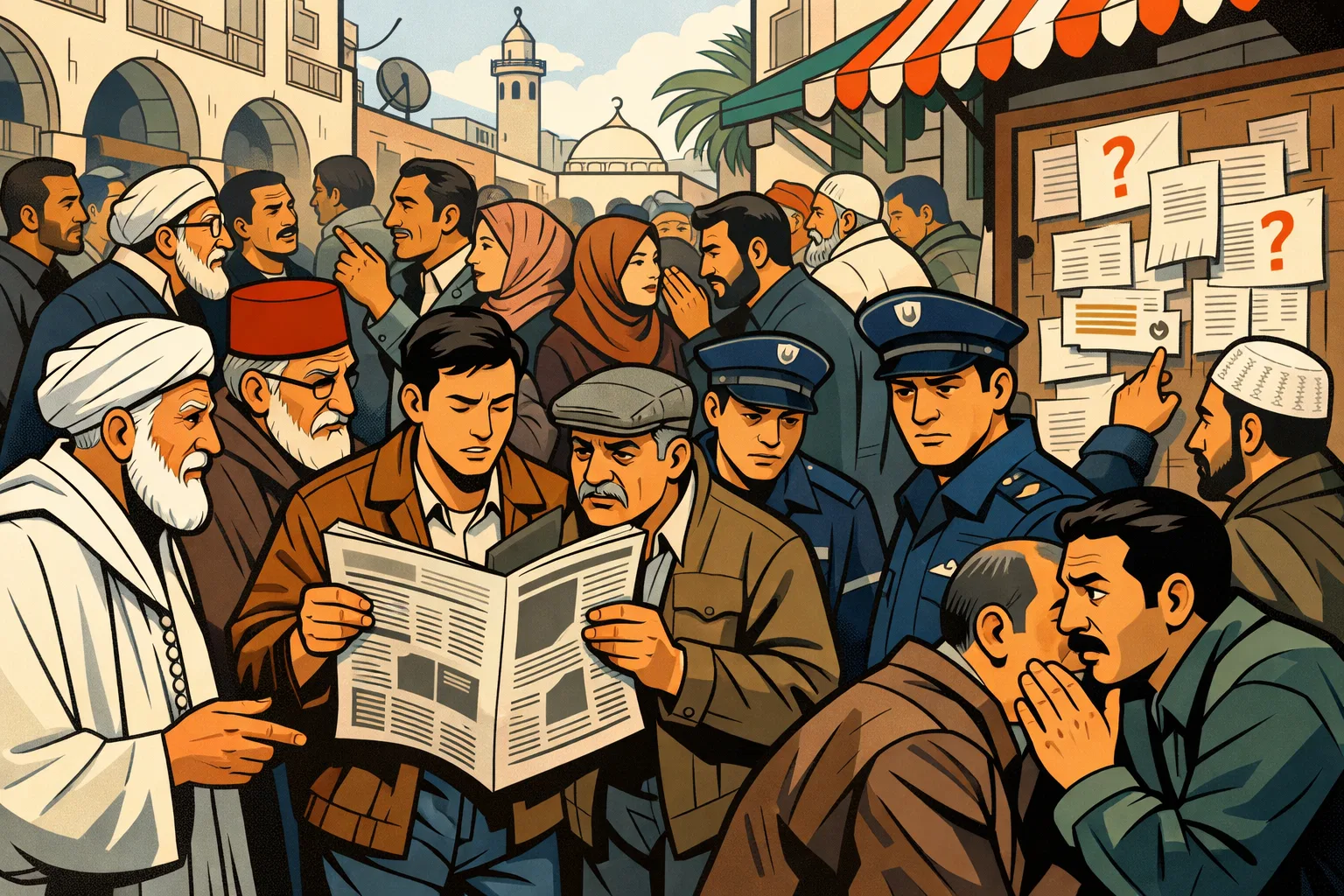
Algeria’s history offers no well-documented equivalent of the Salem witch trials or a famous dancing plague. Its most revealing episodes of collective fear instead involve rumours of hidden enemies, accusations of religious subversion, supernatural harm, online threats and sudden crowd violence.
Page outline Jump by section
Introduction
Three patterns recur. First, colonial and post-independence governments have often treated unfamiliar religious networks as possible political conspiracies. Secondly, frightening stories spread most powerfully when they attach themselves to real insecurity, whether terrorism, social unrest, wildfires or adolescent suicide. Thirdly, official responses have sometimes blurred the line between preventing genuine harm and validating the fear itself.
The result is not a simple catalogue of “mass hysteria”. It is a social history of how Algerians have decided whom to trust, what counts as a dangerous belief and how quickly suspicion can become punishment.
Why Algeria’s panic history looks different
The expression “mass hysteria” is frequently used too loosely. In medicine, the more neutral term mass psychogenic illness describes clusters of genuine physical symptoms, such as fainting, dizziness or shaking, for which investigation finds no sufficient toxic or infectious cause. Such outbreaks commonly occur in close, stressed communities, particularly schools, and can spread through observation, expectation and anxiety.[nih.gov]pmc.ncbi.nlm.nih.govby D Kokota · 2011 · Cited by 39 — Before long, dozens are vomiting, fainting and screaming. The strain of exams is a common trigger…
Reliable published evidence for a major Algerian outbreak of this specific kind is surprisingly scarce. Stories about pupils fainting, spirit possession or unexplained attacks circulate across North Africa, but Algeria does not have a securely established national case comparable with the documented school epidemics studied elsewhere in Africa. That absence matters. It is better to acknowledge a thin record than to convert local reports or folklore into a dramatic national “hysteria” that the evidence cannot support.
Algeria’s stronger cases belong to neighbouring categories:
- moral panic, in which a practice or minority is portrayed as a threat to society;
- rumour panic, in which unverified information drives urgent behaviour;
- religious persecution, where “sect” or “cult” language helps justify restrictions;
- crowd delusion, when a group accepts an accusation without adequate proof;
- supernatural fear, which may coexist with fraud, abuse, illness or sincere religious belief.
These distinctions prevent two common errors: dismissing real suffering as irrational, and treating every alarming claim as established fact.
Colonial rule turned religious uncertainty into a security fear
French rule began in 1830 and brought prolonged military conquest, dispossession and resistance. Colonial administrators quickly became preoccupied with religious leaders, pilgrimage networks, Sufi brotherhoods and respected holy figures whom they believed might mobilise rebellion. Religion was therefore studied not simply as faith, but as a potential communications system for political resistance. Scholarship on French colonial knowledge shows officials trying to classify and separate supposedly harmless religious practice from movements they considered politically dangerous.[escholarship.org]escholarship.orgFrance, Religion, and the Conquest of Algeria, 1830-1870by RE Schley · 2015 · Cited by 11 — “The Tyranny of Tolerance” examin…
Some of those fears had a rational foundation. Religious authorities and networks did play important roles in resistance, and colonial rule repeatedly produced armed revolt. Yet the administrative search for hidden agitators encouraged a wider suspicion that apparently ordinary gatherings, teachers or travelling devotees might conceal organised insurrection.
Colonial officials also presented indigenous rumour as evidence of Muslim irrationality or cultural backwardness. Historians of imperial panic have shown that French observers in Algeria sometimes attributed false news to women or Muslims supposedly governed by ancient anxieties. This language concealed a contradiction: colonial society itself was deeply vulnerable to rumours of revolt, massacre and betrayal. European communities and officials could become alarmed by the same uncertain information they described as a defect of the colonised population.[Cambridge University Press & Assessment]cambridge.orgF14D6FA47FAC798A8BB67F5ACAD392D1Cambridge University Press & AssessmentPanic, False News, and the Roots of Colonial Fearby Z Leonard · 2023 · Cited by 5 — French officia…
The lasting lesson is not that religious networks were imaginary threats. It is that colonial power converted uncertainty into a system of surveillance. A religious leader could be both a genuine political actor and the subject of exaggerated official mythology. That ambiguity survived independence in later claims that unconventional religious groups were fronts for foreign manipulation.
The Ahmadiyya crackdown: minority faith recast as conspiracy
The clearest modern Algerian example of a “cult scare” is the campaign against the Ahmadiyya community in 2016 and 2017. Ahmadis regard themselves as Muslims, but their beliefs concerning the movement’s founder differ from mainstream Sunni doctrine. This theological dispute has led to discrimination in several countries. In Algeria, a small community that had previously worshipped relatively quietly became the focus of arrests, prosecutions and public warnings.[House of Commons Library]commonslibrary.parliament.ukcdpcdp
The immediate turning point came after Ahmadis attempted to register an association and open a place of worship in 2016. Amnesty International reported that at least 280 men and women were subsequently investigated or prosecuted. Charges included collecting donations without authorisation, possessing religious literature and participating in an unregistered association. Community leader Mohamed Fali was arrested and prosecuted over activities Amnesty described as peaceful religious practice.[Amnesty International]amnesty.orgOpen source on amnesty.org.
The panic element lay in the rhetoric surrounding the crackdown. Algerian officials and public figures did not merely dispute Ahmadi theology. The religious affairs minister said members were being manipulated by a “foreign hand” seeking to destabilise the country, while also alleging connections with Israel. Human Rights Watch argued that such statements vilified an already vulnerable minority and helped legitimise prosecution.[State Department]2021-2025.state.govOpen source on state.gov.
This case should not be described simply as the suppression of a “cult”. That was the hostile label used by opponents. A more accurate description is a minority religious movement caught in a moral and security panic. The state treated theological difference, unofficial organisation and foreign origin as parts of a single destabilising scheme.
Why did the claim resonate? Algeria’s civil conflict of the 1990s left powerful memories of clandestine religious organisation and political violence. The state also maintains a strong interest in regulating religious institutions and defending an officially recognised national religious framework. Against that background, even a tiny movement could be represented as a test of national unity rather than a question of individual belief.
The measurable harm was not imaginary: arrests, convictions and pressure to worship underground were documented. What remains unsubstantiated is the larger conspiracy narrative used to explain the community’s existence.
Karakaria and the anatomy of a short-lived “cult” scare
A similar but less legally consequential controversy emerged in 2017 around Karakaria, a small religious group associated with Sufi ideas and distinguished by colourful dress. Algerian imams and commentators warned that the movement was based on superstition, departed from the country’s mainstream religious tradition and might be connected to foreign intelligence services. Regional media repeatedly framed the question as whether Karakaria was a spiritual order, a cult or an imported conspiracy.[middleeastmonitor.com]middleeastmonitor.comMiddle East Monitor Concerns over suspicious cult in AlgeriaMiddle East Monitor Concerns over suspicious cult in Algeria
Public reporting offered little firm evidence of a substantial organisation, coercive recruitment or a coordinated foreign operation. The scare was driven largely by the movement’s unusual appearance, unfamiliar teachings and alleged outside links. This is a classic feature of moral panic: visible difference becomes evidence of concealed danger.
Karakaria also demonstrates why “cult” is an unreliable analytical category. The term can refer to a genuinely abusive high-control organisation, but it is often used merely to mark a minority as strange or illegitimate. In this instance, the most dramatic claims came from critics. Without evidence of systematic coercion, criminality or mass mobilisation, it is safer to describe Karakaria as a controversial religious movement that became the subject of a brief media and clerical scare.
The Ahmadi and Karakaria episodes shared a recognisable structure:
- An unfamiliar group attracted public attention.
- Religious authorities identified doctrinal deviance.
- Commentators added claims of foreign direction.
- Difference was reframed as a threat to social cohesion.
- Limited evidence about the group was overshadowed by speculation about its hidden purpose.
This pattern joins theology to national-security anxiety. It allows a community to be feared not for what its members have demonstrably done, but for what an unseen sponsor might supposedly intend.
The Blue Whale scare brought a global internet panic to Algeria
In late 2017, Algerian media reported that teenagers had been harmed or had died after participating in the “Blue Whale Challenge”. The alleged game was said to assign young people fifty escalating tasks, ending in suicide. Reports described teenagers being admitted for psychiatric treatment and attributed several deaths to the challenge.[The New Arab]newarab.comBlue Whale Challenge hospitalises second teen in AlgeriaBlue Whale Challenge hospitalises second teen in Algeria
The fear was understandable. Online coercion, cyberbullying, self-harm communities and suicide contagion are genuine risks. Research shows that repeated exposure to self-harm material can affect vulnerable adolescents, while sensational coverage can inadvertently spread harmful scripts and increase curiosity.[PMC]pmc.ncbi.nlm.nih.govOpen source on nih.gov.
The specific Blue Whale story, however, was much harder to verify. Its international rise began with sensational claims linking unrelated suicides to secret online administrators. Later research found little evidence for a single organised game operating in the uniform way described by news reports. Researchers studying supposed online “suicide games” concluded that warnings from media and authorities often enlarged the myth, even where no central organisation could be demonstrated.[Cyberbullying Research Center]cyberbullying.orgblue whale challengeblue whale challenge
Algeria’s coverage followed the global pattern. Individual tragedies and psychiatric crises were rapidly fitted into an imported narrative that seemed to explain them. The story offered parents a concrete villain: an invisible online controller targeting children through their phones. That was emotionally easier to grasp than the more complicated realities of depression, family conflict, bullying, social isolation and imitation.
Calling the entire affair a hoax would also be misleading. Once widely publicised, a weakly evidenced legend can generate real behaviour. Copycats may create accounts, adolescents may imitate reported tasks and distressed users may identify with the story. The panic can therefore become partly self-fulfilling. The organised fifty-day “game” may be doubtful while the danger created by its circulation remains real.
The most responsible response is therefore neither denial nor alarmism. It is direct support for distressed young people, careful reporting of suicide, investigation of specific coercive contacts and avoidance of lurid descriptions that advertise the supposed challenge.

Wildfire rumours and the killing of Djamel Ben Ismail
The most devastating Algerian example of contagious accusation occurred during the catastrophic Kabylie wildfires of August 2021. Amid deaths, destroyed homes and widespread anger, suspicion spread that arsonists were deliberately setting fires. Djamel Ben Ismail, a 38-year-old artist who had travelled to the region to assist, was falsely accused of being one of them.
A crowd seized him from police custody in Larbaâ Nath Irathen and killed him. Images of the attack circulated online, extending both the horror and the public humiliation. Police later made dozens of arrests. Courts imposed numerous death sentences, although Algeria maintains a moratorium on executions; human-rights organisations subsequently raised serious concerns about mass proceedings, torture allegations and the fairness of some convictions.[theguardian.com]theguardian.comOpen source on theguardian.com.
This was not mass psychogenic illness and should not be reduced to “mob madness”. It was a rumour-driven lynching under extreme collective stress. Several forces converged:
- a real and immediate disaster;
- official and popular claims that deliberate arson was involved;
- frustration over the emergency response;
- regional and political tensions;
- the rapid circulation of accusations and graphic material;
- the crowd’s mistaken belief that it had identified a guilty outsider.
The case demonstrates how panic can destroy ordinary standards of proof. Once Ben Ismail had been assigned the role of arsonist, his presence in the fire zone and his attempt to explain himself were reinterpreted as evidence against him. The accusation spread faster than verification, and the crowd acted as investigator, judge and executioner.
The later trials punished many alleged participants but also became part of the political dispute. Amnesty International argued that some defendants were prosecuted partly because of political affiliations and that torture claims were not properly investigated. The aftermath therefore produced two separate justice questions: accountability for an appalling mob killing, and the right of every accused person to an individual, fair trial.[Amnesty International]amnesty.orgalgeria mass death sentences marred by unfair trials torture claimsalgeria mass death sentences marred by unfair trials torture claims
For Algeria’s social history, the killing remains a warning about the lethal meeting point between disaster, social media, regional suspicion and collective certainty.
Sorcery fears moved from folklore into criminal law
Belief in harmful magic, spirit attack, divination and supernatural healing remains part of social life for some Algerians, as it does in many societies. Such beliefs are not automatically a panic. People may consult healers privately, combine religious and medical explanations, or understand misfortune through both natural and supernatural causes.
Harm arises where accusations provoke violence, where a practitioner exploits frightened clients, or where an illness is treated solely as possession and urgent medical care is delayed. The language of sorcery can also conceal more familiar crimes such as fraud, poisoning, sexual abuse or coercive treatment.
In April 2024, Algeria amended its Penal Code to create specific offences concerning witchcraft and sorcery. Legal analyses report penalties for people who make such practices a profession, with heavier consequences where conduct causes physical or psychological harm, exploits vulnerable people or involves other offences.[cerist.dz]asjp.cerist.dzdown Articledown Article
The reform can be read in two ways. One interpretation is practical: legislators wanted clearer tools to prosecute fraudulent or dangerous practitioners whose conduct did not fit comfortably under existing offences. Another is more troubling: by criminalising “witchcraft” itself rather than focusing only on provable acts such as deception, assault or unlawful detention, the law risks giving legal force to contested supernatural claims.
That tension resembles older witchcraft laws elsewhere. Courts are well equipped to decide whether money was obtained fraudulently or whether somebody was injured. They are not equipped to determine whether supernatural power exists. Effective enforcement therefore depends on keeping attention on demonstrable conduct and harm, rather than treating magical claims as facts established by the state.
What connects Algeria’s scares
Algeria’s episodes do not share one belief, victim group or historical period. Their common feature is a recurring leap from uncertainty to hidden agency. A fire must have an organised arsonist. A suicide must have an online controller. A minority religion must have a foreign sponsor. Misfortune attributed to sorcery must have a secret human author.
Several social pressures make these explanations attractive.
Memories of real conspiracy and violence. Colonial surveillance, the war of independence and the armed conflict of the 1990s all left evidence that clandestine networks can exist and that hidden organisation can be dangerous. Later conspiracy claims therefore draw strength from genuine history.
Low trust. Where citizens doubt official communication, rumours can become alternative forms of explanation. Yet official warnings may also amplify panic when they repeat dramatic claims before establishing the evidence.
Threats to national unity. Religious and regional differences are frequently discussed through the language of infiltration, division and destabilisation. This can transform ordinary dissent or minority identity into a security question.
Digital acceleration. Social media compresses the interval between suspicion and action. Emotional claims, photographs and accusations circulate before investigators can verify them. The Blue Whale panic and the Ben Ismail lynching show different forms of the same problem: online attention rewards the most frightening interpretation.
A desire for morally clear causes. Hidden enemies offer a simpler story than structural failure, psychological distress or chance. They identify someone to blame and suggest that removing the culprit will restore order.
What should and should not be called a cult or mass hysteria
The Algerian record is most useful when categories remain precise.
The Ahmadiyya community was a persecuted religious minority, not a proven criminal cult. Karakaria was the target of a cult scare, but public accusations exceeded the available evidence. Blue Whale was a global internet panic built around uncertain claims, though its publicity could still encourage real imitation. The Ben Ismail case was a rumour-fuelled lynching, not a mysterious outbreak of insanity. Sorcery fears combine sincere belief, disputed religious interpretation and sometimes demonstrable fraud or abuse.
Nor should collective fear be treated as uniquely Algerian. Similar dynamics appear wherever institutions are mistrusted, unfamiliar groups are politicised and alarming information moves faster than verification. Algeria’s particular history shaped the content of its scares: colonial surveillance, religious regulation, memories of political violence and anxieties about foreign interference.
The central lesson is that a panic need not be wholly imaginary to become dangerous. Wildfires were real. Youth suicide was real. Religious disagreements were real. Fraud carried out under supernatural claims can be real. Panic begins when uncertainty is replaced by a total explanation, evidence becomes secondary and the suspected enemy is punished before the claim has been tested.
Why these episodes still matter
Algeria’s panic history shows that contagious belief is not confined to strange medieval events. It operates through familiar institutions: ministries, mosques, television reports, courts, neighbourhood crowds and social-media feeds. Authorities may calm a scare, but they may also intensify it by attaching official credibility to speculation.
The strongest safeguard is not ridicule. Mocking people as superstitious or hysterical usually deepens mistrust and ignores the real pressures beneath their fear. Better responses separate urgent protection from premature explanation: investigate possible toxins before diagnosing psychogenic illness; support a distressed teenager without advertising an alleged suicide game; prosecute violence and fraud without declaring supernatural claims legally true; and assess minority religious groups by documented conduct rather than hostile labels.
Algeria’s most serious episodes began not with belief alone, but with the collapse of restraint around belief. Once suspicion became certainty, an unfamiliar congregation could be imagined as a foreign plot and an innocent volunteer could be transformed into an arsonist. That is why these cases remain culturally important: they reveal how quickly a society under pressure can move from asking what happened to deciding, without adequate evidence, who must be blamed.
Amazon book picks
Further Reading
Books and field guides related to When Fear Became a Public Threat in Algeria. Use these as the next step if you want deeper reading beyond the article.
Extraordinary Popular Delusions and the Madness of Crowds
Rating: 4.0/5 from 5 Google Books ratings
A famous overview of collective panics and mass belief.
Orientalism
Explores how colonial narratives shaped perceptions of the Arab and Muslim world.
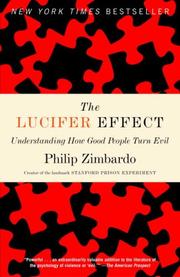
The Lucifer Effect
Helps explain how fear and social pressure influence collective behaviour.
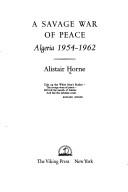
A Savage War of Peace
Explains the historical roots of modern Algerian insecurity and suspicion.
Endnotes
1.
Source: pmc.ncbi.nlm.nih.gov
Link:https://pmc.ncbi.nlm.nih.gov/articles/PMC3588562/
Source snippet
by D Kokota · 2011 · Cited by 39 — Before long, dozens are vomiting, fainting and screaming. The strain of exams is a common trigger...
2.
Source: pmc.ncbi.nlm.nih.gov
Link:https://pmc.ncbi.nlm.nih.gov/articles/PMC7396040/
Source snippet
Mass Psychogenic Illness in Haraza Elementary School, Erop...by KF Ajemu · 2020 · Cited by 7 — Common symptoms of mass psychogenic il...
3.
Source: escholarship.org
Link:https://escholarship.org/uc/item/52v9w979
Source snippet
France, Religion, and the Conquest of Algeria, 1830-1870by RE Schley · 2015 · Cited by 11 — “The Tyranny of Tolerance” examin...
4.
Source: cambridge.org
Link:https://www.cambridge.org/core/journals/journal-of-british-studies/article/panic-false-news-and-the-roots-of-[colonial-fear
Source snippet
Cambridge University Press & AssessmentPanic, False News, and the Roots of Colonial Fearby Z Leonard · 2023 · Cited by 5 — French officia...
5.
Source: reuters.com
Title: algeria defends ahmadiyah sect arrests community says vilified id USKBN17U2B3
Link:https://www.reuters.com/article/world/algeria-defends-ahmadiyah-sect-arrests-community-says-vilified-idUSKBN17U2B3/
6.
Source: amnesty.org
Link:https://www.amnesty.org/en/latest/news/2017/06/algeria-wave-of-arrests-and-prosecutions-of-hundreds-of-ahmadis-2/
7.
Source: amnesty.org
Link:https://www.amnesty.org/en/wp-content/uploads/2021/05/MDE2870792017ENGLISH.pdf
8.
Source: amnesty.org
Link:https://www.amnesty.org/en/latest/news/2021/10/algeria-quash-conviction-of-christian-convert-prosecuted-solely-for-religious-belief/
9.
Source: 2021-2025.state.gov
Link:https://2021-2025.state.gov/reports/2017-report-on-international-religious-freedom/algeria/
10.
Source: pmc.ncbi.nlm.nih.gov
Link:https://pmc.ncbi.nlm.nih.gov/articles/PMC7312265/
11.
Source: cyberbullying.org
Title: blue whale challenge
Link:https://cyberbullying.org/blue-whale-challenge
12.
Source: reuters.com
Title: algeria issues death sentences over wildfire killing 2022 11 24
Link:https://www.reuters.com/world/africa/algeria-issues-death-sentences-over-wildfire-killing-2022-11-24/
13.
Source: amnesty.org
Title: algeria mass death sentences marred by unfair trials torture claims
Link:https://www.amnesty.org/en/latest/news/2023/01/algeria-mass-death-sentences-marred-by-unfair-trials-torture-claims/
14.
Source: amnesty.org
Link:https://www.amnesty.org/en/latest/news/2026/02/algeria-ensure-fair-retrial-of-dozens-accused-of-violence-in-kabylie-without-resort-to-the-death-penalty/
15.
Source: asjp.cerist.dz
Title: down Article
Link:https://asjp.cerist.dz/en/downArticle/133/12/2/257842
16.
Source: research.lancaster-university.uk
Link:https://research.lancaster-university.uk/en/impacts/amendment-to-algerian-anti-witchcraft-legislation/
17.
Source: amnesty.org
Link:https://www.amnesty.org/en/wp-content/uploads/2021/05/MDE2884552018ENGLISH.pdf
18.
Source: amnesty.org
Link:https://www.amnesty.org/en/wp-content/uploads/2021/05/POL1067002018ENGLISH.pdf
19.
Source: amnesty.org
Link:https://www.amnesty.org/en/wp-content/uploads/2023/03/WEBPOL1056702023ENGLISH.pdf
20.
Source: amnesty.org
Title: algeria conviction of journalist is latest escalation in crackdown on media
Link:https://www.amnesty.org/en/latest/news/2023/04/algeria-conviction-of-journalist-is-latest-escalation-in-crackdown-on-media/
21.
Source: amnesty.org
Link:https://www.amnesty.org/en/wp-content/uploads/2025/04/WEBPOL1085152025ENGLISH.pdf
22.
Source: amnesty.org
Link:https://www.amnesty.org/en/wp-content/uploads/2024/04/WEBPOL1072002024ENGLISH.pdf
23.
Source: files.amnesty.org
Title: AmnestyInternational AnnualReport2013 complete en
Link:https://files.amnesty.org/air13/AmnestyInternational_AnnualReport2013_complete_en.pdf
24.
Source: 2021-2025.state.gov
Link:https://2021-2025.state.gov/report/custom/a8e545a326/
25.
Source: 2017-2021.state.gov
Link:https://2017-2021.state.gov/report/custom/e766425167/
26.
Source: 2021-2025.state.gov
Link:https://2021-2025.state.gov/report/custom/bd83b53c0f/
27.
Source: state.gov
Link:https://www.state.gov/report/custom/b237955aa7
28.
Source: state.gov
Link:https://www.state.gov/report/custom/ae9f319040
29.
Source: state.gov
Link:https://www.state.gov/report/custom/eee21f98a5
30.
Source: 2017-2021.state.gov
Link:https://2017-2021.state.gov/report/custom/bbdde34aca/
31.
Source: 2017-2021.state.gov
Link:https://2017-2021.state.gov/report/custom/f6de192059/
32.
Source: state.gov
Link:https://www.state.gov/report/custom/27820b7a40
33.
Source: state.gov
Link:https://www.state.gov/report/custom/a5ae8c8899
34.
Source: cambridge.org
Title: panic false news and the roots of colonial fear
Link:https://www.cambridge.org/core/services/aop-cambridge-core/content/view/F14D6FA47FAC798A8BB67F5ACAD392D1/S0021937123000035a.pdf/panic_false_news_and_the_roots_of_colonial_fear.pdf
35.
Source: cambridge.org
Link:https://www.cambridge.org/core/journals/journal-of-american-studies/article/american-monsters-tabloid-media-and-the-satanic-panic-19702000/D674D558FA7399E91149BFCAB138792D
36.
Source: sajp.org.za
Title: Mass anxiety hysteria has a good prognosis and separating the affected group is
Link:https://sajp.org.za/index.php/sajp/article/view/1671/2648
Source snippet
South African Journal of PsychiatryPredictors of mass psychogenic illness in a junior...by K Siamisang · 2022 · Cited by 7 — The most co...
37.
Source: helda.helsinki.fi
Link:https://helda.helsinki.fi/bitstreams/937502f4-ba44-4e3c-8e7c-85a4e0c6a4ea/download
Source snippet
French Sources of Knowledge in Colonial Algeria, 1846–1871by K Lauwers · 2023 — In their treatment of marabouts, Sufi turuq (tariqas...
38.
Source: commonslibrary.parliament.uk
Title: cdp 2018 0129
Link:https://commonslibrary.parliament.uk/research-briefings/cdp-2018-0129/
39.
Source: middleeastmonitor.com
Title: Middle East Monitor Concerns over suspicious cult in Algeria
Link:https://www.middleeastmonitor.com/20170822-concerns-over-suspicious-cult-in-algeria/
40.
Source: english.alarabiya.net
Title: The Karakaria in Algeria Religious group or foreign conspiracy
Link:https://english.alarabiya.net/features/2017/09/14/The-Karakaria-in-Algeria-Religious-group-or-foreign-conspiracy-
41.
Source: newarab.com
Title: Blue Whale Challenge hospitalises second teen in Algeria
Link:https://www.newarab.com/News/2017/12/17/Blue-Whale-Challenge-hospitalises-second-teen-in-Algeria
42.
Source: theguardian.com
Link:https://www.theguardian.com/world/2021/aug/18/algeria-61-arrested-after-mob-kills-man-falsely-accused-of-starting-deadly-fires
43.
Source: jurist.org
Link:https://www.jurist.org/news/2023/01/amnesty-international-warns-of-trial-violations-and-torture-in-algeria-mass-death-sentencing/
44.
Source: asjp.cerist.dz
Title: down Article
Link:https://asjp.cerist.dz/en/downArticle/512/8/2/268668
45.
Source: asjp.cerist.dz
Title: down Article
Link:https://asjp.cerist.dz/en/downArticle/223/9/4/258743
46.
Source: Wikipedia
Title: Blue Whale Challenge
Link:https://en.wikipedia.org/wiki/Blue_Whale_Challenge
47.
Source: Wikipedia
Title: Killing of Djamel Ben Ismail
Link:https://en.wikipedia.org/wiki/Killing_of_Djamel_Ben_Ismail
48.
Source: theguardian.com
Link:https://www.theguardian.com/science/2008/sep/18/psychology
Additional References
49.
Source: tandfonline.com
Link:https://www.tandfonline.com/doi/full/10.1080/13507486.2022.2120796
Source snippet
Taylor & Francis OnlineFrench colonial publications and their situated re-...by K Lauwers · 2022 · Cited by 2 — This article explores ne...
50.
Source: youtube.com
Title: USCIRF Conversation: Deteriorating Religious Freedom Conditions in Algeria
Link:https://www.youtube.com/watch?v=eG197aL-LCI
Source snippet
Algeria: End persecution of Evangelical Protestants and allow churches to reopen...
51.
Source: youtube.com
Title: Algeria: End persecution of Evangelical Protestants and allow churches to reopen
Link:https://www.youtube.com/watch?v=wTrbYu-Z46A
Source snippet
Islamic Extremists Target Civilians As Algerian Conflict Intensifies...
52.
Source: arxiv.org
Title: arXiv Online Suicide Games: A Form of Digital Self-harm or A Myth?
Link:https://arxiv.org/abs/2012.00530
53.
Source: researchgate.net
Link:https://www.researchgate.net/publication/397452530_The_Criminalization_of_Witchcraft_and_Sorcery_under_Algerian_Law_No_24-06_A_Legal_and_Socio-Cultural_Analysis_of_Articles_303_bis_42_and_303_bis_43_of_the_Penal_Code
54.
Source: facebook.com
Link:https://www.facebook.com/DailyStarNews/posts/an-algerian-court-thursday-sentenced-49-people-to-death-over-the-lynching-of-a-m/5216311018468725/
55.
Source: facebook.com
Link:https://www.facebook.com/lyobserver/posts/a-man-and-his-wife-from-algeria-have-been-arrested-in-benghazi-east-libya-on-cha/2475694409202291/
56.
Source: link.springer.com
Link:https://link.springer.com/content/pdf/10.1007/978-3-319-45136-7.pdf
57.
Source: theatlantic.com
Link:https://www.theatlantic.com/magazine/archive/1956/11/algeria-in-revolt/642293/
58.
Source: rabwah.net
Link:https://www.rabwah.net/algeria-intensifies-controversial-crackdown-on-ahmadiyya-muslims/
Topic Tree
Follow this branch
Related pages 192
- Antigua and Barbuda
- Argentina Belief Scares
- Azerbaijan Belief
- Bahrain Beliefs
- North Korea
- +187 more in sidebar