Within Malta
Was Malta Facing Satanists or a Moral Panic?
Reports of Satanism often blended real vandalism and drug fears with uncertain claims about organised ritual groups.
On this page
- How Satanism became an explanation for disorder
- Mnajdra vandalism and disputed attribution
- What press reports can and cannot prove
Page outline Jump by section
Introduction
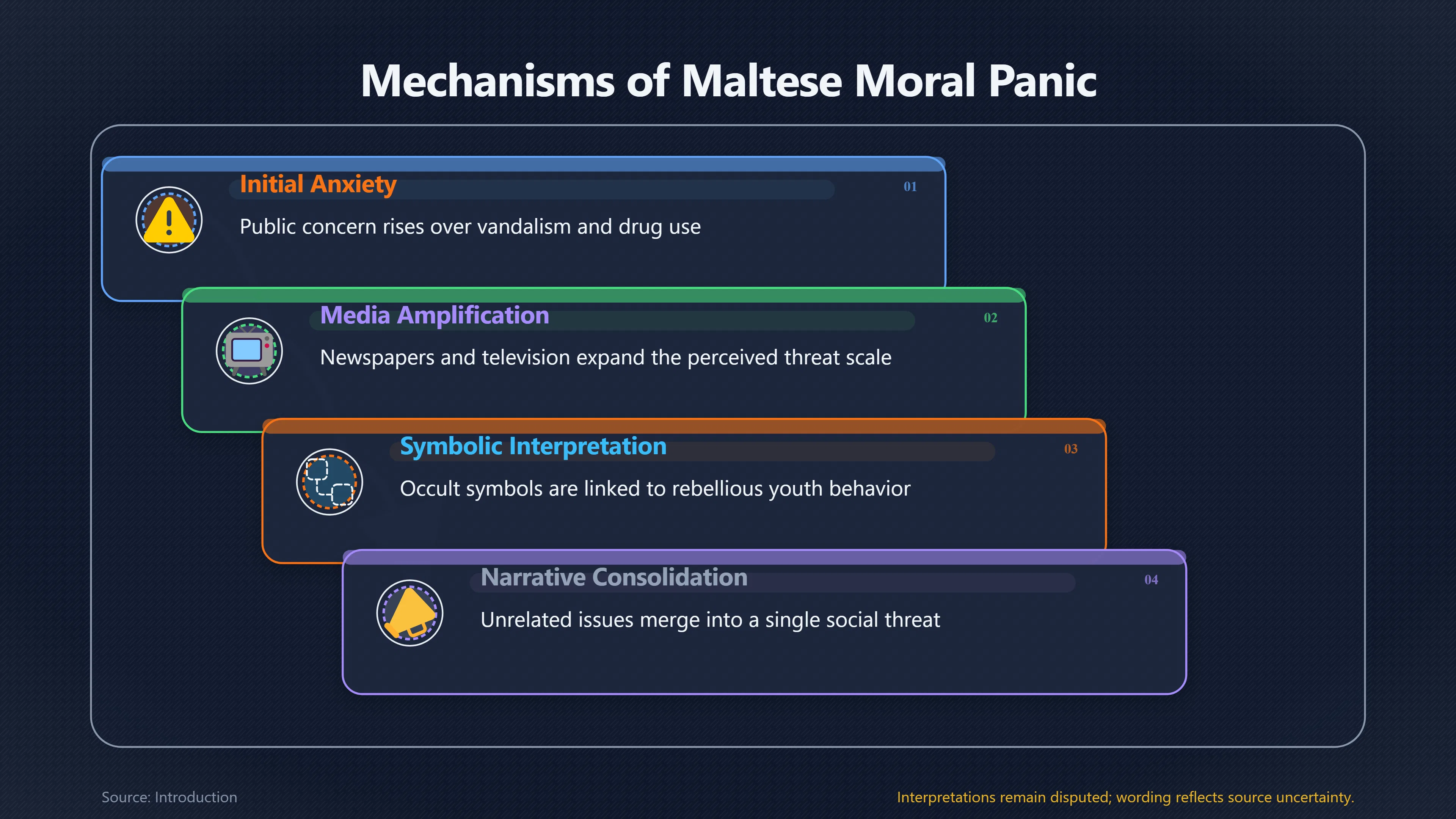
By the late twentieth century, Malta experienced a series of anxieties about Satanism that blended together several different concerns: vandalism at historic sites, youth subcultures, drug use, heavy metal music, Gothic imagery and rumours of hidden ritual groups. Unlike the better-known Satanic Panic in the United States, Malta never produced convincing evidence of a nationwide network of organised Satanic cults carrying out ritual crimes. Instead, genuine criminal acts, isolated incidents and persistent rumours were often interpreted through the lens of a deeply Catholic society in which the Devil remained a familiar moral and religious symbol. Academic studies of Maltese moral panics now argue that many of these scares followed a recognisable pattern in which media attention, public anxiety and official warnings expanded the apparent scale of a poorly evidenced threat.[L-Università ta' Malta]um.edu.mtL-Università ta' Malta OAR@UM: Youth moral panics in Malta: an explorationL-Università ta' Malta OAR@UM: Youth moral panics in Malta: an exploration
How Satanism became an explanation for disorder
Throughout the 1980s, 1990s and early 2000s, reports about Satanism appeared periodically in Maltese newspapers and television. Stories often linked occult symbols with abandoned buildings, cemeteries, drug use, vandalism or rebellious youth culture. In many cases, the existence of pentagrams, black clothing or anti-Christian graffiti was treated as circumstantial evidence of organised Satanic activity rather than as the behaviour of individuals seeking to shock or provoke.
Several factors made this interpretation attractive.
- Malta remained one of Europe’s most strongly Catholic societies, where supernatural ideas about good and evil were part of everyday religious language.
- International stories about Satanic ritual abuse, heavy metal music and occult crime circulated through foreign media and popular books during the same period.
- Growing youth nightlife, electronic dance music and recreational drug use created genuine public concern, making “Satanism” an available explanation for behaviour viewed as morally dangerous.
- Because Malta is a small and closely connected society, rumours could spread rapidly through schools, churches, neighbourhoods and local media.
Research on Maltese youth moral panics has found that public fears frequently merged unrelated issues into a single perceived social threat. Drug use, unconventional fashion, nightlife and supposed occult interests were often discussed together, even when evidence for organised Satanic groups remained weak.[L-Università ta' Malta]um.edu.mtL-Università ta' Malta OAR@UM: Youth moral panics in Malta: an explorationL-Università ta' Malta OAR@UM: Youth moral panics in Malta: an exploration
Academic work examining alleged “cult crime” in Malta similarly notes that press coverage often exceeded the available evidence. While the study records interviews with professionals who believed Satanism existed among some young offenders, it also highlights how difficult it was to distinguish organised religious groups from loose friendship circles, rebellious symbolism or ordinary criminal behaviour. The research itself acknowledges that systematic evidence was limited and that the subject had received little previous scholarly investigation.[L-Università ta' Malta]um.edu.mtL-Università ta' Malta OAR@UM: A study of cult crime in MaltaL-Università ta' Malta OAR@UM: A study of cult crime in Malta
Mnajdra vandalism and disputed attribution
The most famous episode associated with rumours of Satanism was the vandalism of the prehistoric temple complex at Mnajdra in April 2001.
During the attack, around sixty megaliths were toppled or damaged at one of Malta’s UNESCO World Heritage archaeological sites. The destruction shocked the country because the temples are among the oldest free-standing stone monuments in the world.[Archaeology Magazine]archive.archaeology.orgMagazine Attacking Malta's PastArchaeology MagazineAttacking Malta's Past - Archaeology Magazine ArchiveJuly 1, 2001…
In the immediate aftermath, speculation circulated about possible motives. Because the temples were ancient religious monuments, some observers wondered whether occult groups or Satanists might have been responsible. Such suggestions fitted existing public fears about hidden cults.
However, investigations never established organised Satanism as the cause.
Contemporary archaeological reporting instead noted that investigators regarded local conflicts over access to the area by bird hunters as a more plausible line of inquiry than ritual motivations. UNESCO’s response concentrated on security failures, conservation and identifying those responsible rather than endorsing claims about occult involvement. The emphasis quickly shifted from speculation about symbolism to practical protection of cultural heritage.[Archaeology Magazine]archive.archaeology.orgMagazine Attacking Malta's PastArchaeology MagazineAttacking Malta's Past - Archaeology Magazine ArchiveJuly 1, 2001…
This distinction matters historically. The vandalism was unquestionably real, but the claim that it represented organised Satanic activity has never been substantiated by publicly available evidence. The incident illustrates how spectacular acts of destruction can become attached to broader cultural fears even when investigators cannot confirm the popular explanation.
What press reports can and cannot prove
Many newspaper reports described alleged black masses, cemetery gatherings or hidden Satanic rituals. These stories contributed to a widespread impression that Malta faced an expanding underground movement.
The available evidence is much more limited.
Press reports often relied on:
- anonymous witnesses;
- statements from concerned clergy or self-described former participants;
- discovery of occult symbols without identified perpetrators;
- rumours repeated across multiple news outlets.
None of these automatically demonstrates the existence of coordinated ritual organisations.
Academic studies of Maltese moral panics argue that media coverage sometimes amplified isolated events into broader narratives of social decline. This did not necessarily mean journalists invented stories, but repeated reporting could encourage readers to connect unrelated incidents into a single imagined phenomenon. Similar mechanisms have been identified in research on fears surrounding youth parties and nightlife, where concerns about drugs, sexuality and disorder became mutually reinforcing through media attention.[L-Università ta' Malta]um.edu.mtL-Università ta' Malta OAR@UM: Youth moral panics in Malta: an explorationL-Università ta' Malta OAR@UM: Youth moral panics in Malta: an exploration
The same caution applies to reports of occult crime. Discovering Satanic symbols, damaged crosses or ritual-looking objects does not by itself establish an organised movement, since such imagery can also be adopted by vandals, adolescents seeking attention or individuals influenced by popular culture rather than by coherent religious beliefs.
Why the fears spread so effectively
Several social pressures helped Satanic scares gain credibility despite limited evidence.
Religious authority remained influential in Malta, making warnings about spiritual danger especially persuasive. At the same time, rapid cultural change exposed younger generations to music, films, games and fashions that older generations sometimes regarded as foreign or threatening.
Drug use added another layer. During the 1990s, public concern over ecstasy and nightclub culture was genuine, with researchers documenting increasing recreational drug use among young people from varied social backgrounds. Public discussion often blurred distinctions between substance abuse, nightlife, youth rebellion and alleged occult practices, creating a single narrative of moral decline rather than separate social issues.[L-Università ta' Malta]um.edu.mtOpen source on edu.mt.
Media competition also mattered. Dramatic stories about hidden Satanic groups naturally attracted attention, especially when combined with emotional interviews, crime reporting or religious commentary. Moral panic theory predicts exactly this pattern: uncertainty encourages speculation, speculation attracts coverage, and repeated coverage increases the perception that the threat is widespread. Maltese studies applying Stanley Cohen’s theory conclude that this process can be observed in several youth-related controversies, even where the original evidence was limited.[L-Università ta' Malta]um.edu.mtL-Università ta' Malta OAR@UM: Youth moral panics in Malta: an explorationL-Università ta' Malta OAR@UM: Youth moral panics in Malta: an exploration

How historians and sociologists interpret the episode today
Modern scholarship generally treats Malta’s Satanic scares as an example of moral panic rather than proof of an organised nationwide Satanic movement.
This interpretation does not deny that genuine crimes occurred. Cemetery vandalism, property damage, drug offences and occasional violence were all real. Instead, researchers question whether these separate events justified the broader belief that hidden ritual organisations posed a major threat to Maltese society.
The distinction is important because moral panics often emerge when societies undergo rapid cultural change. In Malta, debates about religion, youth identity, nightlife and foreign cultural influences converged around the symbolic figure of the Satanist. The result was a powerful public narrative that sometimes exceeded what criminal investigations or documented evidence could support.
For that reason, Satanic scares occupy an important place in Malta’s modern social history—not because organised Satanic conspiracies were proven, but because they reveal how fear, media reporting and deeply rooted religious beliefs combined to shape public understanding of disorder during a period of significant cultural change.[L-Università ta' Malta]um.edu.mtL-Università ta' Malta OAR@UM: Youth moral panics in Malta: an explorationL-Università ta' Malta OAR@UM: Youth moral panics in Malta: an exploration
Amazon book picks
Further Reading
Books and field guides related to Was Malta Facing Satanists or a Moral Panic?. Use these as the next step if you want deeper reading beyond the article.
Satanic panic
Directly addresses the dynamics behind Satanism scares relevant to Malta.


The Penguin book of witches
Illustrates how societies interpret alleged supernatural threats.
Folk devils and moral panics
Foundational framework for interpreting Malta's Satanism scares.
Endnotes
1.
Source: archive.archaeology.org
Title: Magazine Attacking Malta’s Past
Link:https://archive.archaeology.org/0107/newsbriefs/malta.html
Source snippet
Archaeology MagazineAttacking Malta's Past - Archaeology Magazine ArchiveJuly 1, 2001...
Published: July 1, 2001
2.
Source: whc.unesco.org
Title: World Heritage Centre UNESCO World Heritage Centre
Link:https://whc.unesco.org/en/decisions/5908
Source snippet
UNESCO World Heritage CentreUNESCO World Heritage Centre - Decision - 25 BUR V.261-267...
3.
Source: whc.unesco.org
Link:https://whc.unesco.org/fr/decisions/5908/
4.
Source: um.edu.mt
Title: L-Università ta’ Malta OAR@UM: Youth moral panics in Malta: an exploration
Link:https://www.um.edu.mt/library/oar/handle/123456789/7591
5.
Source: um.edu.mt
Title: L-Università ta’ Malta OAR@UM: A study of cult crime in Malta
Link:https://www.um.edu.mt/library/oar/handle/123456789/85116
6.
Source: um.edu.mt
Link:https://www.um.edu.mt/library/oar/handle/123456789/4944
7.
Source: um.edu.mt
Link:https://www.um.edu.mt/library/oar/handle/123456789/76082
8.
Source: um.edu.mt
Title: L-Università ta’ Malta OAR@UM: Youth moral panic in Malta: a case study
Link:https://www.um.edu.mt/library/oar/handle/123456789/101523
9.
Source: timesofmalta.com
Title: Mnajdra vandalism
Link:https://timesofmalta.com/article/mnajdra-vandalism.83900
10.
Source: um.edu.mt
Link:https://www.um.edu.mt/library/oar/handle/123456789/126748
11.
Source: um.edu.mt
Link:https://www.um.edu.mt/library/oar/handle/123456789/127880
Additional References
12.
Source: timesofmalta.com
Title: ‘I was in tears’: The night vandals brought down Mnajdra’s megaliths
Link:https://timesofmalta.com/article/i-tears-night-vandals-brought-mnajdra-megaliths.1127126
Source snippet
April 22, 2026 — ‘I WAS IN TEARS’: THE NIGHT VANDALS BROUGHT DOWN MNAJDRA’S MEGALITHS Nobody was ever charged for the incident 25 years a...
Published: April 22, 2026
13.
Source: heritagemalta.mt
Title: Heritage Malta Condemns Act of Vandalism at Ġgantija
Link:https://heritagemalta.mt/news/heritage-malta-condemns-act-of-vandalism-at-ggantija-2/
Source snippet
Heritage MaltaFebruary 11, 2026 — HERITAGE MALTA CONDEMNS ACT OF VANDALISM AT ĠGANTIJA Stqarrija bil-Malti Agħfas Hawn / Press Release in...
Published: February 11, 2026
14.
Source: youtube.com
Title: The Satanic Panic was Built on Lies | Satan Wants You | On Docs Podcast
Link:https://www.youtube.com/watch?v=LgfV2zcPjcc
Source snippet
Satanic Panic & The Dangers of Cultural Hysteria | Mental Floss...
15.
Source: youtube.com
Title: Satanic Panic & The Dangers of Cultural Hysteria | Mental Floss
Link:https://www.youtube.com/watch?v=-j3tzxxijvo
Source snippet
"Moral (Panic) Entrepreneurship" | EPISODE 3 | The Devil You Know...
16.
Source: youtube.com
Title: “Moral (Panic) Entrepreneurship” | EPISODE 3 | The Devil You Know
Link:https://www.youtube.com/watch?v=8pRxmb1nVRQ
Source snippet
Moral Panics: A History of Insidious Fear-Mongering...
17.
Source: youtube.com
Title: Exorcism and Deliverance w/ Rev. Dr. S. Attard
Link:https://www.youtube.com/watch?v=BtMRhIZgaf0
Source snippet
The Satanic Panic was Built on Lies | Satan Wants You | On Docs Podcast...
18.
Source: researchgate.net
Link:https://www.researchgate.net/publication/29456205_Exploration_of_Maltese_prehistoric_temples_through_the_application_of_Multimedia_Technologies
19.
Source: etheses.whiterose.ac.uk
Link:https://etheses.whiterose.ac.uk/id/eprint/36794/
20.
Source: research.lancaster-university.uk
Link:https://research.lancaster-university.uk/en/publications/mephedrone-assassin-of-youth-the-rhetoric-of-fear-in-contemporary/
21.
Source: researchportal.port.ac.uk
Title: port.ac.uk The myth of moral panics: sex, snuff, and Satan
Link:https://researchportal.port.ac.uk/en/publications/the-myth-of-moral-panics-sex-snuff-and-satan/
Topic Tree