Within China
Who Decides Which Beliefs Are Dangerous?
From White Lotus accusations to modern anti-cult campaigns, official labels have often blurred fraud, dissent, unregulated religion and rebellion.
On this page
- Why authorities feared independent religious networks
- How heterodox and anti cult labels changed across regimes
- The contested classification and suppression of Falun Gong
Page outline Jump by section
Introduction
Who decides whether a belief is merely unconventional or genuinely dangerous? In Chinese history, the answer has rarely depended on theology alone. Across imperial, republican and communist governments, authorities have usually judged religious movements according to their perceived effects on public order, political loyalty and state authority rather than on doctrine itself. Independent religious networks that crossed regional boundaries, attracted large followings, predicted a new political era or operated outside official supervision have repeatedly attracted suspicion.
This does not mean every banned movement posed the same kind of threat. Some groups were involved in rebellion, fraud or violence, while others were primarily suppressed because they organised outside state control or challenged official authority. The categories used to describe them—such as “heterodox teachings” in imperial China or “evil cult” in the People’s Republic—have therefore combined genuine security concerns with political and ideological objectives. Understanding these labels is essential to understanding both China’s history of religious movements and the recurring controversies over how states define “dangerous belief”.
Why authorities feared independent religious networks
Chinese governments have long accepted that religion could be socially valuable while also believing that uncontrolled religious organisation could become politically dangerous. The central concern was not simply belief itself but the creation of alternative communities with their own leaders, rituals, finances and systems of loyalty.
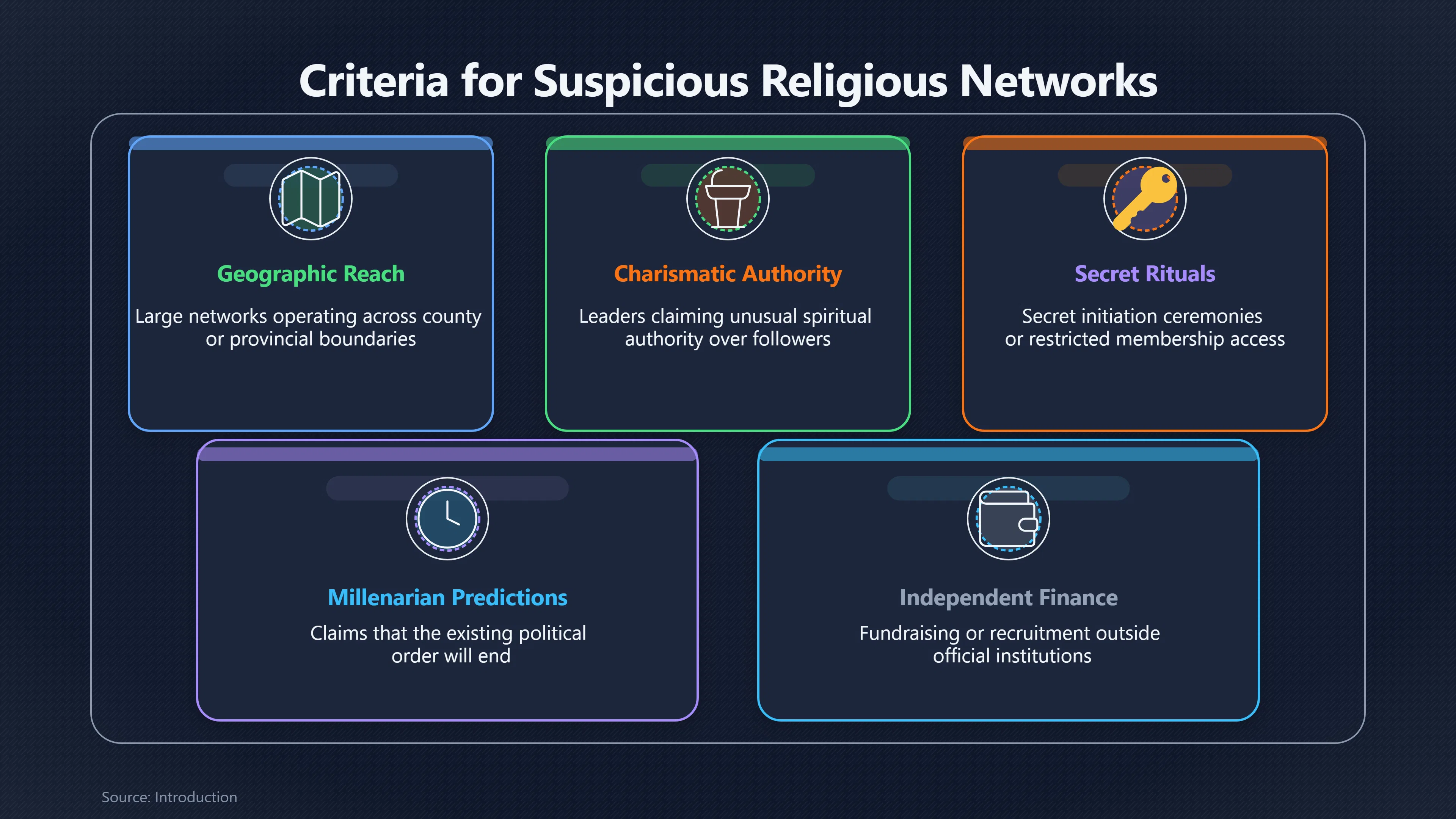
Several recurring features attracted official suspicion:
- Large networks operating across county or provincial boundaries.
- Charismatic leaders claiming unusual spiritual authority.
- Secret initiation ceremonies or restricted membership.
- Predictions that the existing political order would soon end.
- Claims that divine intervention would establish a new era.
- Fundraising or recruitment beyond officially recognised institutions.
These characteristics often overlapped with genuine rebellions, but they did not always do so. As a result, governments frequently treated potential political mobilisation and religious heterodoxy as closely connected rather than separate issues.
Imperial officials were particularly concerned because Chinese history contained several uprisings that had drawn upon religious prophecy or millenarian expectations. Once this association became established, even peaceful movements could be viewed through the lens of earlier rebellions rather than on their own terms. Historians argue that this created a durable administrative tradition in which independent religious organisation itself became evidence of possible sedition.[OUP Academic]academic.oup.comOUP AcademicHeterodox Sects in Premodern China | Oxford Bibliographies in Chinese Studies | Oxford AcademicJune 27, 2018…
How “heterodox” became a political category
A common misunderstanding is that imperial China maintained a fixed list of forbidden religions. In reality, the category of “heterodox teachings” was remarkably flexible.
Rather than identifying one specific faith, officials often grouped together a wide variety of local religious movements, popular sects, healing traditions and salvation societies under broad hostile labels. These classifications could change over time and were shaped by political circumstances as much as by theology.
The best-known example is the label “White Lotus.” Modern scholarship suggests that this term has often been misunderstood. A genuine Buddhist lay movement using the name existed centuries earlier, but after the sixteenth century officials increasingly applied “White Lotus” as a catch-all accusation against many unrelated religious groups. The people being prosecuted frequently did not describe themselves as White Lotus followers at all. Instead, the label functioned as an official shorthand for suspected heterodoxy and possible rebellion.[Brill]brill.comThe White Lotus Teachings in Chinese Religious History | BrillThe White Lotus Teachings in Chinese Religious History | Brill…
This distinction matters because later histories sometimes portrayed very different organisations as members of a single secret conspiracy when they shared little beyond the state’s classification. Modern historians therefore caution against accepting official labels at face value without examining each movement individually.
How different governments redefined dangerous belief
Although Chinese governments have differed enormously in ideology, they have shown striking continuity in linking unauthorised religious organisation with concerns about political stability.
Imperial dynasties
During the Ming and Qing dynasties, officials distinguished between state-recognised religious practice and teachings considered heterodox. Enforcement focused especially on movements suspected of recruiting secretly, collecting followers across large territories or predicting dynastic change. Legal prohibitions were often justified as measures against rebellion rather than against private belief alone.[OUP Academic]academic.oup.comOUP AcademicHeterodox Sects in Premodern China | Oxford Bibliographies in Chinese Studies | Oxford AcademicJune 27, 2018…
Republican governments
The Republic of China inherited many of these concerns while introducing modern ideas about superstition, scientific progress and national modernisation. Religious movements could be criticised not only as politically dangerous but also as obstacles to creating a modern nation-state.
The People’s Republic of China
Since 1949, the Communist Party has officially promoted atheism while allowing only state-regulated religious institutions to operate legally. Buddhism, Taoism, Islam, Catholicism and Protestantism are recognised only through government-approved organisations, while numerous other religious movements remain unauthorised.
Modern regulation therefore combines several different concerns:
- political loyalty;
- public security;
- fraud and financial exploitation;
- protection of public health;
- resistance to what authorities describe as superstition;
- control over organisations operating outside state supervision.
These objectives overlap rather than forming separate legal categories, making the official definition of dangerous belief considerably broader than simple criminal conduct.[Wikipedia]WikipediaHeterodox teachings (Chinese lawHeterodox teachings (Chinese law
Why the term “cult” is so contested
English translations often create confusion because the official Chinese category commonly rendered as “evil cult” carries historical meanings that do not perfectly match the English word “cult.”
The official category refers to organisations that authorities argue deceive followers, elevate leaders, spread superstition or undermine social order. Modern legislation adopted after 1999 provides legal mechanisms for prosecuting organisations designated under this framework.[Wikipedia]WikipediaHeterodox teachings (Chinese lawHeterodox teachings (Chinese law
Outside China, however, many historians and scholars of religion prefer more neutral terms such as:
- new religious movement;[academic.oup.com]academic.oup.comSource details in endnotes.
- salvation movement;
- lay religious network;
- heterodox movement.
They do so because official designation alone does not necessarily resolve whether a group’s beliefs are abusive, politically threatening, socially unconventional or simply independent of state regulation.
The disagreement is therefore partly linguistic and partly political. One side treats designation as a matter of public safety and social stability, while critics argue that the category can also encompass peaceful religious activity that operates outside official control.
The contested classification of Falun Gong
No modern case illustrates these disagreements more clearly than Falun Gong.
Founded during China’s qigong boom of the early 1990s, Falun Gong combines meditation exercises with moral teachings centred on truthfulness, compassion and tolerance. It expanded rapidly through volunteer practice sites and informal organisational networks before relations with the authorities deteriorated.[GOV.UK]GOV.UKcountry policy and information note falun gong china november 2025 accessibleCountry policy and information note: Falun Gong, China, November 2025 (accessible) - GOV.UK…
Following a large demonstration by practitioners outside the central leadership compound in Beijing in April 1999, the government launched a nationwide campaign against the movement. Later that year, new legal measures targeting organisations classified as “heterodox teachings” became the principal framework for suppressing Falun Gong.[Wikipedia]WikipediaHeterodox teachings (Chinese lawHeterodox teachings (Chinese law
The dispute extends well beyond terminology.
The Chinese government argues that Falun Gong functions as an illegal organisation that deceives followers, threatens social order and belongs within the legal category of prohibited “evil cults.” Official sources continue to classify it accordingly.[GOV.UK]GOV.UKcountry policy and information note falun gong china november 2025 accessibleCountry policy and information note: Falun Gong, China, November 2025 (accessible) - GOV.UK…
Many international human-rights organisations, foreign governments and scholars take a different view. While some researchers have critically examined aspects of Falun Gong’s teachings and leadership, many also argue that the state’s designation has been used to justify extensive repression, including arrests, imprisonment and coercive attempts to force practitioners to renounce their beliefs. These reports describe systematic violations of freedom of religion and belief while recognising that opinions differ regarding the movement itself.[GOV.UK]GOV.UKcountry policy and information note falun gong china november 2025 accessibleCountry policy and information note: Falun Gong, China, November 2025 (accessible) - GOV.UK…
This makes Falun Gong an unusually difficult subject to classify. It is simultaneously:
- a spiritual movement with distinctive religious teachings;[english.religion.info]english.religion.infoSource details in endnotes.
- a political issue because of the state’s response;
- an example of how legal categories shape public understanding of religion;
- a continuing source of international human-rights controversy.
What this tells us about dangerous belief in China
Across many centuries, Chinese governments have generally defined dangerous belief less by specific religious doctrine than by perceived risks to political order and state authority.
The labels have changed—from accusations associated with White Lotus teachings to modern anti-cult legislation—but several underlying concerns have remained remarkably consistent. Authorities have repeatedly viewed independent religious organisation, charismatic leadership, nationwide networks and alternative sources of loyalty as potential threats requiring state regulation.
Modern scholarship therefore encourages readers to separate three related but distinct questions whenever a movement is officially condemned:
- Did the movement engage in fraud, coercion or violence?
- Did it challenge political authority or operate outside state regulation?
- How much did official labels shape later public understanding of the movement?
Keeping these questions separate helps explain why debates over “dangerous belief” in China remain so contentious. The same official category has historically encompassed genuine rebellions, fraudulent organisations, unconventional religious movements and peaceful groups that refused state supervision, making careful historical context essential before accepting or rejecting any particular label.
Amazon book picks
Further Reading
Books and field guides related to Who Decides Which Beliefs Are Dangerous?. Use these as the next step if you want deeper reading beyond the article.
The search for modern China
First published 1990. Subjects: History, Historia, Histoire, Qing Dynasty (China), China, history, qing dynasty, 1644-1912.

Falun Gong and the Future of China
First published 2010. Subjects: Falun gong (organization), Qi gong, China, politics and government, New York Times reviewed.
God's Chinese Son
First published 1996. Subjects: History, Historia, Taipingbewegung, Chiliasme, Taiping Rebellion (China : 1850-1864) fast (OCoLC)fst01355...

Endnotes
1.
Source: academic.oup.com
Link:https://academic.oup.com/reference/62338/reference-article-abstract/554184870
Source snippet
OUP AcademicHeterodox Sects in Premodern China | Oxford Bibliographies in Chinese Studies | Oxford AcademicJune 27, 2018...
Published: June 27, 2018
2.
Source: brill.com
Title: The White Lotus Teachings in Chinese Religious History | Brill
Link:https://brill.com/display/title/812?language=en
Source snippet
The White Lotus Teachings in Chinese Religious History | Brill...
3.
Source: Wikipedia
Title: Heterodox teachings (Chinese law)
Link:https://en.wikipedia.org/wiki/Heterodox_teachings_%28Chinese_law%29
4.
Source: GOV.UK
Link:https://www.gov.uk/government/publications/china-country-policy-and-information-notes/country-policy-and-information-note-china-non-christian-religious-groups-december-2024-accessible
Source snippet
Country policy and information note: China: non-Christian religious groups, December 2024 (accessible) - GOV.UK...
Published: december 2024
5.
Source: GOV.UK
Title: country policy and information note falun gong china november 2025 accessible
Link:https://www.gov.uk/government/publications/china-country-policy-and-information-notes/country-policy-and-information-note-falun-gong-china-november-2025-accessible
Source snippet
Country policy and information note: Falun Gong, China, November 2025 (accessible) - GOV.UK...
Published: november 2025
6.
Source: ccdi.gov.cn
Link:https://www.ccdi.gov.cn/specialn/jfbk/jjctjfbk/202506/t20250605_426932.html
Source snippet
纪法百科 | 违反政治纪律的行为:党员信仰宗教————纪法词条——中央纪委国家监委网站June 5, 2025 — 纪法百科 | 违反政治纪律的行为:党员信仰宗教 来源:中央纪委国家监委网站 发布时间: 2025-06-05 17:30 Image 基本释义 党员信仰宗教是...
Published: June 5, 2025
7.
Source: sxgz.shaanxi.gov.cn
Link:https://sxgz.shaanxi.gov.cn/zfxxgk/zc/zcjd/202405/t20240522_2469712.html
Source snippet
shaanxi.gov.cn关于党员信仰宗教、搞迷信活动的处分规定May 22, 2024 — 首页>政务公开>政策 > 政策解读 * 索引号 116100007197833687/2024-00088 主题分类 * 发布机构 省政府国有资产监督管理委员会 成文日期 * 效...
Published: May 22, 2024
8.
Source: drc.hlj.gov.cn
Title: c00 31732000.shtml
Link:https://drc.hlj.gov.cn/drc/c111436/202405/c00_31732000.shtml
9.
Source: academic.oup.com
Link:https://academic.oup.com/book/36596/chapter/321569784
10.
Source: english.religion.info
Link:https://english.religion.info/2018/12/20/china-heterodox-teachings-and-proscription-of-religious-groups-interview-with-edward-irons/
11.
Source: gongbao.court.gov.cn
Title: court.gov.cn最高人民法院 最高人民检察院关于办理组织、利用邪教组织破坏法律实施等刑事案件适用法律若干问题的解释
Link:https://gongbao.court.gov.cn/Details/329600f38f8266b1e3895677e0d88a.html
12.
Source: academic.oup.com
Link:https://academic.oup.com/book/36117/chapter-abstract/313610577
Additional References
13.
Source: youtube.com
Link:https://www.youtube.com/watch?v=stX_YtKk4pY
Source snippet
This video about the Taiping Rebellion history details how a millenarian movement destabilized the Qing dynasty and why imperial authorit...
14.
Source: youtube.com
Title: Yupeng Jiao: Chinese Martial Arts Ritual Groups in the Mid-Twentieth Century
Link:https://www.youtube.com/watch?v=CUX7GAp7A4c
Source snippet
The Taiping Rebellion 1850-1864 | The Story of China | BBC Teach...
15.
Source: youtube.com
Link:https://www.youtube.com/watch?v=24or3zMXU4I
Source snippet
What was the Soulstealing scare of 1768?...
16.
Source: ecoi.net
Link:https://www.ecoi.net/en/document/2111843.html
Source snippet
Criminal law defines banned groups as “cult [xie jiao] organizations” and provides for criminal prosecution of individuals belonging to s...
17.
Source: youtube.com
Title: CHINA: FALUN GONG: LATEST CRACKDOWN
Link:https://www.youtube.com/watch?v=novbq5ujzdo
Source snippet
Yupeng Jiao: Chinese Martial Arts Ritual Groups in the Mid-Twentieth Century...
18.
Source: cambridge.org
Link:https://www.cambridge.org/core/journals/china-quarterly/article/falun-gong-problem-politics-and-the-struggle-for-the-rule-of-law-in-china/897DA646BE1D7F22D967F18FCBECE5C2
19.
Source: tandfonline.com
Link:https://www.tandfonline.com/doi/full/10.1080/1547402X.2016.1168178
20.
Source: cecc.gov
Title: head of religious association religious adherents not arrested due
Link:https://www.cecc.gov/publications/commission-analysis/head-of-religious-association-religious-adherents-not-arrested-due
21.
Source: buddhism.lib.ntu.edu.tw
Title: ntu.edu.tw The White Lotus Teachings in Chinese Religious History
Link:https://buddhism.lib.ntu.edu.tw/en/search/search_detail.jsp?seq=289700
22.
Source: degruyterbrill.com
Title: The White Lotus Teachings in Chinese Religious History
Link:https://www.degruyterbrill.com/de/document/isbn/9789004488069/html
Topic Tree