When Fear Became Fact in Czech History
The Czech Republic’s history of collective fear is not one continuous story of “mass hysteria”.
Page outline Jump by section
Introduction
What connects these cases is not irrationality alone. Each grew from a particular mixture of uncertainty, institutional power, older cultural stories and channels of communication. A rumour became far more dangerous when courts accepted it as evidence, newspapers repeated it, police coerced confessions or political leaders presented suspicion as established fact. Conversely, some movements described as dangerous “cults” were mainly unconventional minorities whose public image was shaped by hostile labels rather than demonstrated harm.
The most useful question is therefore not whether Czech society periodically “went mad”. It is how beliefs and fears acquired authority, who benefited from them, and what happened to people who could not escape the resulting narrative.
When witchcraft became a judicial system
The best-known Czech witch persecutions took place in northern Moravia and neighbouring Silesian territories during the seventeenth century. The major proceedings around Velké Losiny and Šumperk ran chiefly from 1679 into the 1690s, although prosecutions in the wider region had begun earlier. A Charles University study identifies 81 people executed in the Velké Losiny and Šumperk trials, while regional records and exhibitions describe a broader wave extending through the Jeseníky area.[CU Digital Repository]dspace.cuni.czCU Digital RepositoryČarodějnické procesy na severní MoravěDigitální repozitář UKIn northern Moravia, the largest witch trials took place in the years 1679 - 1696 in the Velké Losiny estate and in…
The immediate trigger at Velké Losiny was apparently mundane. A poor woman was accused of taking a consecrated wafer from church, reportedly for use in folk magic intended to improve a cow’s milk production. What might have remained a local religious offence was transformed into evidence of organised witchcraft. The estate authorities called in the inquisitorial judge Jindřich František Boblig, who developed the case into an expanding network of accusations.[VisitCzechia]visitczechia.comVelké Losiny ChateauA sinister period at the chateau came with the witch trials, during which 56 innocent people were incarce…
This expansion followed a familiar mechanism. Tortured suspects were pressed to name accomplices, creating new arrests whose confessions then appeared to confirm the original theory. Ordinary practices, grudges and social connections could be reinterpreted as signs of a hidden sect. Once the court assumed that a secret conspiracy existed, denial itself could be treated as further deception. The panic was therefore not simply a spontaneous wave of village superstition. It was produced and sustained by an official procedure capable of turning coercion into evidence.
Economic and political interests also mattered. Prosecutions could generate fees and place property at risk, while the accused included people with sufficient local standing to attract resentment or official attention. Modern accounts increasingly emphasise this institutional dimension rather than portraying Boblig as a lone fanatic acting upon an otherwise passive population. Czech Radio’s review of recent scholarship notes that historians continue to reassess how responsibility was distributed among the investigator, estate authorities, clergy and courts.[Radio Prague International]english.radio.czRadio Prague InternationalThe 17th century witch trials in northern Moravia4 days ago — The witch trials that swept through northern Mora…
The trials are now among the most publicly remembered episodes of persecution in the Czech lands. Museums and memorials in Šumperk, Jeseník and surrounding towns preserve the victims’ stories, while a regional route links sites associated with the prosecutions. This remembrance has educational value, but tourism can also turn judicial torture into gothic entertainment. The history is clearest when presented not as a supernatural mystery but as an example of institutions making an unprovable belief legally lethal.[visitczechia.com]visitczechia.comThe Witches' Cycle RouteThree exhibitions relate the history of the trials: in Šumperk, in the cellars of the Gothic Moated F…
The Hilsner affair and the return of blood libel
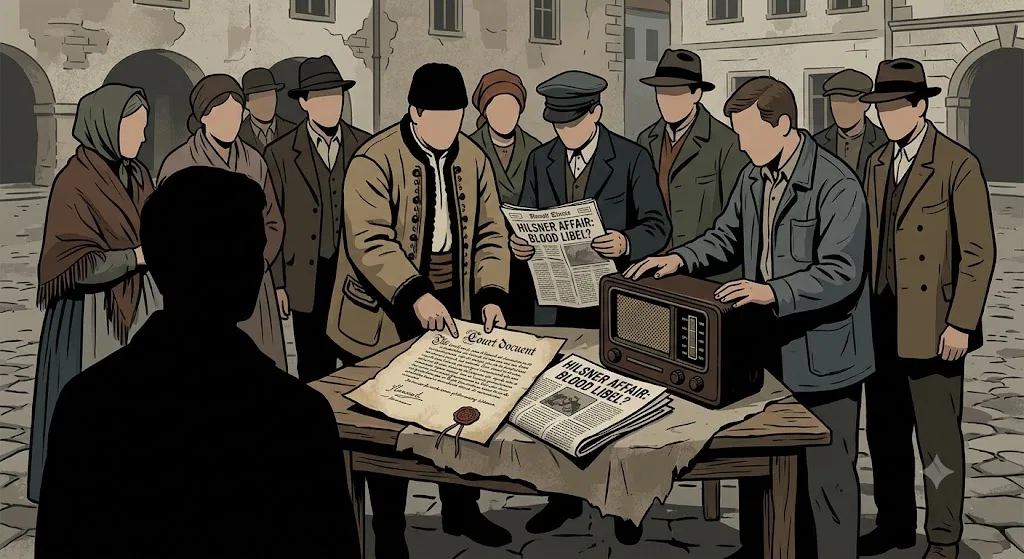
In 1899, the murder of 19-year-old Anežka Hrůzová near Polná became the centre of one of the most notorious antisemitic panics in the modern Czech lands. Her body was found with a cut throat shortly before Easter, which coincided that year with Passover. Because witnesses believed there was less blood at the scene than expected, an ancient accusation resurfaced: the false claim that Jews murdered Christians to obtain blood for religious rituals.[Jewish Museum Prague]jewishmuseum.cz16 April 1879) took place in Březina Wood near Polná, a hundred years ago on Ash Wednesday, 29 March 1899…
Suspicion settled on Leopold Hilsner, a poor Jewish man who lived locally and had been seen in the area. The case against him was weak and heavily dependent on uncertain witness testimony. No convincing evidence established a ritual killing, yet prosecutors and public discussion allowed the blood-libel story to shape how the crime was understood. The allegation also implied unnamed Jewish accomplices, converting an individual murder inquiry into a supposed communal conspiracy.[SReview]sreview.soc.cas.czSReview A Mysterious Murder. The Case of Leopold HilsnerSReview A Mysterious Murder. The Case of Leopold Hilsner
The rumour spread because it joined several powerful tensions. Antisemitism remained embedded in parts of European popular culture. Czech and German nationalism competed within the Habsburg monarchy. Newspapers turned a local crime into a widely discussed political drama. The timing around Christian and Jewish festivals gave promoters of the libel an emotionally effective coincidence, even though coincidence was not evidence.
Tomáš Garrigue Masaryk, then a university professor and later the first president of Czechoslovakia, publicly challenged the ritual-murder claim and criticised the handling of the evidence. His intervention made him a target of intense hostility. The affair consequently became more than a criminal case: it was also a test of whether scientific reasoning and due process could withstand nationalism, inherited prejudice and popular anger.[Wikipedia]WikipediaHilsner affairHilsner affair
Hilsner was convicted, initially sentenced to death and later given life imprisonment. He was pardoned in 1918 after spending 19 years in prison, but his conviction was never formally annulled. The murders themselves remain unsolved. The responsible historical conclusion is therefore not that every detail of the crime is known, but that the ritual-murder theory was unsupported and that antisemitic assumptions gravely distorted the investigation and trial.[Wikipedia]WikipediaHilsner affairHilsner affair
The Hilsner affair demonstrates the difference between an unsolved crime and a mystery filled with folklore. Uncertainty about the murderer did not make the blood libel plausible. Instead, the absence of firm evidence created space for an old story to organise public suspicion.
How the Communist state manufactured hidden enemies
After the Communist takeover of Czechoslovakia in 1948, conspiracy narratives became instruments of government rather than merely popular rumours. The regime repeatedly claimed to have discovered secret networks of traitors, spies, priests, “cosmopolitans” and foreign agents. Investigations and trials were structured to prove predetermined political stories, often through coercive interrogation and scripted confession.
The Slánský trial
The 1952 Slánský trial accused Rudolf Slánský, formerly the Communist Party’s general secretary, and thirteen other senior figures of belonging to an “anti-state conspiracy centre”. Eleven of the fourteen defendants were identified as being of Jewish origin. The prosecution combined accusations of treason, espionage, Zionism and loyalty to Western interests, reflecting the antisemitic purges then spreading through the Soviet bloc. All fourteen were convicted; eleven were executed and three received life sentences.[YIVO Encyclopedia]encyclopedia.yivo.orgEncyclopedia Slánský TrialEncyclopedia Slánský Trial
This was not mass hysteria in the medical sense. It was a state-managed political panic. Newspapers, radio, public meetings and officially published trial material presented the conspiracy as proven, while the defendants’ statements had been produced under extreme pressure. The regime created an apparently self-confirming spectacle: confession demonstrated guilt, ideological language explained motive, and the court’s verdict validated the propaganda that had preceded it.
The trial also shows why “collective delusion” can be an inadequate description of authoritarian campaigns. Many citizens may have believed the charges, but public repetition could also arise from fear, career pressure or the knowledge that disagreement was dangerous. Apparent unanimity did not necessarily mean private conviction.
The Číhošť miracle
A different struggle over belief began in December 1949 in the village of Číhošť. During Mass, several parishioners reported seeing a cross on the altar move. The parish priest, Josef Toufar, said he had not witnessed it because he was facing away. News of the event spread, and visitors began treating it as a possible miracle.[Wikipedia]WikipediaČíhošť miracleČíhošť miracle
The Communist secret police saw an opportunity to portray the Catholic Church as fraudulent and politically subversive. Toufar was arrested and tortured into supporting a claim that he had operated a hidden mechanism. Officials filmed a staged reconstruction, although the alleged method did not convincingly account for what witnesses had reported. Toufar died in February 1950 from injuries inflicted during interrogation.[Radio Prague International]english.radio.czdecember 11 1949 cihost miracle abused communist secret police discredit 8836621december 11 1949 cihost miracle abused communist secret police discredit 8836621
It remains uncertain what caused the cross to move, or precisely what every witness saw. That uncertainty is important. It leaves room for religious interpretation, mechanical explanations, mistaken perception or later embellishment. It does not justify the state’s fabricated solution.
The deeper panic was the regime’s fear of an independent source of authority. A local report became threatening because pilgrimage, miracle belief and loyalty to the Church could gather people outside Communist control. The authorities therefore converted an unexplained event into proof of an organised clerical deception. Toufar was posthumously rehabilitated in 1998, and the case is now remembered primarily as an example of police torture and propaganda rather than as proof or disproof of a miracle.[Wikipedia]WikipediaČíhošť miracleČíhošť miracle
Why “sect” scares grew after 1989
The fall of Communist rule reopened public life to religious organisations, spiritual entrepreneurs and imported movements that had previously operated under restriction or were barely known in Czechoslovakia. This new pluralism coincided with uncertainty about how to distinguish religious freedom from manipulation, fraud or coercive control.
Czech discussion often used words equivalent to “sect” or “cult” broadly, sometimes treating unconventional belief as evidence of danger. Research on Czech new religious movements has found that public perceptions were shaped not only by the groups’ actual behaviour but also by inherited suspicion of organised religion, foreign movements and intense forms of commitment. Scholars have therefore argued for separating demonstrated abuses from assumptions based on unusual doctrine, lifestyle or recruitment.[journal.fi]journal.fiOpen source on journal.fi.
The language of “brainwashing” became especially influential. It offered an apparently simple explanation for why somebody might join a demanding movement: the person’s free will had supposedly been captured by a powerful leader or technique. Yet brainwashing claims can become circular. Strong belief is treated as proof of manipulation, while a member’s denial of manipulation is interpreted as evidence that the control is complete. Recent Czech scholarship has compared this logic with older stories about heretical or magical groups secretly overwhelming their victims’ minds.[Karolinum]karolinum.czOpen source on karolinum.cz.
This does not mean that all fears were invented. Religious or therapeutic organisations can exploit members financially, sexually or psychologically, and allegations require proper investigation. The distinction is between assessing specific conduct and treating an unpopular identity as a diagnosis. Useful questions include whether members can leave, whether leaders conceal material facts, whether children or vulnerable adults are endangered, and whether accusations are supported by witnesses and documents.
The Universe People: apocalypse, aliens and media spectacle
The Universe People became the Czech Republic’s most recognisable UFO religion during the late 1990s. Centred on Ivo Benda, the movement taught that benevolent extraterrestrial beings communicated with chosen humans and would assist a spiritual transformation of the Earth. Its ideas combined contactee UFO traditions, elements drawn from Christianity, apocalyptic expectation and fears of technological control.[Philistine Journals]journals.phil.muni.czPhilistine Journals Kubálková, Klára Counterintuitive yet unsuccessfulPhilistine Journals Kubálková, Klára Counterintuitive yet unsuccessful
The movement is a revealing example of the gap between visibility and social strength. Benda’s lectures, publications, colourful online material and media appearances made the group highly memorable. Journalists and members of the public often treated it as bizarre entertainment. Some coverage, influenced by memories of the Heaven’s Gate deaths in the United States, also raised the possibility that UFO-based apocalyptic belief could lead to similar violence or mass suicide. Available Czech scholarship, however, does not establish that the Universe People were preparing such an event.[Wikipedia]WikipediaUniverse PeopleUniverse People
Later research describes the movement as prominent in the late 1990s but ultimately unsuccessful at sustaining broad participation. This matters because sensational publicity can create the impression of a large and rapidly growing organisation when much of its audience consists of curious visitors, sceptics or people enjoying the spectacle.[Philistine Journals]journals.phil.muni.czPhilistine Journals Kubálková, Klára Counterintuitive yet unsuccessfulPhilistine Journals Kubálková, Klára Counterintuitive yet unsuccessful
The group’s anti-technology warnings also anticipated themes that would become widespread outside UFO religion. Stories about compulsory microchips, total surveillance and non-human forces controlling society later circulated through broader conspiracy cultures. The Universe People did not cause those beliefs, but they show how religious apocalypse and political-technological fear can merge into a single story.
Calling the movement a “cult” may describe how critics and media framed it, but “UFO religion” or “new religious movement” is usually more precise unless discussing specific allegations of harmful control. Its greatest Czech cultural impact may have been symbolic: it became a familiar reference point for eccentric belief, internet folklore and anxiety about what religious freedom might permit.
COVID-19 and the digital conspiracy cycle
The COVID-19 pandemic produced a different kind of collective fear. The disease itself was real, but uncertainty about its origins, government restrictions, vaccines and economic disruption created favourable conditions for exaggerated or conspiratorial explanations.
Czech research has examined narratives claiming that the pandemic was deliberately engineered, that governments or corporations concealed its true purpose, or that public-health measures formed part of a larger programme of control. A study of Czech public opinion found that conspiracy narratives undermined support for measures intended to limit infection, demonstrating that belief could have practical consequences beyond online discussion.[OUP Academic]academic.oup.comOpen source on oup.com.
Czech scepticism was intensified by political inconsistency and declining trust. In early 2021, amid severe infection levels and pressure on hospitals, a poll reported that 45 per cent of respondents regarded the pandemic as a “media bubble”, while only 18 per cent saw the virus as posing a high risk. Such findings should not be read as proof that nearly half the population subscribed to one coherent conspiracy theory. They indicate a mixture of distrust, fatigue, political protest, risk misjudgement and exposure to misleading claims.[The Guardian]theguardian.comThe Guardian'All hypotheses still open' on virus origin; Greece extends lockdownThe Guardian'All hypotheses still open' on virus origin; Greece extends lockdown
Nor should pandemic misinformation itself be called mass psychogenic illness. That term normally refers to groups developing real physical symptoms without an identified toxic or infectious cause, often through stress, expectation and social transmission. COVID conspiracy belief was instead an information and trust crisis surrounding a genuine infectious disease.[PMC]pmc.ncbi.nlm.nih.govPMCMass psychogenic illness and the social networkPMCMass psychogenic illness and the social network
The digital environment nevertheless reproduced older patterns. Hidden enemies were blamed; unrelated facts were joined into a single plot; scepticism towards one institution expanded into rejection of many institutions; and repeated claims acquired familiarity before they acquired evidence. Unlike a local rumour in Polná or a report from a village church, an online narrative could move immediately between Czech, Slovak, German, Russian, American and other media spaces.
What these episodes have in common
The Czech cases differ too much to fit one diagnosis. Witch trials were judicial persecution. The Hilsner affair was an antisemitic moral and legal panic. Communist show trials were manufactured state conspiracies. The Číhošť case involved an unresolved reported phenomenon exploited by a repressive government. Post-1989 “sect” scares mixed legitimate safeguarding concerns with prejudice towards unfamiliar religions. COVID conspiracies grew around a real emergency but often weakened trust in evidence-based responses.
Several recurring mechanisms are nevertheless visible.
A familiar story fills an evidential gap. Missing blood became “proof” of ritual murder. A moving cross became either a confirmed miracle or a clerical plot. Strange religious language became evidence of mind control. Uncertainty was uncomfortable, so a culturally available explanation arrived before adequate investigation.
Institutions decide whether fear becomes harmful. Rumours alone did not execute accused witches, imprison Hilsner or kill Toufar. Courts, estate authorities, police and political organisations converted narratives into coercive action.
Confession can be manufactured. Torture in witch proceedings generated names of supposed accomplices. Communist interrogations produced admissions designed to fit official conspiracy theories. A confession obtained under coercion is not independent confirmation of the story demanded by the interrogator.
Media enlarge both audiences and stakes. Print culture spread the Hilsner accusations; state broadcasting presented Communist trials as public truth; television turned small new religious movements into national curiosities; social media accelerated pandemic conspiracies. Media attention can expose abuse, but it can also make a marginal claim appear socially dominant.
Real grievances can attach themselves to false explanations. Economic insecurity, distrust of government, resentment of elites or anger at institutional religion may be genuine. The presence of such grievances does not validate claims about witches, ritual murder, alien rescue or secret medical plots.
Labels can conceal important distinctions. “Cult”, “panic”, “hysteria”, “conspiracy” and “miracle” are not interchangeable. Each directs attention towards a different explanation and can either clarify or prejudge a case.
The most enduring lesson from the Czech Republic’s history of collective belief is therefore procedural rather than psychological. Unusual claims deserve calm investigation; unexplained events should remain unexplained until evidence supports a conclusion; accusations against minorities require particular scrutiny; and state or media certainty is not a substitute for proof. Across four centuries, the greatest damage occurred when a compelling story was allowed to close the case before the evidence had properly opened it.
Amazon book picks
Further Reading
Books and field guides related to When Fear Became Fact in Czech History. Use these as the next step if you want deeper reading beyond the article.
The Demon-Haunted World
Helps readers understand why unsupported claims and moral panics gain acceptance.

The witch
Explains how witchcraft fears developed across Europe, including Central Europe.
Prague winter
Explores Czech history, ideology and political upheaval in the modern era.
The pursuit of the millennium
Provides broad context for fear, rumor and collective belief across European history.
Endnotes
1.
Source: ok-tourism.cz
Title: Witch trials in Jeseniky
Link:https://www.ok-tourism.cz/en/cil/witch-trials-in-jeseniky-exposition/
Source snippet
expositionThe Inquisition trials in the territory of the Bishopric of Wrocław, to which the Jeseníky region belonged, plagued Silesia fro...
2.
Source: visitczechia.com
Link:https://www.visitczechia.com/en-us/things-to-do/places/landmarks/chateaux/c-velke-losiny-chateau
Source snippet
Velké Losiny ChateauA sinister period at the chateau came with the witch trials, during which 56 innocent people were incarce...
3.
Source: english.radio.cz
Link:https://english.radio.cz/17th-century-witch-trials-northern-moravia-was-everything-really-we-thought-8891053
Source snippet
Radio Prague InternationalThe 17th century witch trials in northern Moravia4 days ago — The witch trials that swept through northern Mora...
4.
Source: visitczechia.com
Link:https://www.visitczechia.com/en-us/things-to-do/places/summer-sports/cycling/s-jeseniky-witches-route
Source snippet
The Witches' Cycle RouteThree exhibitions relate the history of the trials: in Šumperk, in the cellars of the Gothic Moated F...
5.
Source: ok-tourism.cz
Link:https://www.ok-tourism.cz/en/cil/exposition-witch-trials-in-sumperk/
Source snippet
Exposition Witch Trials in ŠumperkThe rule of the Inquisition, which caused the burning of hundreds of innocent people during the witch t...
6.
Source: encyclopedia.yivo.org
Title: Encyclopedia Hilsner Affair
Link:https://encyclopedia.yivo.org/article.aspx/Hilsner_Affair
7.
Source: english.radio.cz
Link:https://english.radio.cz/blood-libel-czech-lawyer-specialising-judicial-rehabilitation-takes-hilsner-8687899
8.
Source: Wikipedia
Title: Hilsner affair
Link:https://en.wikipedia.org/wiki/Hilsner_affair
9.
Source: encyclopedia.yivo.org
Title: Encyclopedia Slánský Trial
Link:https://encyclopedia.yivo.org/article.aspx/Slansky_Trial
10.
Source: Wikipedia
Title: Číhošť miracle
Link:https://en.wikipedia.org/wiki/%C4%8C%C3%ADho%C5%A1%C5%A5_miracle
11.
Source: english.radio.cz
Title: december 11 1949 cihost miracle abused communist secret police discredit 8836621
Link:https://english.radio.cz/december-11-1949-cihost-miracle-abused-communist-secret-police-discredit-8836621
12.
Source: journal.fi
Link:https://journal.fi/scripta/article/view/67319/27616
13.
Source: karolinum.cz
Link:https://karolinum.cz/data/clanek/16743/CEJCR_6_1_0043.pdf
14.
Source: Wikipedia
Title: Universe People
Link:https://en.wikipedia.org/wiki/Universe_People
15.
Source: academic.oup.com
Link:https://academic.oup.com/eurpub/article/34/1/69/7334517
16.
Source: pmc.ncbi.nlm.nih.gov
Title: PMCMass psychogenic illness and the social network
Link:https://pmc.ncbi.nlm.nih.gov/articles/PMC3536509/
17.
Source: Wikipedia
Title: Northern Moravia witch trials
Link:https://en.wikipedia.org/wiki/Northern_Moravia_witch_trials
18.
Source: Wikipedia
Title: Czech Republic
Link:https://en.wikipedia.org/wiki/Czech_Republic
19.
Source: Wikipedia
Title: List of mass panic cases
Link:https://en.wikipedia.org/wiki/List_of_mass_panic_cases
20.
Source: Wikipedia
Title: Velké Losiny
Link:https://en.wikipedia.org/wiki/Velk%C3%A9_Losiny
21.
Source: Wikipedia
Title: Mass psychogenic illness
Link:https://en.wikipedia.org/wiki/Mass_psychogenic_illness
22.
Source: Wikipedia
Title: Slánský trial
Link:https://en.wikipedia.org/wiki/Sl%C3%A1nsk%C3%BD_trial
23.
Source: Wikipedia
Title: Ashtar Sheran
Link:https://en.wikipedia.org/wiki/Ashtar_Sheran
24.
Source: karolinum.cz
Link:https://karolinum.cz/data/clanek/6222/CEJCR_2_2_0099.pdf
25.
Source: english.radio.cz
Link:https://english.radio.cz/a-puppet-some-monstrous-play-josef-toufars-cruel-fate-recalled-70-years-later-8107201
26.
Source: english.radio.cz
Link:https://english.radio.cz/going-viral-czech-researchers-map-local-spread-covid-19-dismisinformation-8706129
27.
Source: history.state.gov
Link:https://history.state.gov/historicaldocuments/frus1952-54v02p2/d302
28.
Source: global.oup.com
Title: the slnsk trial 9780197604083
Link:https://global.oup.com/academic/product/the-slnsk-trial-9780197604083
29.
Source: dspace.cuni.cz
Title: CU Digital RepositoryČarodějnické procesy na severní Moravě
Link:https://dspace.cuni.cz/handle/20.500.11956/54257?show=full
Source snippet
Digitální repozitář UKIn northern Moravia, the largest witch trials took place in the years 1679 - 1696 in the Velké Losiny estate and in...
30.
Source: jewishmuseum.cz
Link:https://www.jewishmuseum.cz/en/program-and-education/exhibits/archive-exhibits/363/
Source snippet
16 April 1879) took place in Březina Wood near Polná, a hundred years ago on Ash Wednesday, 29 March 1899...
Published: April 1879
31.
Source: sreview.soc.cas.cz
Title: SReview A Mysterious Murder. The Case of Leopold Hilsner
Link:https://sreview.soc.cas.cz/pdfs/csr/1996/11/30.pdf
32.
Source: na.gov.cz
Title: National Archives Slánský
Link:https://na.gov.cz/en/for-public/research-room/digital-research-room-archival-records-on-line/political-trials/slansky
33.
Source: journals.phil.muni.cz
Title: Philistine Journals Kubálková, Klára Counterintuitive yet unsuccessful
Link:https://journals.phil.muni.cz/religio/article/view/40555/34230
34.
Source: digilib.phil.muni.cz
Link:https://digilib.phil.muni.cz/sites/default/files/pdf/Religio_33_2025_1_05.pdf
35.
Source: theguardian.com
Title: The Guardian’All hypotheses still open’ on virus origin; Greece extends lockdown
Link:https://www.theguardian.com/world/live/2021/feb/12/coronavirus-live-news-biden-says-trump-did-not-do-his-job-amazon-variant-three-times-more-contagious
36.
Source: pubmed.ncbi.nlm.nih.gov
Link:https://pubmed.ncbi.nlm.nih.gov/39473380/
37.
Source: pmc.ncbi.nlm.nih.gov
Link:https://pmc.ncbi.nlm.nih.gov/articles/PMC12907468/
38.
Source: sreview.soc.cas.cz
Link:https://sreview.soc.cas.cz/pdfs/csr/2004/03/03.pdf
39.
Source: sreview.soc.cas.cz
Title: csr 200403 0003 religious processes in contemporary czech society
Link:https://sreview.soc.cas.cz/artkey/csr-200403-0003_religious-processes-in-contemporary-czech-society.php
40.
Source: jewishhistory.usd.cas.cz
Link:https://www.jewishhistory.usd.cas.cz/projects/zionists-on-trial-the-slansky-affair-and-the-dynamics-of-czechoslovak-stalinism/
41.
Source: dspace.cuni.cz
Link:https://dspace.cuni.cz/bitstream/handle/20.500.11956/36167/DPBE_2010_1_11220_0_36559_0_66807.pdf?isAllowed=y&sequence=3
42.
Source: dspace.cuni.cz
Link:https://dspace.cuni.cz/bitstream/handle/20.500.11956/24832/150010796.pdf?isAllowed=y&sequence=3
43.
Source: anglistika.phil.muni.cz
Link:https://anglistika.phil.muni.cz/media/3286508/thepes_9_2020_1-2.pdf
44.
Source: czechology.com
Title: witch trials
Link:https://www.czechology.com/witch-trials/
45.
Source: journals.akademicka.pl
Link:https://journals.akademicka.pl/politeja/article/view/6698
46.
Source: unexpectedtraveller.com
Link:https://www.unexpectedtraveller.com/toufar/
47.
Source: theguardian.com
Title: was ripon school gripped by mass psychogenic illness
Link:https://www.theguardian.com/science/2015/nov/14/was-ripon-school-gripped-by-mass-psychogenic-illness
48.
Source: theguardian.com
Title: rudolf slansky czechoslovakia show trial
Link:https://www.theguardian.com/world/2018/apr/08/rudolf-slansky-czechoslovakia-show-trial
49.
Source: philosophy-of-megaten.fandom.com
Title: UFO religion
Link:https://philosophy-of-megaten.fandom.com/wiki/UFO_religion
50.
Source: amazon.de
Link:https://www.amazon.de/Sects-Religions-Critical-Concepts-Sociology/dp/0415320291?tag=searcht-20
Additional References
51.
Source: youtube.com
Link:https://www.youtube.com/watch?v=gvf6BXWPpVQ
Source snippet
Who Really Started the Witch Trials in Velké Losiny?...
52.
Source: youtube.com
Title: Velvet Revolution Lies: The Fake Death No One Talks About
Link:https://www.youtube.com/watch?v=5Wt_GWg194w
Source snippet
The Execution of Rudolf Slánský: A Symbol of Communist Persecution and Conspiracies...
53.
Source: youtube.com
Title: Who Really Started the Witch Trials in Velké Losiny?
Link:https://www.youtube.com/watch?v=oZ_z7JodKOk
Source snippet
StB Officer Who Tortured to Death 'Číhošť Miracle' Priest Josef Toufar Dies a Free Man...
54.
Source: academia.edu
Link:https://www.academia.edu/90916674/Focus_on_Religion_in_Central_and_Eastern_Europe
55.
Source: researchgate.net
Link:https://www.researchgate.net/publication/31054984_New_Religions_in_New_Europe
56.
Source: historysnob.com
Link:https://www.historysnob.com/war-and-historical-events/20-chilling-cases-mass-hysteria-throughout-history
57.
Source: researchgate.net
Link:https://www.researchgate.net/publication/326888159_New_religious_movements_and_their_perception_as_conflict_religious_groups_the_case_of_the_Czech_Republic
58.
Source: researchgate.net
Link:https://www.researchgate.net/publication/375085489The%27Satanic_Panic%27_exploring_the_influence_of_film_in_formulating_narratives_surrounding_the_lived_religion_of_the_Occult_and_its_practitioners
59.
Source: researchgate.net
Link:https://www.researchgate.net/publication/392838044_Factors_related_to_the_occurrence_of_mass_psychogenic_illness_in_schools_a_systematic_review
60.
Source: facebook.com
Link:https://www.facebook.com/Czechology/posts/bohemia-moravia-and-silesia-werent-spared-the-witch-trials-happening-in-europe-f/1271975514929862/
Topic Tree
Follow this branch
Related pages 192
- Antigua and Barbuda
- Argentina Belief Scares
- Azerbaijan Belief
- Bahrain Beliefs
- North Korea
- +187 more in sidebar