Within Sri Lanka Panics
How Sterilisation Rumours Fuelled Anti Muslim Violence
False claims of covert Muslim sterilisation turned food, clothing and medical care into supposed weapons in a demographic conspiracy.
On this page
- The Ampara restaurant attack
- Why the infertility claims were implausible
- Rumour, nationalism and political mobilisation
Page outline Jump by section
Introduction
From 2018 onwards, one of the most dangerous rumours in modern Sri Lankan history claimed that Muslims were secretly trying to reduce the Sinhala Buddhist population by causing infertility. The conspiracy theory alleged that “sterilisation pills” or other fertility-reducing substances were being mixed into food, medicines or medical treatment without people’s knowledge. Although these claims had no scientific basis and were repeatedly disproved, they became a powerful catalyst for anti-Muslim violence, helping to justify mob attacks, political agitation and discrimination.
Rather than representing a case of mass psychogenic illness, this episode is better understood as a rumour-driven moral panic. False demographic fears spread through social media, nationalist networks and sensational media coverage before being reinforced by political rhetoric. The resulting violence demonstrates how fabricated health claims can become tools for communal mobilisation when they resonate with existing anxieties about identity, security and demographic change.
The Ampara restaurant attack
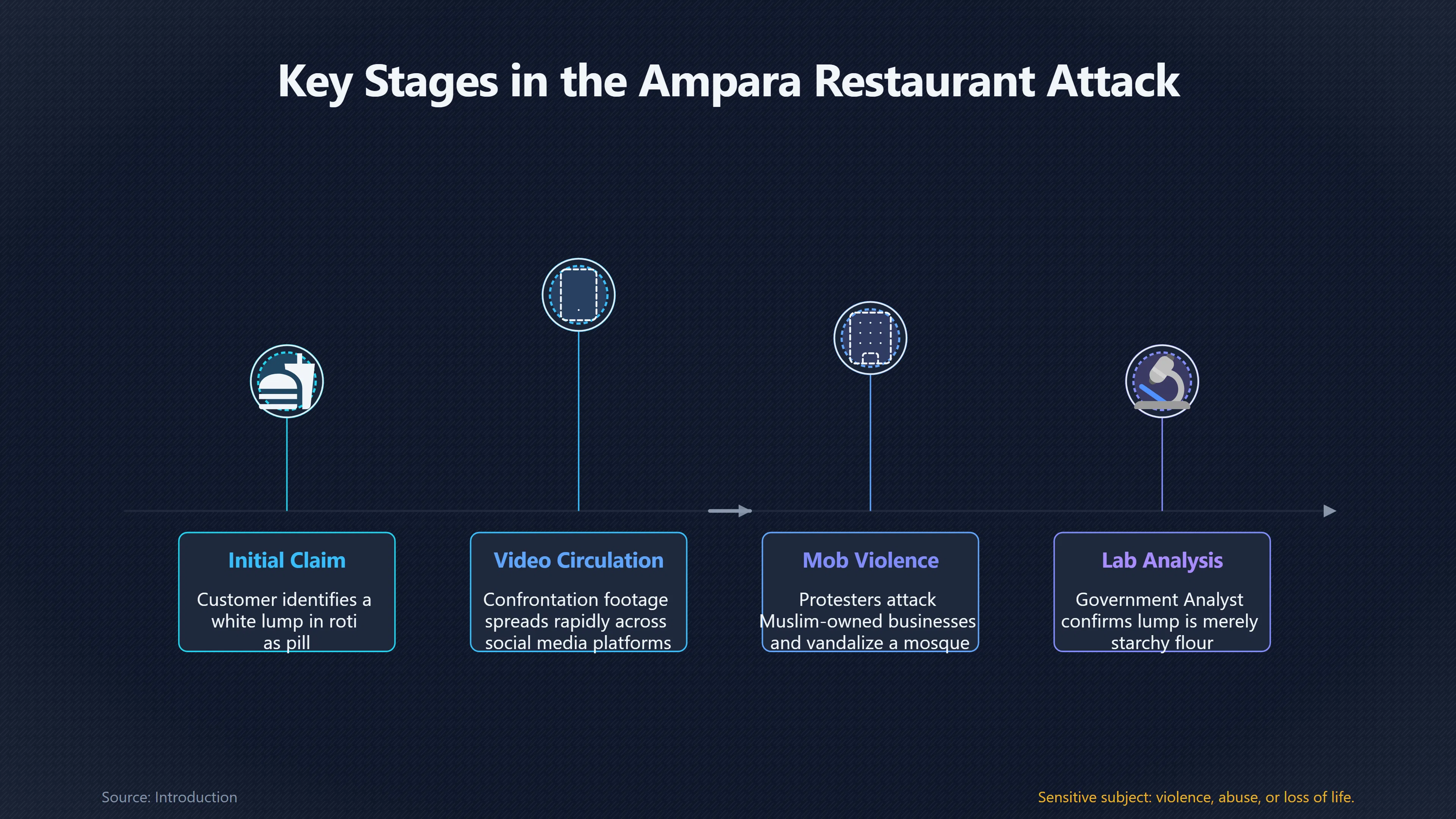
The rumour reached a turning point on 26 February 2018 in the eastern town of Ampara.
A Sinhala customer eating at a Muslim-owned restaurant claimed that a white lump found in a piece of roti or paratha was evidence of a “sterilisation pill”. A video recorded during the confrontation circulated rapidly online. Because the restaurant owner spoke only limited Sinhala, his confused responses were interpreted by the crowd as an admission that sterilising substances had been added deliberately to customers’ food.[csw.org.uk]csw.org.ukCSWGeneral Briefing: Sri LankaMay 1, 2020…
Within hours, the accusation triggered mob violence. Muslim-owned businesses were attacked, property was destroyed and a nearby mosque was vandalised. Several people were injured before police restored order. The incident quickly became a national story rather than remaining an isolated local dispute.[independent.lk]independent.lkCeylon IndependentMuslim shops attacked in Buddhist-Muslim clash in Sri Lanka's East, security strengthened in Ampara - Ceylon Independent…
Crucially, laboratory analysis soon demonstrated that the supposed “pill” was nothing more than starchy food matter—a lump of flour or dough. The Government Analyst found no evidence whatsoever of any chemical or pharmaceutical substance.[Ceylon Independent]independent.lkCeylon IndependentGovernment Analyst's report says clump of flour, not medicinal pills found in the Ampara eatery food - Ceylon Independe…
Why the infertility claims were implausible
The conspiracy rested on a medically impossible premise.
International health organisations responded unusually quickly because the rumour concerned reproductive medicine. The World Health Organization (WHO) and the United Nations Population Fund (UNFPA) jointly stated that there is no medication known to science that can be secretly mixed into food and permanently sterilise a person through ingestion. They described the claim as entirely baseless.[UNFPA Srilanka]srilanka.unfpa.orgSrilanka UNFPA Sri Lanka | UNFPA & WHO: Joint Media StatementUNFPA SrilankaUNFPA Sri Lanka | UNFPA & WHO: Joint Media StatementMarch 7, 2018…
The rumour nevertheless appealed to deeper demographic fears rather than scientific reasoning. It suggested that Muslims were supposedly attempting to outnumber the Sinhala Buddhist majority through a hidden programme of reproductive sabotage instead of ordinary political or social competition. This transformed ordinary commercial interactions—eating at restaurants, visiting pharmacies or receiving medical care—into imagined threats.
The claim also benefited from its simplicity. Unlike complex medical explanations, the rumour offered an emotionally satisfying narrative that appeared to explain broader anxieties about changing demographics and communal relations.
From restaurants to hospitals
The panic did not end with Ampara.
After the Easter Sunday terrorist attacks in April 2019, suspicion shifted towards Muslim medical professionals. The most prominent case involved a Muslim obstetrician, Dr Seigu Shihabdeen Mohamed Shafi, who was accused in newspaper reports of secretly sterilising thousands of Sinhala Buddhist women during Caesarean operations and of having links to Islamist terrorism.
The allegations generated enormous publicity and intensified anti-Muslim hostility. However, extensive investigations by Sri Lanka’s Criminal Investigation Department found no evidence that the doctor had carried out covert sterilisations or that he had terrorist connections. AFP Fact Check later documented that the principal allegations had been disproved by investigators.[AFP Fact Check]factcheck.afp.comAFP Fact CheckSri Lankan authorities found the Muslim surgeon had not performed any sterilisations | Fact CheckJuly 5, 2019…
The episode illustrated how the same conspiracy theory evolved over time. Instead of alleging contaminated food, it expanded into accusations that Muslim doctors were conducting secret demographic warfare through surgical procedures.

Rumour, nationalism and political mobilisation
The sterilisation conspiracy resonated because it connected with long-standing nationalist narratives portraying Sri Lankan Muslims as an organised demographic threat rather than as an ordinary religious minority.
Rumours had circulated for years alleging that Muslim-owned businesses were using contraceptives or fertility-reducing substances against Sinhala customers. Social media significantly accelerated their spread, allowing dramatic but unverified stories to circulate far faster than official corrections. Researchers and observers have noted that Facebook and messaging platforms enabled local incidents to become national controversies within hours.[CSW]csw.org.ukCSWGeneral Briefing: Sri LankaMay 1, 2020…
The Ampara incident also demonstrates how misunderstandings could become politically charged. Accounts from investigators and later analyses describe how a language barrier between the customer and restaurant owner helped transform a routine disagreement into what observers believed was a confession, providing apparent “proof” for an existing conspiracy theory.[CSW]csw.org.ukCSWGeneral Briefing: Sri LankaMay 1, 2020…
Nationalist organisations and some media outlets amplified these narratives by presenting demographic competition as an existential struggle. Once embedded within that framework, ordinary evidence—such as laboratory reports disproving the presence of drugs—struggled to reverse beliefs that had already become emotionally and politically meaningful.
Why the rumour proved so resilient
Several factors helped the conspiracy survive repeated factual refutation.
- Demographic anxiety: The rumour exploited fears that the Sinhala Buddhist majority could become a minority through hidden manipulation rather than normal demographic change.
- Existing communal distrust: Previous episodes of anti-Muslim mobilisation meant many people were already receptive to stories portraying Muslims as conspirators.
- Social media amplification: Videos and emotionally charged allegations spread much faster than corrections from scientists or investigators.
- Confirmation bias: Each new allegation was interpreted as supporting earlier rumours, even after previous claims had been disproved.
- Political usefulness: The conspiracy reinforced broader nationalist campaigns that advocated economic boycotts or increased suspicion towards Muslim communities.[csw.org.uk]csw.org.ukCSWGeneral Briefing: Sri LankaMay 1, 2020…
Lasting significance
The sterilisation rumours became one of the clearest examples in Sri Lanka of a false health claim producing real social harm.
Unlike a panic centred on unexplained illness or supernatural fears, this was a conspiracy theory that transformed fabricated medical claims into justification for communal violence. The violence itself was real, even though the underlying allegation was not.
The episode also illustrates an important feature of modern rumour panics: they rarely depend on complete public belief. Even when many people doubted the claims, repeated circulation through social media, partisan media and political discourse created sufficient uncertainty to legitimise discrimination and violence against an already vulnerable minority.
For historians of collective fear, the Ampara attack and the subsequent sterilisation allegations show how demographic anxieties, misinformation and communal politics can combine to produce a moral panic whose consequences extend far beyond the original rumour.
Amazon book picks
Further Reading
Books and field guides related to How Sterilisation Rumours Fuelled Anti Muslim Violence. Use these as the next step if you want deeper reading beyond the article.
Extraordinary Popular Delusions and the Madness of Crowds
Rating: 4.0/5 from 5 Google Books ratings
Foundational treatment of rumor and collective belief.
The Psychology of Conspiracy Theories
Directly addresses belief in fabricated conspiracies.

Republic of Lies
First published 2019. Subjects: Sociology, Conspiracy theories, Political culture, SOCIAL SCIENCE / Conspiracy Theories.
Endnotes
1.
Source: csw.org.uk
Title: CSWGeneral Briefing: Sri Lanka
Link:https://www.csw.org.uk/2020/05/01/report/4640/article.htm
Source snippet
May 1, 2020...
Published: May 1, 2020
2.
Source: independent.lk
Link:https://www.independent.lk/muslim-shops-attacked-buddhist-muslim-clash-sri-lankas-east-security-strengthened-ampara/
Source snippet
Ceylon IndependentMuslim shops attacked in Buddhist-Muslim clash in Sri Lanka's East, security strengthened in Ampara - Ceylon Independent...
3.
Source: Wikipedia
Title: 2018 anti Muslim riots in Sri Lanka
Link:https://en.wikipedia.org/wiki/2018_anti-Muslim_riots_in_Sri_Lanka
4.
Source: independent.lk
Link:https://www.independent.lk/government-analysts-report-says-clump-flour-not-medicinal-pills-found-ampara-eatery-food/
Source snippet
Ceylon IndependentGovernment Analyst's report says clump of flour, not medicinal pills found in the Ampara eatery food - Ceylon Independe...
5.
Source: srilanka.unfpa.org
Title: Srilanka UNFPA Sri Lanka | UNFPA & WHO: Joint Media Statement
Link:https://srilanka.unfpa.org/en/news/unfpa-who-joint-media-statement
Source snippet
UNFPA SrilankaUNFPA Sri Lanka | UNFPA & WHO: Joint Media StatementMarch 7, 2018...
Published: March 7, 2018
6.
Source: factcheck.afp.com
Link:https://factcheck.afp.com/sri-lankan-authorities-found-muslim-surgeon-had-not-performed-any-sterilisations
Source snippet
AFP Fact CheckSri Lankan authorities found the Muslim surgeon had not performed any sterilisations | Fact CheckJuly 5, 2019...
Published: July 5, 2019
7.
Source: factcheck.afp.com
Link:https://factcheck.afp.com/doc.afp.com.B4M99KE
8.
Source: factcheck.afp.com
Link:https://factcheck.afp.com/man-circled-photo-parliamentarian-sri-lankas-ruling-party-not-doctor-who-was-falsely-accused
9.
Source: factcheck.afp.com
Title: Sri Lanka
Link:https://factcheck.afp.com/AFP-Sri-Lanka
10.
Source: ctc.westpoint.edu
Title: terrorism teardrop island understanding easter 2019 attacks sri lanka
Link:https://ctc.westpoint.edu/terrorism-teardrop-island-understanding-easter-2019-attacks-sri-lanka/
Source snippet
Combating Terrorism Center at West PointTerrorism on the Teardrop Island: Understanding the Easter 2019 Attacks in Sri Lanka - Combating...
11.
Source: aljazeera.com
Link:https://www.aljazeera.com/news/2018/3/13/in-sri-lanka-hate-speech-and-impunity-fuel-anti-muslim-violence
12.
Source: csw.org.uk
Title: General Briefing: Sri Lanka
Link:https://www.csw.org.uk/2021/03/01/report/5022/article.htm
Additional References
13.
Source: srilanka.factcrescendo.com
Title: no evidence to suggest isis agents spreading aids in sri lanka
Link:https://srilanka.factcrescendo.com/english/no-evidence-to-suggest-isis-agents-spreading-aids-in-sri-lanka/
Source snippet
Again in 2026: The ISIS AIDS Injection Hoax Is Still False, and Sri Lanka Police Have Received No Such Reports - Fact Crescendo Sri Lanka...
14.
Source: youtube.com
Link:https://www.youtube.com/watch?v=tT6sNi6FZGM
Source snippet
Dr. Shafi lodges complaint over his arrest with the Ministry of Public Security...
15.
Source: youtube.com
Title: Sri Lanka declares emergency amid anti-Muslim violence
Link:https://www.youtube.com/watch?v=QI84a9chUfw
Source snippet
"Dr. Shafi's Struggle Against the Injustice": Book Penned in Tamil Launched in Colombo...
16.
Source: youtube.com
Title: What is triggering communal violence in Sri Lanka? | Inside Story
Link:https://www.youtube.com/watch?v=UzclGhnbz6o
Source snippet
Sri Lanka: Buddhist nationalists exploiting anti-Muslim sentiment...
17.
Source: youtube.com
Title: Sri Lanka: Buddhist nationalists exploiting anti-Muslim sentiment
Link:https://www.youtube.com/watch?v=0xn7IDjdYro
Source snippet
Sri Lanka declares emergency amid anti-Muslim violence...
18.
Source: ecoi.net
Link:https://www.ecoi.net/en/document/2065821.html
19.
Source: sundaytimes.lk
Link:https://www.sundaytimes.lk/180311/news/manhunt-intensifies-for-ampara-suspects-after-pill-turns-to-flour-285545.html
20.
Source: srilankabrief.org
Link:https://srilankabrief.org/unsubstantiated-claims-muslim-doctor-sterilized-women-raise-tensions-in-sri-lanka/
21.
Source: inkl.com
Link:https://www.inkl.com/news/unsubstantiated-claims-muslim-doctor-sterilized-women-raise-tensions-in-sri-lanka
22.
Source: globalissues.org
Link:https://www.globalissues.org/amp/news/2022/01/25/29895
Topic Tree