Within Timor Leste
Who Were the Zumalai Ninjas?
Rumours of black-clad attackers in Zumalai grew into a national security crisis despite uncertain evidence about who was responsible.
On this page
- How the rumours spread
- Deaths, fear and specialist police operations
- Securitisation and the politics of uncertain threats
Page outline Jump by section
Introduction
The Zumalai Ninja Scare was one of the most unusual security crises in post-independence Timor-Leste. Between late 2009 and 2010, rumours that mysterious black-clad “ninjas” were attacking people around the town of Zumalai in Covalima municipality escalated into a nationwide political issue. Police launched one of the country’s largest security operations since the 2008 attacks on the president and prime minister, hundreds of people were detained, and officials warned of organised armed groups. Yet the evidence that a coherent “ninja” organisation actually existed remained weak and deeply contested. Today, the episode is studied less as proof of a secret criminal network than as a revealing case of how rumour, historical memory and security politics interacted in a fragile post-conflict state.[tandfonline.com]tandfonline.comTaylor & Francis OnlinePhantom Menaces: The Politics of Rumour, Securitisation and Masculine Identities in the Shadows of the Ninjas: The…
Who Were the Zumalai Ninjas?
The “ninjas” were not understood as Japanese martial artists. In Timor-Leste, the label referred to masked or black-clad attackers who were said to move at night, carry knives or other weapons, and possess exceptional stealth. The image had older roots in Indonesian political culture, where “ninja” rumours had appeared during periods of violence and uncertainty. During the Indonesian occupation of East Timor, stories circulated about masked operatives linked to military intimidation, giving the figure a powerful place in local memory.[Taylor & Francis Online]tandfonline.comTaylor & Francis OnlinePhantom Menaces: The Politics of Rumour, Securitisation and Masculine Identities in the Shadows of the Ninjas: The…
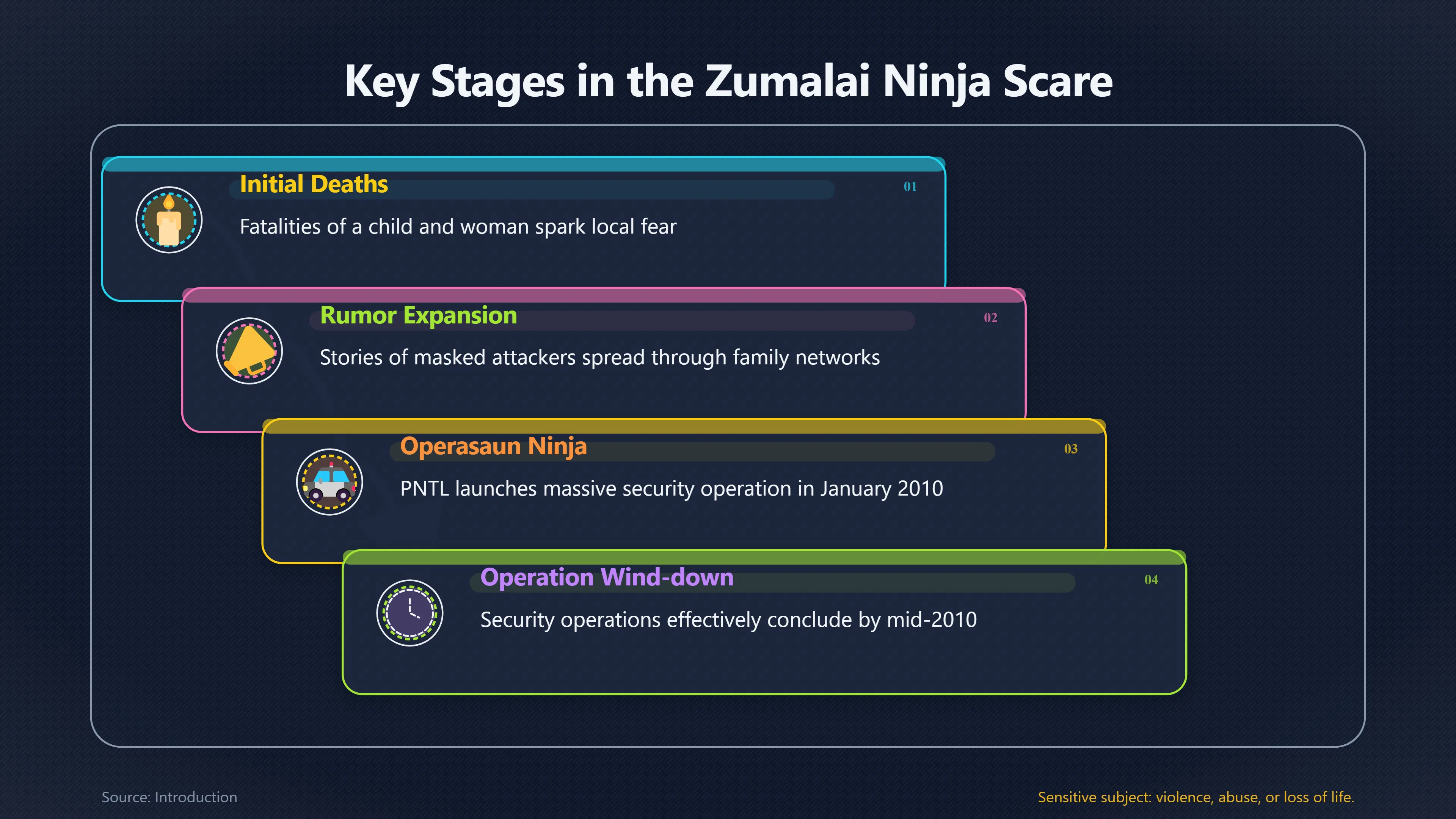
By late 2009, reports from Zumalai described frightening nighttime attacks following the deaths of a child and a young woman. As rumours spread from village to village, many residents came to believe that organised gangs were operating across the district. Accounts varied widely. Some described professional killers, others criminal gangs, while still others attributed almost supernatural abilities to the attackers, including the power to evade capture. These inconsistent descriptions became part of the scare itself rather than evidence for a single identifiable organisation.[Taylor & Francis Online]tandfonline.comTaylor & Francis OnlinePhantom Menaces: The Politics of Rumour, Securitisation and Masculine Identities in the Shadows of the Ninjas: The…
How the rumours spread
Rumours flourished because they offered an explanation for frightening events in communities where trust in formal security institutions was still developing after years of occupation, conflict and the 2006 national crisis. Stories circulated rapidly through family networks, local meetings and word of mouth, with each report reinforcing the next.
Several factors helped the rumours gain credibility:
- Two shocking deaths created an atmosphere of fear before any clear explanation emerged.
- Memories of clandestine violence during the Indonesian occupation made stories about masked attackers seem plausible.
- Existing anxieties about martial arts groups, criminal gangs and veterans’ organisations blurred distinctions between rumour and genuine security concerns.
- Limited verified information encouraged speculation, allowing increasingly dramatic accounts to circulate.[Taylor & Francis Online]tandfonline.comTaylor & Francis OnlinePhantom Menaces: The Politics of Rumour, Securitisation and Masculine Identities in the Shadows of the Ninjas: The…
Researchers note that rumours did not simply arise from irrational fear. They functioned as a way for communities to interpret uncertainty in a society still emerging from decades of political violence. The “ninja” became a symbol onto which different fears could be projected, including crime, unresolved wartime memories and distrust between local communities and state institutions.[Taylor & Francis Online]tandfonline.comTaylor & Francis OnlinePhantom Menaces: The Politics of Rumour, Securitisation and Masculine Identities in the Shadows of the Ninjas: The…
Deaths, fear and specialist police operations
Government leaders treated the reports as a serious national security issue. In January 2010, the National Police of Timor-Leste (PNTL) launched Operasaun Ninja, concentrating on the western districts of Covalima and Bobonaro near the Indonesian border.
The operation was remarkable for its scale:
- Hundreds of police officers participated.
- At least 120 heavily armed special police were deployed, supported for a period by military personnel.
- Checkpoints, searches and large-scale arrests were conducted across affected communities.
- Police leadership publicly declared that alleged ninja groups would be eliminated.[ResearchGate]researchgate.netResearch Gate(PDF) Timor-Leste Armed Violence Assessment Final ReportResearch Gate(PDF) Timor-Leste Armed Violence Assessment Final Report
Official figures indicated that well over one hundred people were detained during the operation, although only a small number were ultimately imprisoned. No cache of firearms or convincing evidence demonstrating the existence of a coordinated nationwide ninja organisation was uncovered. By mid-2010 the operation had effectively wound down.[ResearchGate]researchgate.netResearch Gate(PDF) Timor-Leste Armed Violence Assessment Final ReportResearch Gate(PDF) Timor-Leste Armed Violence Assessment Final Report
Securitisation and the politics of uncertain threats
The Zumalai scare illustrates what political scientists call securitisation: a process in which uncertain or ambiguous dangers become framed as urgent security threats requiring extraordinary state action.
In this case, authorities faced genuine public fear but highly uncertain evidence. Rather than treating the rumours primarily as criminal investigations into specific incidents, the state increasingly presented them as evidence of organised armed groups threatening national stability. This justified exceptional deployments of police resources and broadened the scope of the response beyond the original crimes.[Taylor & Francis Online]tandfonline.comTaylor & Francis OnlinePhantom Menaces: The Politics of Rumour, Securitisation and Masculine Identities in the Shadows of the Ninjas: The…
Some analysts argue that the operation also reflected institutional pressures within the security sector. Following criticism of police performance and allegations of misconduct in other incidents, demonstrating decisive action against a widely feared threat could help restore public confidence in the police. Critics, however, argued that the operation risked reinforcing the rumours by treating an uncertain threat as established fact.[ResearchGate]researchgate.netResearch Gate(PDF) Timor-Leste Armed Violence Assessment Final ReportResearch Gate(PDF) Timor-Leste Armed Violence Assessment Final Report
Human rights concerns and public criticism
Civil society organisations questioned both the necessity and the conduct of Operasaun Ninja.
Criticism focused on several issues:
- large numbers of arrests despite limited prosecutable evidence;
- allegations that some detainees were beaten during questioning;
- fears that innocent residents became targets because of rumours rather than reliable evidence;
- concerns that the operation itself generated additional insecurity within affected communities.[researchgate.net]researchgate.netResearch Gate(PDF) Timor-Leste Armed Violence Assessment Final ReportResearch Gate(PDF) Timor-Leste Armed Violence Assessment Final Report
International human rights reporting likewise recorded allegations of excessive force during the anti-ninja operations, while noting that the underlying criminal investigations produced few concrete results linking detainees to an organised conspiracy.[Refworld]refworld.org2010 Country Reports on Human Rights Practices - Timor-Leste | Refworld…
Why the scare became so persuasive
The persistence of the ninja rumours cannot be explained by misinformation alone. Several historical and social factors reinforced one another.
First, Timor-Leste’s experience of occupation meant that stories about masked men operating secretly already had historical precedents. The image of the ninja therefore resonated with lived experience rather than emerging from popular culture alone.
Second, post-conflict societies often struggle with uncertainty. Weak investigative capacity, unresolved crimes and incomplete trust in institutions can leave rumours filling gaps that official explanations cannot immediately resolve.
Third, the figure of the ninja brought together several different anxieties—crime, masculinity, political violence and social disorder—into one memorable narrative. As researchers argue, the rumour became meaningful not because everyone believed exactly the same story but because it provided a shared language for discussing insecurity.[Taylor & Francis Online]tandfonline.comTaylor & Francis OnlinePhantom Menaces: The Politics of Rumour, Securitisation and Masculine Identities in the Shadows of the Ninjas: The…

Historical significance
The Zumalai Ninja Scare remains one of Timor-Leste’s clearest examples of a rumour developing into a national security crisis. Unlike episodes of mass psychogenic illness or supernatural panic, the central issue was not widespread belief in magical beings but escalating uncertainty about hidden human attackers whose existence was never clearly demonstrated.
The episode continues to attract attention because it highlights several broader lessons. It shows how traumatic historical memories can shape contemporary perceptions of danger, how rumours may influence state policy in fragile democracies, and how security responses can become controversial when evidence remains ambiguous. For historians and social scientists, the Zumalai case is therefore valuable not as proof that organised “ninjas” terrorised Timor-Leste, but as a carefully documented example of collective fear, political decision-making and the complex relationship between public belief and state power.[tandfonline.com]tandfonline.comTaylor & Francis OnlinePhantom Menaces: The Politics of Rumour, Securitisation and Masculine Identities in the Shadows of the Ninjas: The…
Amazon book picks
Further Reading
Books and field guides related to Who Were the Zumalai Ninjas?. Use these as the next step if you want deeper reading beyond the article.

The Lucifer Effect
Explores how situational pressures, authority and perceived threats can drive individuals and institutions toward harmful conduct.

The Jakarta Method
Provides background on Indonesian security culture, clandestine violence and historical memories that shaped the meaning of alleged maske...

A Not-So-Distant Horror
Explains the occupation-era violence, fear and institutional legacies behind later rumours of secret armed groups.

On Rumors
Directly addresses the social mechanisms through which uncertain reports become widely believed and trigger official action.
Endnotes
1.
Source: researchgate.net
Title: Research Gate(PDF) Timor-Leste Armed Violence Assessment Final Report
Link:https://www.researchgate.net/publication/265406467_Timor-Leste_Armed_Violence_Assessment_Final_Report
2.
Source: refworld.org
Link:https://www.refworld.org/reference/annualreport/usdos/2011/en/78708
Source snippet
2010 Country Reports on Human Rights Practices - Timor-Leste | Refworld...
3.
Source: researchgate.net
Link:https://www.researchgate.net/publication/277236066_Histories_of_violence_states_of_denial-militias_martial_arts_and_masculinities_in_Timor-Leste
4.
Source: refworld.org
Link:https://www.refworld.org/reference/annualreport/usdos/2010/en/71531
5.
Source: researchgate.net
Link:https://www.researchgate.net/publication/263142084_Phantom_Menaces_The_Politics_of_Rumour_Securitisation_and_Masculine_Identities_in_the_Shadows_of_the_Ninjas
6.
Source: tandfonline.com
Link:https://www.tandfonline.com/doi/full/10.1080/14442213.2013.821154
Source snippet
Taylor & Francis OnlinePhantom Menaces: The Politics of Rumour, Securitisation and Masculine Identities in the Shadows of the Ninjas: The...
7.
Source: tandfonline.com
Link:https://www.tandfonline.com/doi/abs/10.1080/14442213.2013.821154
Source snippet
f Anthropology: Vol 14, No 5October 22, 2013 — The Asia Pacific Journal of Anthropology Volume 14, 2013 - Issue 5: Engaging Processes of...
Published: October 22, 2013
Additional References
8.
Source: dokumen.pub
Title: Ghost Movies in Southeast Asia and Beyond
Link:https://dokumen.pub/ghost-movies-in-southeast-asia-and-beyond.html
Source snippet
9, 2016 — Stepping Out from the Silver Screen and into the Shadows 185 This chapter is based on observations and di...
Published: August 9, 2016
9.
Source: cambridge.org
Link:https://www.cambridge.org/core/books/southeast-asian-affairs-2010/timorleste-in-2009-marking-ten-years-of-independence-or-dependence-on-international-assistance/A6F027F41D8DEE30656DF16F9886FBF8
Source snippet
Southeast Asian Affairs 2010October 21, 2015 — TIMOR-LESTE IN 2009: MARKING TEN YEARS OF INDEPENDENCE OR DEPENDENCE ON INTERNATIONAL “ASS...
Published: October 21, 2015
10.
Source: youtube.com
Title: INDONESIA: EAST TIMOR: RESIDENTS FLEE FEARING RENEWED VIOLENCE
Link:https://www.youtube.com/watch?v=bWZs_03MQ3U
Source snippet
The Ninja Case in Banyuwangi, Gus Dur: "Green Dragon Operation"...
11.
Source: youtube.com
Title: The Ninja Case in Banyuwangi, Gus Dur: “Green Dragon Operation”
Link:https://www.youtube.com/watch?v=Ohsz1OtWTYs
Source snippet
Rebels convicted over plot to assassinate PM and president...
12.
Source: youtube.com
Title: Rebels convicted over plot to assassinate PM and president
Link:https://www.youtube.com/watch?v=mmjieRV5tfk
Source snippet
Timor Leste: Anti-human trafficking operation...
13.
Source: youtube.com
Title: Timor Leste: Anti-human trafficking operation
Link:https://www.youtube.com/watch?v=DGPpqCjZ4Ew
Source snippet
Timor-Leste: The Worst Genocide You've Probably Never Heard Of...
14.
Source: scribd.com
Link:https://www.scribd.com/document/598622888/Ghost-movies-in-Southeast-Asia
15.
Source: cambridge.org
Link:https://www.cambridge.org/core/journals/journal-of-asian-studies/article/abs/great-rumor-mill-gossip-mass-media-and-the-ninja-fear/E4A207660DE03F999D9E4F846885060F
16.
Source: umalulik.blogspot.com
Link:https://umalulik.blogspot.com/2010/01/timor-leste-policia-nacional-lanca-mega.html
17.
Source: dn.pt
Title: Timor-Leste: Polícia Nacional lança “mega-operação” de “caça aos ninjas”
Link:https://www.dn.pt/arquivo/diario-de-noticias/timor-leste%3A-policia-nacional-lanca-%22mega-operacao%22-de-%22caca-aos-ninjas%22.html
Topic Tree