When Belief Became a Force in Yemen
Yemen’s history does not offer a neat catalogue of witch trials, dance plagues or officially diagnosed outbreaks of “mass hysteria”.
Page outline Jump by section
Introduction
These episodes matter because they show collective belief operating under extreme pressure. Yemen’s divided governments, recurring wars, poverty, fragile communications and long traditions of religious interpretation have repeatedly created conditions in which a promise of redemption—or a frightening claim about hidden enemies—could acquire unusual force. Yet the evidence also demands restraint. Some events were genuine religious movements rather than irrational delusions; some supposed “panics” were labels imposed by opponents; and many modern fears grew from real experiences of violence, institutional failure and medical scarcity.
When promises of deliverance became political movements
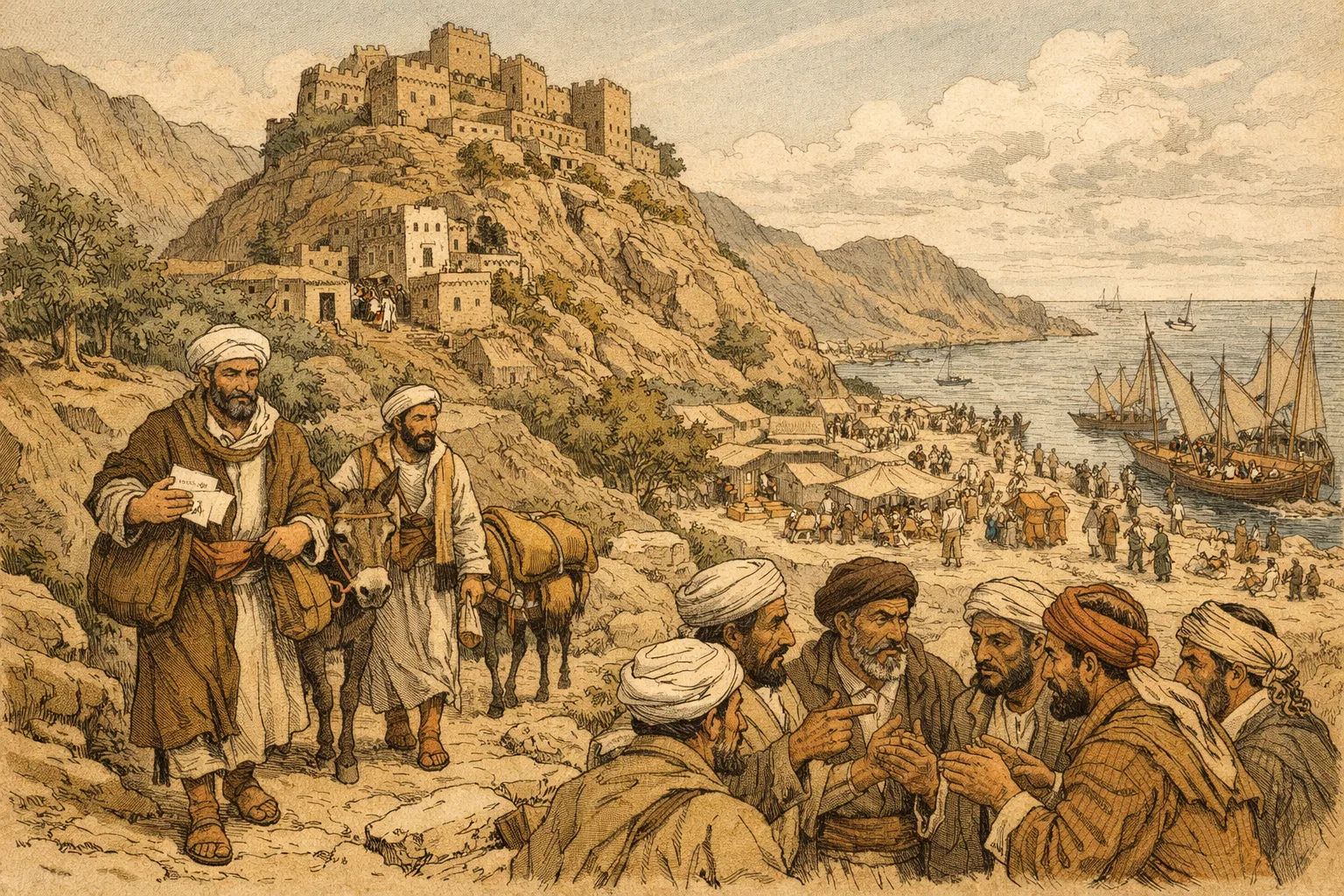
The clearest early example comes from twelfth-century Yemen, when religious upheaval affected Muslims and Jews at the same time. Ali ibn Mahdi built a militant reform movement that challenged existing rulers and presented his cause in language associated with divinely guided renewal. His successors imposed harsh policies on religious minorities, including pressure on Jews to convert. The crisis formed the setting for one of medieval Judaism’s best-known emergency interventions: the letter commonly called the Epistle to Yemen, written by the philosopher and religious authority Maimonides around 1172.[anumuseum.org.il]anumuseum.org.ilMuseum of the Jewish People Maimonides and the Jews of YemenMuseum of the Jewish PeopleMaimonides and the Jews of Yemen - Hand in…21 Jan 2018 — The Fatimid Caliphate who ruled over Yemen for lon…
Yemen’s Jewish community was facing both persecution and the appearance of an unnamed claimant who announced a new redemptive mission. Surviving accounts describe teachings that blended elements of Judaism and Islam and encouraged followers to see contemporary turmoil as evidence that a decisive religious transformation had begun. Community leaders feared not only theological confusion but retaliation against all Jews if the claimant provoked the authorities. Maimonides therefore urged them to reject attempts to calculate the exact date of redemption and warned that the claimant’s activity could endanger innocent people.[wikisource.org]en.wikisource.orgEpistle to Yemen/Complete26 Nov 2022 — THE EPISTLE TO YEMEN, probably a compilation of several shorter responsa, was written by…
Calling this episode “mass hysteria” would obscure more than it explains. The persecution was real, the political order was unstable, and hope for supernatural deliverance offered a way of making sense of powerlessness. The movement is better understood as crisis-driven messianism: an organised expectation that history was approaching a sacred turning point. It also shows how beliefs crossed communal boundaries. Scholarship on Yemeni messianism argues that Jewish and Muslim expectations developed in proximity to one another rather than in sealed religious worlds.[JSTOR]jstor.orgAt this time and place the mutual…
Why nineteenth-century Yemen produced several Jewish messiahs
Messianic excitement returned with striking intensity among Yemeni Jews in the nineteenth century. The three most important movements centred on Shukr Kuhayl I, active from 1861 until his death in 1865; Shukr Kuhayl II, who led a larger movement from 1868 to 1875; and Yosef Abdullah, a messianic herald whose activity continued into the early 1890s. Historians have described these as the final cluster of major messianic claimants to emerge in the traditional Jewish diaspora before the twentieth century.[Persée]persee.frrjuiv 0484 8616 1992 numPerséeMessiahs and Rabbis: The Yemeni Experienceby BZ Eraqi-Klorman · 1992 — The last three messianic movements to appear anywhere in th…
Shukr Kuhayl I began as an ascetic preacher calling for repentance. He abandoned ordinary domestic life, dressed simply and travelled among communities before presenting himself more directly as the expected redeemer. Accounts suggest that his message found a receptive audience during political disorder and economic insecurity. His death in 1865 did not immediately end belief in him; some followers expected his return. Three years later, Judah ben Shalom claimed to be the same Shukr Kuhayl restored to life and became known to historians as Shukr Kuhayl II.[Wikipedia]WikipediaShukr Kuhayl IShukr Kuhayl I
The second movement was more structured. Its leader maintained networks of supporters, collected a religious tithe and issued letters that circulated beyond his immediate locality. Muslim participants also became involved, demonstrating that the movement cannot be reduced to an isolated fantasy within one minority community. Charismatic authority, established religious ideas and practical organisation all helped the message travel.[Cambridge University Press & Assessment]cambridge.orgMahdi in Twelver Shi⊂ism…
Several pressures made these claims persuasive:
- Political uncertainty: Weak or contested government encouraged the sense that ordinary authority had failed.
- Material hardship: Poverty and insecurity made promises of justice and restoration emotionally powerful.
- Religious precedent: Familiar teachings about redemption supplied a ready-made language for interpreting crisis.
- Communication networks: Letters, travelling preachers and communal contributions allowed belief to spread between distant settlements.
- Ambiguous clerical responses: Rabbis did not always react in the same way. Their support, hesitation or opposition could influence whether a claimant appeared credible.
These movements should not be dismissed as episodes of collective madness. Followers acted within a shared religious framework and responded to recognisable social pressures. At the same time, the movements could demand money, create conflict over religious authority and expose communities to punishment. Historians therefore examine them as forms of active messianism: attempts to accelerate or participate in redemption rather than merely await it.[Persée]persee.frrjuiv 0484 8616 1992 numPerséeMessiahs and Rabbis: The Yemeni Experienceby BZ Eraqi-Klorman · 1992 — The last three messianic movements to appear anywhere in th…
Rumour, communal fear and the destruction of Jewish Aden
The most devastating modern episode of contagious fear in Yemen’s wider historical sphere occurred in the British colony of Aden in December 1947. Following the United Nations vote to partition Palestine, a protest strike escalated into attacks on Aden’s Jewish population. Official figures commonly cited for the violence record 82 Jewish deaths, dozens of other fatalities and injuries, and widespread destruction of homes, schools, synagogues and businesses. Local security forces failed to control the disorder; members of the Aden Protectorate Levies were themselves accused of shooting civilians.[wikipedia.org]Wikipedia1947 anti Jewish riots in Aden1947 anti Jewish riots in Aden
This was not an inexplicable crowd delusion. Anger over Palestine, colonial weakness, communal hostility and opportunities for looting were concrete causes. Nevertheless, inflammatory stories helped make violence imaginable and Jews collectively punishable for events occurring elsewhere. A further outbreak of looting in early 1948 was reportedly encouraged by a false allegation that Jews had ritually murdered two local girls—an example of the old blood-libel story being adapted to a new political crisis. The documentation for this particular rumour is thinner than for the December 1947 riot itself, so it is safest to treat it as one contributing account rather than the single cause of Aden’s collapse.[Wikipedia]WikipediaYemenite JewsYemenite Jews
The distinction matters. Describing Aden simply as a “rumour panic” would minimise organised prejudice and failures of colonial protection. Yet ignoring rumour would miss the mechanism by which distant political conflict became a local threat. A story about secret ritual violence transformed neighbours into imagined conspirators and gave communal aggression a moral pretext.
The violence, together with insecurity elsewhere in Yemen, contributed to the mass departure of Yemeni Jews. Between 1949 and 1950, nearly 50,000 were flown from the Aden area to Israel in the operation officially associated with the biblical image of being carried “on eagles’ wings”. Many migrants understood the journey through religious ideas of return and redemption, while organisers also employed messianic language to encourage migration.[jdc.org]archives.jdc.orgOpen source on jdc.org.
Later popular memory turned this migration into a miraculous rescue story, sometimes called “Operation Magic Carpet”. That version contains genuine elements of hope and deliverance but can hide the suffering involved. Research has emphasised overcrowding, disease and preventable deaths in transit camps, as well as difficult conditions after arrival. The episode therefore sits at the border between collective faith and national mythmaking: religious expectation gave meaning to an extraordinary movement of people, while later retellings polished a badly managed humanitarian operation into a near-seamless miracle.[JSTOR]jstor.orgOpen source on jstor.org.
Sorcery accusations as instruments of terror
Belief in harmful magic has existed in Yemen in many ordinary religious and folkloric forms, but the strongest recent evidence concerns accusations used by armed extremists. In 2015, Al-Qaeda in the Arabian Peninsula announced that it had killed four men in Hadramawt after accusing them of witchcraft or sorcery. Residents reported that militants had circulated a notice naming the men, and other alleged practitioners had previously been threatened or killed in areas under extremist control.[thearabweekly.com]thearabweekly.comqaeda yemen fights sorcery executionsqaeda yemen fights sorcery executions
These were not witch trials in the early modern European sense. There was no large, centrally recorded judicial campaign, no reliable evidence of an expanding chain of confessions, and no documented countrywide panic. The accusations functioned instead as a weapon of local rule. By defining selected people as practitioners of forbidden supernatural harm, an armed organisation could claim religious authority, frighten the population and eliminate individuals without meaningful due process.
It is also impossible to know from militant statements whether every victim was genuinely regarded as a magician, had provided folk-healing or divination services, or was targeted for unrelated reasons. That uncertainty is characteristic of sorcery persecution: the charge is difficult to disprove because the alleged offence is secret by definition. International human-rights specialists warn that such beliefs can facilitate torture, expulsion and murder, particularly where legal protections have collapsed.[OHCHR]ohchr.orgOpen source on ohchr.org.
The Yemeni case therefore belongs less to the history of spontaneous mass hysteria than to the history of moralised terror. Supernatural accusations supplied a language of danger, but organised armed power determined who was punished.
Health rumours in a country where mistrust is rational
Yemen’s civil war and institutional breakdown have created modern scares in which false information spreads alongside genuine disease. During the COVID-19 pandemic, medical organisations reported that some Yemenis feared treatment centres because of rumours that patients would be detained or deliberately killed by lethal injection. Fear of stigma also led patients or relatives to leave hospitals early, sometimes against medical advice.[Doctors Without Borders]msf.orgaddressing covid 19 yemen amongst fear stigma and misinformationaddressing covid 19 yemen amongst fear stigma and misinformation
These beliefs were dangerous, but they did not arise in a vacuum. Many Yemenis had experienced air strikes, arbitrary detention, political repression, unaffordable treatment and the collapse of basic services. In such conditions, an official reassurance could be less persuasive than a warning shared by relatives or neighbours. Research on Yemen’s pandemic information environment found that misinformation travelled through social media and face-to-face gatherings, while distrust and information overload weakened compliance with public-health guidance.[PMC]pmc.ncbi.nlm.nih.govOpen source on nih.gov.
Vaccine rumours have produced similar problems. UNICEF and polio-eradication partners have relied on local doctors, community figures and religious leaders to answer false claims and persuade families that vaccination is compatible with their faith and protects children. In 2023, a campaign in southern Yemen reached about 1.2 million children under five, illustrating both the scale of the public-health effort and the continuing need to build trust person by person.[UNICEF]unicef.orgfighting polio vaccine misinformationfighting polio vaccine misinformation
The consequences are not theoretical. Yemen has faced recurrent outbreaks of polio and other preventable diseases, while cholera has flourished amid damaged water systems, malnutrition and a weakened health service. In 2024, the World Health Organization reported nearly 250,000 suspected cholera cases and 861 associated deaths in Yemen by 1 December. Rumour did not create the contaminated water, broken sanitation or shortage of medicines, but fear and mistrust could delay treatment and obstruct prevention.[who.int]emro.who.intyemen reports the highest burden of cholera globallyyemen reports the highest burden of cholera globally
Calling this “mass hysteria” would be both inaccurate and unfair. The more useful concept is an infodemic: an overabundance of competing information, including falsehoods, that makes sound health decisions harder. Yemen demonstrates how an infodemic becomes especially destructive when people have good historical reasons to doubt institutions.
What Yemen’s cases reveal about contagious belief
Yemen’s record is best understood not as a procession of bizarre irrational episodes, but as a history of belief under pressure. The most important cases share several mechanisms.
Crisis makes sacred explanations more urgent. Twelfth- and nineteenth-century messianic movements translated political disorder into a story of imminent justice. Their followers were not simply confused; they were using inherited religious expectations to interpret dangerous circumstances.
Rumours identify a human enemy. In Aden, false or inflammatory stories helped redirect regional political anger towards a vulnerable local minority. In sorcery accusations, invisible harm was attributed to named individuals who could then be punished.
Authority can spread fear as readily as crowds do. Governments, armed groups, community leaders and media networks do not merely respond to panics. They may validate, exploit or suppress them. Al-Qaeda’s notices concerning alleged sorcerers show a deliberate attempt to turn supernatural accusation into public discipline.
Mistrust is often grounded in experience. COVID-19 and vaccination rumours gained strength because Yemenis were navigating war, coercion and medical collapse. Correcting a false claim therefore required more than presenting facts. It required credible messengers and evidence that seeking help would not itself create danger.
Later storytelling simplifies complicated events. The “Magic Carpet” image recast a hazardous mass migration as miraculous fulfilment. Such stories can preserve communal pride while obscuring mismanagement, suffering and competing motives.
The central lesson is that collective belief in Yemen cannot be separated from power. Hopes of redemption, fears of sorcery, communal rumours and medical misinformation became socially consequential when they interacted with persecution, political collapse or institutional distrust. The beliefs mattered, but the conditions that made them persuasive—and the authorities that acted upon them—usually determined the scale of the harm.

Amazon book picks
Further Reading
Books and field guides related to When Belief Became a Force in Yemen. Use these as the next step if you want deeper reading beyond the article.
Extraordinary Popular Delusions and the Madness of Crowds
Rating: 4.0/5 from 5 Google Books ratings
Useful background for collective belief and rumour.

The Oxford history of Islam
Places Yemen's religious history in broader Islamic context.

The Jews of Arab Lands in Modern Times
First published 1991. Subjects: Jews, Ethnic relations, Sources, Zionism, Jewish-Arab relations.
Endnotes
1.
Source: cambridge.org
Title: University Press & Assessment Regional Surveys (B.)
Link:https://www.cambridge.org/core/books/cambridge-history-of-judaism/regional-surveys/E6525119960DACB93CD213FE78EBA80A
Source snippet
Cambridge University Press & AssessmentRegional Surveys (B.) - The Cambridge History of JudaismIn the Yemen, messianic expectations among...
2.
Source: en.wikisource.org
Link:https://en.wikisource.org/wiki/Epistle_to_Yemen/Complete
Source snippet
Epistle to Yemen/Complete26 Nov 2022 — THE EPISTLE TO YEMEN, probably a compilation of several shorter responsa, was written by...
3.
Source: Wikipedia
Title: Epistle to Yemen
Link:https://en.wikipedia.org/wiki/Epistle_to_Yemen
4.
Source: jstor.org
Link:https://www.jstor.org/stable/163740
Source snippet
At this time and place the mutual...
5.
Source: cambridge.org
Link:https://www.cambridge.org/core/journals/international-journal-of-middle-east-studies/article/jewish-and-muslim-messianism-in-yemen/D79E19A5BEDD28755C314B6E87D3772A
Source snippet
Mahdi in Twelver Shi⊂ism...
6.
Source: Wikipedia
Title: Shukr Kuhayl I
Link:https://en.wikipedia.org/wiki/Shukr_Kuhayl_I
7.
Source: resolve.cambridge.org
Link:https://resolve.cambridge.org/core/services/aop-cambridge-core/content/view/E9CD9BC730C11B8EC5DF85619E9567F6/9781789627831c13_p291-318_CBO.pdf/messianic-leadership-in-jewish-history-movements-and-personalities.pdf
8.
Source: Wikipedia
Title: 1947 anti Jewish riots in Aden
Link:https://en.wikipedia.org/wiki/1947_anti-Jewish_riots_in_Aden
9.
Source: justiceforjews.com
Link:https://justiceforjews.com/wp-content/uploads/2026/01/ADEN-FINAL-DIGITAL.pdf
10.
Source: Wikipedia
Title: Yemenite Jews
Link:https://en.wikipedia.org/wiki/Yemenite_Jews
11.
Source: archives.jdc.org
Link:https://archives.jdc.org/project/yemenite-jews-and-operation-magic-carpet/
12.
Source: sephardivoices.org.uk
Link:https://www.sephardivoices.org.uk/countries/aden
13.
Source: jstor.org
Link:https://www.jstor.org/stable/10.2979/israelstudies.16.3.149
14.
Source: ohchr.org
Link:https://www.ohchr.org/en/special-procedures/ie-albinism/witchcraft-and-human-rights
15.
Source: pmc.ncbi.nlm.nih.gov
Link:https://pmc.ncbi.nlm.nih.gov/articles/PMC10093864/
16.
Source: unicef.org
Title: fighting polio vaccine misinformation
Link:https://www.unicef.org/stories/fighting-polio-vaccine-misinformation
17.
Source: emro.who.int
Title: yemen reports the highest burden of cholera globally
Link:https://www.emro.who.int/media/news/yemen-reports-the-highest-burden-of-cholera-globally.html
18.
Source: pmc.ncbi.nlm.nih.gov
Link:https://pmc.ncbi.nlm.nih.gov/articles/PMC6086153/
19.
Source: cambridge.org
Link:https://www.cambridge.org/core/books/cambridge-history-of-judaism/jews-in-the-medieval-islamic-world/FD2F528F96BAE1571004DDDE00F5B41C
20.
Source: Wikipedia
Title: List of Mahdi claimants
Link:https://en.wikipedia.org/wiki/List_of_Mahdi_claimants
21.
Source: Wikipedia
Title: Witchcraft in the Middle East
Link:https://en.wikipedia.org/wiki/Witchcraft_in_the_Middle_East
22.
Source: Wikipedia
Title: Muhammad Ahmad
Link:https://en.wikipedia.org/wiki/Muhammad_Ahmad
23.
Source: Wikipedia
Title: List of mass panic cases
Link:https://en.wikipedia.org/wiki/List_of_mass_panic_cases
24.
Source: Wikipedia
Link:https://en.wikipedia.org/wiki/Mahdi
25.
Source: Wikipedia
Link:https://en.wikipedia.org/wiki/Messiah
26.
Source: Wikipedia
Title: Al Qaeda insurgency in Yemen
Link:https://en.wikipedia.org/wiki/Al-Qaeda_insurgency_in_Yemen
27.
Source: emro.who.int
Link:https://www.emro.who.int/fr/yemen/news/who-iom-raise-concern-over-covid-19-discrimination-against-migrants-in-yemen.html
28.
Source: emro.who.int
Link:https://www.emro.who.int/yemen/news/who-unicef-and-mophp-launch-a-second-round-of-polio-vaccination-in-government-of-yemen-controlled-areas.html
29.
Source: applications.emro.who.int
Title: epi monitor 2012 5 22
Link:https://applications.emro.who.int/dsaf/epi/2012/epi_monitor_2012_5_22.pdf
30.
Source: jstor.org
Link:https://www.jstor.org/stable/40903641
31.
Source: unicef.org
Link:https://www.unicef.org/media/173146/file/equity-immunization-Yemen-case-study.pdf
32.
Source: anumuseum.org.il
Title: Museum of the Jewish People Maimonides and the Jews of Yemen
Link:https://anumuseum.org.il/blog/yemen-and-maimonides/
Source snippet
Museum of the Jewish PeopleMaimonides and the Jews of Yemen - Hand in...21 Jan 2018 — The Fatimid Caliphate who ruled over Yemen for lon...
33.
Source: persee.fr
Title: rjuiv 0484 8616 1992 num 151 1 2410
Link:https://www.persee.fr/doc/rjuiv_0484-8616_1992_num
Source snippet
PerséeMessiahs and Rabbis: The Yemeni Experienceby BZ Eraqi-Klorman · 1992 — The last three messianic movements to appear anywhere in th...
34.
Source: degruyterbrill.com
Link:https://www.degruyterbrill.com/document/isbn/9789004679115/html?srsltid=AfmBOopslftT0McXxM9nYHzNkWb5gaa4vk69u7_8HNefjaro9C3mfJP5
Source snippet
De Gruyter BrillThe Jews of Yemen in the Nineteenth Centuryby E Klorman · 2023 · Cited by 27 — Particular attention is devoted to the mes...
35.
Source: thearabweekly.com
Title: qaeda yemen fights sorcery executions
Link:https://thearabweekly.com/qaeda-yemen-fights-sorcery-executions
36.
Source: aljazeera.com
Title: al qaeda in yemen claims killing of men over witchcraft
Link:https://www.aljazeera.com/news/2015/10/10/al-qaeda-in-yemen-claims-killing-of-men-over-witchcraft
37.
Source: msf.org
Title: addressing covid 19 yemen amongst fear stigma and misinformation
Link:https://www.msf.org/addressing-covid-19-yemen-amongst-fear-stigma-and-misinformation
38.
Source: facebook.com
Link:https://www.facebook.com/unicefyemen/posts/the-community-has-become-more-accepting-of-vaccinesthis-is-what-we-like-to-hear-/1114202884081290/
39.
Source: unicef.org.uk
Link:https://www.unicef.org.uk/press-releases/vaccination-demand-observatory-launched-to-strengthen-local-communication-programmes-to-address-vaccine-misinformation/
40.
Source: pmc.ncbi.nlm.nih.gov
Link:https://pmc.ncbi.nlm.nih.gov/articles/PMC3536509/
41.
Source: pmc.ncbi.nlm.nih.gov
Link:https://pmc.ncbi.nlm.nih.gov/articles/PMC3588562/
42.
Source: pmc.ncbi.nlm.nih.gov
Link:https://pmc.ncbi.nlm.nih.gov/articles/PMC10323996/
43.
Source: thejoint.org.au
Title: Operation Magic Carpet
Link:https://thejoint.org.au/news/operation-magic-carpet-the-little-known-mass-evacuation-of-yemen/
Additional References
44.
Source: youtube.com
Title: The Epistle to Yemen
Link:https://www.youtube.com/watch?v=t6aCdk5QtBM
Source snippet
Epistle to Yemen – Maimonides on Persecution and False Messiahs...
45.
Source: academia.edu
Link:https://www.academia.edu/5514414/Wizardry_and_Witchcraft_in_6th_Century_Arabia
46.
Source: researchgate.net
Link:https://www.researchgate.net/publication/271759288_Mass_hysteria_among_South_African_primary_school_learners_in_Kwa-Dukuza_KwaZulu-Natal
47.
Source: researchgate.net
Link:https://www.researchgate.net/publication/376973814_Mahdist_Movement_Political_Dimensions_in_Sudan_Islamic_State_Creation_Religious_Mentality_during_the_Nineteenth_Century
48.
Source: facebook.com
Link:https://www.facebook.com/applausepakistan/posts/a-disturbing-incident-at-a-school-in-pyuthan-nepal-has-drawn-widespread-attentio/951335227963845/
49.
Source: reuters.com
Link:https://www.reuters.com/news/picture/al-qaeda-in-yemen-idJPRTR4LGBE/
50.
Source: cmi.no
Link:https://www.cmi.no/publications/9171-al-mahdiya-continues-to-haunt-sudan
51.
Source: eprints.whiterose.ac.uk
Link:https://eprints.whiterose.ac.uk/id/eprint/209771/6/COVID-19%20surveillance%20in%20fragile%20health%20systems%20%20armed%20conflict%20and%20humanitarian%20crisis%20%20the%20case%20of%20Yemen.pdf
52.
Source: unesco.org
Link:https://www.unesco.org/en/articles/empowering-yemeni-journalists-amidst-covid-19-crisis
53.
Source: facebook.com
Link:https://www.facebook.com/unicefyemen/posts/from-conquering-smallpox-to-battling-polio-watch-unicefs-remarkable-impact-in-va/640775128090737/
Topic Tree
Follow this branch
Related pages 192
- Antigua and Barbuda
- Argentina Belief Scares
- Azerbaijan Belief
- Bahrain Beliefs
- North Korea
- +187 more in sidebar