Within Bolivia
When Andean Worship Became a Colonial Threat
Spanish authorities turned local worship into evidence of idolatry, disloyalty and demonic influence.
On this page
- How missionaries reclassified Indigenous belief
- Accusations, punishment and colonial control
- What survived in modern Bolivian religion
Page outline Jump by section
Introduction
Spanish rule in what is now Bolivia did not simply replace one religion with another. It redefined Indigenous Andean worship as a threat to both Christianity and colonial authority. Missionaries, bishops and colonial officials frequently described local ceremonies, sacred places, ritual specialists and offerings as forms of “idolatry”, superstition or even demonic deception. This language transformed religious difference into evidence of moral corruption and political disloyalty, helping to justify closer surveillance of Indigenous communities, the destruction of sacred objects and the punishment of those who maintained traditional practices.[Google Books]books.google.comIdolatry and Its EnemiesGoogle BooksIdolatry and Its Enemies: Colonial Andean Religion and Extirpation, 1640-1750 - Kenneth Mills - Google Books…
Although the largest formal campaigns to “extirpate idolatry” were organised in parts of colonial Peru, the Audiencia of Charcas—covering much of present-day Bolivia—belonged to the same religious and administrative world. Clergy exchanged ideas, legal practices and missionary methods across the central Andes, and many of the same assumptions about Indigenous religion shaped life in colonial Bolivia. Understanding this process helps explain why modern Bolivian spirituality often combines Catholic and Indigenous traditions rather than representing a complete break with the pre-colonial past.[dra.revistas.csic.es]dra.revistas.csic.esUn clérigo muy particular ante los indios de Charcas (Bolivia) y su memorial de 1588 recién publicado | Disparidades. Revista de Antropol…
How missionaries reclassified Indigenous belief
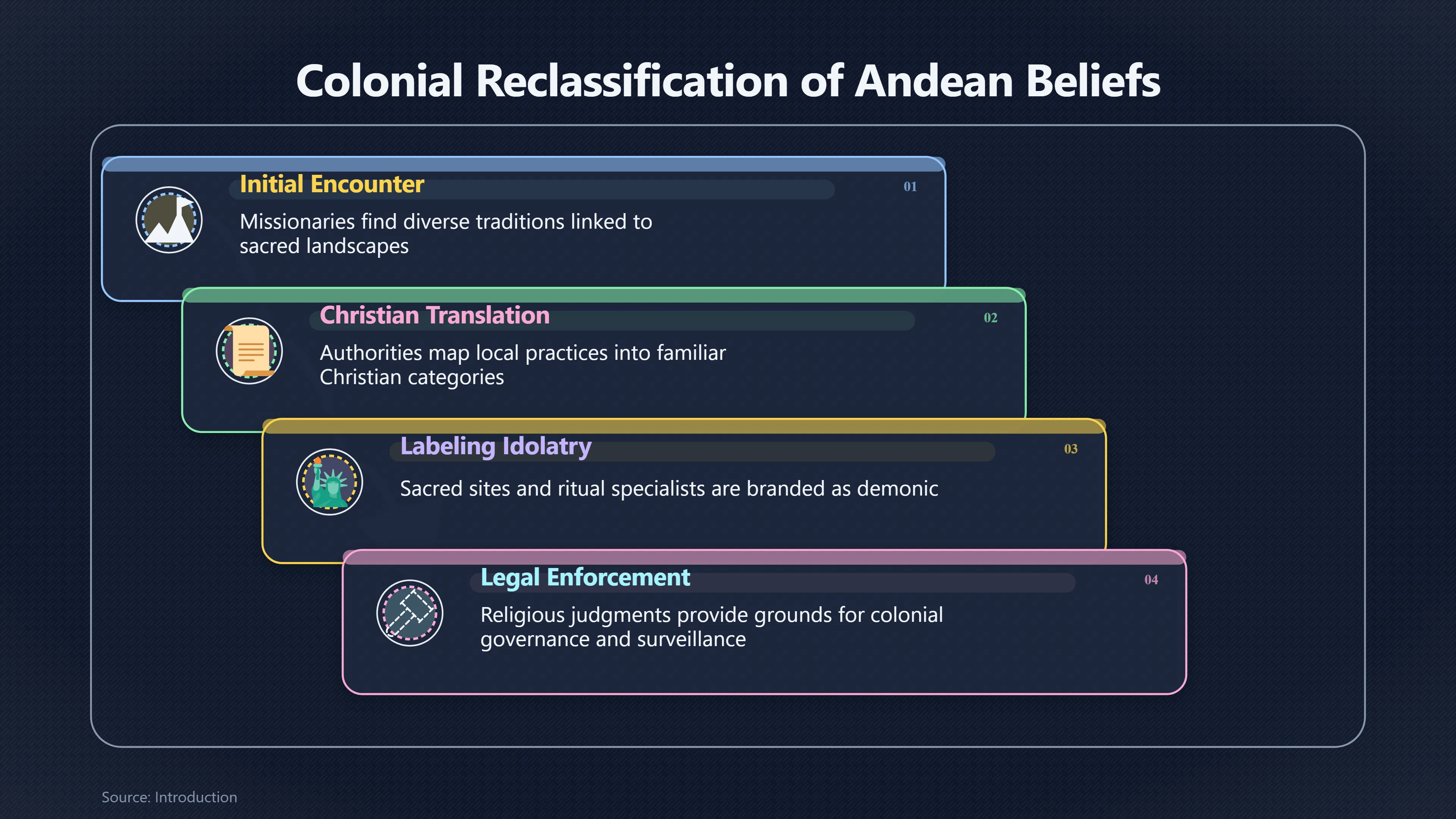
Spanish missionaries did not encounter a single organised “Andean religion”. Instead, they found diverse local traditions centred on sacred landscapes, ancestors, ritual offerings, agricultural cycles and community obligations. Rather than interpreting these practices on their own terms, many church authorities translated them into familiar Christian categories. Sacred sites became “idols”, ritual specialists became sorcerers, and offerings to the landscape became evidence of devil worship.[Google Books]books.google.comIdolatry and Its EnemiesGoogle BooksIdolatry and Its Enemies: Colonial Andean Religion and Extirpation, 1640-1750 - Kenneth Mills - Google Books…
This reclassification reflected the religious climate of Counter-Reformation Spain, where defending Catholic orthodoxy had become a central political concern. Missionaries believed that recently baptised Indigenous people should abandon previous religious practices entirely. When communities continued older customs alongside Christian worship, many clergy concluded that conversion had failed or that hidden idolatry was flourishing beneath an outward appearance of Christianity.[Revistas UdeA]revistas.udea.edu.coRevistas UdeAExtirpación de idolatrías e identidad cultural en las sociedades andinas del Perú virreinal (siglo XVII) | Boletín de Antrop…
A revealing example comes from the priest Bartolomé Álvarez, whose 1588 report from Charcas argued that Indigenous people had never truly embraced Christianity. He portrayed traditional beliefs not simply as mistaken but as a continuing obstacle to Spanish rule, demonstrating how religious judgement and colonial governance became closely linked.[dra.revistas.csic.es]dra.revistas.csic.esUn clérigo muy particular ante los indios de Charcas (Bolivia) y su memorial de 1588 recién publicado | Disparidades. Revista de Antropol…
Accusations, punishment and colonial control
Calling Indigenous worship “idolatry” had practical consequences. It gave colonial authorities legal and moral grounds to intervene in community life. Ecclesiastical investigations searched for hidden shrines, confiscated ritual objects, questioned witnesses and punished people suspected of maintaining prohibited ceremonies. While these investigations differed from the large-scale European witch hunts, they similarly relied on the assumption that forbidden religious practices threatened both society and salvation.[Google Books]books.google.comIdolatry and Its EnemiesGoogle BooksIdolatry and Its Enemies: Colonial Andean Religion and Extirpation, 1640-1750 - Kenneth Mills - Google Books…
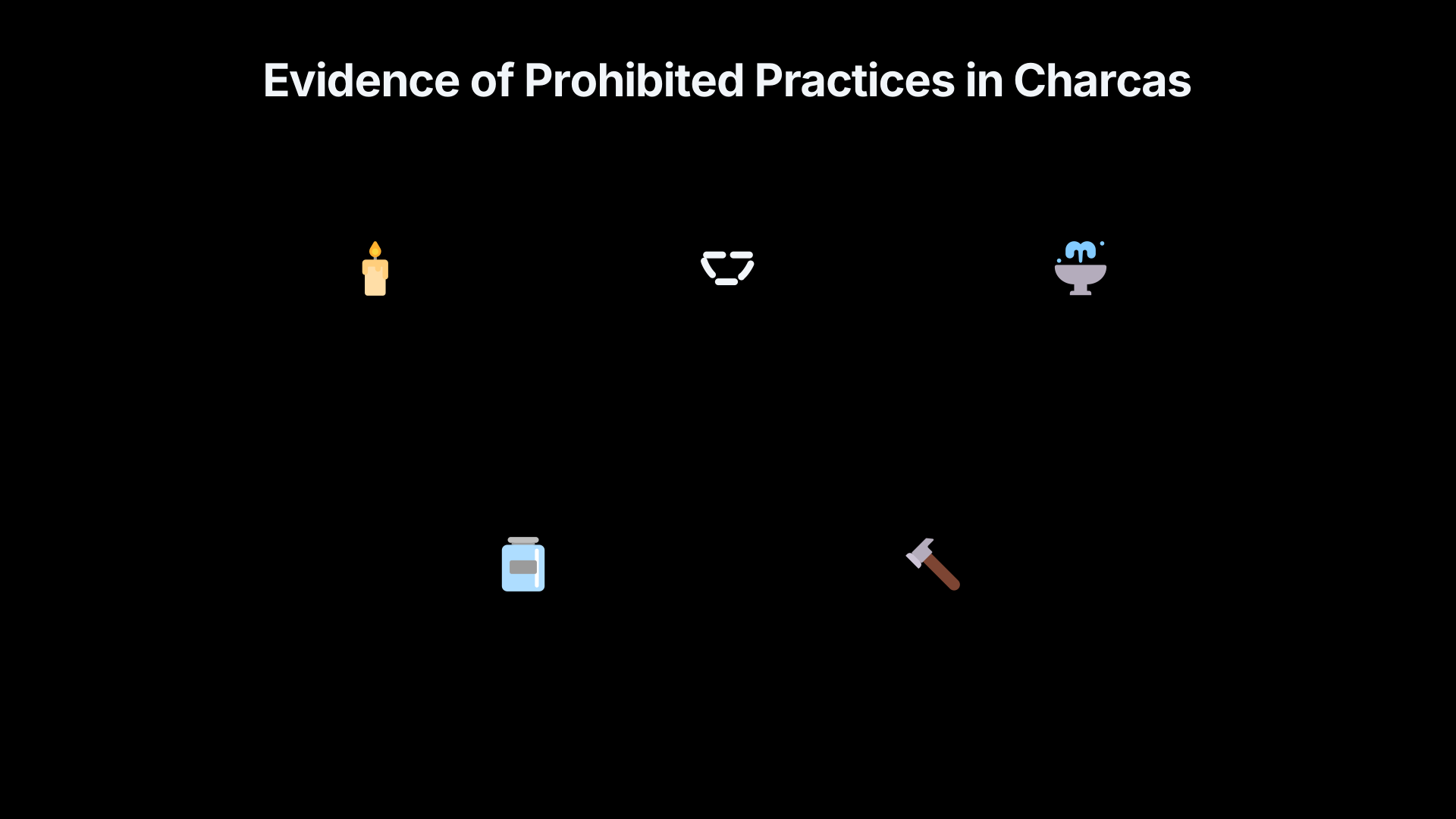
In Charcas, accusations often focused on:
- Maintaining ancestral ceremonies after baptism.
- Consulting Indigenous ritual specialists for healing or agricultural rites.
- Leaving offerings at sacred mountains, springs or other revered places.
- Preserving ceremonial objects associated with earlier traditions.
These actions were interpreted as evidence that converts secretly rejected Christianity. Colonial officials therefore viewed them not merely as religious offences but as signs of resistance to imperial authority.[dra.revistas.csic.es]dra.revistas.csic.esUn clérigo muy particular ante los indios de Charcas (Bolivia) y su memorial de 1588 recién publicado | Disparidades. Revista de Antropol…
Historians emphasise that these prosecutions should not be confused with claims about organised satanic cults. Colonial documents routinely imposed Christian concepts such as “devil worship” onto beliefs that were rooted in relationships with ancestors, land and community rather than an opposition between God and Satan. The records therefore reveal as much about colonial fears as they do about Indigenous religion itself.[Google Books]books.google.comIdolatry and Its EnemiesGoogle BooksIdolatry and Its Enemies: Colonial Andean Religion and Extirpation, 1640-1750 - Kenneth Mills - Google Books…
Why fear of “hidden idolatry” spread
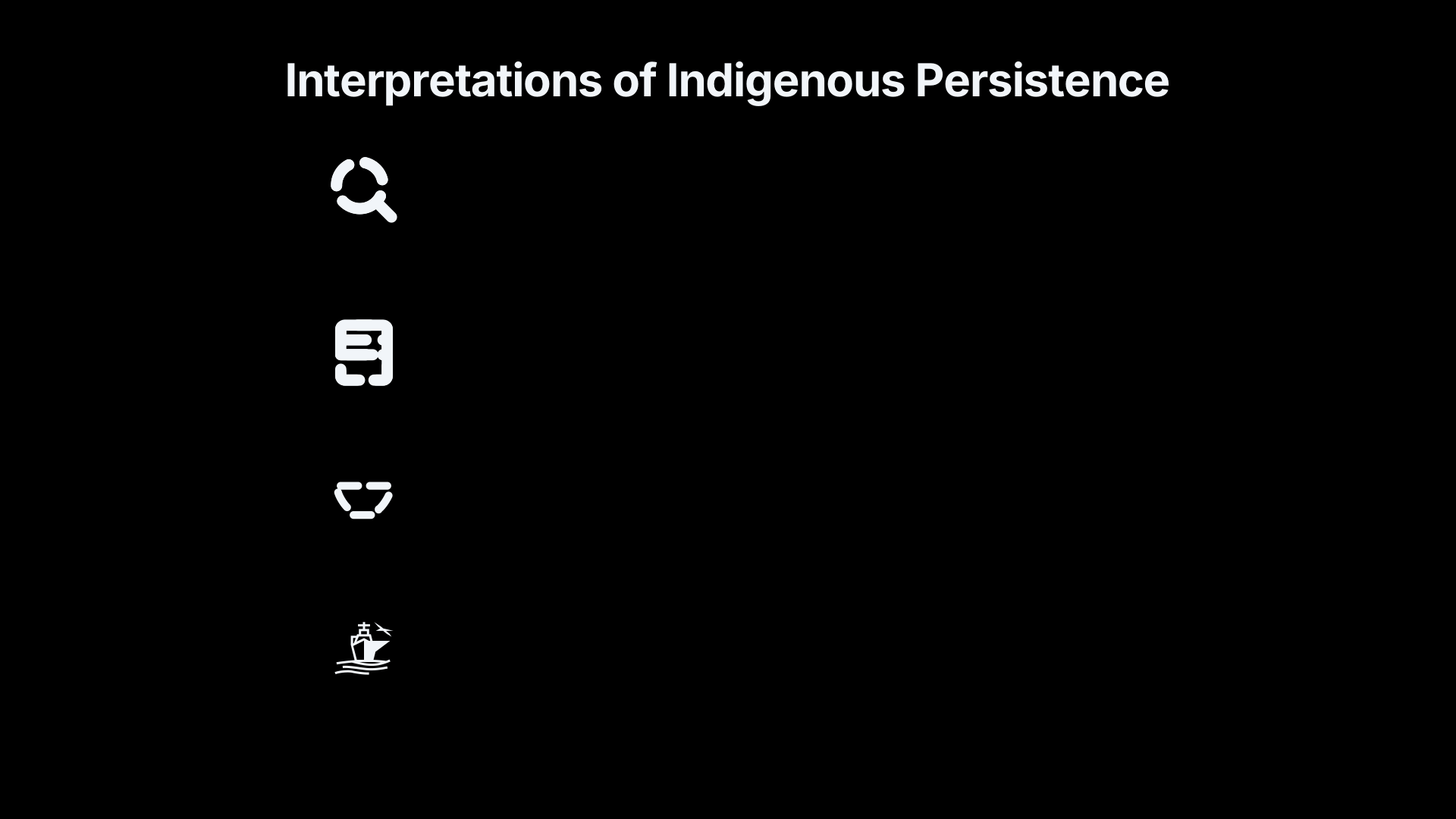
The persistence of Indigenous traditions frustrated many missionaries because baptism alone did not erase older religious identities. Communities often attended Mass while continuing local ceremonies connected with farming, healing or the annual cycle. To colonial observers this looked like deception: outward conformity concealing forbidden beliefs.
Modern historians interpret this differently. Rather than seeing secret paganism, they describe a process of religious coexistence and adaptation. Many Indigenous people regarded Christian practices as additions to existing spiritual relationships instead of replacements for them. The resulting blend challenged the colonial expectation that conversion should produce a complete religious break.[Revistas UdeA]revistas.udea.edu.coRevistas UdeAExtirpación de idolatrías e identidad cultural en las sociedades andinas del Perú virreinal (siglo XVII) | Boletín de Antrop…
This gap between colonial expectations and Indigenous practice helped create a recurring moral panic. Ordinary customs could suddenly be interpreted as signs of concealed religious rebellion, encouraging repeated investigations even where no organised resistance existed. The fear became self-reinforcing: every surviving traditional practice appeared to confirm missionary warnings that idolatry remained widespread.[Revistas UdeA]revistas.udea.edu.coRevistas UdeAExtirpación de idolatrías e identidad cultural en las sociedades andinas del Perú virreinal (siglo XVII) | Boletín de Antrop…
Coca, sacred practice and colonial contradiction
The colonial debate over coca illustrates how economic interests and religious fears collided. Some churchmen argued that coca consumption was closely connected with Indigenous ceremonies and even claimed its effects reflected demonic influence. Others recognised that coca played an essential role in everyday labour, particularly in the mining economy on which Spanish wealth depended.
This contradiction exposed the limits of colonial religious policy. Authorities condemned coca when it appeared within Indigenous ritual life, yet tolerated or profited from its widespread use when it supported colonial production. The same practice could therefore be denounced as idolatrous or accepted as economically necessary depending on context.[Google Books]books.google.comIdolatry and Its EnemiesGoogle BooksIdolatry and Its Enemies: Colonial Andean Religion and Extirpation, 1640-1750 - Kenneth Mills - Google Books…
What survived in modern Bolivian religion
Colonial campaigns never eliminated Indigenous spirituality. Instead, many traditions adapted by existing alongside Catholic beliefs. Offerings associated with the land, respect for sacred mountains, community rituals and local religious festivals continued, often becoming intertwined with Christian saints’ days and church celebrations rather than disappearing altogether.[Revistas UdeA]revistas.udea.edu.coRevistas UdeAExtirpación de idolatrías e identidad cultural en las sociedades andinas del Perú virreinal (siglo XVII) | Boletín de Antrop…
For historians, this survival demonstrates that colonial descriptions of “idolatry” cannot simply be read as objective accounts of Indigenous religion. They were official documents produced by people whose purpose was to identify, classify and suppress practices they believed endangered Christian society. Modern scholarship therefore treats these records as valuable but deeply shaped by colonial assumptions and power relations.[revistaschilenas.uchile.cl]revistaschilenas.uchile.clOpen source on uchile.cl.
The legacy remains visible in Bolivia today. Religious festivals, pilgrimages and household rituals often combine Catholic symbolism with much older Andean understandings of sacred landscapes and reciprocal relationships with the natural world. What colonial authorities portrayed as dangerous survivals have instead become part of the country’s distinctive religious heritage, illustrating that attempts to erase Indigenous belief ultimately produced enduring forms of religious blending rather than complete replacement.[bibliotecanacional.gob.cl]bibliotecanacional.gob.clOpen source on gob.cl.
Amazon book picks
Further Reading
Books and field guides related to When Andean Worship Became a Colonial Threat. Use these as the next step if you want deeper reading beyond the article.

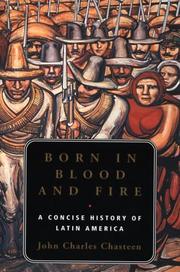
Born in blood and fire
Explains colonial Latin America and Indigenous-European encounters.
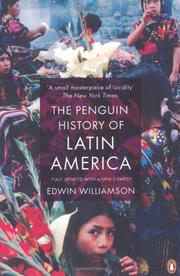
The Penguin history of Latin America
First published 1992. Subjects: History, Latin america, history.
Endnotes
1.
Source: books.google.com
Title: Idolatry and Its Enemies
Link:https://books.google.com/books/about/Idolatry_and_Its_Enemies.html?id=GgTcSA3bib8C
Source snippet
Google BooksIdolatry and Its Enemies: Colonial Andean Religion and Extirpation, 1640-1750 - Kenneth Mills - Google Books...
2.
Source: dra.revistas.csic.es
Link:https://dra.revistas.csic.es/index.php/dra/article/view/409
Source snippet
Un clérigo muy particular ante los indios de Charcas (Bolivia) y su memorial de 1588 recién publicado | Disparidades. Revista de Antropol...
3.
Source: revistaschilenas.uchile.cl
Link:https://revistaschilenas.uchile.cl/handle/2250/157877
4.
Source: bibliotecanacional.gob.cl
Link:https://www.bibliotecanacional.gob.cl/publicaciones/vol-viii-de-idolos-santos-evangelizacion-y-religion-andina-en-los-andes-del-sur
5.
Source: dra.revistas.csic.es
Link:https://dra.revistas.csic.es/index.php/dra/article/view/409/0
6.
Source: revistas.udea.edu.co
Link:https://revistas.udea.edu.co/index.php/boletin/user/setLocale/en_US?source=%2Findex.php%2Fboletin%2Farticle%2Fview%2F6974%3FarticlesBySimilarityPage%3D4
Source snippet
Revistas UdeAExtirpación de idolatrías e identidad cultural en las sociedades andinas del Perú virreinal (siglo XVII) | Boletín de Antrop...
7.
Source: revistas.udea.edu.co
Link:https://revistas.udea.edu.co/index.php/boletin/article/view/6974
Source snippet
Revistas UdeAExtirpación de idolatrías e identidad cultural en las sociedades andinas del Perú virreinal (siglo XVII) | Boletín de Antrop...
8.
Source: revistas.udea.edu.co
Link:https://revistas.udea.edu.co/index.php/boletin/user/setLocale/pt_BR?source=%2Findex.php%2Fboletin%2Farticle%2Fview%2F6974%3FarticlesBySimilarityPage%3D195
Source snippet
udea.edu.coExtirpación de idolatrías e identidad cultural en las sociedades andinas del Perú virreinal (siglo XVII) | Boletim de Antropol...
9.
Source: bibliotecadigital.udea.edu.co
Link:https://bibliotecadigital.udea.edu.co/entities/publication/517d1a01-57ec-4b2d-8585-a79a9626ea59
Additional References
10.
Source: degruyterbrill.com
Title: Idolatry and Its Enemies
Link:https://www.degruyterbrill.com/document/doi/10.1515/9780691187334/html
Source snippet
Your documents are now available to view. Mills, Kenneth and Mills, Kenneth. Idolatry and Its Enemies: Colonial Andean Religion and Extir...
11.
Source: degruyterbrill.com
Title: Idolatry and Its Enemies
Link:https://www.degruyterbrill.com/document/doi/10.1515/9780691187334/html?lang=en
Source snippet
June 5, 2018 — IDOLATRY AND ITS ENEMIES Colonial Andean Religion and Extirpation, 1640-1750 * Kenneth Mills Language: English Published/C...
Published: June 5, 2018
12.
Source: youtube.com
Title: The Incas Decoded: How the Inca Ruled the Andes | Full Documentary
Link:https://www.youtube.com/watch?v=VpgX5dkNfGY
Source snippet
How Christianity Demonized Indigenous Beliefs...
13.
Source: youtube.com
Title: The Inca Empire | The War Against Idolatry
Link:https://www.youtube.com/watch?v=ecrOB2liLMA
Source snippet
Colonization and Resistance | Part I | Indigenous Peoples and the Catholic Church...
14.
Source: redcol.minciencias.gov.co
Link:https://redcol.minciencias.gov.co/Record/UDEA2_c0ef8da7d4f423e60a40cebd3b89ef6f/Description
15.
Source: nationalhumanitiescenter.org
Title: idolatry and its enemies colonial andean religion and extirpation 1640 1750
Link:https://nationalhumanitiescenter.org/fellows-books/idolatry-and-its-enemies-colonial-andean-religion-and-extirpation
16.
Source: cambridge.org
Link:https://www.cambridge.org/core/journals/church-history/article/idolatry-and-its-enemies-colonial-andean-religion-and-extirpation-16401750-by-kenneth-mills-princeton-princeton-university-press-1997-xvi-337-pp-5500-cloth/98F7C7BC19324437C19AD1FA9DAEBAE7
17.
Source: youtube.com
Link:https://www.youtube.com/watch?v=9iImmVKrWzI
Source snippet
The Incas Decoded: How the Inca Ruled the Andes | Full Documentary...
18.
Source: openurl.ebsco.com
Link:https://openurl.ebsco.com/contentitem/doi%3A10.2307/481561?id=ebsco%3Adoi%3A10.2307%2F481561&sid=ebsco%3Aplink%3Acrawler
19.
Source: jstor.org
Link:https://www.jstor.org/stable/j.ctv39x67x
Topic Tree