Within Kiribati Belief Panics
How Conversion Turned Into Civil War
On Tabiteuea, rival faiths became rival political communities, ending in armed conquest and the suppression of Tioba followers.
On this page
- The rise of Tioba and Protestant rivalry
- Hymns, firearms and the final campaigns
- Why the conflict was not mass hysteria
Page outline Jump by section
Introduction
The Tabiteuea religious wars were among the most violent episodes in the history of what is now Kiribati. Between the late 1860s and the early 1880s, the atoll became divided into rival religious communities whose disagreements over belief also became struggles over political authority, land, and social order. A new syncretic movement centred on the deity Tioba (Jehovah) competed directly with Protestant Christianity introduced through Hawaiian missionaries and local converts. The conflict ended not with peaceful coexistence but with military conquest, the destruction of Tioba’s institutions, and the forced conversion or killing of many of its followers. Far from being an example of mass hysteria, the wars illustrate how religious change could reshape existing political alliances and produce organised civil conflict rather than irrational collective panic.[usp.ac.fj]repository.usp.ac.fjKiribati Vol 3 pg 228 to 236Worldmark Encyclopedia of Religious Practices, 2nd Edition, Volume 3 – Finals/ 8/1/2014 19:25 Page 228November 25, 2014…
The rise of Tioba and Protestant rivalry
Before Christianity spread widely across Tabiteuea, authority rested in autonomous communities organised around the maneaba, the traditional meeting house where elders governed by discussion rather than under a single paramount chief. This decentralised political system meant that new religious ideas were adopted unevenly. Different districts could choose different alliances, creating lasting divisions across the atoll.[Wikipedia]WikipediaOpen source on wikipedia.org.
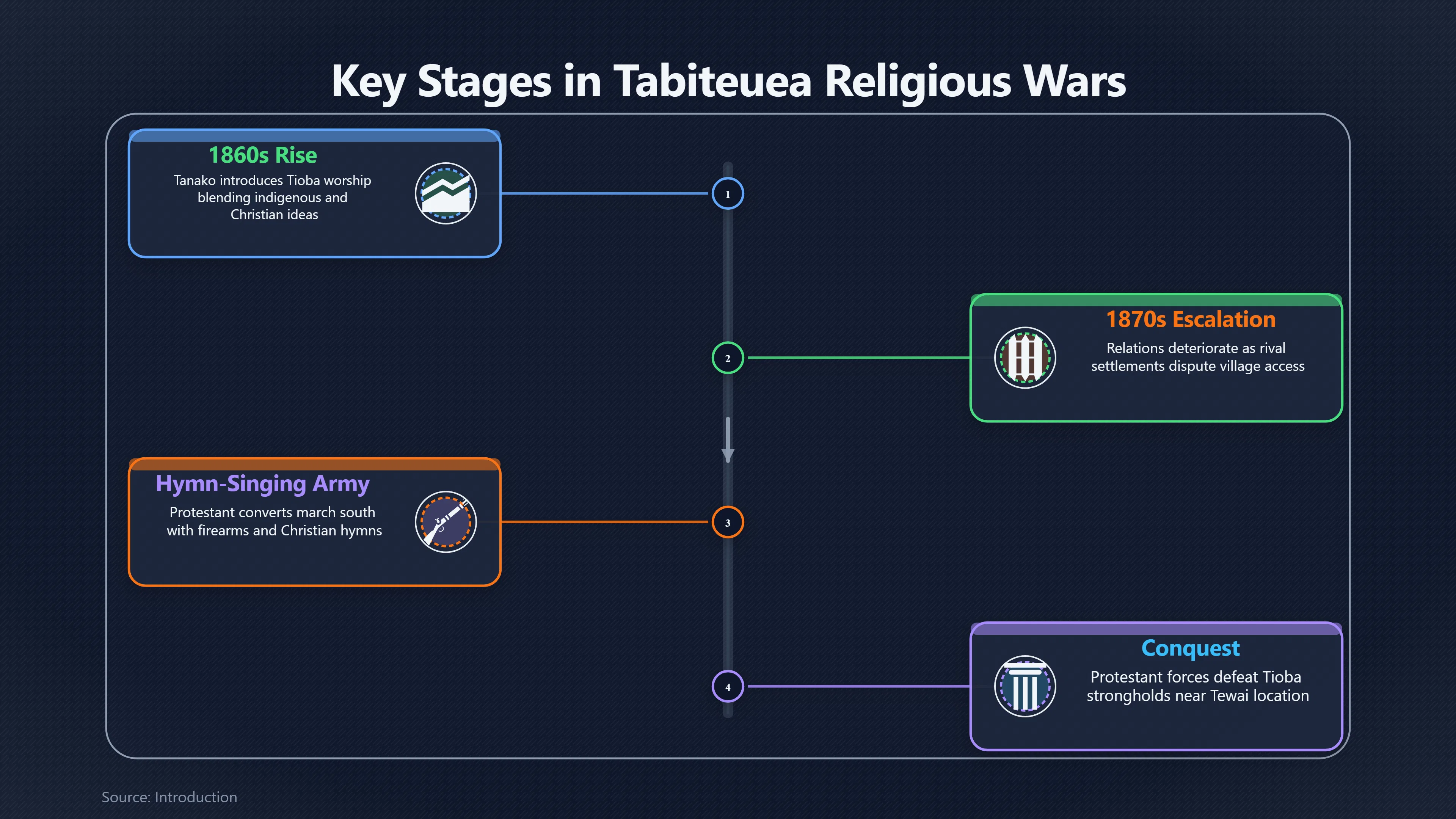
During the 1860s, a Gilbertese religious leader commonly identified as Tanako (or Toinako in some missionary accounts) introduced the worship of Tioba after exposure to Christian ideas while travelling through Fiji and other Pacific islands. Rather than preserving an untouched pre-Christian faith, Tioba combined indigenous beliefs with elements of Christianity. Followers worshipped a feathered sacred object representing Tioba (Jehovah), incorporated Christian terminology and ideas, and created a distinctly local religious movement often known as Te Buraeniman (“the Feathered People”).[wikipedia.org]WikipediaOpen source on wikipedia.org.
At almost the same time, Protestant missions supported by the Hawaiian Evangelical Association expanded across the Gilbert Islands. Hawaiian missionaries, particularly William B. Kapu and Henry Nalimu, found growing numbers of converts in northern Tabiteuea while southern districts remained strongholds of Tioba. As conversion accelerated, religious identity increasingly became identical with political allegiance. Communities were no longer simply debating theology; they were choosing between competing systems of authority and competing visions of the island’s future.[bishopmuseum.org]blog.bishopmuseum.orgTabiteuean Religious Wars – Bishop Museum BlogTabiteuean Religious Wars – Bishop Museum Blog
Hymns, firearms and the final campaigns
Relations deteriorated through the 1870s as both sides accused the other of threatening community life. Missionary reports describe disputes over access to villages, the destruction of Tioba sacred objects, and escalating confrontations between rival settlements. Tioba supporters, meanwhile, regarded the missionaries as outsiders who undermined established customs and local autonomy.[blog.bishopmuseum.org]blog.bishopmuseum.orgTabiteuean Religious Wars – Bishop Museum BlogTabiteuean Religious Wars – Bishop Museum Blog
The conflict eventually became organised warfare. Protestant converts from northern Tabiteuea assembled what later writers described as a “hymn-singing army”, marching south while singing Christian hymns and carrying firearms alongside traditional weapons. Kapu portrayed the campaign as a holy struggle in which faith would ensure victory. Surviving accounts preserve one battle hymn encouraging the fighters not to lose heart because Jesus was with them.[tandfonline.com]tandfonline.comTaylor & Francis Online The Journal of Pacific HistoryTaylor & Francis Online The Journal of Pacific History
The decisive campaign culminated near Tewai in 1880 after years of intermittent fighting. Protestant forces defeated the Tioba strongholds, destroyed their religious symbols and meeting places, and broke organised resistance. Contemporary and later historical accounts agree that the aftermath involved widespread coercion: Tioba adherents were either killed, compelled to abandon their religion, or absorbed into Protestant communities. The movement effectively disappeared as an organised faith on Tabiteuea.[tandfonline.com]tandfonline.comTaylor & Francis Online The Journal of Pacific HistoryTaylor & Francis Online The Journal of Pacific History
The consequences extended beyond religion. Victory shifted political influence toward Protestant communities, strengthened missionary authority, and permanently altered the island’s religious landscape. Later Catholic missions expanded into Tabiteuea, but they did so after Tioba had already been eliminated as an organised rival.[Wikipedia]WikipediaOpen source on wikipedia.org.

Why the conflict was not mass hysteria
Although later writers have sometimes referred to Tioba as a “cult”, the label requires care. It largely reflects missionary and colonial language rather than a neutral description. Modern historians generally describe Tioba as a syncretic or indigenous Christian movement that blended imported religious ideas with existing Gilbertese traditions.[usp.ac.fj]repository.usp.ac.fjKiribati Vol 3 pg 228 to 236Worldmark Encyclopedia of Religious Practices, 2nd Edition, Volume 3 – Finals/ 8/1/2014 19:25 Page 228November 25, 2014…
Nor does the episode fit the pattern of mass hysteria or mass psychogenic illness. Several features distinguish it:
- The conflict unfolded over more than a decade rather than through a sudden outbreak of irrational behaviour.
- Both sides organised themselves politically and militarily, making strategic decisions instead of acting through contagious panic.
- Material issues—including leadership, community autonomy, and relations with foreign missionaries—were inseparable from theological disagreements.
- The violence was deliberate and sustained, culminating in conquest rather than in the spontaneous collapse typical of episodes of collective delusion.[tandfonline.com]tandfonline.comTaylor & Francis Online The Journal of Pacific HistoryTaylor & Francis Online The Journal of Pacific History
Missionary narratives often portrayed Tioba followers as superstitious or dangerously misguided. Those accounts remain valuable primary sources but must be read critically because they were written by participants who sought to justify their own mission. More recent scholarship places greater emphasis on indigenous agency, arguing that Tioba represented a creative local response to rapid social change rather than simple resistance to Christianity or evidence of irrational belief.[bishopmuseum.org]blog.bishopmuseum.orgTabiteuean Religious Wars – Bishop Museum BlogTabiteuean Religious Wars – Bishop Museum Blog
Why the wars still matter
The Tabiteuea religious wars remain one of the clearest examples in Pacific history of conversion becoming civil war. They demonstrate that the spread of Christianity was neither uniform nor peaceful and that island communities actively reshaped imported beliefs instead of passively accepting them.
For the wider history of Kiribati, the episode also serves as a reminder that religious conflict cannot be understood solely through doctrine. Imported faiths became intertwined with local political structures, existing rivalries, and questions of legitimate authority. The destruction of Tioba was therefore not simply a theological victory for Protestantism but a transformation of power on Tabiteuea itself.[tandfonline.com]tandfonline.comTaylor & Francis Online The Journal of Pacific HistoryTaylor & Francis Online The Journal of Pacific History
Amazon book picks
Further Reading
Books and field guides related to How Conversion Turned Into Civil War. Use these as the next step if you want deeper reading beyond the article.

Guns, Germs, and Steel
Broad historical context for societal transformation in the Pacific.

The anthropology of religion, magic, and witchcraft
Useful for understanding religious conflict analytically.
Endnotes
1.
Source: repository.usp.ac.fj
Title: Kiribati Vol 3 pg 228 to 236
Link:https://repository.usp.ac.fj/id/eprint/7832/1/Kiribati_Vol_3_pg_228_to_236.pdf
Source snippet
Worldmark Encyclopedia of Religious Practices, 2nd Edition, Volume 3 – Finals/ 8/1/2014 19:25 Page 228November 25, 2014...
Published: November 25, 2014
2.
Source: blog.bishopmuseum.org
Title: Tabiteuean Religious Wars – Bishop Museum Blog
Link:https://blog.bishopmuseum.org/nupepa/tabiteuean-religious-wars/
3.
Source: Wikipedia
Link:https://en.wikipedia.org/wiki/Tabiteuea
4.
Source: Wikipedia
Link:https://en.wikipedia.org/wiki/Tanaeang
5.
Source: paperzz.com
Link:https://paperzz.com/doc/7976469/document
Source snippet
Document...
6.
Source: repository.usp.ac.fj
Title: usp.ac.fj Items where Subject is “BR Christianity”
Link:https://repository.usp.ac.fj/view/subjects/BR.type.html
Source snippet
(1997) Keimami sa vakila na liga ni Kalou (Feeling the Hand of God: human and nonhuman impacts on Pacific Island environments). The Un...
7.
Source: repository.usp.ac.fj
Title: usp.ac.fj Items where Author is “Tebano, Temakei”
Link:https://www.repository.usp.ac.fj/view/creators/Tebano%3D3ATemakei%3D3A%3D3A.html
Source snippet
where Author is "Tebano, Temakei" - USP Electronic Research RepositoryMarch 30, 2026 — USP Electronic Research Repository ITEMS WHERE AUT...
Published: March 30, 2026
8.
Source: repository.usp.ac.fj
Title: usp.ac.fj Items where Author is “Uriam, Kambati K.”
Link:https://repository.usp.ac.fj/view/creators/Uriam%3D3AKambati_K%3D2E%3D3A%3D3A.html
9.
Source: repository.usp.ac.fj
Title: usp.ac.fj Items where Author is “Teaero, Teweiariki”
Link:https://www.repository.usp.ac.fj/view/creators/Teaero%3D3ATeweiariki%3D3A%3D3A.html
10.
Source: repository.usp.ac.fj
Title: usp.ac.fj Browse by Type
Link:https://www.repository.usp.ac.fj/view/types/book%3D5Fsection.html
11.
Source: repository.usp.ac.fj
Title: usp.ac.fj Kiribati
Link:https://repository.usp.ac.fj/id/eprint/8788/
12.
Source: repository.usp.ac.fj
Title: usp.ac.fj Browse by Type
Link:https://www.repository.usp.ac.fj/view/types/book%3D5Fsection.default.html
13.
Source: tandfonline.com
Title: Taylor & Francis Online The Journal of Pacific History
Link:https://www.tandfonline.com/doi/pdf/10.1080/00223344.2025.2523834
14.
Source: digital.library.adelaide.edu.au
Title: Adelaide Digital Library I
Link:https://digital.library.adelaide.edu.au/dspace/bitstream/2440/101517/1/Series%20O_%201_%20Synopses.pdf
Source snippet
/ SYNOPSIS OF BOOK A The text is the work of Teu...
15.
Source: tandfonline.com
Link:https://www.tandfonline.com/doi/abs/10.1080/00223344.2025.2523834
16.
Source: academickids.com
Link:https://academickids.com/encyclopedia/index.php/Tabiteuea
Additional References
17.
Source: researchgate.net
Link:https://www.researchgate.net/publication/326054109_The_Origins_of_the_Baha%27i_Faith_in_the_Pacific_Island_The_Case_of_the_Gilbert_and_Ellice_Islands
18.
Source: africabib.org
Link:https://www.africabib.org/rec.php?RID=100018246
19.
Source: fondation-culturelle-barbier-mueller.org
Link:https://www.fondation-culturelle-barbier-mueller.org/en/tabiteuea-kiribati/
20.
Source: cambridge.org
Link:https://www.cambridge.org/core/journals/journal-of-ecclesiastical-history/article/abs/going-native-converting-narratives-in-tiwi-histories-of-twentiethcentury-missions/E65068C986A217320763EA95BA44F5A0
21.
Source: digitalpasifik.org
Link:https://digitalpasifik.org/items/800188
22.
Source: hawaii.edu
Link:https://www.hawaii.edu/oceanic/rotuma/os/howsel/22religiouswars.html
23.
Source: mdpi.com
Link:https://www.mdpi.com/2077-1444/8/10/221
24.
Source: fondation-culturelle-barbier-mueller.org
Title: Tabiteuea Kiribati – Fondation culturelle Barbier-Mueller
Link:https://www.fondation-culturelle-barbier-mueller.org/tabiteuea-kiribati/
25.
Source: youtube.com
Title: A Brief History of Kiribati
Link:https://www.youtube.com/watch?v=KeMoTR8vEFk
Source snippet
Geography Now! Kiribati...
26.
Source: persee.fr
Title: Une religion syncrétique en Côte d’Ivoire
Link:https://www.persee.fr/doc/cea_0008-0055_1962_num
Topic Tree