Within Tonga
What Christian Reform Changed in Everyday Tonga
Missionary discipline reached beyond worship into dancing, sport, smoking, clothing, sexuality and the public observance of Sunday.
On this page
- Rules for recreation, dress and behaviour
- The destruction and reclassification of older sacred practices
- How royal law made Christian time public
Page outline Jump by section
Introduction
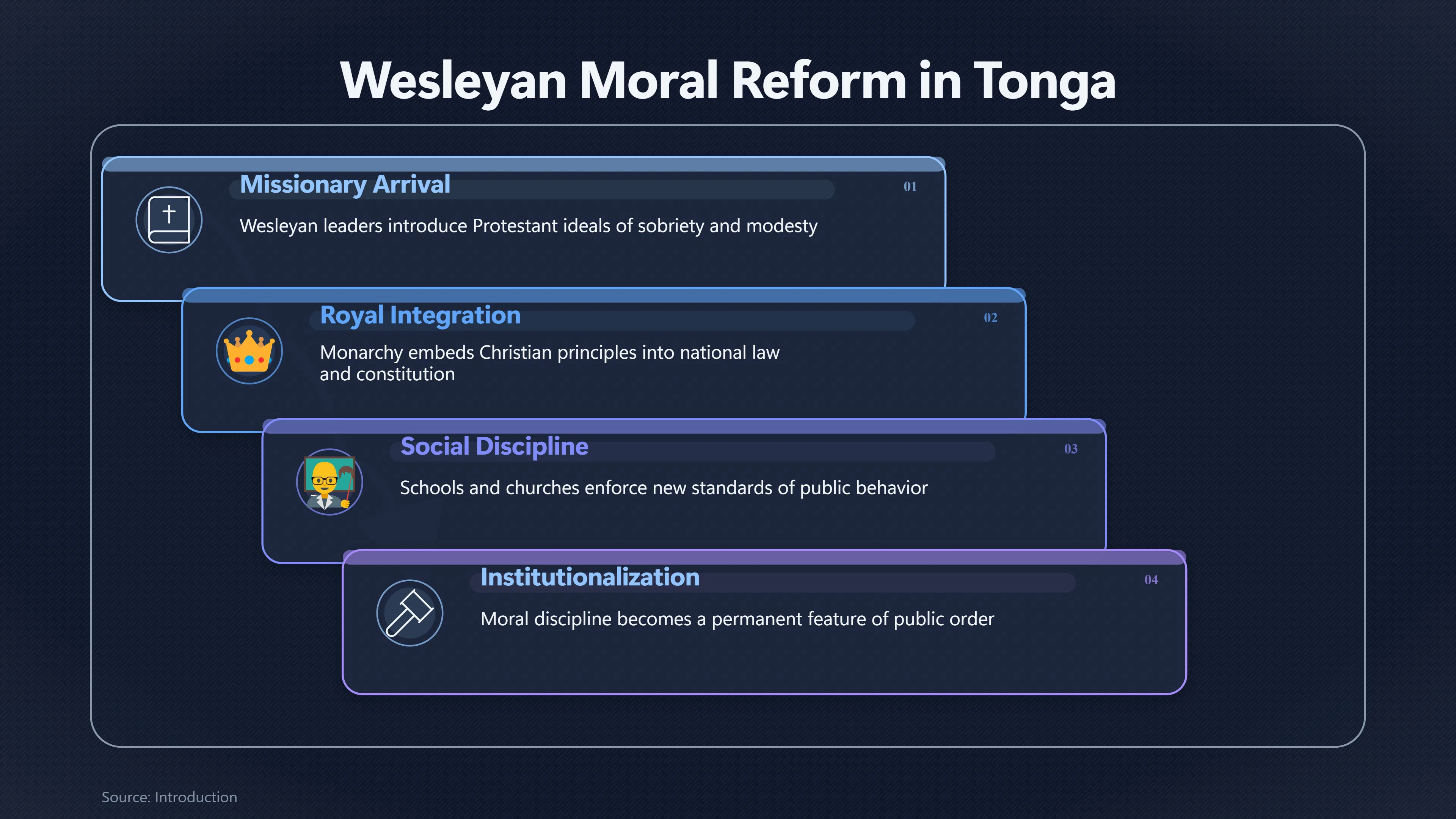
Wesleyan Christianity reshaped far more than religious belief in nineteenth-century Tonga. As missionaries and the emerging Christian monarchy worked together, they sought to remake ordinary life by regulating recreation, dress, sexuality, work, public behaviour and the observance of Sunday. These reforms were not simply private religious advice. They became embedded in royal law, schools and local communities, making Christian moral discipline part of the kingdom’s public order. The result was a profound transformation of everyday life that outlasted the missionary era and still influences Tongan society. At the same time, the reforms involved the suppression or reclassification of many older sacred customs, creating lasting debates about how Christianity and indigenous culture became intertwined rather than simply replacing one another.[The Methodist Church]methodist.org.ukThe Methodist Church TongaThe Methodist ChurchTonga - The Methodist Church…
Rules for recreation, dress and behaviour
Wesleyan missionaries believed that genuine conversion required visible changes in daily conduct. Their aim was not only to establish churches but to cultivate disciplined Christian communities whose behaviour reflected Protestant ideals of sobriety, modesty and self-control.
Missionaries therefore criticised a wide range of activities that had previously formed part of social life. Historian Sione Latukefu notes that Wesleyan leaders condemned practices such as dancing, many sporting contests and smoking because they associated them with moral disorder or distractions from Christian living. Clothing also became a marker of conversion. More modest styles of dress were encouraged, while behaviour surrounding courtship and sexuality came under increasing religious scrutiny. These expectations were reinforced through preaching, church membership rules and the growing network of mission schools, where literacy and religious instruction were taught together.
The reforms were intended to produce a recognisably Christian society rather than simply a population that attended church. Respectability became something that could be seen in public appearance, family life and everyday conduct, making moral discipline part of personal identity as well as religious belief. This reflected broader nineteenth-century Methodist ideas found elsewhere in the Pacific, but in Tonga they gained unusual force because they were increasingly backed by royal authority rather than remaining voluntary church expectations.[The Methodist Church]methodist.org.ukThe Methodist Church TongaThe Methodist ChurchTonga - The Methodist Church…
Why older sacred practices were redefined
The reforms did not merely introduce new religious habits; they also changed how older customs were understood. Rituals, ceremonies and performances that had once possessed sacred or chiefly significance increasingly came to be classified as incompatible with Christian life.
This process was selective rather than absolute. Some customs disappeared because they were directly associated with pre-Christian religious practice. Others survived after being stripped of their earlier spiritual meanings and reinterpreted as elements of national culture rather than religious devotion. Dancing illustrates this pattern well. While missionaries initially condemned many traditional performances, later generations accepted numerous forms of Tongan dance as cultural expression once they were detached from older ritual contexts and adapted to Christian moral expectations.
The distinction between “culture” and “religion” therefore changed fundamentally. Practices once embedded within indigenous cosmology were often recast as folklore, heritage or entertainment, while Christian worship became the accepted public expression of the sacred. This was not simply imposed from outside. Tongan converts, chiefs and later governments actively participated in deciding which traditions could be preserved, modified or abandoned, producing a distinctly Tongan form of Christian society rather than a complete copy of European Methodism.[The Methodist Church]methodist.org.ukThe Methodist Church TongaThe Methodist ChurchTonga - The Methodist Church…

How royal law made Christian time public
Perhaps the clearest example of everyday moral reform was the creation of a legally protected Christian Sunday. The Sabbath ceased to be only a church observance and became a public institution shaping the rhythm of the entire kingdom.
Under the influence of King George Tupou I and Wesleyan advisers, Christian principles became incorporated into national law and later reflected in the 1875 Constitution. The Constitution declared that the Sabbath should be kept holy and prohibited most forms of business except where authorised by law. Over time, legislation also restricted many recreational activities on Sundays, ensuring that the weekly calendar itself reflected Christian priorities.[Refworld]refworld.orgU.S. Department of State Annual Report on International Religious Freedom for 1999 - Tonga | Refworld…
The practical consequences were highly visible:
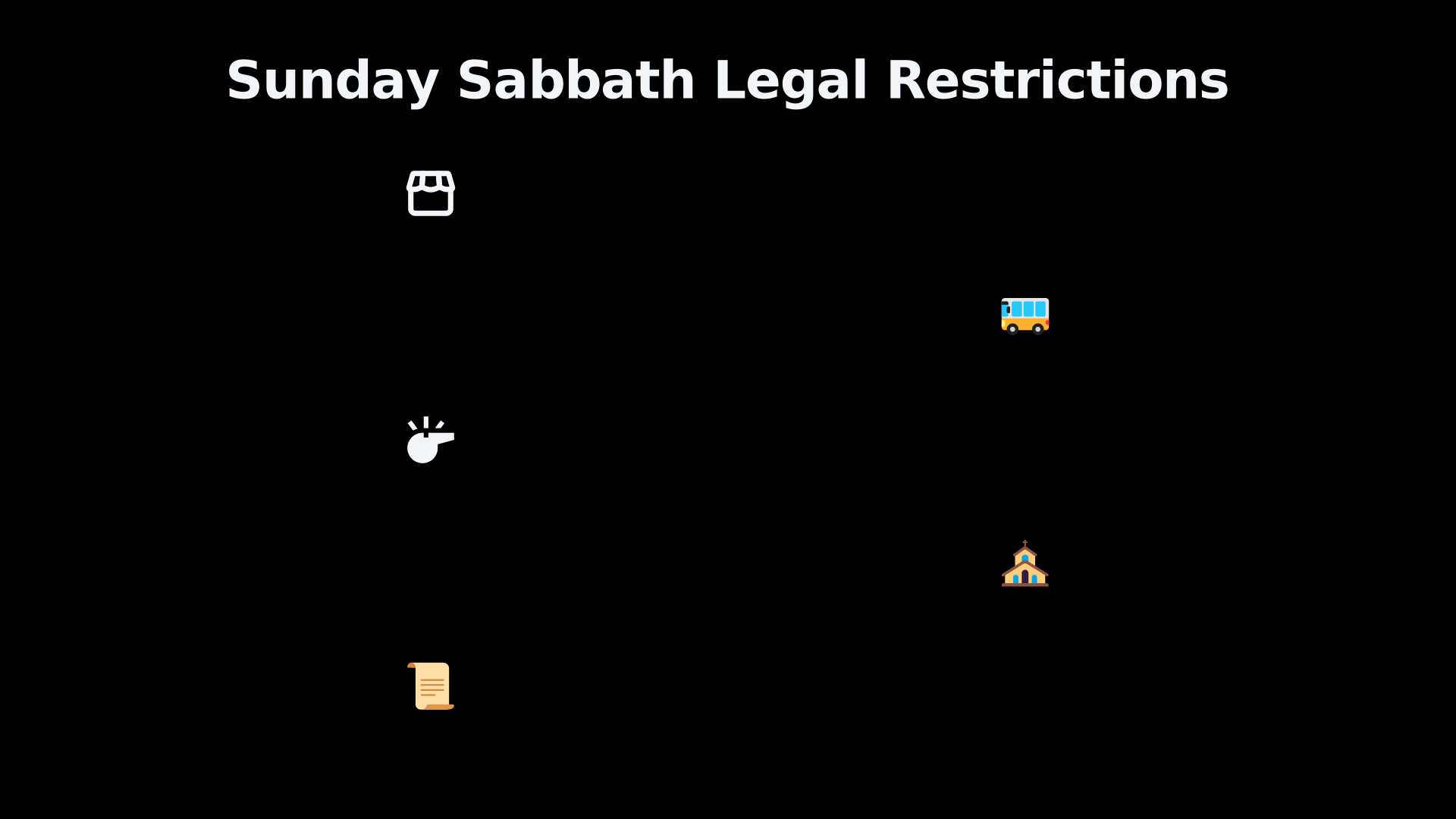
- Most shops and commercial businesses closed.
- Public transport and many forms of work ceased except for essential services.
- Sporting and many recreational activities were restricted.
- Church attendance became the expected centre of community life on Sundays.
Visitors frequently remarked on the unusual quietness of the kingdom on Sundays. Even modern descriptions of Tonga note that commercial life largely stops for the day, illustrating how nineteenth-century Wesleyan ideas about sacred time became enduring features of public life rather than merely private religious observance.[churchofjesuschrist.org]churchofjesuschrist.orgThe Church of Jesus Christ Tonga: A Land of Believing PeopleThe Church of Jesus Christ Tonga: A Land of Believing People
Moral reform as social discipline rather than mass hysteria
Within the wider history of collective belief, Tonga’s Wesleyan reforms are better understood as an organised programme of moral transformation than as an episode of mass hysteria. People did not suddenly adopt irrational fears through rumour or panic. Instead, missionaries, chiefs and the monarchy gradually created a new moral order that linked religious faith with respectable citizenship.
Nevertheless, the process shared some mechanisms found in moral panics. Behaviour once regarded as normal could rapidly become defined as spiritually dangerous or socially unacceptable. Activities associated with the pre-Christian past were increasingly viewed through a moral lens in which they represented temptation, disorder or resistance to God’s will. Community pressure, church discipline and legal authority reinforced these judgements, making conformity both a religious and civic expectation.
Unlike a short-lived panic, however, these changes became institutionalised. Schools, churches, courts and the monarchy all helped maintain the new standards across generations. The endurance of Sunday observance and the continuing influence of the Free Wesleyan tradition demonstrate that this was not simply a temporary wave of religious enthusiasm but a lasting remaking of everyday life in Tonga.[methodist.org.uk]methodist.org.ukThe Methodist Church TongaThe Methodist ChurchTonga - The Methodist Church…
Why the reforms still matter
The legacy of Wesleyan moral reform remains visible in contemporary Tonga. Christianity continues to shape public life, while the close historical relationship between the monarchy and the Free Wesleyan Church has given religious practice an unusually prominent place in national identity. Strict Sunday observance, expectations of modest public behaviour and the central role of churches in community life all reflect reforms first established during the nineteenth century.[methodist.org.uk]methodist.org.ukThe Methodist Church TongaThe Methodist ChurchTonga - The Methodist Church…
At the same time, modern Tongans increasingly distinguish between Christianity and traditional culture rather than treating them as mutually exclusive. Many performances, ceremonies and artistic traditions once criticised by missionaries are now celebrated as expressions of national heritage. This continuing negotiation between inherited Christian discipline and older cultural identity is one of the most important long-term consequences of the Wesleyan remaking of everyday life, illustrating how religious reform can permanently reshape society while still leaving room for cultural adaptation and revival.[Cultural Atlas]culturalatlas.sbs.com.auCultural Atlas TonganCultural AtlasTongan - Religion — Cultural Atlas…

Endnotes
1.
Source: methodist.org.uk
Title: The Methodist Church Tonga
Link:https://www.methodist.org.uk/for-churches/global-relationships/partner-churches-and-organisations/asia-pacific/tonga/
Source snippet
The Methodist ChurchTonga - The Methodist Church...
2.
Source: refworld.org
Link:https://www.refworld.org/reference/annualreport/usdos/1999/en/36923
Source snippet
U.S. Department of State Annual Report on International Religious Freedom for 1999 - Tonga | Refworld...
3.
Source: culturalatlas.sbs.com.au
Title: Cultural Atlas Tongan
Link:https://culturalatlas.sbs.com.au/tongan-culture/tongan-culture-religion
Source snippet
Cultural AtlasTongan - Religion — Cultural Atlas...
4.
Source: churchofjesuschrist.org
Title: The Church of Jesus Christ Tonga: A Land of Believing People
Link:https://www.churchofjesuschrist.org/study/ensign/2001/09/tonga-a-land-of-believing-people?lang=eng
5.
Source: teara.govt.nz
Title: Culture | Te Ara Encyclopedia of New Zealand
Link:https://teara.govt.nz/en/tongans/page-3
6.
Source: churchofjesuschrist.org
Title: tonga a land dedicated to god
Link:https://www.churchofjesuschrist.org/study/liahona/2014/08/tonga-a-land-dedicated-to-god?lang=eng
7.
Source: churchofjesuschrist.org
Title: tonga a land of believing people
Link:https://www.churchofjesuschrist.org/study/liahona/2002/04/tonga-a-land-of-believing-people?lang=eng
8.
Source: 2017-2021.state.gov
Link:https://2017-2021.state.gov/reports/2019-report-on-international-religious-freedom/tonga/
9.
Source: en.wikisource.org
Link:https://en.wikisource.org/wiki/1911_Encyclop%C3%A6dia_Britannica/Tonga
Additional References
10.
Source: abc.net.au
Link:https://www.abc.net.au/news/2025-06-08/tonga-sabbath-laws-sunday-business-activity-ban/105378874
Source snippet
ABC NewsJune 8, 2025 — Tonga is one of the world's most devout keepers of the Sabbath — but some say there's more to faith Share Share ar...
Published: June 8, 2025
11.
Source: tonga-gov.pt
Link:https://tonga-gov.pt/en/150th-anniversary-of-the-constitution-of-the-kingdom-of-tonga-1875-2025-national-celebration-of-history-identity-and-constitutional-continuity/
Source snippet
150th Anniversary of the Constitution of the Kingdom of Tonga (1875–2025) - National Celebration of History, Identity and Constitutional...
12.
Source: tandfonline.com
Title: Church and State in Tonga
Link:https://www.tandfonline.com/doi/abs/10.2307/2755492
Source snippet
The Wesleyan Methodist Missionaries and Political Development, 1822-1875: By Sione Latukefu. Honolulu: The University Press of Hawaii. 19...
13.
Source: 2021-2025.state.gov
Title: U.S. Department of State Tonga
Link:https://2021-2025.state.gov/reports/2021-report-on-international-religious-freedom/tonga/
Source snippet
U.S. Department of StateTonga - United States Department of State...
14.
Source: mpe.gov.to
Link:https://mpe.gov.to/?tribe_events=tupou-1-day
Source snippet
TUPOU 1 DAY – PUBLIC HOLIDAY December 4, 2023 * « Tonga National Day – Public Holiday * C...
Published: December 4, 2023
15.
Source: docslib.org
Link:https://docslib.org/doc/9498752/section-4-king-george-tupou-1-the-development-of-development-of
16.
Source: youtube.com
Title: Tonga’s Ancient Religion: Surprising Links to Early Christianity
Link:https://www.youtube.com/watch?v=e9Xhf-8NV8Y
Source snippet
Tongan History in 3 Minutes...
17.
Source: persee.fr
Title: The case of the Wesleyan Mission in Tonga
Link:https://www.persee.fr/doc/jso_0300-953x_1969_num
18.
Source: books.google.com.tj
Link:https://books.google.com.tj/books?id=Ze8XBAAAQBAJ
19.
Source: books.google.co.nz
Link:https://books.google.co.nz/books?id=Ze8XBAAAQBAJ
Topic Tree