Within Kenya
How Did Kenya's Satanic Panic Spread?
The 1990s Satanism scare turned youth rebellion, crime and inequality into evidence of a hidden national conspiracy.
On this page
- Rumours of recruitment, ritual crime and secret elites
- The Kirima Commission and official endorsement
- Why the conspiracy became almost impossible to disprove
Page outline Jump by section
Introduction
During the 1990s, Kenya experienced one of its most influential modern moral panics: a nationwide fear that organised networks of devil worshippers were recruiting children, infiltrating schools and churches, performing ritual killings, and secretly controlling parts of the country’s political and business elite. Unlike many rumours that remain confined to local communities, these claims gained extraordinary authority because they were repeated by respected church leaders, politicians, newspapers and, ultimately, a presidential commission of inquiry.[Taylor & Francis]taylorfrancis.comOpen source on taylorfrancis.com.
The result was a powerful feedback loop. Rumours encouraged official investigations, while the very existence of those investigations convinced many people that the rumours must be true. Even where evidence was weak, contradictory or anecdotal, official endorsement made scepticism difficult. The panic became a striking example of how governments, religious institutions and the media can unintentionally transform unverified fears into accepted public knowledge.
How did the panic spread?
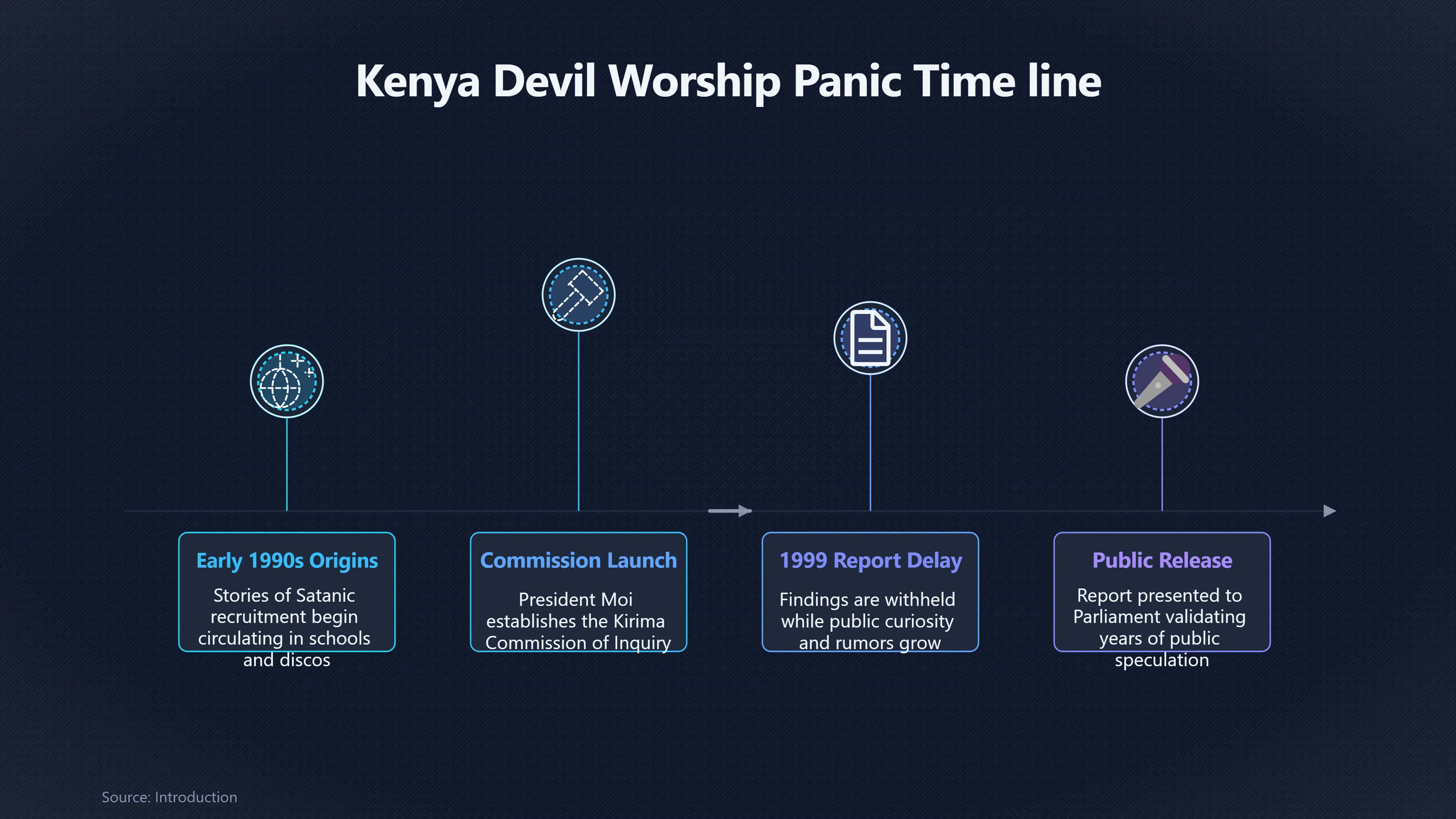
The panic did not begin with a single incident. Throughout the early 1990s, stories circulated that young people were being recruited into Satanic organisations through schools, universities, discos, music, drugs and secret ceremonies. Newspapers carried reports of ritual murders, disappearances and mysterious wealth supposedly linked to occult practices, while evangelical churches warned congregations about hidden spiritual warfare.[Taylor & Francis]taylorfrancis.comOpen source on taylorfrancis.com.
Several factors made these stories unusually persuasive.
First, many rumours reflected genuine anxieties about rapid social change. Kenya was experiencing economic hardship, political uncertainty after the introduction of multi-party politics, growing urban crime and widening inequality. Parents worried about influences they struggled to understand, including changing youth culture, imported popular music and weakening traditional forms of authority. Rather than seeing these developments as separate problems, many narratives merged them into a single hidden conspiracy.[OUP Academic]academic.oup.comOUP Academic“Satan Is an Imitator”: Kenya’s Recent Cosmology of Corruption | For Money and Elders: Ritual, Sovereignty, and the Sacred in…
Second, rumours spread through overlapping networks rather than one source alone. Churches repeated testimony from converts. Newspapers reported dramatic allegations. Politicians discussed the issue publicly. Stories then returned to local communities with added credibility because they had appeared in the national press or been mentioned by religious leaders.
The rumours themselves were remarkably flexible. They claimed that Satanists recruited students through gifts, scholarships or invitations to exclusive clubs; that ritual murders produced wealth and political success; and that respected professionals secretly belonged to occult organisations. Because alleged members were said to conceal their identities, the absence of evidence could itself be interpreted as proof of how powerful the conspiracy supposedly was.[Taylor & Francis]taylorfrancis.comOpen source on taylorfrancis.com.
The Kirima Commission and official endorsement
The turning point came in 1994 when President Daniel arap Moi established the Presidential Commission of Inquiry into the Cult of Devil Worship, chaired by Archbishop Nicodemus Kirima. Its membership included senior Christian clergy together with a senior criminal investigator, reflecting the belief that devil worship represented both a religious and national security problem.[Bunge Library]libraryir.parliament.go.keOpen source on go.ke.
Although the commission completed its work in 1994, its report was withheld for several years before being presented to Parliament in 1999. By then public curiosity had grown considerably. Leaks and newspaper reporting created the impression that the government possessed alarming evidence which had been deliberately hidden.[The Guardian]theguardian.comThe Guardian Kenya 'in grip of devil worship' | World news | The GuardianThe Guardian Kenya 'in grip of devil worship' | World news | The Guardian
When the report finally became public, it appeared to validate years of speculation.
The commission concluded that devil worship existed in Kenya and suggested that it threatened schools, churches and national life. It associated Satanism with a remarkably broad collection of behaviours and organisations, including ritual murder, human sacrifice, secret societies and alleged infiltration of certain religious groups and organisations such as Freemasonry. It recommended stronger state action against the perceived threat.[go.ke]libraryir.parliament.go.keOpen source on go.ke.
For many readers, the most significant fact was not the report’s contents but its official status. A presidential inquiry carries institutional authority. Even where individual claims rested largely on testimony, hearsay or accumulated allegations rather than forensic investigation, publication encouraged many Kenyans to conclude that government experts had confirmed a hidden conspiracy.
Why the conspiracy became almost impossible to disprove
The devil-worship panic displayed several characteristics common to moral panics around the world, but Kenya’s version was especially difficult to challenge because it relied on a self-reinforcing style of reasoning.
If no evidence appeared, believers argued that Satanists were exceptionally secretive.
If respected individuals denied involvement, those denials could be interpreted as further deception.
If police failed to uncover large organisations, critics could claim the conspiracy had already infiltrated law enforcement.
In this framework, almost every outcome strengthened rather than weakened belief.
The alleged conspiracy also absorbed many unrelated social problems. Youth crime, family conflict, corruption, unexplained wealth, drug use, sexual behaviour and violent crime could all be interpreted as symptoms of the same invisible network. This made the theory highly adaptable because virtually any disturbing event could be incorporated into it.[OUP Academic]academic.oup.comOUP Academic“Satan Is an Imitator”: Kenya’s Recent Cosmology of Corruption | For Money and Elders: Ritual, Sovereignty, and the Sacred in…
Scholars have argued that this flexibility explains much of the panic’s longevity. Rather than functioning as a conventional criminal investigation, devil worship became a moral language through which wider fears about modern Kenya could be expressed.[Taylor & Francis]taylorfrancis.comOpen source on taylorfrancis.com.

What evidence supported the claims?
This remains one of the most important distinctions.
Kenya has experienced genuine cases of murder, child abuse, religious exploitation and criminal groups. The existence of these crimes does not automatically demonstrate a nationwide organised Satanic conspiracy.
The Kirima Commission assembled many testimonies, reports and allegations, but critics noted that much of its material relied on personal accounts, religious interpretation or unverified claims rather than criminal convictions establishing an organised national network. The government itself took little practical action after publication beyond public discussion, and later official reporting noted that the commission was no longer active and that no comprehensive follow-up investigation had been pursued.[Refworld]refworld.orgU.S. Department of State Annual Report on International Religious Freedom for 2001 - Kenya | RefworldOctober 26, 2001…
Researchers therefore distinguish between two separate questions:
- whether individual occult-related crimes or exploitative groups existed; and
- whether evidence demonstrated the vast coordinated conspiracy described in public rumours.
Most academic analyses conclude that convincing evidence for the latter was never produced, even though belief in it became widespread.[Taylor & Francis]taylorfrancis.comOpen source on taylorfrancis.com.

Why official rumours mattered so much
The Kenyan case illustrates how rumours can become institutional facts without necessarily becoming evidential facts.
Normally, rumours circulate because people trust friends, neighbours or community leaders. In Kenya’s devil-worship panic, presidential action dramatically increased their credibility. Once the state appointed a commission, many citizens assumed there must already have been compelling evidence. Publication of the report then reinforced the belief that previous rumours had been officially verified.
This process altered public debate. Instead of asking whether organised devil worship had been demonstrated, discussion often shifted towards how extensive the hidden network might be and how it should be defeated. The basic premise became increasingly difficult to question without appearing naïve or morally irresponsible.
Academic studies also connect the panic to broader political conditions under President Moi. During a period marked by economic instability, corruption allegations and contested political authority, stories about invisible Satanic elites provided a powerful explanation for why wealth and power appeared detached from ordinary moral expectations. Rumours about occult sacrifice became a symbolic way of discussing corruption, inequality and elite privilege.[OUP Academic]academic.oup.comOUP Academic“Satan Is an Imitator”: Kenya’s Recent Cosmology of Corruption | For Money and Elders: Ritual, Sovereignty, and the Sacred in…
Why the panic still matters
Kenya’s devil-worship scare remains one of Africa’s best-known examples of a modern moral panic because it demonstrates the unusual power of official endorsement. Rumours that might otherwise have faded instead became part of national memory through government inquiry, parliamentary debate and sustained media attention.
The episode also offers a broader lesson. Governments sometimes establish commissions to calm public fears, yet investigations can unintentionally legitimise those same fears if their conclusions rely heavily on anecdote or if the existence of an inquiry is itself interpreted as proof of a hidden threat.
For historians and sociologists, the devil-worship panic is therefore less a story about proving the existence of a secret Satanic organisation than about how societies explain rapid change, uncertainty and inequality. It shows how religious language, political authority and media reporting can combine to transform rumours into widely accepted public belief—even when the underlying evidence remains contested.[taylorfrancis.com]taylorfrancis.comOpen source on taylorfrancis.com.
Amazon book picks
Further Reading
Books and field guides related to How Did Kenya's Satanic Panic Spread?. Use these as the next step if you want deeper reading beyond the article.
Extraordinary Popular Delusions and the Madness of Crowds
Rating: 4.0/5 from 5 Google Books ratings
Illustrates recurring patterns of moral panic and collective belief.


Endnotes
1.
Source: academic.oup.com
Link:https://academic.oup.com/chicago-scholarship-online/book/34160/chapter-abstract/289509181
Source snippet
OUP Academic“Satan Is an Imitator”: Kenya’s Recent Cosmology of Corruption | For Money and Elders: Ritual, Sovereignty, and the Sacred in...
2.
Source: refworld.org
Link:https://www.refworld.org/reference/annualreport/usdos/2000/en/39692
Source snippet
U.S. Department of State Country Report on Human Rights Practices 1999 - Kenya | Refworld...
3.
Source: refworld.org
Link:https://www.refworld.org/reference/annualreport/usdos/2001/en/29826
Source snippet
U.S. Department of State Annual Report on International Religious Freedom for 2001 - Kenya | RefworldOctober 26, 2001...
Published: October 26, 2001
4.
Source: refworld.org
Link:https://www.refworld.org/reference/annualreport/usdos/2002/en/39017
5.
Source: refworld.org
Link:https://www.refworld.org/reference/annualreport/usdos/2001/en/25819
6.
Source: refworld.org
Link:https://www.refworld.org/reference/annualreport/usdos/2000/en/22440
7.
Source: refworld.org
Link:https://www.refworld.org/reference/annualreport/usdos/1999/en/22449
8.
Source: taylorfrancis.com
Link:https://www.taylorfrancis.com/chapters/edit/10.4324/9780203872659-14/devil-worship-moral-discourse-youth-kenya-david-samper
9.
Source: libraryir.parliament.go.ke
Link:https://libraryir.parliament.go.ke/items/48d6ab48-6b7c-4cbd-b8c2-adbc3d9c80b5/full
10.
Source: theguardian.com
Title: The Guardian Kenya ‘in grip of devil worship’ | World news | The Guardian
Link:https://www.theguardian.com/world/1999/aug/12/1
11.
Source: libraryir.parliament.go.ke
Link:https://libraryir.parliament.go.ke/items/48d6ab48-6b7c-4cbd-b8c2-adbc3d9c80b5
12.
Source: libraryir.parliament.go.ke
Link:https://libraryir.parliament.go.ke/items/c953ba8a-d561-4719-b7df-a747a626ce14/full
13.
Source: libraryir.parliament.go.ke
Link:https://libraryir.parliament.go.ke/items/c953ba8a-d561-4719-b7df-a747a626ce14
Additional References
14.
Source: mdpi.com
Link:https://www.mdpi.com/2077-1444/15/6/703
Source snippet
June 6, 2024 — MAPPING THE TERRITORY OF THE DEVIL: ROMAN CATHOLICISM, THE SATANISM SCARE, AND THE ORIGINS OF CONTEMPORARY DEMONOLOGY by B...
Published: June 6, 2024
15.
Source: youtube.com
Title: Kenyan Starvation Cult | Between Us
Link:https://www.youtube.com/watch?v=J0_W3AS-4ug
Source snippet
This news report captures the public anxiety and moral panic surrounding alleged occult activities in local schools and communities, demo...
16.
Source: youtube.com
Title: Bishop Margaret Wanjiru: I was involved in satanism and witchcraft
Link:https://www.youtube.com/watch?v=GoVA0fQKb58
Source snippet
WITCH-HUNTERS: The practice of Witchcraft in the Gusiiland...
17.
Source: youtube.com
Title: WITCH-HUNTERS: The practice of Witchcraft in the Gusiiland
Link:https://www.youtube.com/watch?v=tL-TWZgMQyU
Source snippet
Kenyan elders killed in witch-hunt - 26 Dec 09...
18.
Source: youtube.com
Title: Voi ‘Devil Worshipers’ giving out invitations
Link:https://www.youtube.com/watch?v=sIQEBNpkUq0
Source snippet
Bishop Margaret Wanjiru: I was involved in satanism and witchcraft...
19.
Source: journals.sagepub.com
Link:https://journals.sagepub.com/doi/10.1177/10887679221129302
Source snippet
Superstition That Mutilates Children in Africa: Exploring the Scale and Features of Juju-Driven Pedicide in Kenya - Emmanuel Sarpong Owus...
20.
Source: cambridge.org
Link:https://www.cambridge.org/core/journals/africa/article/politics-by-night-histories-of-extraversion-and-rumours-of-body-part-theft-on-the-south-coast-of-kenya/151E9B40D541189A8FE3B4313A03F391
21.
Source: christiancentury.org
Link:https://www.christiancentury.org/article/2011-07/reporting-satan
22.
Source: independent.co.uk
Link:https://www.independent.co.uk/news/world/kenyans-fear-satanism-charges-mask-a-witchhunt-1357944.html
23.
Source: researchgate.net
Link:https://www.researchgate.net/publication/292458401_Making_peace_with_the_devil_The_political_life_of_devil_worship_rumors_in_Kenya
Topic Tree