Within Turkey's Collective Fears
How One Messiah Claim Shook Jewish Communities
A mystic from Izmir inspired a transnational wave of redemption hopes that survived even his forced conversion.
On this page
- Why 1666 seemed charged with meaning
- How the movement crossed cities and borders
- Conversion, survival and later conspiracy myths
Page outline Jump by section
Introduction
Sabbatai Zevi was a seventeenth-century Jewish mystic from the Ottoman city of İzmir whose claim to be the long-awaited Messiah inspired one of the largest and fastest-spreading religious movements in early modern Jewish history. At its peak in 1665 and 1666, belief in his mission reached Jewish communities across the Ottoman Empire, Italy, the Netherlands, Poland, North Africa and beyond. What makes the movement remarkable is not only its scale but also its survival. Even after Zevi converted to Islam under pressure from the Ottoman authorities in 1666, many followers refused to abandon their faith in him, instead reinterpreting his conversion as part of a hidden divine plan.[Cambridge University Press & Assessment]cambridge.orgUniversity Press & AssessmentCambridge University Press & AssessmentIntroduction - Sabbatai ZeviJuly 11, 2020…

Within Turkey’s wider history of collective belief, the Sabbatean movement is best understood as a millenarian movement rather than an example of “mass hysteria”. It was an organised religious movement built around expectations of imminent redemption, supported by respected scholars, merchants and religious leaders rather than by a brief emotional panic. It also left an unusually long afterlife through the Dönme community and, much later, through conspiracy theories that tell us more about modern political anxieties than about the historical movement itself.[Cambridge University Press & Assessment]cambridge.orgCambridge University Press & AssessmentSabbatai Zevi and the Sabbatean Movement (Chapter 18) - The Cambridge History of Judaism…
Why 1666 Seemed Charged With Meaning
The Sabbatean movement did not emerge in a vacuum. By the middle of the seventeenth century many Jewish communities had endured decades of instability. Wars between major European powers disrupted trade and displaced populations. The devastating massacres of Jewish communities during the Cossack uprisings in eastern Europe beginning in 1648 created profound expectations that history had entered a period of extraordinary suffering before redemption. Mystical interpretations of Jewish scripture also encouraged speculation that the year 1666 carried exceptional religious significance.[Cambridge University Press & Assessment]cambridge.orgUniversity Press & AssessmentCambridge University Press & AssessmentIntroduction - Sabbatai ZeviJuly 11, 2020…
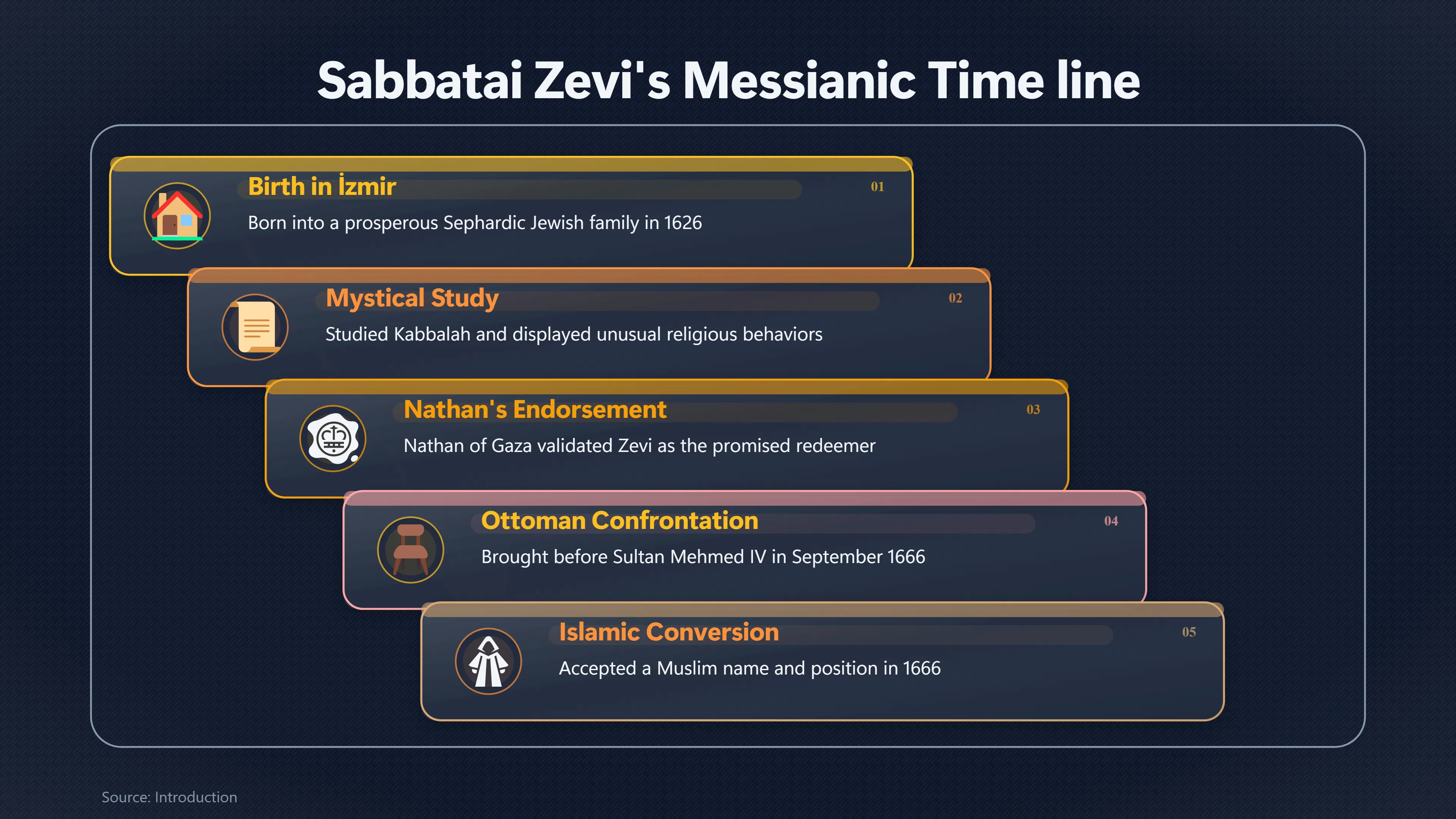
Sabbatai Zevi himself had long displayed unusual religious behaviour. Born in İzmir in 1626 into a prosperous Sephardic Jewish family, he studied Kabbalah, the mystical tradition within Judaism. Earlier attempts to proclaim himself the Messiah had brought criticism from rabbis and periods of exile from several Jewish communities. His fortunes changed dramatically after meeting Nathan of Gaza, a young mystic who became convinced that Zevi truly was the promised redeemer. Nathan’s theological authority transformed what had been an isolated personal claim into an international movement.[Cambridge University Press & Assessment]cambridge.orgUniversity Press & AssessmentCambridge University Press & AssessmentIntroduction - Sabbatai ZeviJuly 11, 2020…
Nathan argued that Zevi’s unconventional behaviour was not evidence against his mission but proof that he was fulfilling hidden divine purposes beyond ordinary religious understanding. This reinterpretation gave followers a framework that could absorb apparent contradictions rather than abandon belief.
How the Movement Crossed Cities and Borders
One striking feature of the Sabbatean movement was the speed with which it spread despite the absence of newspapers, telegraphs or modern communications.
The movement travelled through well-established Jewish commercial and religious networks:
- Merchants carried letters between Mediterranean ports.
- Rabbis circulated reports to distant congregations.
- Pilgrims and travellers repeated stories of miracles and prophecies.
- Religious correspondence linked Ottoman communities with those in Europe and North Africa.
These existing networks allowed reports from İzmir and Gaza to reach Jewish communities across thousands of kilometres within months. Historians describe this as one of the best examples of long-distance religious communication in the early modern Jewish diaspora.[Cambridge University Press & Assessment]cambridge.orgCambridge University Press & AssessmentSabbatai Zevi and the Sabbatean Movement (Chapter 18) - The Cambridge History of Judaism…
Many communities reorganised everyday religious life around the expectation that redemption was imminent. Traditional prayers were altered, public celebrations multiplied, debts were sometimes forgiven, and preparations began for an expected return to the Holy Land. Some believers postponed ordinary business because they anticipated that history itself was about to end and a new divine age would begin.[Cambridge University Press & Assessment]cambridge.orgUniversity Press & AssessmentCambridge University Press & AssessmentIntroduction - Sabbatai ZeviJuly 11, 2020…
Importantly, support was not confined to poorly educated believers. Wealthy merchants, respected scholars and influential communal leaders also accepted Zevi’s claims, demonstrating that collective religious movements cannot simply be explained through ignorance or emotional excitement.
The Ottoman Authorities and the Crisis of 1666
For much of the movement’s rise, Ottoman officials did not treat Sabbatai Zevi as an immediate political threat. Jewish communities generally governed their own religious affairs under Ottoman rule, and messianic expectations alone did not automatically provoke state intervention.
The decisive turning point came after Zevi was brought before Sultan Mehmed IV in September 1666. Faced with severe pressure and the prospect of execution, Zevi converted to Islam. He accepted a position within the Ottoman court and took a Muslim name.[Cambridge University Press & Assessment]cambridge.orgUniversity Press & AssessmentCambridge University Press & AssessmentIntroduction - Sabbatai ZeviJuly 11, 2020…
For many observers, this appeared to destroy his credibility instantly. A Messiah who publicly embraced another religion seemed impossible to reconcile with traditional Jewish expectations.
Yet the movement did not simply collapse.
Instead, many committed followers developed new theological explanations. Rather than viewing the conversion as failure, they argued that the Messiah had deliberately entered Islam to redeem hidden sparks of holiness or accomplish a mysterious stage of the divine plan. This remarkable reinterpretation allowed belief to survive despite overwhelming contradictory evidence. Historians often point to this as an important example of how strongly held religious commitments can adapt after apparently decisive disconfirmation.[Cambridge University Press & Assessment]cambridge.orgCambridge University Press & AssessmentSabbatai Zevi and the Sabbatean Movement (Chapter 18) - The Cambridge History of Judaism…

How the Dönme Community Emerged
Some followers converted to Islam alongside Sabbatai Zevi while privately maintaining distinctive religious traditions. Their descendants became known as the Dönme.
The Dönme were neither conventionally Muslim nor conventionally Jewish. Publicly they participated in Muslim society, while privately preserving rituals, teachings and communal identities inherited from the Sabbatean movement. Over generations they developed their own internal religious practices and marriage networks, particularly in Salonica (now Thessaloniki), then part of the Ottoman Empire, as well as in İzmir and later Istanbul.[OUP Academic]academic.oup.comOUP AcademicThe Burden of Silence: Sabbatai Sevi and the Evolution of the Ottoman-Turkish Donmes | Oxford Academic…
Modern scholarship increasingly treats the Dönme as a distinctive historical community rather than simply “secret Jews”. Their identity evolved over centuries and reflected influences from Jewish mysticism, Ottoman society and changing political conditions. Marc David Baer’s work emphasises that they were active participants in Ottoman modernisation and urban life rather than an isolated underground sect.[Stanford University Press]sup.orgStanford University Press The Dönme | Stanford University PressStanford University Press The Dönme | Stanford University Press
Why Later Conspiracy Theories Distort the History
The historical Sabbatean movement and later conspiracy theories about its descendants should be kept carefully separate.
During the late Ottoman period and especially after the Young Turk Revolution of 1908, opponents increasingly portrayed the Dönme as a hidden network secretly controlling finance, politics or the creation of secular Turkey. These stories often claimed that leading reformers were secretly descended from Sabbatai Zevi’s followers or remained loyal to hidden Jewish interests.[ResearchGate]researchgate.netOpen source on researchgate.net.
Professional historians reject these sweeping claims.
Research instead shows that conspiracy theories developed because the Dönme occupied an unusual social position. They had publicly Muslim identities, distinctive communal traditions and close associations with cosmopolitan Salonica. These characteristics made them convenient targets for antisemitic narratives seeking hidden explanations for rapid political change. Rather than revealing genuine secret control, such stories reflect broader fears about modernisation, secularisation and national identity.[ResearchGate]researchgate.netOpen source on researchgate.net.
Distinguishing documented history from later mythmaking is essential. The Sabbatean movement unquestionably existed and transformed Jewish religious life across much of the seventeenth-century world. Claims that its descendants secretly directed Turkish politics belong to a very different tradition of political conspiracy.
Was This a Cult, a Panic or a Millenarian Movement?
Modern readers sometimes describe the movement as a cult, but that label oversimplifies both its scale and historical context.
Several features distinguish it from a moral panic or mass psychogenic illness:
- It centred on hope rather than fear. Followers anticipated redemption instead of reacting to an imagined social threat.
- It possessed organised leadership. Figures such as Nathan of Gaza produced detailed theological arguments supporting Zevi’s claims.
- It spread through trusted institutions. Rabbis, merchants and communal leaders transmitted belief using existing religious networks.
- Its influence lasted decades. The movement generated lasting communities rather than disappearing after a brief emotional episode.
- It adapted after apparent failure. Zevi’s conversion produced theological reinterpretation rather than immediate collapse.[Cambridge University Press & Assessment]cambridge.orgCambridge University Press & AssessmentSabbatai Zevi and the Sabbatean Movement (Chapter 18) - The Cambridge History of Judaism…
For these reasons, historians generally classify Sabbateanism as one of history’s most important millenarian movements rather than as an episode of irrational crowd behaviour.
Why the Movement Still Matters
The story of Sabbatai Zevi continues to attract historians because it illustrates several enduring features of collective belief.
First, it demonstrates how rapidly ideas can spread through trusted communication networks even without modern technology. Letters and commercial contacts created an information system capable of transmitting extraordinary religious claims across continents.
Second, it shows that failed prophecies do not necessarily destroy movements. Believers often reinterpret disappointing events in ways that preserve rather than weaken commitment.
Finally, the movement’s later history illustrates how genuine historical communities can become transformed into symbols within conspiracy theories. The documented Sabbatean movement belongs to the religious history of the Ottoman Empire. The later myth of an all-powerful hidden Dönme network belongs to the history of modern political imagination.
Within Turkey’s broader history of collective belief, Sabbatai Zevi’s movement stands not as a story of irrational panic but as one of the most influential examples of how religious expectation, communication networks and historical uncertainty combined to reshape communities across the early modern world.
Amazon book picks
Further Reading
Books and field guides related to How One Messiah Claim Shook Jewish Communities. Use these as the next step if you want deeper reading beyond the article.

Major Trends in Jewish Mysticism
Provides theological background to messianic expectations.

The Jews of the Ottoman Empire and the Turkish Republic
Explains the Ottoman setting in which the movement spread.


Sabbatai Ṣevi
First published 1973. Subjects: Sabbathaians, Jews, Biography, Cabala, Jews, turkey.
Endnotes
1.
Source: cambridge.org
Title: University Press & Assessment
Link:https://www.cambridge.org/core/books/abs/sabbatai-zevi/introduction/AD93B44A20A260046F264321C0495F64
Source snippet
Cambridge University Press & AssessmentIntroduction - Sabbatai ZeviJuly 11, 2020...
Published: July 11, 2020
2.
Source: cambridge.org
Link:https://www.cambridge.org/core/books/abs/cambridge-history-of-judaism/sabbatai-zevi-and-the-sabbatean-movement/10D5A1FB8D131C58B6F9792E824E7EA1
Source snippet
Cambridge University Press & AssessmentSabbatai Zevi and the Sabbatean Movement (Chapter 18) - The Cambridge History of Judaism...
3.
Source: researchgate.net
Link:https://www.researchgate.net/publication/265883339_An_Enemy_Old_and_New_The_Donme_Anti-Semitism_and_Conspiracy_Theories_in_the_Ottoman_Empire_and_Turkish_Republic
4.
Source: academic.oup.com
Link:https://academic.oup.com/book/2984
Source snippet
OUP AcademicThe Burden of Silence: Sabbatai Sevi and the Evolution of the Ottoman-Turkish Donmes | Oxford Academic...
5.
Source: cambridge.org
Title: Sabbatai Zevi
Link:https://www.cambridge.org/core/books/sabbatai-zevi/0FC38AC02719729799A89A2E37F84466
6.
Source: academic.oup.com
Link:https://academic.oup.com/book/2984?itm_content=Oxford_Academic_Books_0
7.
Source: academic.oup.com
Title: reference article
Link:https://academic.oup.com/reference/62376/reference-article-abstract/554974837
8.
Source: cambridge.org
Title: Sabbatai Sevi in England | AJS Review | Cambridge Core
Link:https://www.cambridge.org/core/journals/ajs-review/article/sabbatai-sevi-in-england/3EE1FCF9646946BECAB64A75C46259A3
9.
Source: plato.stanford.edu
Link:https://plato.stanford.edu/archives/fall2022/entries/scholem/
10.
Source: plato.stanford.edu
Link:https://plato.stanford.edu/archives/fall2020/entries/scholem/
11.
Source: cambridge.org
Link:https://www.cambridge.org/core/journals/comparative-studies-in-society-and-history/article/double-bind-of-race-and-religion-the-conversion-of-the-donme-to-turkish-secular-nationalism/FC0481331F50EC7D400AEEB5B23F9BB3
12.
Source: sup.org
Title: Stanford University Press The Dönme | Stanford University Press
Link:https://www.sup.org/books/middle-east-studies/donme
13.
Source: degruyterbrill.com
Title: The Dönme
Link:https://www.degruyterbrill.com/document/doi/10.1515/9780804772563/html
Source snippet
"Jewish Converts, Muslim Revolutionaries, and Secular Turks, Redwood City: Stanford University Press, 2009. [https://doi.org/10.1515/978080..."](https://doi.org/10.1515/978080...")...
14.
Source: degruyterbrill.com
Title: The Dönme
Link:https://www.degruyterbrill.com/document/doi/10.1515/9780804772563/html?lang=en
Source snippet
September 7, 2020 — THE DÖNME Jewish Converts, Muslim Revolutionaries, and Secular Turks * Marc David Baer Language: English Published/Co...
Published: September 7, 2020
15.
Source: degruyterbrill.com
Title: The Dönme
Link:https://www.degruyterbrill.com/de/document/doi/10.1515/9780804772563/html
Source snippet
Ihre Dokumente können jetzt angezeigt werden. Baer, Marc David. The Dönme: Jewish Converts, Muslim Revolutionaries, and Secular Turks, Re...
16.
Source: worldhistory.org
Link:https://www.worldhistory.org/Kabbalah/
17.
Source: shavei.org
Link:https://www.shavei.org/blog/2011/03/28/turkey/
18.
Source: hermetism.org
Link:https://hermetism.org/encyclopedia/sabbateanism/
Additional References
19.
Source: plato.sydney.edu.au
Title: sydney.edu.au Gershom Scholem (Stanford Encyclopedia of Philosophy)
Link:https://plato.sydney.edu.au/entries/scholem/
Source snippet
Scholem (Stanford Encyclopedia of Philosophy)April 14, 2026 — GERSHOM SCHOLEM First published Tue Apr 14, 2026 [Editor’s Note: The follow...
Published: April 14, 2026
20.
Source: youtube.com
Title: Kabbalistic Theology of the Heretic Messiah Sabbatai Zevi
Link:https://www.youtube.com/watch?v=d9w-c8A6oNQ
Source snippet
Shabbetai Tzvi: The False Messiah who Betrayed Judaism | The Jewish Story...
21.
Source: youtube.com
Link:https://www.youtube.com/watch?v=poyXUgpH7K0
Source snippet
Kabbalistic Theology of the Heretic Messiah Sabbatai Zevi - The Klippot & Redemption through Sin...
22.
Source: youtube.com
Title: Shabbetai Tzvi: The False Messiah who Betrayed Judaism | The Jewish Story
Link:https://www.youtube.com/watch?v=RufDOf3Fsls
Source snippet
Shabbetai Tsvi, False Messiah (Jewish History Lab)...
23.
Source: youtube.com
Title: Shabbetai Tsvi, False Messiah (Jewish History Lab)
Link:https://www.youtube.com/watch?v=4eKKnUeFeAY
Source snippet
Sabbatai Zevi: The "Messiah" who almost brought down Judaism...
24.
Source: sabbateanstudies.org
Link:https://www.sabbateanstudies.org/about-us
25.
Source: encyclopedia.com
Link:https://www.encyclopedia.com/religion/dictionaries-thesauruses-pictures-and-press-releases/donmeh
26.
Source: ebsco.com
Link:https://www.ebsco.com/research-starters/history/gershom-scholem
27.
Source: sabbateanstudies.org
Link:https://www.sabbateanstudies.org/published-work
28.
Source: izmirjh.com
Link:https://www.izmirjh.com/en/iz-birakanlar/sabetay-sevi/
Topic Tree