Why Collective Fear Took Hold in Cambodia
Cambodia’s history of collective fear and contagious belief is not best understood as a catalogue of bizarre “cults”. Its strongest documented cases sit at the meeting point of political upheaval, economic pressure, spiritual belief and unreliable information.

Page outline Jump by section
Introduction
These episodes differed sharply. A rebellion against forced labour was not a medical outbreak; workers fainting in a hot factory were not simply acting out folklore; and a politically amplified rumour was not spontaneous “mob madness”. Yet each case shows how a shared interpretation can spread when it gives recognisable form to distress. In Cambodia, the most useful question is therefore not whether people were irrational, but why a particular belief, fear or bodily response became convincing at a particular moment.
When distress travels through a crowd
Cambodia’s most extensively studied modern episodes are the mass faintings reported in garment factories, especially during the rapid expansion of the export clothing industry. In these incidents, one worker might collapse or become distressed, after which numerous colleagues developed dizziness, weakness, breathlessness, trembling, loss of consciousness or apparent possession. An ethnographic study conducted between 2010 and 2015 found at least one fainting episode in 34 of 48 factories examined; nine episodes were associated with spirit-possession narratives.[PubMed]pubmed.ncbi.nlm.nih.govMass fainting in garment factories in Cambodiaby M Eisenbruch · 2017 · Cited by 24 — One or more episodes of mass fainting occurred…
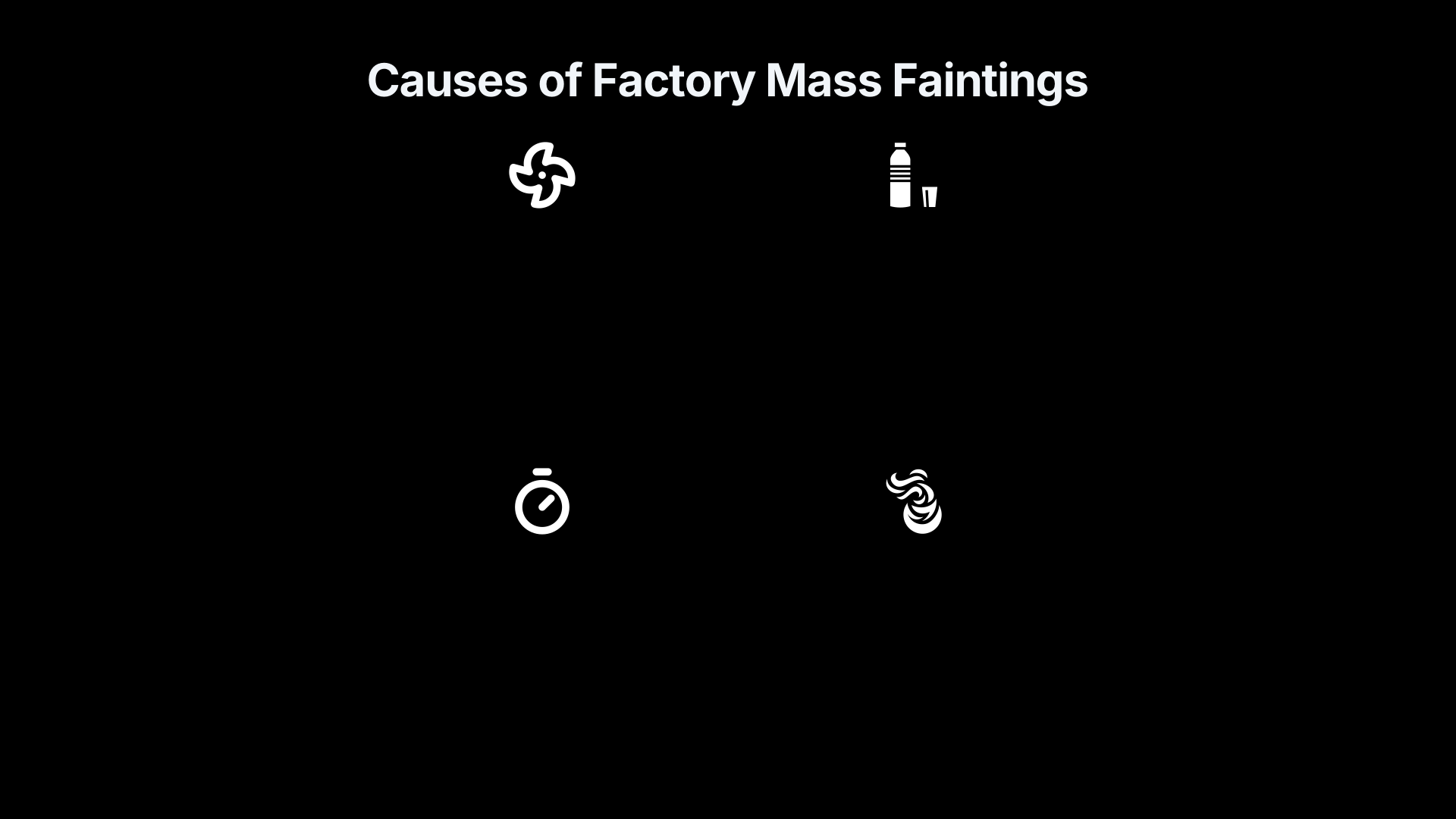
The convenient label “mass hysteria” obscures more than it explains. Researchers and public-health investigators have considered several overlapping mechanisms:
- heat, poor ventilation and exposure to unpleasant smells;
- inadequate nutrition, anaemia and dehydration;
- long hours, production pressure and fear of dismissal;
- anxiety after witnessing another person collapse;
- shared expectations about spirits, polluted places or disturbed burial grounds;
- the possibility that bodily distress expressed grievances workers could not safely voice in another form.
Better Factories Cambodia, an International Labour Organization programme, treated fainting as a workplace-welfare problem rather than dismissing it as superstition. Its prevention work encouraged factories to improve hygiene, nutrition, heat management and communication between workers and managers. Contemporary labour research also found that many women in the sector were young migrants from poor provinces and that low pay, compulsory or difficult-to-refuse overtime, household obligations and insecure employment created sustained pressures beyond the factory floor.[betterwork.org]betterwork.orgBetter WorkBetter Factories Cambodia "One Change" Campaign Helps…March 12, 2013 — In the midst of the industry's rapid growth, reports…

Why one faint can become many
Mass psychogenic illness is a term used when genuine symptoms spread through a socially connected group without a single toxic or infectious cause being sufficient to explain the pattern. It does not mean that sufferers are pretending. Fear can alter breathing, balance, muscle control and consciousness, while the sight of colleagues collapsing can increase attention to ordinary sensations until they become frightening. In tightly packed workplaces, the process can move quickly.
Some observers argued that the Cambodian factory pattern fitted this diagnosis because investigators frequently found no contaminant capable of explaining the number and timing of cases. Yet the absence of one poison does not prove that working conditions were irrelevant. Malnutrition, heat, exhaustion and anxiety can lower the threshold at which contagious symptoms begin. The strongest explanation is therefore layered: physical strain created vulnerable bodies, social pressure created fearful expectations, and visible collapses supplied a trigger.[SPH UMN]sph.umn.eduSPH UMNMass faintings among Cambodian workers may haveOctober 1, 2019 — 1 Oct 2019 — Other studies have suggested the causes include dehydration, “mass hysteria” and anxiety about fainting, a…
Spirit explanations also carried practical and moral meaning. Workers sometimes interpreted fainting as a reaction from a spirit angered by construction, neglected offerings, disrespectful behaviour or the disturbance of a significant place. Monks or ritual specialists might be invited to make offerings, bless a site or restore proper relations with unseen beings. Maurice Eisenbruch’s research argues that public-health responses worked better when they took these interpretations seriously instead of forcing workers to choose between medical treatment and spiritual observance.[PMC]pmc.ncbi.nlm.nih.govPMCPutting the Spirit into Culturally Responsive Public HealthPMCPutting the Spirit into Culturally Responsive Public Health
This does not establish that a spirit caused the symptoms. It shows that spiritual language helped workers explain why an apparently modern factory could feel unsafe, unjust or morally disordered. Ritual could calm anxiety and acknowledge grievances even when improvements to food, ventilation, wages or workload remained necessary.
Schools, ghosts and contagious fear
Similar incidents have occurred in Cambodian schools. In late 2017, nearly 50 pupils reportedly fainted at a secondary school in Kampot province after the first student became unwell. Accounts circulated involving spirits, and the school combined medical attention with religious activity intended to reassure pupils and families.[phnompenhpost.com]phnompenhpost.comkampot school makes spirited crusade against mass faintingskampot school makes spirited crusade against mass faintings
Reports of school outbreaks often use dramatic terms such as “possession” or “hysteria”, particularly when pupils scream, shake, cry, faint or say that they have seen a ghost. Such wording can make an event sound more mysterious than the available evidence warrants. Symptoms may follow ordinary illness, heat, examination pressure, fear, hyperventilation or the alarm caused by watching a friend collapse. Once a supernatural explanation spreads, ambiguous sensations and rumours may reinforce one another.
At the same time, it would be misleading to treat belief in spirits as an exotic error unique to rural pupils. In many societies, collective symptoms are interpreted through culturally familiar threats: gas leaks, poisoned food, curses, demonic attack, terrorism or infection. The local imagery varies, but the underlying social process can be similar. People notice the explanation their community has made available to them.
School cases also expose a difficult balance for authorities. Immediate medical checks are necessary because a real environmental hazard must not be overlooked. Aggressive dismissal of pupils’ beliefs, however, can deepen fear and distrust. Conversely, sensational reporting or highly theatrical rituals may unintentionally confirm that an extraordinary danger is present. The least harmful response combines calm medical assessment, attention to heat and stress, clear communication with families and culturally respectful reassurance.
Holy men, supernatural protection and rebellion
Long before the factory faintings, Cambodian religious ideas sometimes entered politics through rebellions led by monks, princes or self-proclaimed possessors of exceptional merit. Scholars commonly describe some of these movements as millenarian: they expected not merely a change of ruler but a profound restoration of moral and political order.
The clearest early example is the rebellion of 1820 led by the monk Kai. Historian David Chandler describes it as the best-documented Cambodian “holy man” rebellion of its kind. It arose near the Cambodian-Vietnamese border during a period of intrusive Vietnamese power and severe labour demands. Ian Harris links the movement to the conditions endured by thousands of Cambodian labourers working on the Vĩnh Tế Canal. Kai was credited with supernatural powers, gathered monks and lay followers, occupied the sacred site of Ba Phnom and was proclaimed king before the rebellion was defeated.[jstor.org]jstor.orgOpen source on jstor.org.
The supernatural claims should not distract from the material causes. Forced labour, foreign domination, weakened royal authority and disruption of village life gave the movement its urgency. Belief in Kai’s powers supplied legitimacy and courage. Protective rituals, amulets or claims of invulnerability could make resistance appear morally authorised and militarily possible, particularly to people with little access to conventional political power.
Cambodian rebellions of the nineteenth and early twentieth centuries cannot all be placed in one category. Some were dynastic conflicts; others were tax protests, anti-colonial uprisings or resistance to foreign control. Anne Hansen’s work on Buddhism and modernity distinguishes millenarian-style revolts from later, more explicitly political opposition to French rule. Buddhist responses also changed as monks and intellectuals developed new forms of education, print culture, ethical reform and nationalism.[iias.asia]iias.asiaOpen source on iias.asia.
Calling such movements “cults” would therefore be misleading. The term suggests an isolated, deviant group dominated by a manipulative leader. Kai’s rebellion belonged instead to a wider Southeast Asian tradition in which sacred authority, kingship and expectations of moral renewal could become languages of resistance. Its followers were responding to recognisable oppression, even if their confidence in supernatural protection made the struggle appear possible.
The rumour that helped ignite the 2003 riots
On 29 January 2003, rioters attacked and burned the Thai embassy in Phnom Penh and damaged numerous Thai-owned businesses. The immediate trigger was a newspaper report claiming that a popular Thai actress had said Angkor Wat properly belonged to Thailand or had been stolen by Cambodia. No reliable evidence emerged that she had made the remark. Nevertheless, other newspapers and radio outlets repeated the story, politicians amplified it, and copies reportedly circulated among students.[refworld.org]refworld.orgOpen source on refworld.org.
The rumour was powerful because it touched a national symbol. Angkor Wat represents not only a celebrated monument but also memories of imperial greatness, territorial loss and difficult relations with neighbouring states. Anthropologist Alexander Hinton argues that the violence drew upon established ideas of Cambodian identity and constructions of Thailand as a threatening or arrogant “other”. The false quotation did not manufacture those feelings from nothing; it compressed them into an insult that was simple, emotional and easy to repeat.[Cambridge University Press & Assessment]cambridge.orgOpen source on cambridge.org.
This was a moral and nationalist panic, but not merely a spontaneous crowd delusion. A United States government review examined the Cambodian authorities’ slow response, while Human Rights Watch noted that security forces initially failed to intervene effectively. Cambodian human-rights organisation LICADHO warned that the riots damaged security, political stability, livelihoods and foreign confidence. The political setting mattered: Cambodia was approaching a national election, public assembly was tightly contested, and responsibility for mobilising or permitting the violence became the subject of competing accusations.[hrw.org]hrw.orgOpen source on hrw.org.
The consequences went far beyond the credibility of one newspaper. Thailand downgraded relations, evacuated citizens and demanded compensation; businesses were destroyed, and ordinary Thai residents or workers faced danger because they had been transformed into representatives of an imagined collective insult.[The Guardian]theguardian.comThe Guardian Thais cut links with Cambodia after riots | World newsThe Guardian Thais cut links with Cambodia after riots | World news
The episode demonstrates a familiar chain of escalation:
- A claim attached itself to a historically sensitive symbol.
- Repetition by several outlets made the claim appear independently confirmed.
- Political endorsement increased its authority.
- Anger shifted from the alleged speaker to an entire nationality.
- Weak or delayed restraint allowed protest to become attack and looting.
Describing the riots as “mass hysteria” would understate accountability. The participants acted amid emotional contagion, but media organisations, political figures and security institutions made choices that helped determine whether the rumour would fade, become useful propaganda or turn violent.
Why the Khmer Rouge is a different category
The Khmer Rouge is sometimes described informally as a cult, especially in discussions of obedience to its secretive leadership, absolute ideology and demands for radical social transformation. That comparison can illuminate features such as isolation, controlled information, denunciation and the elevation of an infallible organisation. It can also mislead.
Democratic Kampuchea was a state exercising military and administrative power, not simply a voluntary religious sect. Between 1975 and 1979, its authorities dismantled institutions, emptied cities, abolished ordinary economic life, separated families, persecuted religious communities and caused mass death through execution, starvation, overwork and disease. Organised Buddhism was targeted, monks were forced to disrobe, and religious institutions had to be rebuilt after the regime fell.[AP News]apnews.comOpen source on apnews.com.
The more accurate analytical categories are dictatorship, revolutionary ideology, mass violence and genocide. “Cult of personality” may be useful when discussing leadership and obedience, but “cult” should not replace political history or reduce state crimes to collective irrationality. Cambodians did not all believe the regime’s promises, and compliance could reflect hunger, terror, surveillance or the impossibility of escape rather than ideological conversion.
This distinction matters throughout Cambodia’s history. Collective belief can contribute to harm, but so can coercion without belief. A frightened pupil, a fainting worker, a follower of a prophetic rebel, a newspaper reader and a prisoner under a violent state are not variations of the same psychological type.

What Cambodia’s cases have in common
The best-supported Cambodian cases point to several recurring conditions rather than one national tendency towards superstition.
Pressure finds a shared language. Factory workers expressed distress through fainting and spirit narratives; nineteenth-century rebels imagined moral restoration under sacred leadership; anti-Thai anger condensed into the defence of Angkor.
Belief and material conditions interact. Heat, exhaustion and hunger can coexist with fear of spirits. Religious expectations can coexist with opposition to forced labour. A false rumour can coexist with genuine memories of conflict and inequality.
Authority changes the scale of an episode. Monks, managers, journalists, politicians, police and health officials can calm an event or intensify it. Repetition from an apparently trusted source often matters more than the original claim.
Labels distribute blame. “Hysteria” may blame sufferers while hiding unsafe workplaces. “Superstition” may hide political grievances. “Cult” may erase differences between faith, protest, manipulation and coercion. “Spontaneous riot” may conceal the actions of people who publicised a rumour or withheld restraint.
Cambodia’s history therefore offers a warning against easy explanations. Collective episodes are rarely produced by belief alone. They spread when a story fits existing fears, when bodies or symbols make the danger visible, and when institutions fail to provide a more credible account. The strange surface of an event—a ghost, a holy man, a supposedly insulting actress—often points towards ordinary but powerful forces beneath it: insecurity, exploitation, historical grievance, political competition and the human need to make suffering intelligible.
Amazon book picks
Further Reading
Books and field guides related to Why Collective Fear Took Hold in Cambodia. Use these as the next step if you want deeper reading beyond the article.

The Spirit Catches You and You Fall Down
Shows how spiritual beliefs and medical explanations interact.
Imagined communities
Useful for understanding shared identities and collective narratives.

A history of Cambodia
Gives historical background to recurring periods of instability.
Endnotes
1.
Source: sph.umn.edu
Title: SPH UMNMass faintings among Cambodian workers may have
Link:https://www.sph.umn.edu/news/mass-faintings-among-cambodian-workers-may-have-multiple-intermingled-causes/
Source snippet
October 1, 2019 — 1 Oct 2019 — Other studies have suggested the causes include dehydration, “mass hysteria” and anxiety about fainting, a...
Published: October 1, 2019
2.
Source: pmc.ncbi.nlm.nih.gov
Title: PMCPutting the Spirit into Culturally Responsive Public Health
Link:https://pmc.ncbi.nlm.nih.gov/articles/PMC6338711/
3.
Source: phnompenhpost.com
Title: kampot school makes spirited crusade against mass faintings
Link:https://phnompenhpost.com/national/kampot-school-makes-spirited-crusade-against-mass-faintings/
4.
Source: jstor.org
Link:https://www.jstor.org/stable/20070109
5.
Source: cambridge.org
Link:https://www.cambridge.org/core/journals/journal-of-southeast-asian-studies/article/an-antivietnamese-rebellion-in-early-nineteenth-century-cambodia-precolonial-imperialism-and-a-prenationalist-response/13EF3837803AAB0565B338D8A06E46DF
6.
Source: iias.asia
Link:https://www.iias.asia/the-review/khmer-buddhists-respond-challenges-modernity
7.
Source: cambridge.org
Link:https://www.cambridge.org/core/books/violence-and-the-civilising-process-in-cambodia/resistance-of-a-peasant-society/B817AB5C3E0F9F8CBAAEC64C1BCB2658
8.
Source: refworld.org
Link:https://www.refworld.org/reference/annualreport/cpj/2004/en/56201
9.
Source: cambridge.org
Link:https://www.cambridge.org/core/services/aop-cambridge-core/content/view/4867638CC125FDA224F923EEC0C9AEE7/S0022463406000737a.pdf/khmerness_and_the_thai_other_violence_discourse_and_symbolism_in_the_2003_antithai_riots_in_cambodia.pdf
10.
Source: cambridge.org
Link:https://www.cambridge.org/core/journals/journal-of-southeast-asian-studies/article/khmerness-and-the-thai-other-violence-discourse-and-symbolism-in-the-2003-antithai-riots-in-cambodia/4867638CC125FDA224F923EEC0C9AEE7
11.
Source: 2001-2009.state.gov
Link:https://2001-2009.state.gov/p/eap/rls/rpt/20565.htm
12.
Source: licadho-cambodia.org
Link:https://www.licadho-cambodia.org/pressrelease.php?perm=26
13.
Source: jstor.org
Link:https://www.jstor.org/stable/178333
14.
Source: jstor.org
Link:https://www.jstor.org/stable/312424
15.
Source: cambridge.org
Link:https://www.cambridge.org/core/journals/european-journal-of-sociology-archives-europeennes-de-sociologie/article/millenarian-movements/55658B3B4BA0CCB0E2701E4692B80BC3
16.
Source: cambridge.org
Link:https://www.cambridge.org/core/journals/comparative-studies-in-society-and-history/article/saint-with-indras-sword-khruubaa-srivichai-and-buddhist-millenarianism-in-northern-thailand/ABDF8BCD15F1725A87D780ABB66382B6
17.
Source: cambridge.org
Link:https://www.cambridge.org/core/journals/international-journal-of-asian-studies/article/embodied-national-history-leaders-regime-change-and-regional-historiographical-trends-of-independent-cambodia/EAF4A6AF9A4703968E103AF591A25E8E
18.
Source: iias.asia
Link:https://www.iias.asia/the-review/edge-forest-essays-cambodia-history-and-narrative-honor-david-chandler
19.
Source: kutuphane.tbmm.gov.tr
Title: tbmm.gov.tr Bilaketaren emaitzak
Link:https://kutuphane.tbmm.gov.tr/vufind/EDS/Search?dfApplied=1&filter%5B0%5D=EXPAND%3A%22fulltext%22&lng=eu&lookfor=%22Hinton%2C+A.%22&type=AU&view=list%7Cbrief
20.
Source: pubmed.ncbi.nlm.nih.gov
Link:https://pubmed.ncbi.nlm.nih.gov/28398195/
Source snippet
Mass fainting in garment factories in Cambodiaby M Eisenbruch · 2017 · Cited by 24 — One or more episodes of mass fainting occurred...
21.
Source: betterwork.org
Link:https://betterwork.org/better-factories-cambodia-one-change-campaign-helps-to-address-fainting-challenges/
Source snippet
Better WorkBetter Factories Cambodia "One Change" Campaign Helps...March 12, 2013 — In the midst of the industry's rapid growth, reports...
Published: March 12, 2013
22.
Source: betterwork.org
Link:https://betterwork.org/wp-content/uploads/Gender-and-Care-Responsibilities-Examining-the-differences-for-garment-workers-in-Better-Factories-Cambodia.pdf
Source snippet
Better WorkGender and Care Responsibilities:While women struggle in combining overtime demands in the factory with household pressures, m...
23.
Source: webapps.ilo.org
Title: International Labour Organization ILO
Link:https://webapps.ilo.org/ievaldiscovery/files/file/181054
Source snippet
International Labour OrganizationILO - EVALUATIONThe One Change Campaign 2012 has been designed in order to help Cambodia's garment facto...
24.
Source: ilo.org
Link:https://www.ilo.org/sites/default/files/wcmsp5/groups/public/%40asia/%40ro-bangkok/%40sro-bangkok/documents/publication/wcms_204166.pdf
Source snippet
The garment and footwear industries have provided many employment.Read more...
25.
Source: silkwormbooks.com
Link:https://silkwormbooks.com/products/how-to-behave
26.
Source: latimes.com
Title: la xpm 2003 feb 03 fg cambo3 story
Link:https://www.latimes.com/archives/la-xpm-2003-feb-03-fg-cambo3-story.html
27.
Source: hrw.org
Link:https://www.hrw.org/legacy/backgrounder/asia/cambodia/cambodia061203.pdf
28.
Source: theguardian.com
Title: The Guardian Thais cut links with Cambodia after riots | World news
Link:https://www.theguardian.com/world/2003/jan/31/cambodia
29.
Source: apnews.com
Link:https://apnews.com/article/9617bb40911a857027ba3a0740149f83
30.
Source: hrw.org
Link:https://www.hrw.org/legacy/wr2k3/asia3.html
31.
Source: hrw.org
Title: cambodia0618 web 0
Link:https://www.hrw.org/sites/default/files/report_pdf/cambodia0618_web_0.pdf
32.
Source: betterwork.org
Title: BFC Annual Report 2018
Link:https://betterwork.org/wp-content/uploads/BFC-Annual-Report-2018.pdf
33.
Source: betterwork.org
Title: DP35 BETTER WORK BEYOND THE WORKPLACE V2
Link:https://betterwork.org/wp-content/uploads/DP35_BETTER-WORK-BEYOND-THE-WORKPLACE_V2.pdf
34.
Source: betterwork.org
Title: Heat Stress Report Oct 31 2025
Link:https://betterwork.org/wp-content/uploads/Heat_Stress-Report_Oct-31_2025.pdf
35.
Source: betterwork.org
Title: Book Of People 200x280 EN
Link:https://www.betterwork.org/wp-content/uploads/BookOfPeople_200x280_EN.pdf
36.
Source: betterwork.org
Link:https://betterwork.org/wp-content/uploads/Discussion-Paper-45.pdf
37.
Source: buddhism.lib.ntu.edu.tw
Title: search detail.jsp
Link:https://buddhism.lib.ntu.edu.tw/en/search/search_detail.jsp?seq=539562
38.
Source: aefek.fr
Link:https://www.aefek.fr/chandler.html
39.
Source: journal.equinoxpub.com
Link:https://journal.equinoxpub.com/BSR/article/view/8868/10320
40.
Source: bookshop.iseas.edu.sg
Link:https://bookshop.iseas.edu.sg/account/downloads/get/7809
Additional References
41.
Source: journals.sagepub.com
Link:https://journals.sagepub.com/doi/abs/10.1177/1363461517703918
Source snippet
Sage JournalsMass fainting in garment factories in Cambodiaby M Eisenbruch · 2017 · Cited by 24 — One or more episodes of mass fainting o...
42.
Source: youtube.com
Title: Worker’s Information Centre
Link:https://www.youtube.com/watch?v=CxPR0p9wjcE
Source snippet
VICE News Daily: Beyond The Headlines - April 4, 2014...
Published: April 4, 2014
43.
Source: youtube.com
Title: CTN Comedy Episode 1: Workers’ Nutrition
Link:https://www.youtube.com/watch?v=eDa1Dgn1Ro8
Source snippet
Worker's Information Centre - Supporting garment workers in Cambodia...
44.
Source: academia.edu
Link:https://www.academia.edu/14514163/The_Mass_Fainting_Movement_in_Cambodia_or_From_the_Annals_of_Abjection_s_Arsenal
45.
Source: researchgate.net
Link:https://www.researchgate.net/publication/256841027_Millenarian_Movements_in_Southern_Laos_and_North_Eastern_Siam_Thailand_at_the_Turn_of_the_Twentieth_Century_Reconsidering_the_Involvement_of_the_Champassak_Royal_House
46.
Source: researchgate.net
Link:https://www.researchgate.net/publication/231788379Khmerness_and_the_Thai%27Other%27_Violence_Discourse_and_Symbolism_in_the_2003_Anti-Thai_Riots_in_Cambodia
47.
Source: slideshare.net
Link:https://www.slideshare.net/slideshow/ahistoryofcambodiachandlerdavidpdf/252445638
48.
Source: facebook.com
Link:https://www.facebook.com/mountainbeacon2600/photos/bontoc-school-explains-student-incident-as-no-demons-just-distressby-frank-cimat/122252269916122796/
49.
Source: scispace.com
Link:https://scispace.com/pdf/buddhism-power-and-political-order-ch5n3h1c9f.pdf
50.
Source: scribd.com
Link:https://www.scribd.com/document/77679912/Cambodian-Buddhism-Culture-Practice
Topic Tree
Follow this branch
Related pages 192
- Antigua and Barbuda
- Argentina Belief Scares
- Azerbaijan Belief
- Bahrain Beliefs
- North Korea
- +187 more in sidebar