Within Seychelles Panics
Why Did Seychelles Still Criminalise Witchcraft?
Archaic laws aimed at fraud and intimidation can still make courts appear to judge whether magic itself is real.
On this page
- What the Penal Code prohibited
- How colonial wording shaped public fear
- Why conduct based offences offer a clearer alternative
Page outline Jump by section
Introduction
Seychelles still retains criminal offences dealing with witchcraft because its Penal Code inherited provisions drafted during British colonial rule rather than creating them through modern domestic debate. These provisions were originally intended to punish deception, intimidation and fraudulent claims of supernatural power, not to recognise that magic itself exists. Even so, their language refers directly to “witchcraft”, “charms”, “superstitious means” and fortune telling, creating an uncomfortable tension in a modern legal system. When these offences were used during the high-profile 2023–24 witchcraft prosecution, critics argued that the law appeared to place courts in the position of judging allegations involving occult powers rather than focusing solely on demonstrable criminal conduct. That controversy has renewed discussion over whether Seychelles should replace colonial-era wording with clearer offences targeting fraud, coercion, intimidation and grave crimes without referring to supernatural beliefs.[wipo.int]wipo.intPenal Code (Chapter 158) (as consolidated to December 1, 2014), Seychelles, WIPO LexDecember 1, 2014…
What the Penal Code prohibited
The relevant provisions appear in the Seychelles Penal Code, which has its origins in the colonial legal system established under British administration.
Section 303 creates offences for a range of conduct connected with claimed supernatural powers. It criminalises people who pretend to deal in witchcraft, pretend to tell fortunes, use or claim to use witchcraft or charms to deceive others or cause fear or injury, seek supernatural advice for any purpose, or possess charms or other objects intended for use in committing such offences. The section also links payments for such services to offences involving false pretences, reinforcing the idea that the law was aimed primarily at fraudulent conduct.[WIPO]wipo.intPenal Code (Chapter 158) (as consolidated to December 1, 2014), Seychelles, WIPO LexDecember 1, 2014…
Another provision, section 182A, goes further by criminalising the use of supposedly supernatural processes intended to influence another person’s thoughts, judgement or wellbeing after receiving advice from someone claiming occult knowledge. The wording assumes neither that magic works nor that it is impossible. Instead, it criminalises behaviour associated with such claims.[WIPO]wipo.intPenal Code (Chapter 158) (as consolidated to December 1, 2014), Seychelles, WIPO LexDecember 1, 2014…
This distinction is important. The law was not written as a ban on private religious belief or folk traditions in general. Rather, it attempted to regulate conduct that colonial legislators associated with deception, manipulation or social disorder. Nevertheless, because the legislation repeatedly uses the language of witchcraft itself, modern readers can easily conclude that the legal system is treating supernatural claims as matters for criminal adjudication.
How colonial wording shaped public fear
The language of these offences reflects a broader pattern found across the former British Empire. Colonial administrations frequently adopted laws against people “pretending” to exercise witchcraft or supernatural powers. The underlying legal philosophy was sceptical: officials generally regarded magical powers as fraudulent while recognising that widespread public belief in witchcraft could provoke violence, extortion or panic. Colonial legislation therefore sought to suppress both alleged practitioners and those who exploited popular fears.[Cambridge University Press & Assessment]cambridge.orgCambridge University Press & AssessmentWitchcraft and British Colonial Law | Africa | Cambridge CoreAugust 21, 2012…
That compromise produced enduring ambiguities.
On one hand, provisions referring to “pretending” suggest that the law assumes supernatural powers are not genuine. On the other hand, offences referring to charms, witchcraft and supernatural processes require courts to interpret conduct framed in explicitly occult language. Critics argue that this can blur the distinction between prosecuting measurable actions and appearing to adjudicate supernatural claims.
In societies where belief in harmful magic remains culturally significant, this ambiguity can amplify public anxiety. Criminal investigations involving unusual objects, symbolic markings or ritual practices may attract exceptional media attention because the legal vocabulary itself appears to validate the possibility of an organised occult threat, even when prosecutors ultimately rely on ordinary evidence rather than proof of supernatural events.
Why the 2023–24 prosecution revived reform arguments
The controversy surrounding the prosecution of opposition leader Patrick Herminie illustrated these concerns.
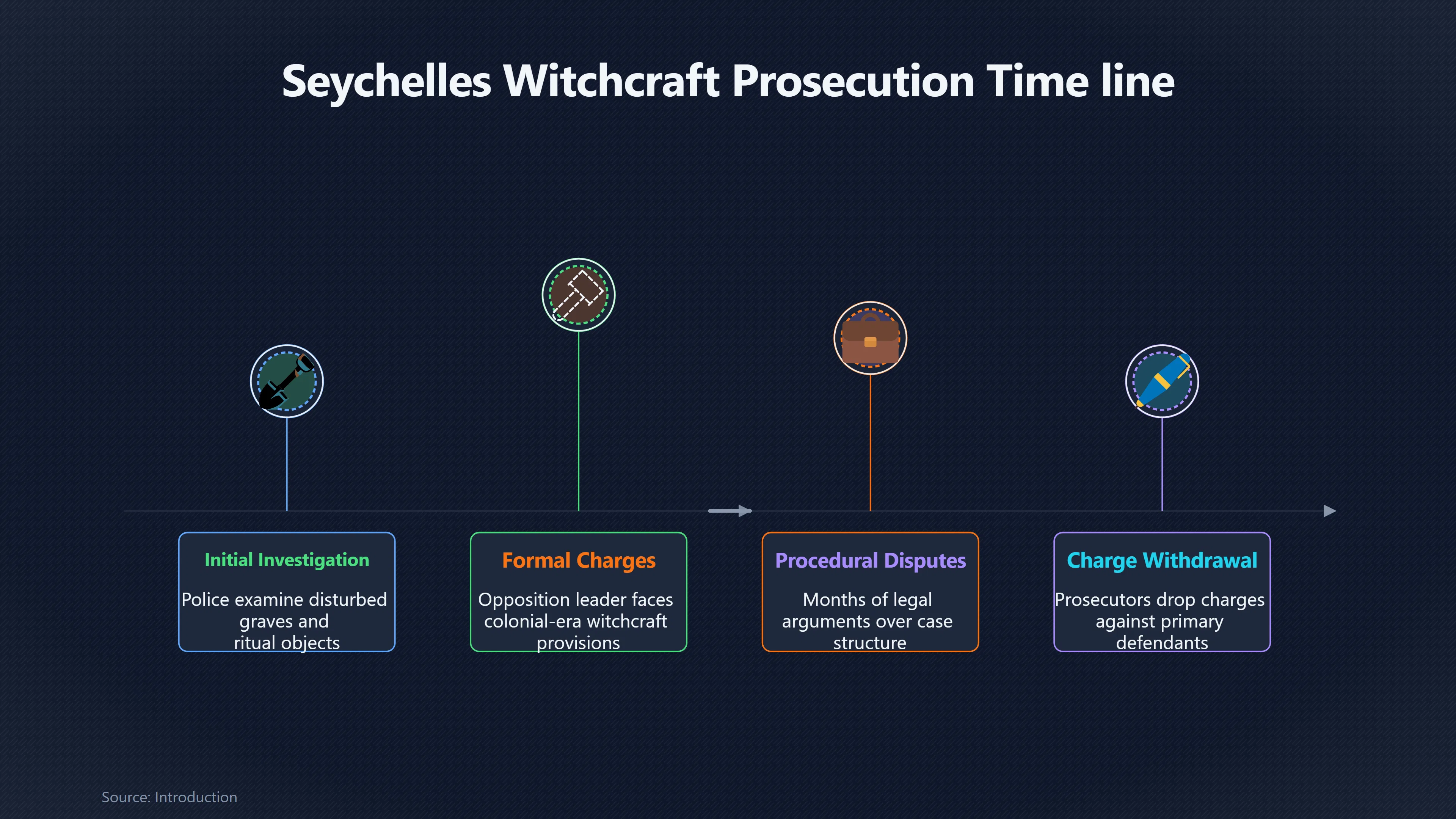
Police investigations into disturbed graves and objects allegedly associated with witchcraft expanded into a case involving several defendants, including Herminie. The proceedings attracted intense domestic and international attention because a serving opposition leader was charged under colonial-era witchcraft provisions. After months of procedural disputes, prosecutors withdrew charges against Herminie and several co-defendants while restructuring the remaining case against others.[Seychelles Nation]nation.scSeychelles NationMagistrate’s court orders severance of witchcraft charges -Seychelles NationFebruary 2, 2024…
Regardless of political interpretations of the case, it demonstrated how colonial wording can shape public perception.
Rather than focusing public debate on alleged acts such as grave desecration, conspiracy or intimidation—offences that can be investigated through ordinary forensic evidence—discussion frequently centred on “witchcraft” itself. International reporting often highlighted that Seychelles still possessed criminal offences referring explicitly to witchcraft, making the legal framework appear unusual by contemporary standards.[seychellesnewsagency.com]seychellesnewsagency.comSeychelles News AgencyWitchcraft charges dropped against United Seychelles party leader - Seychelles News Agency…
For legal reform advocates, the episode exposed a broader problem: laws drafted in colonial language may unintentionally encourage public debate about whether supernatural powers exist instead of keeping attention on objectively provable criminal conduct.

Why conduct-based offences offer a clearer alternative
Many legal scholars and reform advocates argue that criminal law should concentrate on harmful behaviour that can be demonstrated through evidence rather than on supernatural terminology.
A conduct-based approach would continue to punish acts such as:
- fraud through false claims intended to obtain money or property;
- coercion or intimidation using threats of supernatural harm;
- extortion exploiting another person’s beliefs;
- grave desecration and offences involving human remains;
- assault, poisoning or criminal conspiracy where evidence exists.
Under this model, courts would never need to consider whether witchcraft is real. Instead, they would ask familiar legal questions: Was someone deceived? Was money obtained dishonestly? Was another person threatened, intimidated or physically harmed? Were graves unlawfully disturbed? These questions can be answered using ordinary standards of criminal evidence without engaging with supernatural claims.
This approach has become increasingly attractive because it separates respect for individual religious or cultural beliefs from the state’s responsibility to punish demonstrable criminal acts.
The wider case for reform
Calls for reform do not necessarily argue that exploitation associated with claimed supernatural powers should become lawful. Instead, they question whether colonial terminology remains appropriate in a modern criminal code.
Supporters of reform advance several arguments:
- Legal clarity. Modern offences should describe prohibited conduct precisely rather than relying on broad references to witchcraft or superstition.
- Neutrality. Criminal courts should avoid language that appears to endorse or reject particular supernatural beliefs.
- Consistency. Fraud, intimidation and coercion can already be prosecuted through well-established criminal principles.
- Public confidence. Removing archaic terminology may reduce the perception that criminal proceedings are judging metaphysical questions rather than evidence.
Opponents of changing the law sometimes argue that explicit witchcraft provisions recognise real social harms because people can be manipulated or terrorised through claims of occult power. Reform proposals therefore generally seek not to eliminate protection against such exploitation but to rewrite offences so they target intimidation and deception directly.
Why the issue matters beyond one case
The debate over Seychelles’ witchcraft laws is ultimately less about belief in magic than about how criminal law should be written.
Colonial legislation was drafted for an imperial legal system attempting to regulate societies where belief in supernatural harm was widespread while maintaining an official scepticism about occult powers. More than a century later, that wording can create confusion about what exactly the law is punishing.
The controversy generated by the 2023–24 prosecution demonstrated how quickly archaic legal language can become the centre of public debate. Whether or not Seychelles eventually reforms these provisions, the case has highlighted a broader legal principle: criminal law is generally clearest and most legitimate when it punishes observable acts—fraud, coercion, intimidation and violence—rather than appearing to adjudicate questions about supernatural belief.[wipo.int]wipo.intPenal Code (Chapter 158) (as consolidated to December 1, 2014), Seychelles, WIPO LexDecember 1, 2014…
Amazon book picks
Further Reading
Books and field guides related to Why Did Seychelles Still Criminalise Witchcraft?. Use these as the next step if you want deeper reading beyond the article.


The Penguin book of witches
Illustrates how witchcraft entered legal and political institutions.
Law and Revolution
Provides background on the historical development of legal systems.

Magic, science, and religion, and other essays
Explains enduring belief systems alongside formal institutions.
Endnotes
1.
Source: wipo.int
Link:https://www.wipo.int/wipolex/en/legislation/details/16117
Source snippet
Penal Code (Chapter 158) (as consolidated to December 1, 2014), Seychelles, WIPO LexDecember 1, 2014...
Published: December 1, 2014
2.
Source: nation.sc
Title: Seychelles Nation Witchcraft case -Seychelles Nation
Link:https://www.nation.sc/articles/21128/witchcraft-case
3.
Source: cambridge.org
Link:https://www.cambridge.org/core/journals/africa/article/abs/witchcraft-and-british-colonial-law/18C65EF64367A657D70D626DA53B544C
Source snippet
Cambridge University Press & AssessmentWitchcraft and British Colonial Law | Africa | Cambridge CoreAugust 21, 2012...
Published: August 21, 2012
4.
Source: nation.sc
Link:https://www.nation.sc/articles/20963/magistrates-court-orders-severance-of-witchcraft-charges
Source snippet
Seychelles NationMagistrate’s court orders severance of witchcraft charges -Seychelles NationFebruary 2, 2024...
Published: February 2, 2024
5.
Source: nation.sc
Link:https://www.nation.sc/articles/20815/procedural-setbacks-for-prosecution-in-witchcraft-case
6.
Source: cambridge.org
Link:https://www.cambridge.org/core/journals/international-journal-of-legal-information/article/witchcraft-accusations-and-the-tort-of-defamation-in-anglophone-africa/22930E9DEDD422B529CE891441433B33
7.
Source: nation.sc
Link:https://www.nation.sc/articles/21145/us-considering-legal-action-after-party-president-discharged-from-witchcraft-case
8.
Source: nation.sc
Title: Witchcraft related case set for January 19 -Seychelles Nation
Link:https://www.nation.sc/articles/20554/witchcraft-related-case-set-for-january-19
9.
Source: nation.sc
Title: Magistrates Court hears witchcraft case -Seychelles Nation
Link:https://www.nation.sc/articles/19577/magistrates-court-hears-witchcraft-case-
10.
Source: nation.sc
Link:https://www.nation.sc/articles/19553/us-party-president-arrested-and-released-for-alleged-witchcraft-related-offences
11.
Source: wipo.int
Link:https://www.wipo.int/wipolex/fr/legislation/details/16117
12.
Source: cambridge.org
Title: Witchcraft and Colonial Legislation | Africa | Cambridge Core
Link:https://www.cambridge.org/core/journals/africa/article/abs/witchcraft-and-colonial-legislation/3F22A22925069F7C9477E0AE1D2F4414
13.
Source: wipo.int
Link:https://www.wipo.int/wipolex/en/legislation/details/16118
14.
Source: wipo.int
Link:https://www.wipo.int/wipolex/en/legislation/details/9985
15.
Source: wipo.int
Link:https://www.wipo.int/wipolex/fr/legislation/details/9985
16.
Source: seychellesnewsagency.com
Link:https://www.seychellesnewsagency.com/articles/20092/Witchcraft%2Bcharges%2Bdropped%2Bagainst%2BUnited%2BSeychelles%2Bparty%2Bleader
Source snippet
Seychelles News AgencyWitchcraft charges dropped against United Seychelles party leader - Seychelles News Agency...
17.
Source: law.cornell.edu
Link:https://www.law.cornell.edu/gender-justice/location/seychelles
Additional References
18.
Source: jutajournals.co.za
Link:https://www.jutajournals.co.za/the-spirits-and-the-law-the-role-of-superstition-laws-in-modernity-in-kenya-and-seychelles-a-literature-review/
Source snippet
Juta JournalsFebruary 15, 2026 — Image: JCLA25 THE SPIRITS AND THE LAW – THE ROLE OF SUPERSTITION LAWS IN MODERNITY IN KENYA AND SEYCHELL...
Published: February 15, 2026
19.
Source: journals.co.za
Title: Ange-Ebrahim Michelle St. Ange-Ebrahim Search for more papers
Link:https://journals.co.za/doi/10.47348/JCLA/v12/i2a4
Source snippet
The Spirits and the Law – the Role of Superstition Laws in Modernity in Kenya and Seychelles – a Literature Review1 | Journal of Comparat...
20.
Source: youtube.com
Title: WANTAM:SEYCHELLES’ Patrick Herminie’ beats incumbent in a Stunning Victory
Link:https://www.youtube.com/watch?v=F3LglWbdOwc
Source snippet
Election info changes quickly. Verify responses with official sources...
21.
Source: youtube.com
Title: BBC interviews Dr. Patrick Herminie after he was charged for witchcraft
Link:https://www.youtube.com/watch?v=WxUV7PQdqmk
Source snippet
Opposition's Herminie Secures Victory in Seychelles Run-off Election...
22.
Source: youtube.com
Title: Opposition’s Herminie Secures Victory in Seychelles Run-off Election
Link:https://www.youtube.com/watch?v=C0uc4SqoncQ
Source snippet
Law Reforms: Albinos in Uganda Call for More Protection for Them...
23.
Source: youtube.com
Title: When Was The Last ‘Witch’ Convicted In Britain?
Link:https://www.youtube.com/watch?v=WwgDtdRWM-Y
Source snippet
WANTAM:SEYCHELLES' Patrick Herminie' beats incumbent in a Stunning Victory...
24.
Source: youtube.com
Title: Law Reforms: Albinos in Uganda Call for More Protection for Them
Link:https://www.youtube.com/watch?v=J4xBDQYjb6g
Source snippet
When Was The Last 'Witch' Convicted In Britain?...
25.
Source: nationalassembly.sc
Link:https://www.nationalassembly.sc/bills
26.
Source: gazette.sc
Link:https://www.gazette.sc/
27.
Source: africanews.com
Title: Seychelles: leader of main opposition party charged with witchcraft | Africanews
Link:https://www.africanews.com/2023/10/03/seychelles-leader-of-main-opposition-party-charged-with-witchcraft/
Topic Tree