Within Burkina Faso
How Does a Soul Eating Accusation Spread?
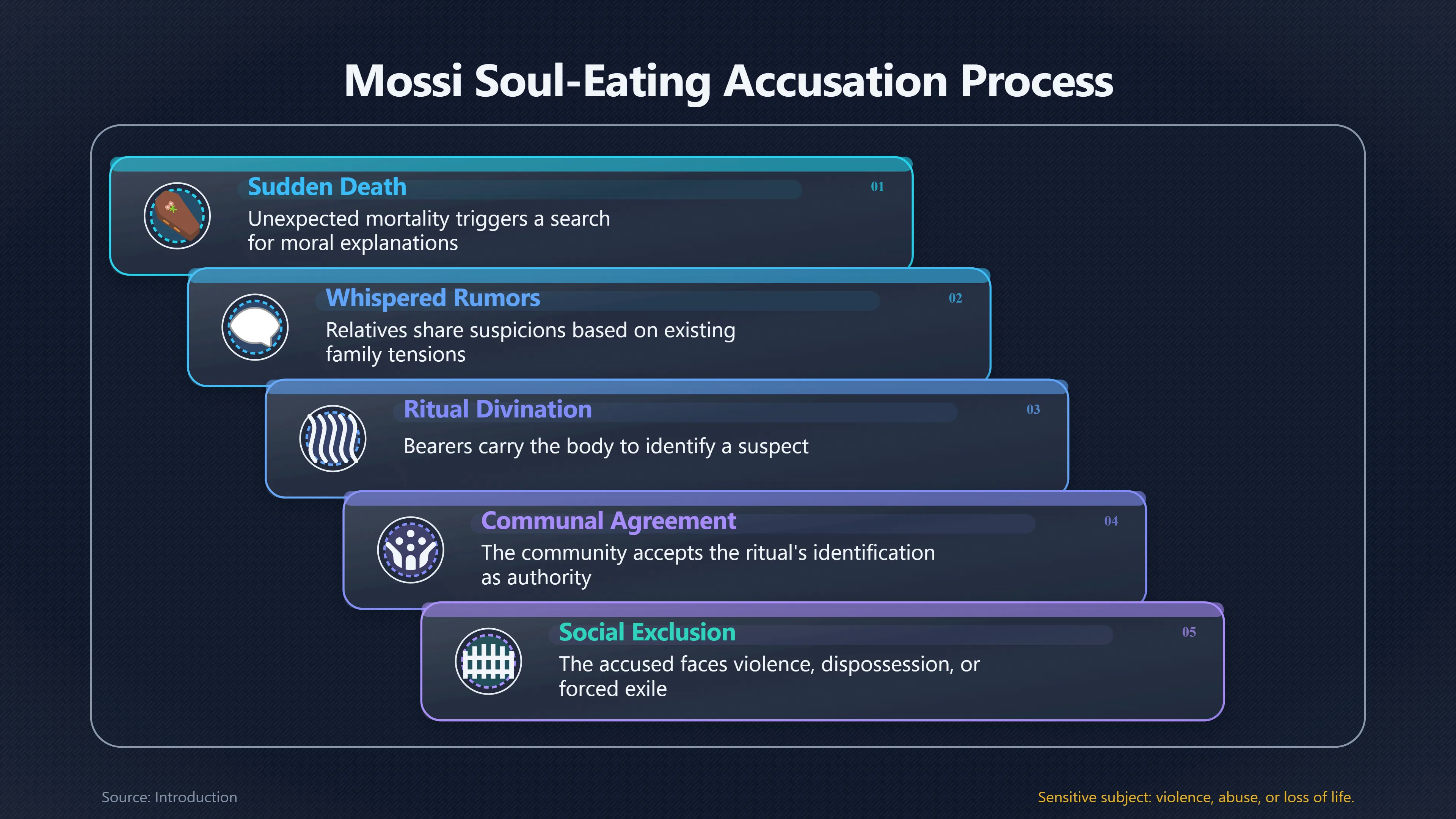
Unexpected deaths can trigger rumours, divination and self-reinforcing claims that an unseen attacker has consumed a victim's vital force.
On this page
- Why an unexpected death demands an explanation
- How rumours and divination identify a suspect
- Why denial rarely ends the accusation
Page outline Jump by section
Introduction
In parts of Burkina Faso, especially among some Mossi communities, an unexpected death has sometimes been understood not simply as a medical event but as evidence that someone secretly consumed the victim’s vital force. This belief, often described in French as “soul-eating”, provides a powerful explanation for deaths that seem premature or inexplicable. The accusation does not usually begin with direct evidence. Instead, it develops through grief, rumour, divination and communal interpretation until one person—most often an older woman—is identified as responsible. Anthropologists emphasise that this is a social process rather than proof of supernatural events. Understanding how suspicion spreads helps explain why accusations can become so persuasive, why they are difficult to challenge, and why they continue to have serious human consequences despite legal reforms.[Digital Commons USF]digitalcommons.usf.eduOpen source on usf.edu.

Why an unexpected death demands an explanation
A sudden death creates two different questions. The first is how the person died. The second is why this particular person died at this particular moment. Where illness is poorly understood, medical care is limited, or a healthy child or young adult dies unexpectedly, many families seek a moral or social explanation rather than accepting chance alone.[Digital Commons USF]digitalcommons.usf.eduOpen source on usf.edu.
Within this framework, the idea of a hidden “soul-eater” offers an explanation that connects misfortune to human relationships. Instead of viewing death as random, it becomes the result of concealed hostility inside the community. This interpretation can make emotional sense to grieving relatives because it identifies an apparent cause and a person to blame, even though there is no material evidence that such supernatural harm occurred. Anthropologists stress that these beliefs should be understood within their cultural setting rather than dismissed as simple superstition, while also recognising the real harm accusations cause.[usf.edu]digitalcommons.usf.eduOpen source on usf.edu.
How rumours and divination identify a suspect
The spread of a soul-eating accusation rarely begins with a formal declaration. It often starts with whispers among relatives after an unexplained death. Existing family tensions, inheritance disputes, conflicts between co-wives, or long-standing resentments may already exist before any supernatural explanation emerges. Once rumours begin, they encourage people to reinterpret earlier events as signs that someone had always been dangerous.[Digital Commons USF]digitalcommons.usf.eduOpen source on usf.edu.
In many documented accounts from Mossi communities, divination or rituals surrounding the deceased are believed to reveal the person responsible. One widely described practice involves ritual questioning of the corpse, in which bearers carrying the body are believed to be guided by the deceased towards the guilty party. To participants, such rituals provide communal confirmation rather than mere opinion. Once a suspect has been identified through an accepted ritual, the accusation gains considerable social authority.[Le Monde.fr]lemonde.frÀ travers son projet photographique initié lors d'une résidence artistique au Musée du quai Branly en 2013, il présente un regard humanis…
Research also shows that accusations are commonly initiated within families rather than by strangers. Although ritual specialists may conduct the divination, relatives of the deceased frequently request the process or promote the original suspicions. This means that what appears to be a supernatural judgement is often deeply connected to existing family relationships and local power structures.[ResearchGate]researchgate.netOpen source on researchgate.net.
Why denial rarely ends the accusation
One of the strongest features of the accusation mechanism is that it is difficult to disprove. Because the alleged act is understood as secret and invisible, denying involvement does not necessarily weaken the claim. Instead, denial may be interpreted as further evidence of deception.
The accusation therefore becomes self-reinforcing in several ways:
- Every later illness or death may be treated as additional confirmation.
- Earlier disputes can be reinterpreted as signs that the accused had hidden malicious intentions all along.
- A lack of physical evidence does not undermine the accusation because the alleged crime is considered supernatural.
- Community agreement can become more persuasive than individual protest.
This creates what social scientists describe as a closed system of belief, in which contradictory evidence carries little weight because the accusation itself explains why proof is difficult to obtain.[Digital Commons USF]digitalcommons.usf.eduOpen source on usf.edu.
Why suspicion falls on particular people
Studies of Burkina Faso consistently show that accusations are not distributed randomly. The women most often accused are older, widowed, economically vulnerable, or socially isolated. Many have lost the protection of husbands or influential relatives and therefore have fewer people willing to defend them publicly.[Digital Commons USF]digitalcommons.usf.eduOpen source on usf.edu.
This pattern suggests that social vulnerability shapes who becomes believable as a suspect. Researchers argue that accusations frequently emerge where grief intersects with unequal family relationships, gender hierarchies and economic insecurity. Rather than creating new social divisions, the belief can reinforce tensions that already existed before the death occurred.[Digital Commons USF]digitalcommons.usf.eduOpen source on usf.edu.
Importantly, anthropologists caution against treating this as a universal belief throughout Burkina Faso. The country’s religious and ethnic traditions are diverse, and the best-documented examples come from particular Mossi communities rather than the nation as a whole.[Digital Commons USF]digitalcommons.usf.eduOpen source on usf.edu.

Why the mechanism remains socially powerful
The power of a soul-eating accusation lies less in the original rumour than in the sequence that follows: unexpected death, demand for explanation, circulating suspicion, ritual confirmation, social agreement and eventual exclusion of the accused. Each stage makes the next appear more convincing to participants.
Recent legal reforms recognise the harm caused by this process. Burkina Faso’s Penal Code now specifically criminalises accusations of witchcraft that damage another person’s honour, safety or life, reflecting growing official recognition that such allegations can lead to violence, dispossession and forced exile. Human-rights organisations have also continued to condemn public witchcraft accusations, including those amplified through social media, showing that while the setting may change, the underlying mechanism of suspicion can still operate.[ResearchGate]researchgate.netOpen source on researchgate.net.
The continuing importance of these accusations is therefore not evidence that supernatural claims have been verified. Rather, it illustrates how grief, uncertainty, communal authority and existing social inequalities can combine to create a persuasive narrative that is extraordinarily resistant to contradiction.
Amazon book picks
Further Reading
Books and field guides related to How Does a Soul-Eating Accusation Spread?. Use these as the next step if you want deeper reading beyond the article.

African religions and philosophy
Provides broad context for supernatural explanations of misfortune.


Mistakes Were Made (But Not by Me)
Explains why people maintain accusations despite weak evidence.
Endnotes
1.
Source: digitalcommons.usf.edu
Link:https://digitalcommons.usf.edu/etd/8919/
2.
Source: researchgate.net
Link:https://www.researchgate.net/publication/402411065_Violence_Gender_and_Poverty_in_the_Context_of_Sweba_Accusations_in_Burkina_Faso
3.
Source: researchgate.net
Link:https://www.researchgate.net/publication/342898556_Who%27s_the_witch_Social_exclusion_of_older_Mossi_women_accused_of_Witchcraft_in_Burkina_Faso_Africa
4.
Source: researchgate.net
Link:https://www.researchgate.net/publication/394069524_Moose_Socio-Cosmic_Dualism_The_Logic_of_the_Village_and_the_Logic_of_the_State_in_Burkina_Faso
5.
Source: researchgate.net
Link:https://www.researchgate.net/publication/392978088_Je_ne_veux_pas_mourir_ici_Perception_de_la_mort_chez_les_femmes_accusees_de_sorcellerie_vivant_dans_les_centres_d%27accueil_au_Burkina_Faso
6.
Source: researchgate.net
Link:https://www.researchgate.net/publication/224022934_Des_souris_des_genies_et_des_hommes_divination_par_la_souris_en_pays_Mossi_au_Burkina_Faso
7.
Source: lemonde.fr
Link:https://www.lemonde.fr/afrique/article/2025/02/22/photographie-lorsque-nyaba-leon-ouedraogo-rencontre-des-devoreuses-d-ames-du-burkina-faso_6558641_3212.html
Source snippet
À travers son projet photographique initié lors d'une résidence artistique au Musée du quai Branly en 2013, il présente un regard humanis...
8.
Source: hrw.org
Title: burkina faso
Link:https://www.hrw.org/world-report/2025/country-chapters/burkina-faso
Additional References
9.
Source: hrw.org
Link:https://www.hrw.org/news/2026/04/02/qa-war-crimes-crimes-against-humanity-by-all-sides-in-burkina-faso
Source snippet
April 2, 2026 — Q&A: WAR CRIMES, CRIMES AGAINST HUMANITY BY ALL SIDES IN BURKINA FASO Print Donate Now Image: Shelters and tents at the W...
Published: April 2, 2026
10.
Source: hrw.org
Title: Burkina Faso: Crimes Against Humanity by All Sides | Human Rights Watch
Link:https://www.hrw.org/news/2026/04/02/burkina-faso-crimes-against-humanity-by-all-sides
Source snippet
April 2, 2026 — BURKINA FASO: CRIMES AGAINST HUMANITY BY ALL SIDES Print Donate Now April 2, 2026 12:00AM EDT | News Release Available In...
Published: April 2, 2026
11.
Source: ungeneva.org
Title: burkina faso un comite de lonu denonce des exactions contre les
Link:https://www.ungeneva.org/fr/news-media/news/2026/05/118300/burkina-faso-un-comite-de-lonu-denonce-des-exactions-contre-les
Source snippet
Burkina Faso: un comité de l’ONU dénonce des exactions contre les Peuls | ONU GENEVEMay 4, 2026 — BURKINA FASO: UN COMITÉ DE L’ONU DÉNO...
Published: May 4, 2026
12.
Source: hrw.org
Title: war crimes and crimes against humanity in burkina faso by all
Link:https://www.hrw.org/report/2026/04/02/none-can-run-away/war-crimes-and-crimes-against-humanity-in-burkina-faso-by-all
Source snippet
“None Can Run Away”: War Crimes and Crimes Against Humanity in Burkina Faso by All Sides | HRWApril 2, 2026 — April 2, 2026 “NONE CAN RUN...
Published: April 2, 2026
13.
Source: youtube.com
Title: Meet the anti-witch hunter
Link:https://www.youtube.com/watch?v=yzBi8KVSwlY
Source snippet
Cry Witch: Take My Land, Take My Life - BBC Africa Eye Documentary...
14.
Source: ecoi.net
Link:https://www.ecoi.net/de/dokument/1028439.html
15.
Source: theguardian.com
Link:https://www.theguardian.com/global-development/2012/may/14/burkina-faso-women-accused-witchcraft
16.
Source: sciencedirect.com
Link:https://www.sciencedirect.com/science/article/pii/S2666560322001062
17.
Source: ecoi.net
Link:https://www.ecoi.net/en/document/2110402.html
18.
Source: classiques.uqam.ca
Link:https://classiques.uqam.ca/contemporains/egrot_marc/divination_lieu_de_rencontre_maladie/divination.html
Topic Tree