Within Japan Panics
How Earthquake Rumours Turned Into Mass Killing
After the 1923 earthquake, false claims about Koreans became a licence for vigilante violence reinforced by racism and official authority.
On this page
- The disaster and the spread of false accusations
- Vigilantes, language tests and state involvement
- Memory, denial and contested commemoration
Page outline Jump by section
Introduction
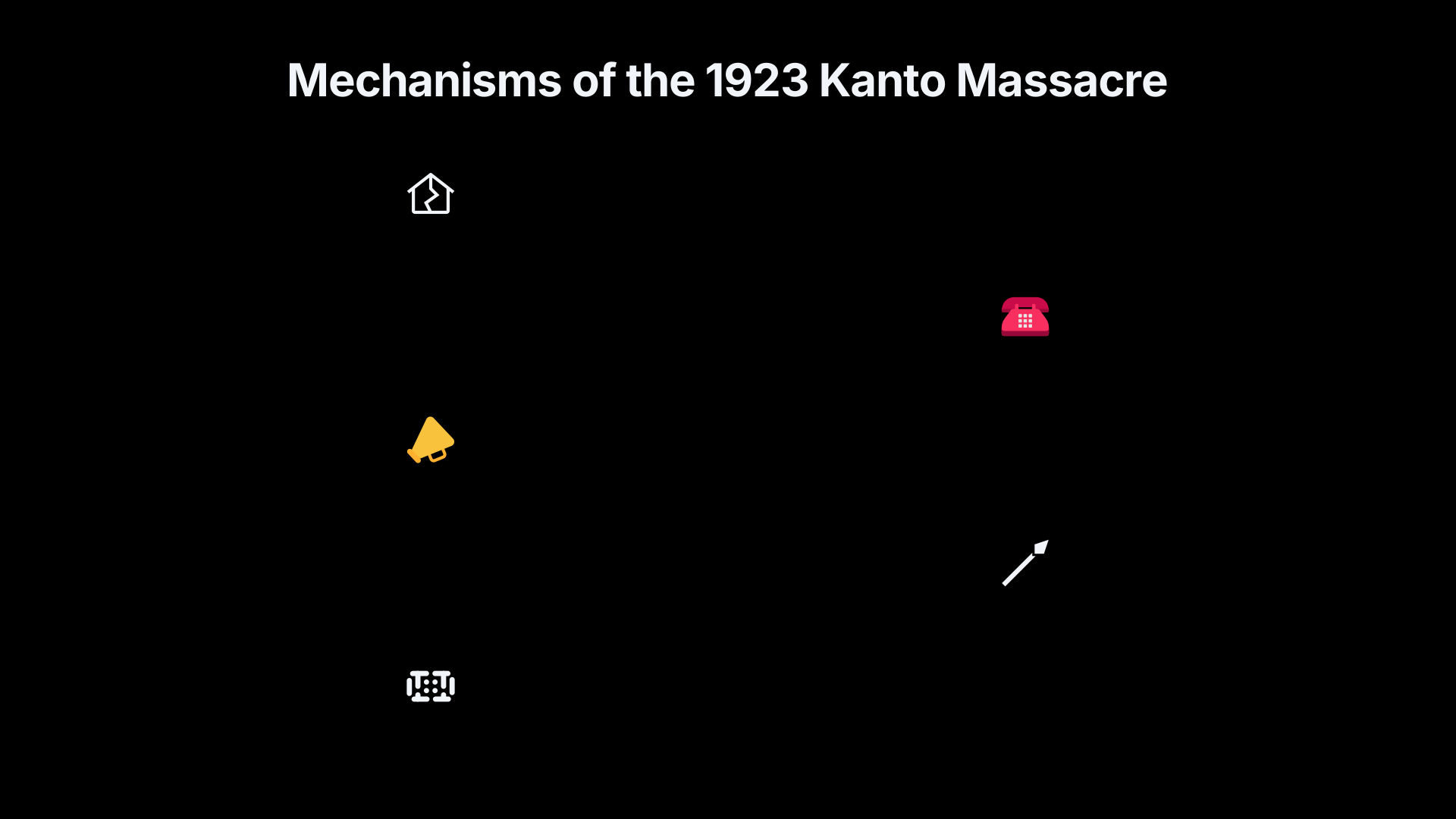
The Great Kantō earthquake of 1 September 1923 was Japan’s deadliest natural disaster of the modern era, devastating Tokyo, Yokohama and the surrounding region. Yet one of its darkest legacies was not caused by the earthquake itself. In the confusion that followed, false rumours spread that ethnic Koreans were poisoning wells, setting fires, looting, or preparing an armed uprising. These fabricated claims, reinforced by long-standing colonial prejudice and amplified through official channels, triggered a wave of vigilante violence in which thousands of Koreans were murdered. Chinese residents, Japanese mistaken for Koreans, and some political activists also became victims.
The episode is one of the clearest examples in modern history of how collective fear, racism and official failures can transform rumours into mass killing. Historians now broadly agree that the violence cannot be explained simply as spontaneous panic. Instead, it reflected the interaction of disaster, colonial ideology, state authority and local vigilantism. It remains one of the most contested chapters in modern Japanese memory.[sophia.ac.jp]dept.sophia.ac.jpKenji Hasegawa | Monumenta Nipponica…
The disaster and the spread of false accusations
The earthquake struck shortly before midday, causing enormous destruction across the Kantō region. Fires destroyed entire districts, communications collapsed and government agencies struggled to establish reliable information. In this environment of fear and uncertainty, rumours spread with extraordinary speed.
The central accusation was that Korean residents were deliberately worsening the disaster. Stories claimed they were poisoning drinking water, setting additional fires, throwing bombs, attacking refugees or planning an insurrection. None of these allegations has been supported by credible historical evidence. Modern research shows they were false rumours rather than genuine reports of organised attacks.[brown.edu]library.brown.eduBrown University LibraryThe Great Kanto Earthquake of 1923…
Several factors made these rumours especially believable to many Japanese at the time.
- Korea had been under Japanese colonial rule since 1910, and many Japanese already viewed Koreans through racist stereotypes.
- Recent Korean independence movements had encouraged officials to portray Korean nationalism as a security threat.
- The destruction of communications made it difficult to verify claims.
- Fear created a strong demand for simple explanations and identifiable enemies.
Rumours did not remain confined to private conversations. Police messages, military communications and some newspaper reports repeated or failed to challenge allegations about Korean sabotage. Later official accounts often described the rumours as uncontrolled public panic, but recent scholarship argues that some official communications actively helped legitimise or spread the accusations.[dept.sophia.ac.jp]dept.sophia.ac.jpKenji Hasegawa | Monumenta Nipponica…
How rumours became organised violence
Once rumours took hold, neighbourhood self-defence groups formed across affected areas. These vigilante organisations claimed they were protecting communities from supposed Korean attacks.
Many established roadblocks where travellers were forced to prove they were Japanese. One notorious method involved making suspects pronounce particular Japanese words. Because regional accents and individual speech patterns varied, these so-called language tests frequently failed to distinguish anyone accurately. Some Japanese citizens from rural areas were attacked after being mistaken for Koreans, demonstrating how unreliable these tests were.[Brown University Library]library.brown.eduBrown University LibraryThe Great Kanto Earthquake of 1923…
Victims were beaten, stabbed or killed with swords, bamboo spears and other improvised weapons. Violence occurred in streets, refugee camps and villages throughout the disaster zone. Korean homes and businesses were also targeted.
The killings extended beyond Koreans alone. Chinese residents were attacked, while Japanese anarchists, labour organisers and socialists were also murdered during the atmosphere of emergency. The best-known political victims included the anarchists Sakae Ōsugi and Noe Itō, who were killed by military police in what became known as the Amakasu Incident.
Vigilantes, police and military involvement
The massacre has become an important case study because responsibility did not lie solely with uncontrolled mobs.
Modern historians describe a spectrum of involvement.
- Vigilante groups carried out many of the killings directly.
- Police sometimes repeated rumours, armed or cooperated with local defence groups, and in some places participated in violence.
- Military units also became involved in arrests, shootings and the suppression of people identified as Korean or politically suspect.
The extent of official participation varied between locations. Some officers encouraged or tolerated violence, while others attempted to stop it.
One frequently cited example of resistance was police chief Tsunekichi Okawa in Tsurumi, who sheltered hundreds of Koreans inside his police station and negotiated their safe evacuation despite pressure from surrounding vigilantes. His actions demonstrate that officials had choices: some reinforced rumours, while others rejected them and protected vulnerable people.[dept.sophia.ac.jp]dept.sophia.ac.jpKenji Hasegawa | Monumenta Nipponica…
Recent historical research has challenged older interpretations that portrayed the massacre as merely the result of irrational crowd behaviour. Studies of police records suggest official warnings and communications themselves played an important role in giving credibility to false reports, particularly in Yokohama.[dept.sophia.ac.jp]dept.sophia.ac.jpKenji Hasegawa | Monumenta Nipponica…
How many people were killed?
The precise death toll remains uncertain because many bodies were never formally recorded and official investigations were incomplete.
Most historians agree that several thousand people were killed. Estimates commonly range from around 3,000 to more than 6,000 victims, with many scholars citing approximately 6,000 deaths, most of them ethnic Koreans. Chinese residents, Japanese mistaken for Koreans and political prisoners were also among those killed.[harvard-yenching.org]harvard-yenching.orgHarvard-Yenching Institute関東大震災時の朝鮮人虐殺とその後―虐殺の国家責任と民衆責任 - Harvard-Yenching Institute…
The uncertainty itself reflects one of the tragedy’s lasting problems. Documentation was inconsistent, some official records disappeared or were incomplete, and later political disputes complicated attempts to establish a definitive figure.
Why the rumours spread so easily
Psychologists and historians generally reject explanations based on mass irrationality alone. Instead, they point to several reinforcing social pressures.
The earthquake created extreme uncertainty. Survivors faced firestorms, food shortages, disrupted communications and widespread fear. In such conditions, rumours often spread because people seek explanations that appear to restore order.
However, disaster alone does not explain why Koreans became the target. Colonial rule had already normalised suspicion of Koreans among many Japanese. Official surveillance of Korean activists before the earthquake meant existing stereotypes could quickly be reactivated. Rather than inventing a completely new enemy, the rumours attached themselves to prejudices that already existed.[brown.edu]library.brown.eduBrown University LibraryThe Great Kanto Earthquake of 1923…
Recent scholarship also argues that describing all misinformation simply as “rumours” risks hiding the political choices made by authorities. Researchers examining police documents have suggested that official records sometimes retrospectively reshaped how rumours were presented, influencing later public understanding of responsibility.[KCI]kci.go.krci Sere Arti View.kciKCI관동대지진과 ‘유언비어’ ─ 경시청 자료 『大正大震火災誌』』(1925)의 ‘유언비어’ 기록에 대한 재고찰…
Memory, denial and contested commemoration
Remembering the massacre has remained politically contentious throughout the post-war period.
Local historians, Korean community organisations and human rights groups have preserved survivor testimony, organised memorial ceremonies and campaigned for official recognition. Their work has been especially important because many eyewitnesses died before their experiences entered mainstream historical accounts.[OUP Academic]academic.oup.comOUP AcademicMemory, testimony, and activism: the politics of commemorating the massacre of Koreans after the 1923 Great Kantō Earthquake…
At the same time, nationalist groups have questioned or denied aspects of the massacre, disputing casualty estimates or suggesting the killings have been exaggerated. These claims are rejected by the overwhelming consensus of professional historians, who regard the massacre itself as firmly established through survivor testimony, contemporary documents and independent historical research.[OUP Academic]academic.oup.comOUP AcademicMemory, testimony, and activism: the politics of commemorating the massacre of Koreans after the 1923 Great Kantō Earthquake…
Public commemorations have also become controversial. Annual memorial ceremonies continue in Tokyo, but debates over official participation and statements of remembrance have reflected wider disagreements about Japan’s colonial history and historical responsibility. The centenary of the earthquake in 2023 renewed public discussion of both disaster preparedness and the unresolved legacy of the massacre.[AP News]apnews.comThe earthquake, of 7.9 magnitude, caused a massive fire in the Tokyo region, destroying nearly 300,000 homes. A tragic aftermath saw the…
Why the episode still matters
The Kantō massacre illustrates how quickly fear can become persecution when rumours reinforce existing prejudice and receive official credibility. It demonstrates that misinformation becomes especially dangerous when institutions fail to challenge it—or actively contribute to its spread.
For historians of collective fear, the episode is not simply an example of panic after a natural disaster. It shows how racial stereotypes, colonial power, emergency governance and unreliable information combined to produce organised violence. That combination makes the massacre one of the most significant and tragic examples of rumour-driven persecution in twentieth-century Japan.

Endnotes
1.
Source: dept.sophia.ac.jp
Link:https://dept.sophia.ac.jp/monumenta/article/the-massacre-of-koreans-in-yokohama-in-the-aftermath-of-the-great-kanto-earthquake-of-1923/
Source snippet
Kenji Hasegawa | Monumenta Nipponica...
2.
Source: harvard-yenching.org
Link:https://www.harvard-yenching.org/research/the-great-kanto-earthquake/
Source snippet
Harvard-Yenching Institute関東大震災時の朝鮮人虐殺とその後―虐殺の国家責任と民衆責任 - Harvard-Yenching Institute...
3.
Source: library.brown.edu
Link:https://library.brown.edu/cds/kanto/denewa.html
Source snippet
Brown University LibraryThe Great Kanto Earthquake of 1923...
4.
Source: academic.oup.com
Link:https://academic.oup.com/ssjj/article/doi/10.1093/ssjj/jyaf035/8342788
Source snippet
OUP AcademicMemory, testimony, and activism: the politics of commemorating the massacre of Koreans after the 1923 Great Kantō Earthquake...
5.
Source: apnews.com
Link:https://apnews.com/article/64e84452dacfec3b7b6024b107b1a77d
Source snippet
The earthquake, of 7.9 magnitude, caused a massive fire in the Tokyo region, destroying nearly 300,000 homes. A tragic aftermath saw the...
6.
Source: kci.go.kr
Title: ci Sere Arti View.kci
Link:https://www.kci.go.kr/kciportal/ci/sereArticleSearch/ciSereArtiView.kci?sereArticleSearchBean.artiId=ART003077491
Source snippet
KCI관동대지진과 ‘유언비어’ ─ 경시청 자료 『大正大震火災誌』』(1925)의 ‘유언비어’ 기록에 대한 재고찰...
7.
Source: journal.kci.go.kr
Link:https://journal.kci.go.kr/JJC/archive/articleView?artiId=ART002623799
8.
Source: kci.go.kr
Title: ci Sere Arti View.kci
Link:https://www.kci.go.kr/kciportal/ci/sereArticleSearch/ciSereArtiView.kci?sereArticleSearchBean.artiId=ART003007742
9.
Source: kci.go.kr
Title: ci Sere Arti View.kci
Link:https://www.kci.go.kr/kciportal/ci/sereArticleSearch/ciSereArtiView.kci?sereArticleSearchBean.artiId=ART002299196
Additional References
10.
Source: pacificaffairs.ubc.ca
Link:https://pacificaffairs.ubc.ca/film-reviews/1923-kanto-massacre-directed-by-kim-taeyoung-and-jinhee-josephine-lee-september-1923-directed-by-tatsuya-mori/
Source snippet
ubc.ca1923 KANTO MASSACRE | Directed by and produced by Tae-yeong Kim, Gyu-seog Choi, and Jinhee Josephine Lee / SEPTEMBER 1923 | Directe...
Published: september 1923
11.
Source: cambridge.org
Title: Lessons from the Great Kantō Earthquake | Asia-Pacific Journal | Cambridge Core
Link:https://www.cambridge.org/core/journals/asia-pacific-journal/article/lessons-from-the-great-kanto-earthquake/80A2F669A7B329375D26EA40DF67ECD1
Source snippet
March 14, 2025 — LESSONS FROM THE GREAT KANTŌ EARTHQUAKE Published online by Cambridge University Press: 14 March 2025 Kerry Smith * * *...
Published: March 14, 2025
12.
Source: youtube.com
Title: 4 Angles Ep47 The Great Kanto Earthquake and Massacre of Ethnic Koreans in Japan
Link:https://www.youtube.com/watch?v=iYLD2uU9Ezg
Source snippet
List of Koreans killed in 1923 Great Kanto Earthquake found in Japanese records...
13.
Source: youtube.com
Title: How much do you know about the Kanto Massacre of thousands of Koreans in Japan?
Link:https://www.youtube.com/watch?v=FHTFMaU4Fw0
Source snippet
A century on from Great Kanto Earthquake, focus on massacre of Koreans...
14.
Source: youtube.com
Link:https://www.youtube.com/watch?v=4LvoUuF3Ino
Source snippet
How much do you know about the Kanto Massacre of thousands of Koreans in Japan?...
15.
Source: researchgate.net
Link:https://www.researchgate.net/publication/397988301_Memory_testimony_and_activism_the_politics_of_commemorating_the_massacre_of_Koreans_after_the_1923_Great_Kanto_Earthquake
16.
Source: gjia.georgetown.edu
Link:https://gjia.georgetown.edu/human-rights-development/un-remembering-the-massacre-how-japans-history-wars-are-challenging-research-integrity-domestically-and-abroad/
17.
Source: youtube.com
Link:https://www.youtube.com/watch?v=iCrtjJ-xPBo
Source snippet
1923 Kanto Massacre Documentary...
18.
Source: scholars.eiu.edu
Title: the enemy within earthquake rumors and massacre in the japanese e
Link:https://scholars.eiu.edu/en/publications/the-enemy-within-earthquake-rumors-and-massacre-in-the-japanese-e/
19.
Source: unseen-japan.com
Title: The Kanto Massacre: A Story of Disinformation and Denialism
Link:https://unseen-japan.com/kanto-massacre-disinformation-2/
Topic Tree