When Fear Turns Neighbours Into Suspects
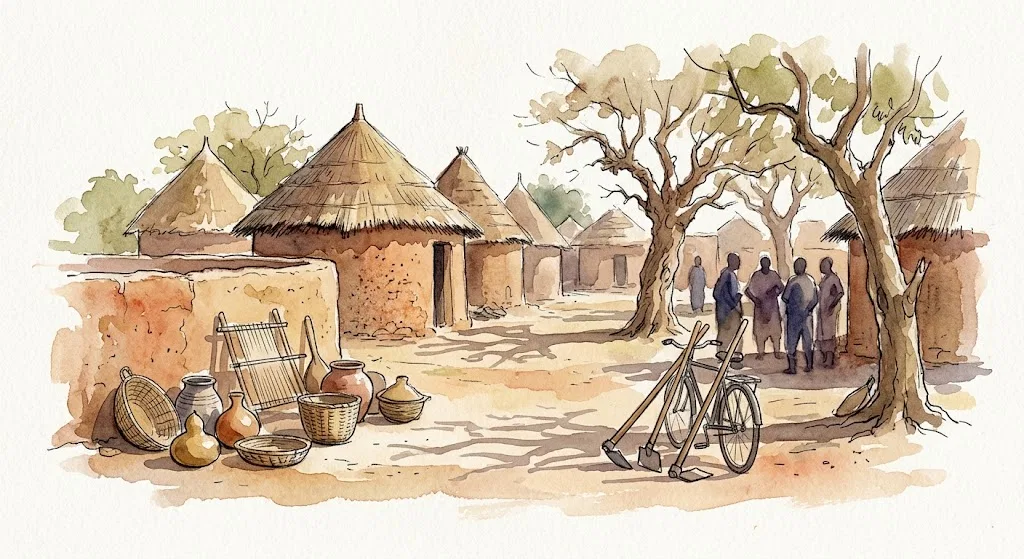
Burkina Faso’s clearest documented history of contagious belief and collective fear is not a single spectacular outbreak of “mass hysteria”. It is the repeated accusation and expulsion of people—especially older women—said to have caused illness or death through witchcraft.
Page outline Jump by section
Introduction
This is best understood as a witchcraft-accusation system and a form of social persecution, rather than proof of supernatural activity or a conventional mass psychogenic illness. The belief supplies an explanation for misfortune, but the choice of suspect often reflects gender inequality, family rivalry, poverty, bereavement and disputes over status or property. Burkina Faso has introduced laws, reintegration programmes and public campaigns, yet recent human-rights reviews indicate that accusations and exclusions have not disappeared.[usf.edu]digitalcommons.usf.eduDigital CommonsSocial Exclusion of Older Mossi Women Accused of Witchcraft…by C Barbier · Cited by 7 — Accusations of witchcraft are w…
The country’s central witchcraft scare
Belief in harmful supernatural power exists in many societies, but the form most closely associated with Burkina Faso’s documented cases is sometimes described as “soul-eating”. The feared person is not necessarily imagined casting a visible spell. Instead, she is suspected of secretly consuming another person’s vital force, particularly when a child, young adult or otherwise healthy person dies unexpectedly.
Anthropologists caution that such ideas cannot be reduced to ignorance or treated as a single national creed. Burkina Faso contains many ethnic, religious and regional traditions, and Muslims, Christians and followers of indigenous religions often combine different understandings of illness, destiny and invisible power. The most detailed accounts concern Mossi areas in the central plateau, not every community in the country.[usf.edu]digitalcommons.usf.eduDigital CommonsSocial Exclusion of Older Mossi Women Accused of Witchcraft…by C Barbier · Cited by 7 — Accusations of witchcraft are w…
A death commonly provides the immediate trigger. Grieving relatives want to know not merely how the person died, but why this particular death occurred. Where disease is poorly diagnosed, treatment has failed or the victim was young, a supernatural explanation may seem emotionally and socially persuasive. In some reported traditions, divination or the ritual “questioning” of a corpse is believed to identify the responsible person. The procedure can give communal authority to an accusation that may already have been circulating as rumour.[Le Monde.fr]lemonde.frÀ travers son projet photographique initié lors d'une résidence artistique au Musée du quai Branly en 2013, il présente un regard humanis…
Once named, the accused woman may have little practical opportunity to disprove the claim. Witchcraft is defined as secret and invisible, so denial can be interpreted as deception. Illnesses or later deaths may be added retrospectively to the case against her. What begins as suspicion can therefore become a self-reinforcing story: every misfortune appears to confirm the danger, while contradictory evidence carries less emotional force.
Why older women become targets
The pattern is strongly gendered. Studies and human-rights submissions describe the typical accused person as an older woman who is widowed, menopausal, childless, economically dependent or poorly protected within an extended or polygynous household. These characteristics do not cause accusations, but they can leave a woman with fewer relatives willing or able to defend her.[usf.edu]digitalcommons.usf.eduDigital CommonsSocial Exclusion of Older Mossi Women Accused of Witchcraft…by C Barbier · Cited by 7 — Accusations of witchcraft are w…
Research involving accused Mossi women found that family tensions often preceded the supernatural allegation. Conflicts with co-wives, daughters-in-law, husbands or other relatives could be recast as evidence of hidden malice. A woman who was outspoken, socially isolated or considered no longer economically or reproductively useful might be easier to portray as a source of danger.[Digital Commons]digitalcommons.usf.eduDigital CommonsSocial Exclusion of Older Mossi Women Accused of Witchcraft…by C Barbier · Cited by 7 — Accusations of witchcraft are w…
A joint submission to the United Nations, based on earlier research with Burkina Faso’s social-welfare authorities, reported that relatives instigated a large majority of the accusations it examined. It also linked accusations to child illness and mortality, limited access to effective healthcare and consultations with practitioners who interpreted sickness through witchcraft. Such figures come from particular studies rather than a complete national register, but they show why the phenomenon cannot be explained simply as spontaneous village panic.[OHCHR]ohchr.orgViolation of older women's rights in Burkina FasoAbout 80% of witchcraft accusations are instigated by relatives, due to the low val…
The accusation can also resolve practical disputes in favour of the accusers. Expulsion may remove someone from a household, weaken her claim to land or possessions, or release relatives from the obligation to support her. For that reason, scholars distinguish sincere belief from strategic accusation. A family may genuinely fear witchcraft while some members also benefit from the suspect’s removal.
How suspicion becomes collective persecution
Witch accusations spread through ordinary mechanisms of social influence. A sudden death creates fear and uncertainty. Existing gossip identifies a plausible suspect. A respected elder, diviner or relative gives the rumour authority. Public repetition turns private suspicion into apparent community knowledge. Few people wish to defend someone portrayed as capable of killing invisibly, because defenders may themselves become suspect.
This resembles a moral panic in the way a perceived hidden enemy comes to embody broader anxieties. Yet it differs from the short, media-driven scares often described by that term. In Burkina Faso, the belief may be embedded in long-standing explanations of illness, kinship and misfortune. The panic is usually local, unfolding within a family or village rather than sweeping across the whole nation at once.
It is also different from mass psychogenic illness. In a psychogenic outbreak, a group develops real physical symptoms—such as fainting, shaking or nausea—without an identified infectious or toxic cause, often under intense shared stress. Burkina Faso’s best-documented cases instead concern the social interpretation of genuine deaths and illnesses, followed by accusation and exclusion. African schools have experienced psychogenic outbreaks elsewhere, but there is little strong published evidence for a major, well-investigated Burkinabè episode that should anchor the country’s history.[PMC]pmc.ncbi.nlm.nih.govOpen source on nih.gov.
Calling the women “witches” repeats the accusation as though it were an established identity. More accurate descriptions are women accused of witchcraft, ostracised women or victims of witchcraft-related persecution. Belief itself is not the same as abuse. The human-rights problem arises when an allegation leads to threats, assault, forced displacement, property loss or denial of medical and legal protection. International guidance therefore recommends punishing harmful conduct rather than attempting to criminalise private religious or cultural belief.[OHCHR]ohchr.orgaccusations of witchcraft and ritual attacksaccusations of witchcraft and ritual attacks
Life after banishment
Expulsion can be devastating. Accused women have reported physical violence, psychological trauma, loss of property, separation from children and the destruction of the social ties on which rural survival depends. An older woman forced from her village may have no independent income, secure housing or realistic means of returning safely.[ohchr.org]ohchr.orgViolation of older women's rights in Burkina FasoAbout 80% of witchcraft accusations are instigated by relatives, due to the low val…
Some travel to refuge centres, of which the best known is the Catholic-supported Delwende centre in Ouagadougou. It has sheltered hundreds of people at different points, overwhelmingly women but occasionally men as well. A 2011 religious-freedom report said the centre housed about 317 people accused of witchcraft; another report covering the following period recorded roughly 350 residents, including six men. These totals describe the centre’s population at particular moments and should not be mistaken for a national count of accusations.[U.S. Department of State]2009-2017.state.govU.S. Department of State Burkina FasoU.S. Department of State Burkina Faso
Shelters prevent homelessness and immediate violence, but they also expose a painful contradiction. A woman may be physically safe while remaining permanently separated from her family, land and community. Long-term residence can unintentionally turn banishment into an accepted social solution: the village removes the person it fears, while a charity carries the cost.
Reintegration is therefore more difficult than simply arranging transport home. Negotiators must persuade relatives and traditional authorities that the woman can return without provoking renewed hostility. They may need to address inheritance, housing and livelihood questions as well as belief. Some projects have used community education, mediation and the involvement of local leaders to prevent expulsions and secure returns, with reported successes in villages in Kourwéogo and Passoré provinces.[power-humanrights-education.org]power-humanrights-education.orgExhibition HRE Panel 10Exhibition HRE Panel 10
What the state has done
The Burkinabè government adopted a national action plan in 2012 aimed at ending the exclusion of women accused of witchcraft. Measures included legal assistance, psychological and social support, economic help and negotiations for rehabilitation and reintegration. Authorities also worked with traditional leaders and civil-society organisations to challenge accusations at community level.[theguardian.com]theguardian.comThe Guardian Burkina Faso moves to support banished women accusedThe Guardian Burkina Faso moves to support banished women accused
Burkina Faso’s 2018 Penal Code strengthened the legal response. Human-rights reporting states that physical or psychological abuse of women and girls accused of witchcraft is punishable by imprisonment and fines. The important legal shift is that exclusion and violence are treated as offences even though the state does not try to decide whether supernatural power exists.[U.S. Department of State]state.govburkina fasoDepartment of State2023 Country Reports on Human Rights Practices: Burkina…The law, which was seldom enforced, made the physical or mo…
Enforcement has remained a concern. The United States’ 2023 human-rights report described the relevant law as seldom enforced. During a United Nations review in March 2025, Burkina Faso’s representatives said that approximately 30 accused women had been helped to return to family settings during 2024. That indicates active intervention, but it also shows the modest scale of documented reintegration compared with the longstanding population of shelters and the likelihood of unreported rural cases.[U.S. Department of State]state.govburkina fasoDepartment of State2023 Country Reports on Human Rights Practices: Burkina…The law, which was seldom enforced, made the physical or mo…
Law alone cannot undo an accusation whose authority comes from relatives, elders and communal fear. A victim may be unwilling to prosecute her family, police may regard the matter as a private tradition, and witnesses may fear supernatural retaliation or social isolation. Effective protection therefore depends on local mediation, healthcare access, women’s property rights, income security and credible investigation of unexplained deaths as much as criminal penalties.
Religion can challenge or reinforce the fear
Burkina Faso is religiously diverse and has a long reputation for everyday coexistence among Muslims, Catholics, Protestants and followers of indigenous traditions. Witchcraft beliefs do not belong neatly to one religion. People may attend a mosque or church while also accepting inherited ideas about divination, ancestors or harmful invisible forces.
Christian organisations have played a major protective role, especially by running shelters and supporting reintegration. At the same time, some forms of Pentecostal and charismatic preaching across Africa interpret misfortune through demons, curses and spiritual warfare. Deliverance ministries may present prayer as a way to overcome witchcraft, translating older fears into Christian language rather than rejecting the underlying diagnosis. Research on African Pentecostalism, including practices observed in Burkina Faso, describes this overlap between witchcraft narratives and spiritual deliverance.[OpenEdition Journals]journals.openedition.orgOpen source on openedition.org.
That does not mean Pentecostal churches generally promote accusations, nor that traditional healers uniformly identify witches. Responses vary widely. Religious leaders may defend an accused person, intensify suspicion or redirect fear towards prayer without naming an individual. The decisive question is not which faith is involved, but whether its authorities protect the vulnerable, demand evidence and prevent coercion.
Miracle crowds and the search for healing
Collective belief in Burkina Faso also appears in less persecutory forms. In 2023, thousands reportedly travelled to see a young woman outside Ouagadougou who was credited by visitors with healing powers. The gatherings reflected hope as much as credulity: people facing chronic illness, expensive treatment or limited medical access sought help where conventional services had failed or felt unreachable.[Africanews]africanews.comyoung woman in burkina faso becomes famous for her healing powersyoung woman in burkina faso becomes famous for her healing powers
Such an episode should not automatically be called a cult or panic. There was no clear evidence in the reporting of an organised coercive movement, apocalyptic doctrine or mass psychogenic outbreak. It was closer to a miracle-healing phenomenon centred on reputation, testimony and pilgrimage. Claims of cures remained beliefs reported by visitors rather than medically verified findings.
Miracle movements become socially dangerous when leaders discourage necessary treatment, demand exploitative payments, isolate followers or treat illness as proof of sin or witchcraft. The available account of this Burkinabè case does not establish those features. Its importance lies in showing why extraordinary healing claims can spread quickly where medical need is high and personal testimonies carry more emotional force than institutional warnings.
Health rumours and mistrust
Rumour has also shaped responses to medical research. During a malaria study involving placental biopsies in Burkina Faso, researchers encountered fears about what would be done with placental tissue and why it was being collected. The study found that trust depended heavily on careful explanation, local relationships and opportunities for participants to discuss sensitive ideas, including witchcraft.[PMC]pmc.ncbi.nlm.nih.govOpen source on nih.gov.
These fears were not simply random superstition. Medical procedures involving blood, organs or reproductive material can be difficult to understand, particularly when technical explanations are delivered by outsiders or when communities have limited control over research decisions. Rumours fill the gap between what institutions say they are doing and what people believe powerful organisations might conceal.
COVID-19 created a wider information crisis. Researchers and humanitarian organisations working with internally displaced people in Burkina Faso documented widespread rumours about the disease and vaccines. Radio programmes and social-media initiatives were developed to identify false claims, answer questions in accessible language and strengthen trusted local sources of information.[Elrha]elrha.orgOpen source on elrha.org.
This is better described as an infodemic—an overload of accurate and inaccurate information—than a single national panic. War, displacement, weak healthcare access and distrust of authorities made alarming claims easier to believe. The response that appeared most promising was not ridicule or censorship alone, but repeated communication through familiar broadcasters and community voices.
From village rumour to digital mythology
Burkina Faso’s modern information environment has added a new form of contagious belief: politically charged stories circulating far beyond the country. Since Captain Ibrahim Traoré took power in September 2022, fabricated photographs, invented celebrity endorsements, misleading videos and exaggerated accounts of national achievements have helped construct an online image of him as a heroic Pan-African saviour.
Some material is produced or amplified by ideological influencers and foreign information networks; some is shared by ordinary users expressing genuine pride or frustration with former colonial powers. The distinction matters. People do not always share a heroic image because they literally believe every detail. A false story can function as a political symbol—a picture of the leader or future they wish existed.[The Week]theweek.comThe Week Burkina Faso's misinformation warBehind this digital influence campaign are strategic alliances, particularly with Russia, which has conducted multiple disinformation ope…
This digital mythology is not a “cult” in the narrow religious sense. There is no evidence of one bounded organisation with a single doctrine, initiation system and controlled membership. It is better understood as charismatic political fandom mixed with propaganda, anti-colonial aspiration and algorithmic amplification.
Nevertheless, its social mechanisms resemble older rumour systems. Repetition creates familiarity; emotionally satisfying claims travel farther than corrections; sceptics risk being portrayed as enemies; and real insecurity makes stories of decisive rescue especially attractive. The hidden witch blamed for village misfortune and the flawless digital hero credited with national renewal occupy opposite moral roles, but both turn complex crises into stories centred on extraordinary personal power.
Film and photography changed the public picture
Burkinabè artists have been central to challenging witchcraft accusations. Pierre Yaméogo’s 2005 film Delwende follows a woman accused after a child’s death and forced to flee her village. The drama connects supernatural blame with patriarchal authority, family conflict and the limited choices available to an older woman. It won the Prize of Hope in the Un Certain Regard section at the Cannes Film Festival.[Wikipedia]WikipediaOpen source on wikipedia.org.
The film matters because it reverses the usual direction of the story. Instead of treating the alleged witch as a mysterious threat, it asks the audience to experience accusation from the victim’s side. The frightening element is no longer invisible magic but the speed with which grief, gossip and male authority can erase a woman’s standing.
Photographer Nyaba Léon Ouédraogo has taken a similar approach in portraits of women living at the Delwende centre. His paired images present the same women in everyday and carefully styled forms, restoring individuality to people reduced by accusation to a feared category. Reporting on the project in 2025 described it as both an artistic exploration of visible and invisible worlds and a protest against the loss of dignity imposed on the accused.[Le Monde.fr]lemonde.frÀ travers son projet photographique initié lors d'une résidence artistique au Musée du quai Branly en 2013, il présente un regard humanis…
These works do not attempt to disprove every spiritual belief. Their intervention is more human and more politically direct: even where people believe in witchcraft, an allegation should not deprive a person of safety, family, property or personhood.
What the evidence does and does not show
The evidence supports several firm conclusions. Witchcraft accusations in Burkina Faso are real social events with documented victims. Older and socially vulnerable women are disproportionately affected. Illness and unexpected death commonly trigger suspicion, while family disputes and gendered power shape who is blamed. Banishment causes measurable harm, and shelters, mediation programmes and legal reforms have been necessary responses.[usf.edu]digitalcommons.usf.eduDigital CommonsSocial Exclusion of Older Mossi Women Accused of Witchcraft…by C Barbier · Cited by 7 — Accusations of witchcraft are w…
The available evidence does not establish that accused women possess supernatural powers. Nor does it justify portraying all Burkinabè people as governed by witchcraft fears. Most cases documented by researchers and rights organisations come from particular regions, communities and institutions. National totals are uncertain because accusations are often informal, victims may avoid authorities, and shelter populations do not capture women who flee elsewhere or remain trapped within abusive households.
There is also no strong basis for presenting Burkina Faso as a major centre of apocalyptic cults, UFO religions, satanic panics or classic school-based mass psychogenic illness. The country’s most important contribution to the social history of collective fear is more persistent and less theatrical: the way private bereavement can become public accusation, and the way an invisible threat can be attached to a woman who already lacks protection.
Why the story still matters
Burkina Faso’s witchcraft accusations demonstrate that collective fear does not require a crowd running through the streets. It can operate slowly, through family conversations, ritual authority, remembered grievances and the conviction that repeated misfortune must have a human author. By the time outsiders recognise a “panic”, the accused person may already have lost her home.
The cases also reveal why factual correction is rarely sufficient. An accusation can answer several needs at once: it explains a death, identifies someone to punish, protects a family’s moral order and settles conflicts that may have little to do with the supernatural. Challenging it therefore requires more than saying witchcraft is unproven. Communities need reliable healthcare, trusted explanations of death, protection for widows, secure property rights and respected leaders willing to oppose expulsion.
The most useful lesson is the distinction between belief and harm. Governments need not police every spiritual idea, and researchers need not dismiss local cosmologies to recognise persecution. The defensible boundary is practical: no person should be beaten, dispossessed, expelled or denied care because others believe she possesses an invisible power. Burkina Faso’s laws and reintegration efforts increasingly reflect that principle, but the continuing need for shelters and official interventions shows that it has not yet been fully secured.[OHCHR]ohchr.orgaccusations of witchcraft and ritual attacksaccusations of witchcraft and ritual attacks
Amazon book picks
Further Reading
Books and field guides related to When Fear Turns Neighbours Into Suspects. Use these as the next step if you want deeper reading beyond the article.

The Spirit Catches You and You Fall Down
First published 1997. Subjects: Asian Americans, Attitude, Attitude of Health Personnel, Child, Communication.

The Penguin book of witches
First published 2014. Subjects: Witchcraft, History, Witchcraft, europe.
The fear
First published 2011. Subjects: Politics and government, Social conditions, Economic conditions, Mugabe, robert gabriel, 1924-2019, Zimba...
Endnotes
1.
Source: ohchr.org
Link:https://www.ohchr.org/en/meeting-summaries/2025/03/dialogue-burkina-faso-experts-human-rights-committee-commend-electoral
Source snippet
In Dialogue with Burkina Faso, Experts of the Human...6 Mar 2025 — The Penal Code issued penalties of imprisonment and fines for pe...
2.
Source: state.gov
Title: burkina faso
Link:https://www.state.gov/reports/2023-country-reports-on-human-rights-practices/burkina-faso
Source snippet
Department of State2023 Country Reports on Human Rights Practices: Burkina...The law, which was seldom enforced, made the physical or mo...
3.
Source: ohchr.org
Link:https://www.ohchr.org/sites/default/files/lib-docs/HRBodies/UPR/Documents/Session3/BF/HAI_BFA_UPR_S3_2008_HelpAgeInternational_Etal_uprsubmission.pdf
Source snippet
Violation of older women's rights in Burkina FasoAbout 80% of witchcraft accusations are instigated by relatives, due to the low val...
4.
Source: state.gov
Title: burkina faso
Link:https://www.state.gov/reports/2016-country-reports-on-human-rights-practices/burkina-faso
5.
Source: ohchr.org
Title: A HRC WG6 3 BFA 3 Burkina Faso E
Link:https://www.ohchr.org/sites/default/files/lib-docs/HRBodies/UPR/Documents/Session3/BF/A_HRC_WG6_3_BFA_3_BurkinaFaso_E.pdf
6.
Source: pmc.ncbi.nlm.nih.gov
Link:https://pmc.ncbi.nlm.nih.gov/articles/PMC3588562/
7.
Source: ohchr.org
Title: accusations of witchcraft and ritual attacks
Link:https://www.ohchr.org/sites/default/files/2022-12/PAP-Guidelines-EN.pdf
8.
Source: 2009-2017.state.gov
Title: U.S. Department of State Burkina Faso
Link:https://2009-2017.state.gov/j/drl/rls/irf/2011/af/192685.htm
9.
Source: 2009-2017.state.gov
Title: U.S. Department of State Burkina Faso
Link:https://2009-2017.state.gov/j/drl/rls/irf/2010_5/168390.htm
10.
Source: power-humanrights-education.org
Title: Exhibition HRE Panel 10
Link:https://www.power-humanrights-education.org/wpdata/wp-content/uploads/2018/07/Exhibition_HRE_Panel_10.pdf
11.
Source: power-humanrights-education.org
Title: Burkina Faso
Link:https://www.power-humanrights-education.org/exhibition/success-stories/burkina-faso/
12.
Source: ohchr.org
Title: experts committee elimination racial discrimination commend burkina fasos
Link:https://www.ohchr.org/en/meeting-summaries/2026/04/experts-committee-elimination-racial-discrimination-commend-burkina-fasos
13.
Source: journals.openedition.org
Link:https://journals.openedition.org/etudesafricaines/10382?lang=en
14.
Source: journals.openedition.org
Link:https://journals.openedition.org/etudesafricaines/pdf/10382
15.
Source: africanews.com
Title: young woman in burkina faso becomes famous for her healing powers
Link:https://www.africanews.com/2023/03/03/young-woman-in-burkina-faso-becomes-famous-for-her-healing-powers/
16.
Source: pmc.ncbi.nlm.nih.gov
Link:https://pmc.ncbi.nlm.nih.gov/articles/PMC6238265/
17.
Source: elrha.org
Link:https://www.elrha.org/resource/misinformation-covid-19-burkina-faso
18.
Source: Wikipedia
Link:https://en.wikipedia.org/wiki/Delwende
19.
Source: Wikipedia
Title: Mass psychogenic illness
Link:https://en.wikipedia.org/wiki/Mass_psychogenic_illness
20.
Source: Wikipedia
Title: Movement for the Restoration of the Ten Commandments of God
Link:https://en.wikipedia.org/wiki/Movement_for_the_Restoration_of_the_Ten_Commandments_of_God
21.
Source: Wikipedia
Title: List of mass panic cases
Link:https://en.wikipedia.org/wiki/List_of_mass_panic_cases
22.
Source: 2001-2009.state.gov
Link:https://2001-2009.state.gov/g/drl/rls/irf/2007/90084.htm
23.
Source: 2009-2017.state.gov
Link:https://2009-2017.state.gov/j/drl/rls/irf/2008/108355.htm
24.
Source: 2009-2017.state.gov
Link:https://2009-2017.state.gov/j/drl/rls/irf/2009/127219.htm
25.
Source: 2021-2025.state.gov
Link:https://2021-2025.state.gov/report/custom/7ee409dcbc/
26.
Source: 2021-2025.state.gov
Link:https://2021-2025.state.gov/report/custom/78722d7697/
27.
Source: state.gov
Link:https://www.state.gov/report/custom/e5c68c1b2c
28.
Source: 2009-2017.state.gov
Link:https://2009-2017.state.gov/j/drl/rls/hrrpt/2010/af/154333.htm
29.
Source: ohchr.org
Link:https://www.ohchr.org/en/press-releases/2017/10/committee-elimination-discrimination-against-women-reviews-report-burkina?sub-site=HRC
30.
Source: ohchr.org
Link:https://www.ohchr.org/zh/press-releases/2013/08/committee-elimination-racial-discrimination-considers-report-burkina-faso
31.
Source: tbinternet.ohchr.org
Title: Download Draft.aspx
Link:https://tbinternet.ohchr.org/_layouts/15/TreatyBodyExternal/DownloadDraft.aspx?key=u8YKZ9Md0kNGr6kAMUmbMpCA6uXjgvdJpokOGSpmS2gQcb82NWdxdPoc3WLMzVoj
32.
Source: ohchr.org
Link:https://www.ohchr.org/sites/default/files/Documents/Issues/Housing/SecurityTenure/HelpAgeSecurityTenureForOlderWomen.pdf
33.
Source: ohchr.org
Title: human rights council discusses challenges facing human rights defenders
Link:https://www.ohchr.org/en/meeting-summaries/2023/03/human-rights-council-discusses-challenges-facing-human-rights-defenders
34.
Source: journals.openedition.org
Link:https://journals.openedition.org/etudesafricaines/22870?lang=fr
35.
Source: journals.openedition.org
Link:https://journals.openedition.org/africanistes/13122
36.
Source: journals.openedition.org
Link:https://journals.openedition.org/assr/18013?lang=en
37.
Source: journals.openedition.org
Link:https://journals.openedition.org/ried/20155?lang=en
38.
Source: journals.openedition.org
Link:https://journals.openedition.org/africanistes/7301
39.
Source: journals.openedition.org
Link:https://journals.openedition.org/apad/pdf/2843
40.
Source: journals.openedition.org
Link:https://journals.openedition.org/span/pdf/642
41.
Source: youtube.com
Link:https://www.youtube.com/watch?v=4PNLtcRuRn8
Source snippet
For Rain to Fall: The Sky Sorcerers of Burkina Faso...
42.
Source: digitalcommons.usf.edu
Link:https://digitalcommons.usf.edu/etd/8919/
Source snippet
Digital CommonsSocial Exclusion of Older Mossi Women Accused of Witchcraft...by C Barbier · Cited by 7 — Accusations of witchcraft are w...
43.
Source: lemonde.fr
Link:https://www.lemonde.fr/afrique/article/2025/02/22/photographie-lorsque-nyaba-leon-ouedraogo-rencontre-des-devoreuses-d-ames-du-burkina-faso_6558641_3212.html
Source snippet
À travers son projet photographique initié lors d'une résidence artistique au Musée du quai Branly en 2013, il présente un regard humanis...
44.
Source: pmc.ncbi.nlm.nih.gov
Link:https://pmc.ncbi.nlm.nih.gov/articles/PMC4408602/
Source snippet
The symptoms someone experiences when attacked by a witch...Read more...
45.
Source: un.org
Link:https://www.un.org/womenwatch/ianwge/taskforces/vaw/Version_anglaise_de_l_etude_de_base_VEF_2009-ud.pdf
Source snippet
ited NationsBURKINA FASOThe people accused of witchcraft are generally elderly women above 40 years of age, are widows, women who have...
46.
Source: docs.un.org
Link:https://docs.un.org/en/A/HRC/34/59
47.
Source: digitallibrary.un.org
Title: CEDAW C BFA CO 6 EN
Link:https://digitallibrary.un.org/record/695149/files/CEDAW_C_BFA_CO_6-EN.pdf
48.
Source: theguardian.com
Title: The Guardian Burkina Faso moves to support banished women accused
Link:https://www.theguardian.com/global-development/2012/may/14/burkina-faso-women-accused-witchcraft
49.
Source: docs.un.org
Link:https://docs.un.org/en/CCPR/C/126/2/ADD.3
50.
Source: digitallibrary.un.org
Title: CEDAW C BFA CO 6 Add.1 EN
Link:https://digitallibrary.un.org/record/834748/files/CEDAW_C_BFA_CO_6_Add.1-EN.pdf
51.
Source: theweek.com
Title: The Week Burkina Faso’s misinformation war
Link:https://theweek.com/politics/burkina-fasos-misinformation-war
Source snippet
Behind this digital influence campaign are strategic alliances, particularly with Russia, which has conducted multiple disinformation ope...
52.
Source: pmc.ncbi.nlm.nih.gov
Link:https://pmc.ncbi.nlm.nih.gov/articles/PMC12860665/
53.
Source: pmc.ncbi.nlm.nih.gov
Link:https://pmc.ncbi.nlm.nih.gov/articles/PMC7396040/
54.
Source: pmc.ncbi.nlm.nih.gov
Link:https://pmc.ncbi.nlm.nih.gov/articles/PMC12863508/
55.
Source: pmc.ncbi.nlm.nih.gov
Link:https://pmc.ncbi.nlm.nih.gov/articles/PMC12416808/
56.
Source: pmc.ncbi.nlm.nih.gov
Link:https://pmc.ncbi.nlm.nih.gov/articles/PMC4552613/
57.
Source: pmc.ncbi.nlm.nih.gov
Link:https://pmc.ncbi.nlm.nih.gov/articles/PMC11682911/
58.
Source: pmc.ncbi.nlm.nih.gov
Link:https://pmc.ncbi.nlm.nih.gov/articles/PMC3655658/
59.
Source: pmc.ncbi.nlm.nih.gov
Link:https://pmc.ncbi.nlm.nih.gov/articles/PMC9648979/
60.
Source: pmc.ncbi.nlm.nih.gov
Link:https://pmc.ncbi.nlm.nih.gov/articles/PMC8397279/
61.
Source: pmc.ncbi.nlm.nih.gov
Link:https://pmc.ncbi.nlm.nih.gov/articles/PMC6021763/
62.
Source: pmc.ncbi.nlm.nih.gov
Link:https://pmc.ncbi.nlm.nih.gov/articles/PMC12124026/
63.
Source: pmc.ncbi.nlm.nih.gov
Link:https://pmc.ncbi.nlm.nih.gov/articles/PMC10631015/
64.
Source: pmc.ncbi.nlm.nih.gov
Link:https://pmc.ncbi.nlm.nih.gov/articles/PMC9128470/
65.
Source: digitalcommons.andrews.edu
Link:https://digitalcommons.andrews.edu/cgi/viewcontent.cgi?article=1357&context=jams
66.
Source: frontiersin.org
Link:https://www.frontiersin.org/journals/communication/articles/10.3389/fcomm.2020.00045/pdf
67.
Source: theguardian.com
Link:https://www.theguardian.com/science/2008/sep/18/psychology
68.
Source: theguardian.com
Title: witch hunts ritual child abuse albinism africa
Link:https://www.theguardian.com/global-development/commentisfree/2022/jun/08/witch-hunts-ritual-child-abuse-albinism-africa
69.
Source: theguardian.com
Title: carol morley the falling mass hysteria is a powerful group activity
Link:https://www.theguardian.com/film/2015/mar/29/carol-morley-the-falling-mass-hysteria-is-a-powerful-group-activity
70.
Source: ebsco.com
Link:https://www.ebsco.com/research-starters/social-sciences-and-humanities/mass-hysteria
71.
Source: healthline.com
Title: mass hysteria
Link:https://www.healthline.com/health/mental-health/mass-hysteria
72.
Source: revista.domhelder.edu.br
Link:https://revista.domhelder.edu.br/index.php/veredas/article/view/4235
Additional References
73.
Source: researchgate.net
Link:https://www.researchgate.net/publication/342231343_Rising_Above_Misinformation_or_Fake_News_in_Africa_Another_Strategy_to_Control_COVID-19_Spread
74.
Source: researchgate.net
Link:https://www.researchgate.net/publication/342898556_Who%27s_the_witch_Social_exclusion_of_older_Mossi_women_accused_of_Witchcraft_in_Burkina_Faso_Africa
75.
Source: instagram.com
Link:https://www.instagram.com/p/DVmVmr3EwEu/
76.
Source: apothecaries.org
Link:https://www.apothecaries.org/wp-content/uploads/2019/06/Mass-psychogenic-illness-and-how-to-respond.pdf
77.
Source: childrenbelieve.ca
Link:https://childrenbelieve.ca/stories/in-the-news/misinformation-about-covid-19-is-causing-fear-and-anxiety
78.
Source: researchgate.net
Link:https://www.researchgate.net/publication/45681143_Doomsday_movements_in_Africa_Restoration_of_the_Ten_Commandments_of_God
79.
Source: facebook.com
Link:https://www.facebook.com/SonnieBaduPage/posts/testimony-alertthis-young-man-was-in-the-hospital-in-bukina-faso-when-the-lord-u/565468534935523/
80.
Source: x.com
Link:https://x.com/naijaconfra/status/1978445491131040102
81.
Source: pambazuka.org
Link:https://www.pambazuka.org/long-road-freedom-women-burkina-faso
82.
Source: facebook.com
Link:https://www.facebook.com/naija.confra.2025/posts/the-number-1-man-of-burkina-faso-atabor-recently-signed-out-of-school-in-the-bur/122253642776194958/
Topic Tree
Follow this branch
Related pages 192
- Antigua and Barbuda
- Argentina Belief Scares
- Azerbaijan Belief
- Bahrain Beliefs
- North Korea
- +187 more in sidebar