How Fear and Hidden Power Shaped Equatorial Guinea
Equatorial Guinea has no securely documented equivalent of the Salem trials, a dance plague or a large school-based outbreak of mass psychogenic illness.
Page outline Jump by section
Introduction
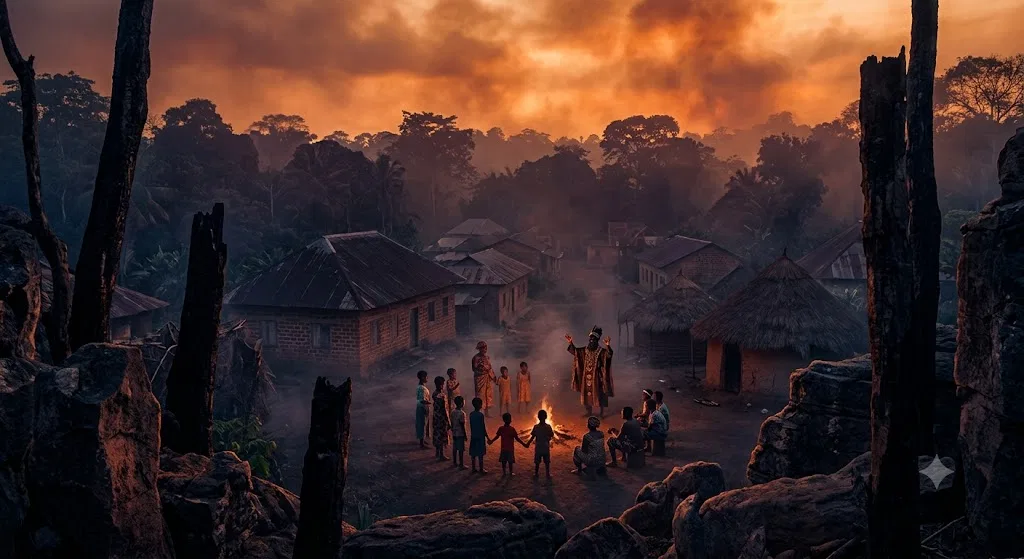
The evidence is uneven. Anthropologists recorded how Fang communities interpreted illness, sudden death, wealth and social conflict through accusations of hidden supernatural harm. Human-rights reports later described violence against suspected witches, while more recent allegations of ritual murder have circulated in a society where censorship makes independent verification exceptionally difficult. These episodes should not be collapsed into a single story of “mass hysteria”. Some were genuine religious movements, some were systems of social accusation, some were political propaganda, and some remain frightening rumours whose factual basis cannot be established.[persee.fr]persee.frPersée Christian Acculturation and Fang WitchcraftPerséeChristian Acculturation and Fang Witchcraft - Persée…
Why witchcraft fears became a language of crisis
Among Fang communities in mainland Equatorial Guinea, witchcraft has historically meant more than stage magic or an eccentric superstition. It has provided a way of explaining why misfortune appears to strike unfairly: why one person becomes ill, why a relative dies unexpectedly, or why somebody prospers while neighbours struggle. Such beliefs can also turn private suspicion into a public accusation, especially when family rivalry, jealousy, economic change or religious disagreement has already damaged trust.
Anthropologist James W. Fernandez’s research in the region during the late colonial period described a society negotiating between Christian teaching and older explanations of hidden power. Christianity stressed sin, confession and individual responsibility, while local accounts of witchcraft located danger within concealed relationships between people. Fernandez argued that the meeting of these systems did not simply erase older beliefs. It produced new combinations, including Christianised campaigns against witchcraft and increasingly elaborate stories about secret evil.[Persée]persee.frPersée Christian Acculturation and Fang WitchcraftPerséeChristian Acculturation and Fang Witchcraft - Persée…
That distinction matters. A belief may be shared without creating a panic. It becomes socially dangerous when people begin naming supposed perpetrators, when healers or preachers claim special powers to detect them, or when authorities tolerate punishment based on accusation rather than evidence. In Equatorial Guinea, the historical record points less to one explosive “witch craze” than to recurring waves of suspicion shaped by colonial disruption, religious competition and rapid changes in wealth and status.
Anti-witchcraft movements promised protection
Witchcraft fears often generated organised attempts to defeat witchcraft. These movements could offer purification, diagnosis, healing and a renewed sense of moral order. They were not necessarily secret criminal organisations, despite the way colonial officials sometimes described them. Some were reform movements within African religious life, responding to fears that existing institutions could no longer protect communities.
Historical research on Spanish Guinea indicates that witchcraft accusations increased among Fang communities from the late 1930s. Colonial observers frequently failed to distinguish between those believed to practise harmful magic and movements formed to expose or suppress it. From an administrative viewpoint, both could appear irrational, disruptive or politically threatening. From inside the community, however, an anti-witchcraft movement could present itself as the cure rather than the danger.[estudiosafrohispanicos.files.wordpress.com]estudiosafrohispanicos.files.wordpress.comequatorial guinea 1927-1979: a new african traditionThe rise in witchcraft accusations that since the late 1930s affected Fang society…
This ambiguity helps explain why the word “cult” is often misleading. A movement might involve initiation, ritual specialists and dramatic ceremonies, yet still function as a recognised form of communal healing or moral reform. Colonial labels also carried political weight: calling a movement superstitious or dangerous could justify surveillance and suppression, while overlooking the insecurity that had made the movement attractive.
The Fang religious world was also connected across what are now Equatorial Guinea, Gabon and Cameroon. Movements and beliefs travelled through kinship networks, labour migration and trade rather than respecting colonial borders. Comparisons with neighbouring countries can therefore clarify the regional setting, but they should not be used to import spectacular incidents into Equatorial Guinea without evidence that they occurred there.
The Ekong fear joined witchcraft to modern wealth
One of the most revealing modern beliefs studied in Equatorial Guinea is the Ekong complex. Anthropologist Josep Martí describes it as a comparatively recent form of witchcraft belief found across parts of Central Africa. In its broader regional form, it imagines that a victim can be secretly captured, made to appear dead and forced to labour for the benefit of a witch or wealthy exploiter. The imagery is strikingly modern: hidden plantations, invisible workers and riches accumulated through the stolen life of another person.[csic.es]digital.csic.esthe Ekong Case in Equatorial GuineaThe ekong is a relatively modem notion of wilchcraft which is spread throughot large areas…
The importance of Ekong is not whether invisible labour camps literally existed. It is what the belief made imaginable. Sudden wealth could be interpreted not merely as good fortune or business success but as evidence that somebody else had been consumed, enslaved or sacrificed. Economic inequality thus became a supernatural mystery with a suspected human culprit.
This is a recurring feature of witchcraft beliefs under rapid economic change. Older ideas about predation adapt to new forms of labour, money and consumption. In the Ekong case, supernatural enslavement offered a moral explanation for wealth that seemed to appear without visible work. The belief connected intimate fears—bereavement, envy and family betrayal—to larger experiences of colonial labour and unequal access to modern goods.
Calling this “mass hysteria” would flatten its meaning. Ekong was not simply a contagious false rumour producing identical behaviour across a crowd. It was a framework through which people discussed exploitation, illegitimate enrichment and the fear that social advancement might depend upon concealed violence.
When accusations led to real violence
Whatever the supernatural claims involved, attacks on accused witches were real. A United States religious-freedom report covering the early 2000s recorded accounts of villagers believed to be witches being harassed, beaten and sometimes killed by neighbours. It also reported that courts had prosecuted some perpetrators of violence against suspected witches. The account does not establish the scale of the problem, but it confirms that accusation could move beyond private belief into physical punishment.[Department of Justice]justice.govreligious tolerance among members of different religious groups, there were several reported mob… witchcraft during the period covered…
These incidents fit the pattern of a witch panic more closely than the existence of witchcraft beliefs alone. The central danger is not that people hold a supernatural explanation for illness. It is that suspicion becomes self-confirming: misfortune is treated as proof that a witch exists; denial becomes evidence of deception; and violence is presented as communal defence.
Reliable nationwide figures are unavailable. Equatorial Guinea has long had severe restrictions on journalism and political criticism, limiting the documentation of local violence. A Canadian government research review noted that broadcast media were overwhelmingly controlled by the state or the president’s family and that critics risked arrest or abuse. Under such conditions, both crimes and false rumours may remain difficult to investigate.[ecoi.net]ecoi.netIRB – Immigration and Refugee Board of Canada (Author): “Equatorial Guinea: Targeted ritual killings and dismemberment of children by sta…
Ritual-killing rumours require special caution
Reports of “ritual murder” occupy an especially uncertain territory. A 2021 response prepared by Canada’s Immigration and Refugee Board collected claims that killings and mutilations had been associated with beliefs about power, loyalty or magical value. It cited academic informants, opposition material and press reports, while stressing that the response was not conclusive. It also identified a documented 2017 criminal case in which two men accused of a ritual killing were sentenced to death.[ecoi.net]ecoi.netIRB – Immigration and Refugee Board of Canada (Author): “Equatorial Guinea: Targeted ritual killings and dismemberment of children by sta…
The strongest conclusion is therefore limited. Equatorial Guinea has experienced criminal cases and persistent fears in which murder is interpreted through witchcraft or political ritual. It is not possible, from the available public evidence, to confirm broad claims that an organised system of ritual killing routinely operates within the state.
Such rumours may nevertheless have powerful social effects. In a tightly controlled political environment, stories about elite sacrifice can express beliefs that wealth and office are gained through hidden brutality. They may combine memories of actual state violence, unexplained disappearances, economic inequality and older ideas about supernatural exchange. A rumour does not have to be factually accurate in every detail to reveal what people fear about power.
The humane approach is to keep two possibilities in view. Genuine crimes must not be dismissed as mere superstition, especially where investigation is weak. At the same time, unverified allegations can endanger innocent people, minorities, disabled people or anyone marked as magically suspicious. The absence of transparent policing and independent reporting makes both errors more likely.
Macías turned political power into a personality cult
Equatorial Guinea’s clearest example of deliberately manufactured collective belief was political rather than religious: the personality cult of Francisco Macías Nguema, president from independence in 1968 until his overthrow in 1979.
Macías did not merely demand obedience. His regime attempted to reshape public reality around his person. Children were required to learn slogans promoting him, according to the International Commission of Jurists’ observer report written after his fall. The same report described the collapse of schools, public services, healthcare and the legal system, alongside the persecution of intellectuals and the elimination of independent sources of information.[International Commission of Jurists]icj.orgInternational Commission of JuristsInternational Commission of Jurists
He adopted grandiose titles, including “Unique Miracle”, and official imagery blurred the line between political loyalty and sacred reverence. Churches were drawn into the performance of loyalty before Macías eventually turned against organised Christianity. Catholic institutions were closed, religious activity was severely restricted and the Catholic Church was banned in 1978.[blackpast.org]blackpast.orgfrancisco macias nguemafrancisco macias nguema
This was not spontaneous mass delusion. It was enforced belief under dictatorship. People repeated slogans because schools, officials, militias and state media required them to do so. Some may have accepted the official mythology; others performed loyalty to survive. The distinction between sincere belief and coerced public behaviour is central to understanding any personality cult.
Fear also helped make the propaganda effective. Macías’s government saw conspiracies everywhere, persecuted suspected opponents and dismantled institutions capable of checking official claims. When independent newspapers disappear, education collapses and political disagreement becomes dangerous, the state can make implausible statements part of ordinary public ritual without persuading everyone that they are literally true.
Religion and power after Macías
Teodoro Obiang Nguema Mbasogo overthrew Macías in 1979 and restored formal relations with the Catholic Church. Yet religion has remained closely connected to state ceremony. The government gives established churches privileges, while smaller religious organisations face registration and administrative requirements. A 2022 religious-freedom report noted that authorities had dissolved groups that failed to meet new certification rules.[U.S. Department of State]2021-2025.state.govU.S. Department of State Equatorial GuineaU.S. Department of State Equatorial Guinea
This does not prove the existence of a modern “cult panic”. It does show why official descriptions of unfamiliar churches must be treated carefully. Governments may present regulation as protection against fraud or disorder, while minority congregations experience it as selective control. The word “sect” can describe a theological minority, a genuinely abusive organisation or simply a group without political favour; it should not be treated as evidence of danger by itself.
The continued fusion of public religion and presidential authority also recalls, in a less extreme form, the political use of sacred legitimacy under Macías. Catholic ceremonies appear at major state occasions, and critics argue that official religious spectacle can lend moral respectability to authoritarian power. Church representatives, meanwhile, have had to operate within a system where open confrontation with the government may carry serious consequences.[AP News]apnews.comDuring his visit, the Pope denounced exploitation of African resources and inequality but stopped short of directly condemning the regime…
What the evidence does—and does not—show
Equatorial Guinea’s history within the study of cults, panics and collective fear is important precisely because it resists sensational treatment.
The available record supports several conclusions:
- Witchcraft beliefs have provided influential explanations for illness, death, jealousy and unequal success, particularly in Fang social history.
- Christian conversion did not simply replace these ideas; it helped generate new combinations of confession, healing and anti-witchcraft campaigning.
- Ekong beliefs translated fears of predation into the language of modern labour and hidden enrichment.
- Accusations against supposed witches have sometimes resulted in harassment, assault and killing.
- Ritual-murder claims exist, but the most sweeping versions remain difficult to verify in a censored political environment.
- Macías’s personality cult was a documented system of enforced public belief, supported by schooling, propaganda, religious intrusion and terror.
What the evidence does not support is a dramatic national chronology filled with clearly dated mass-hysteria outbreaks. There is no strong public record of a countrywide witch trial, mass fainting epidemic, satanic school panic or apocalyptic communal disaster in Equatorial Guinea. The silence may partly reflect weak archives and censorship, but missing evidence should not be replaced with invented certainty.
The country’s most revealing story is therefore not one sudden frenzy. It is the long interaction between supernatural suspicion, social change and concentrated political power. Witchcraft accusations made private tensions visible; rumours turned unequal wealth into stories of hidden sacrifice; and dictatorship transformed compulsory praise into a national ritual. Together, these episodes show how collective fear can spread without a frenzied crowd—and how belief becomes most harmful when accusation, violence and authority reinforce one another.
Amazon book picks
Further Reading
Books and field guides related to How Fear and Hidden Power Shaped Equatorial Guinea. Use these as the next step if you want deeper reading beyond the article.

The state of Africa
First published 2005. Subjects: History, Politics and government, Africa, history, Africa, politics and government.
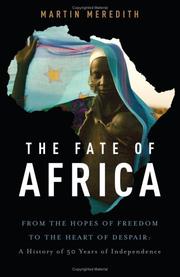
The fate of Africa
First published 2004. Subjects: Politics and government, Social conditions, Economic conditions, Politique et gouvernement, Conditions so...
Persuasions and performances
First published 1986. Subjects: Ethnology, Philosophy, Rites and ceremonies, Social life and customs, Symbolism.
Witchcraft, Oracles and Magic Among the Azande
Foundational work on African witchcraft beliefs and social accusation.
Endnotes
1.
Source: digital.csic.es
Link:https://digital.csic.es/handle/10261/81458?locale=en
Source snippet
the Ekong Case in Equatorial GuineaThe ekong is a relatively modem notion of wilchcraft which is spread throughot large areas...
2.
Source: ecoi.net
Link:https://www.ecoi.net/en/document/2064771.html
Source snippet
IRB – Immigration and Refugee Board of Canada (Author): “Equatorial Guinea: Targeted ritual killings and dismemberment of children by sta...
3.
Source: estudiosafrohispanicos.files.wordpress.com
Link:https://estudiosafrohispanicos.files.wordpress.com/2013/05/eokenve-phdthesis.pdf
Source snippet
equatorial guinea 1927-1979: a new african traditionThe rise in witchcraft accusations that since the late 1930s affected Fang society...
4.
Source: dokumen.pub
Title: sorcery in the black atlantic 9780226645797
Link:https://dokumen.pub/sorcery-in-the-black-atlantic-9780226645797.html
Source snippet
It is there that the witches would put their victims to work on their invisible plantations. Among the Douala, this form of witchcraft is...
5.
Source: dokumen.pub
Link:https://dokumen.pub/the-intestines-of-the-state-youth-violence-and-belated-histories-in-the-cameroon-grassfields-9780226026138.html
Source snippet
form of witchcraft involving enslavement or forced labor have also replaced a...
6.
Source: justice.gov
Link:https://www.justice.gov/file/278901/dl?inline=
Source snippet
religious tolerance among members of different religious groups, there were several reported mob... witchcraft during the period covered...
7.
Source: icj.org
Title: International Commission of Jurists
Link:https://www.icj.org/wp-content/uploads/1979/01/Equatorial-Guinea-fair-trial-trial-observation-report-1979-eng.pdf
8.
Source: Wikipedia
Title: Francisco Macías Nguema
Link:https://en.wikipedia.org/wiki/Francisco_Mac%C3%ADas_Nguema
9.
Source: 2021-2025.state.gov
Title: U.S. Department of State Equatorial Guinea
Link:https://2021-2025.state.gov/reports/2022-report-on-international-religious-freedom/equatorial-guinea/
10.
Source: Wikipedia
Title: Witch cult hypothesis
Link:https://en.wikipedia.org/wiki/Witch-cult_hypothesis
11.
Source: Wikipedia
Title: List of mass panic cases
Link:https://en.wikipedia.org/wiki/List_of_mass_panic_cases
12.
Source: Wikipedia
Title: Cargo cult
Link:https://en.wikipedia.org/wiki/Cargo_cult
13.
Source: Wikipedia
Title: Modern witch hunts
Link:https://en.wikipedia.org/wiki/Modern_witch_hunts
14.
Source: 2021-2025.state.gov
Link:https://2021-2025.state.gov/report/custom/dfca0e75a1/
15.
Source: 2021-2025.state.gov
Link:https://2021-2025.state.gov/report/custom/fe487727c3/
16.
Source: state.gov
Link:https://www.state.gov/report/custom/65626a20c4
17.
Source: 2021-2025.state.gov
Title: guinea bissau
Link:https://2021-2025.state.gov/reports/2021-report-on-international-religious-freedom/guinea-bissau/
18.
Source: 2021-2025.state.gov
Title: central african republic
Link:https://2021-2025.state.gov/reports/2023-report-on-international-religious-freedom/central-african-republic/
19.
Source: 2021-2025.state.gov
Link:https://2021-2025.state.gov/report/custom/4b02fd45e3/
20.
Source: 2021-2025.state.gov
Link:https://2021-2025.state.gov/reports/2022-report-on-international-religious-freedom/zambia/
21.
Source: 2021-2025.state.gov
Link:https://2021-2025.state.gov/reports/2020-report-on-international-religious-freedom/guatemala/
22.
Source: 2021-2025.state.gov
Link:https://2021-2025.state.gov/report/custom/6900445bb8/
23.
Source: 2021-2025.state.gov
Link:https://2021-2025.state.gov/reports/2021-report-on-international-religious-freedom/liberia/
24.
Source: 2021-2025.state.gov
Link:https://2021-2025.state.gov/reports/2023-report-on-international-religious-freedom/kenya/
25.
Source: 2021-2025.state.gov
Title: central african republic
Link:https://2021-2025.state.gov/reports/2017-report-on-international-religious-freedom/central-african-republic/
26.
Source: 2021-2025.state.gov
Link:https://2021-2025.state.gov/report/custom/a48a642035/
27.
Source: digital.csic.es
Link:https://digital.csic.es/browse?etal=10&null=&offset=404049&order=ASC&rpp=20&sort_by=1&type=title
28.
Source: digital.csic.es
Link:https://digital.csic.es/browse?authority=rp13718&etal=10&offset=216&order=ASC&rpp=20&sort_by=1&type=author
29.
Source: digital.csic.es
Link:https://digital.csic.es/bitstream/10261/41216/1/Marti_2010_Tattoo-cultural.pdf
30.
Source: digital.csic.es
Link:https://digital.csic.es/browse?authority=rp13718&etal=10&offset=201&order=ASC&rpp=20&sort_by=1&type=author
31.
Source: digital.csic.es
Link:https://digital.csic.es/browse?etal=45&null=&offset=408167&order=ASC&rpp=55&sort_by=1&type=title
32.
Source: imf.csic.es
Title: Memoria IMF 2009 2011
Link:https://www.imf.csic.es/wp-content/uploads/2022/11/Memoria_IMF_2009_2011.pdf
33.
Source: dokumen.pub
Link:https://dokumen.pub/memories-of-the-slave-trade-ritual-and-the-historical-imagination-in-sierra-leone-9780226764467.html
34.
Source: dokumen.pub
Link:https://dokumen.pub/bwiti-an-ethnography-of-the-religious-imagination-in-africa-9780691093901-9780691196282-9780691101224.html
35.
Source: ecoi.net
Link:https://www.ecoi.net/en/document/2091938.html
36.
Source: youtube.com
Title: FRANCISCO MACIAS NGUEMA: Africa’s scariest Dictator?
Link:https://www.youtube.com/watch?v=nRSpVi5PxW8
Source snippet
Equatorial Guinea...
37.
Source: youtube.com
Title: Equatorial Guinea
Link:https://www.youtube.com/watch?v=mOjjC8Xko9E
Source snippet
Nguema The dictator who executed husbands of his ex-wives, entire cabinet and his own family...
38.
Source: persee.fr
Title: Persée Christian Acculturation and Fang Witchcraft
Link:https://www.persee.fr/doc/cea_0008-0055_1961_num
Source snippet
PerséeChristian Acculturation and Fang Witchcraft - Persée...
39.
Source: blackpast.org
Title: francisco macias nguema 1924 1979
Link:https://blackpast.org/global-african-history/francisco-macias-nguema-1924-1979/
40.
Source: apnews.com
Link:https://apnews.com/article/d0e9fef2c7a7377da7b6f13acb097872
Source snippet
During his visit, the Pope denounced exploitation of African resources and inequality but stopped short of directly condemning the regime...
41.
Source: facebook.com
Link:https://www.facebook.com/groups/251840933405729/posts/1093470412576106/
42.
Source: icj.org
Link:https://www.icj.org/resource/the-trial-of-macias-in-equatorial-guinea-the-story-of-a-dictatorship/
43.
Source: journals.openedition.org
Link:https://journals.openedition.org/etudesafricaines/pdf/18023
44.
Source: journals.openedition.org
Link:https://journals.openedition.org/etudesafricaines/pdf/17982
45.
Source: hts.org.za
Link:https://hts.org.za/index.php/hts/article/view/5152/12196
Additional References
46.
Source: youtube.com
Link:https://www.youtube.com/watch?v=FFTnx7_rTg0
Source snippet
Macias Nguema - ruler of Equatorial Guinea...
47.
Source: govinfo.gov
Link:https://www.govinfo.gov/content/pkg/CPRT-110JPRT38274/html/CPRT-110JPRT38274.htm
48.
Source: jstor.org
Link:https://www.jstor.org/stable/4390798
Source snippet
Christian Acculturation and Fang Witchcraftby JW Fernández · 1961 · Cited by 31 — Witchcraft accusations and anti-witchcraft movemen...
49.
Source: researchgate.net
Link:https://www.researchgate.net/publication/236695018_Witch_Craze_Beyond_the_Legends_of_Panic
50.
Source: academia.edu
Link:https://www.academia.edu/10959074/Witchcraft_and_the_Colonial_Life_of_the_Fetish
51.
Source: normanmillerarchive.com
Link:https://normanmillerarchive.com/wp/wp-content/uploads/2018/08/Brief-Guide-to-the-Norman-Miller-Collection-06-23.pdf
52.
Source: everything-everywhere.com
Link:https://everything-everywhere.com/francisco-macias-nguema/
53.
Source: crazyalchemist.com
Link:https://www.crazyalchemist.com/bestiary/ngi/
54.
Source: instagram.com
Link:https://www.instagram.com/reel/C3ChuuDNRIz/?hl=zh-cn
55.
Source: facebook.com
Link:https://www.facebook.com/NTVKenya/posts/of-sects-and-doomsday-cults/927741495671732/
Topic Tree
Follow this branch
Related pages 192
- Antigua and Barbuda
- Argentina Belief Scares
- Azerbaijan Belief
- Bahrain Beliefs
- North Korea
- +187 more in sidebar