Within Niger
How a Fashion Festival Sparked a Moral Riot
Opposition to an international fashion festival became a wider attack on women, bars, churches and symbols of foreign influence.
On this page
- Why the festival became a public provocation
- How gender and urban change shaped the panic
- Why churches, bars and Bori sites were attacked
Page outline Jump by section
Introduction
In November 2000, opposition to an international fashion festival in Niger developed into one of the country’s clearest examples of an urban moral panic. What began as protests against the Second International Festival of African Fashion (FIMA) quickly expanded into attacks on bars, betting kiosks, churches, women seen as violating standards of modesty, and other symbols associated with foreign influence and moral decline. The unrest was not simply a dispute about clothing. It became a wider struggle over religion, gender, public space and the direction of Nigerien society at a time of political liberalisation and increasing religious activism. Historians generally interpret the violence as a case in which a cultural event acted as a trigger for much deeper anxieties rather than as the sole cause of the disorder.[Taylor & Francis Online]tandfonline.comTaylor & Francis OnlineAnatomy of a Riot: The Social Imaginary, Single Women, and Religious Violence in Niger: Canadian Journal of Africa…
Why the festival became a public provocation
The fashion festival was organised near Niamey between 9 and 12 November 2000 and aimed to promote African designers, tourism and cultural industries. Supported by international organisations and featuring prominent designers from across Africa and beyond, it projected an image of cosmopolitan modernity that contrasted sharply with the social conservatism of many Nigeriens.[Inter Press Service]ipsnews.netOpen source on ipsnews.net.
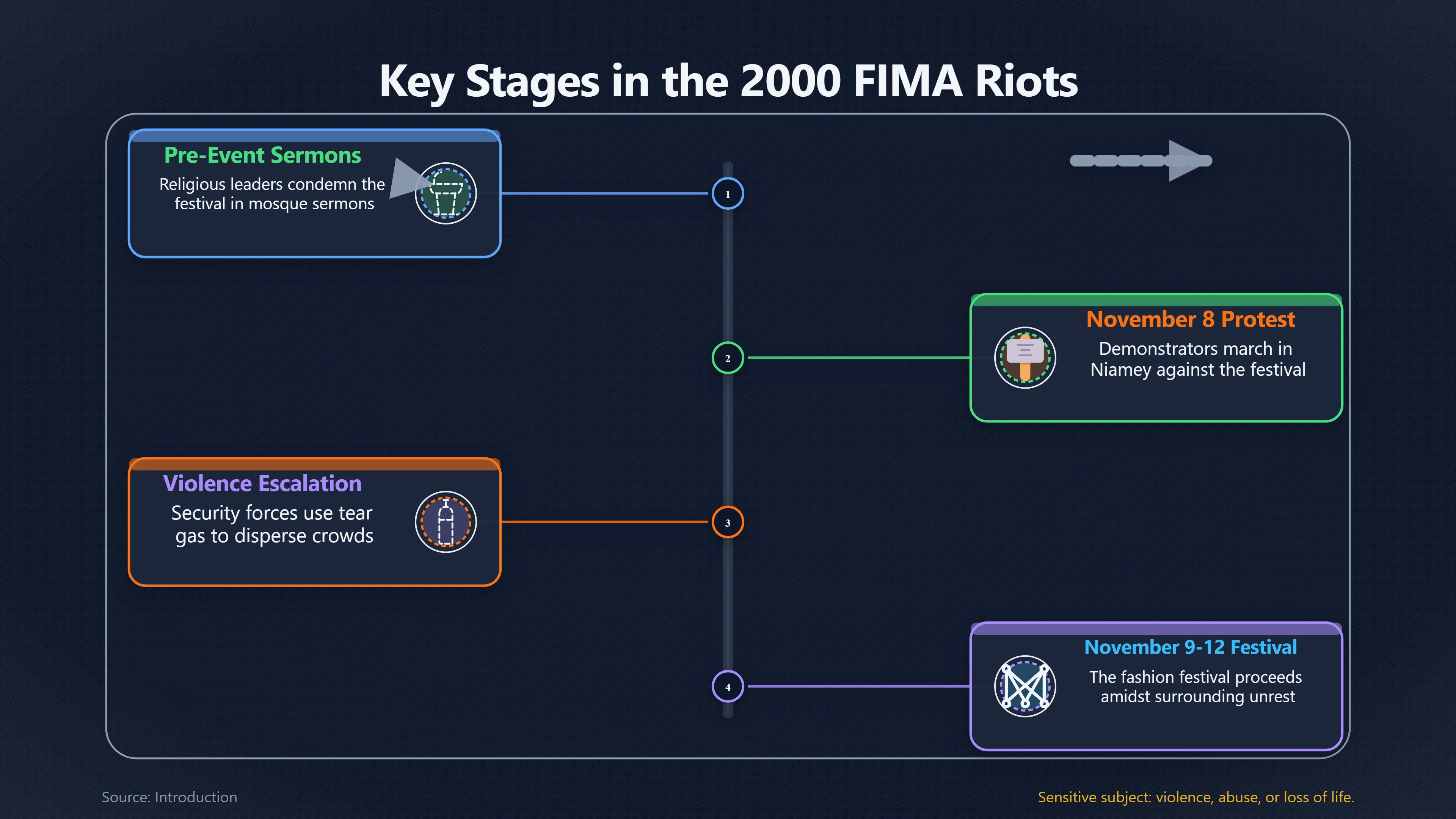
Opposition did not emerge spontaneously. In the days before the festival, religious leaders used mosque sermons and public meetings to condemn the event as incompatible with Islamic values. Critics argued that fashion shows featuring women in revealing clothing represented moral corruption, Western cultural influence and an attack on public decency. Some opponents also associated the festival with broader fears about homosexuality, prostitution and the erosion of religious authority.[Inter Press Service]ipsnews.netOpen source on ipsnews.net.
On 8 November demonstrators marched in Niamey against the festival. After security forces dispersed the protest with tear gas, violence spread into nearby neighbourhoods. Rather than targeting the festival itself, many protesters attacked places and people they regarded as representing immoral or foreign ways of life.[Inter Press Service]ipsnews.netOpen source on ipsnews.net.
How gender and urban change shaped the panic
The riots became a moral panic because the controversy rapidly expanded beyond the original event. The fashion festival came to symbolise a much wider set of fears about changing gender roles, urban life and Niger’s relationship with global culture.
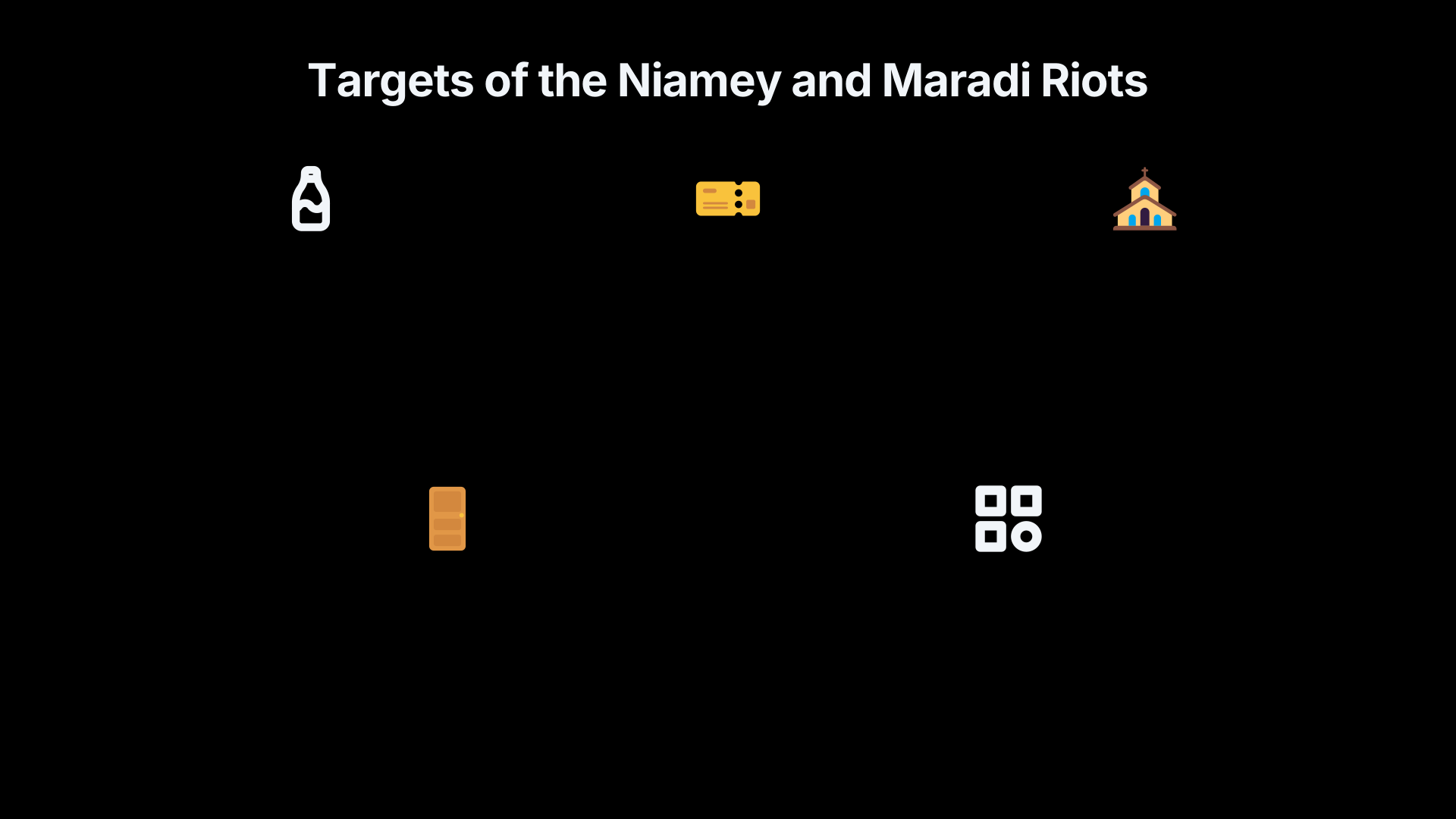
Historian Barbara Cooper argues that the violence reflected several overlapping transformations occurring in Niger at the same time. Democratic reforms during the 1990s had widened public debate, religious movements had become more politically active, and international donors were increasingly visible in state policy. The female body became the symbolic site on which these wider political struggles were fought.[Taylor & Francis Online]tandfonline.comTaylor & Francis OnlineAnatomy of a Riot: The Social Imaginary, Single Women, and Religious Violence in Niger: Canadian Journal of Africa…
Women, particularly unmarried women living independently in towns, became highly visible targets. Protesters harassed women wearing miniskirts or Western-style clothing because such dress was interpreted as evidence of moral decline rather than merely a fashion choice. The attacks therefore expressed attempts to police public behaviour as much as opposition to a single cultural event.[Inter Press Service]ipsnews.netOpen source on ipsnews.net.
The rapid spread of televised images also mattered. International models, luxury fashion and celebrity designers appeared on national broadcasts in a country where most people experienced very different economic realities. Researchers note that these striking visual contrasts intensified perceptions that foreign values were being publicly celebrated with official support.[ResearchGate]researchgate.netOpen source on researchgate.net.
Why churches, bars and Bori sites were attacked
One of the defining features of the unrest was that violence spread well beyond the fashion festival itself.
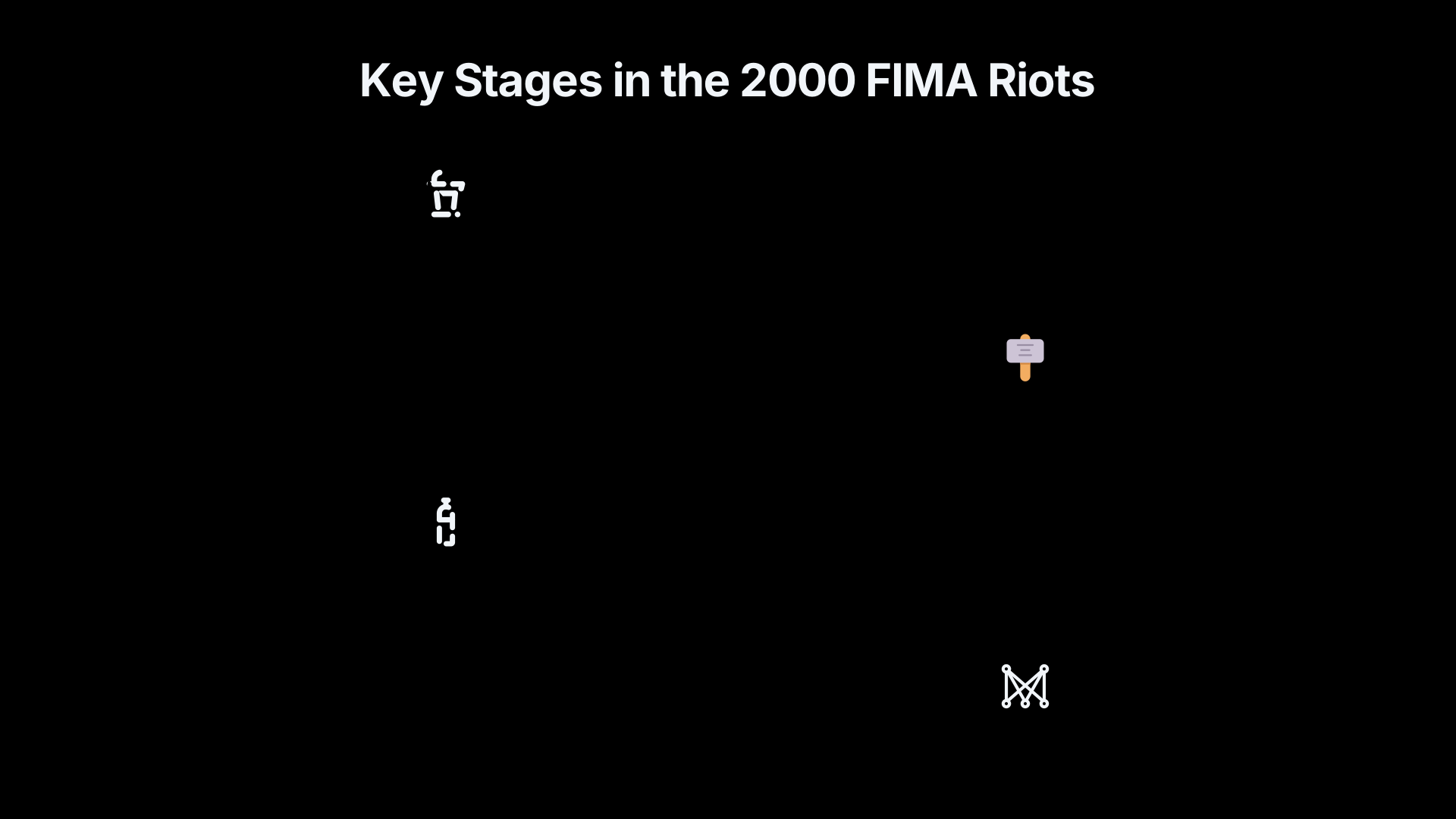
In both Niamey and Maradi, crowds attacked targets that symbolised what they regarded as moral disorder or undesirable outside influence. These included:
- bars and alcohol-related businesses;
- betting kiosks and gambling facilities;
- brothels and locations associated with prostitution;
- Christian churches and missionary property;
- in some accounts, symbols associated with Bori spirit-possession traditions, which some religious reformers regarded as incompatible with stricter forms of monotheistic Islam.[ipsnews.net]ipsnews.netOpen source on ipsnews.net.
Government figures reported the destruction of two churches, seven bars and twenty-six betting kiosks, while dozens of people were arrested. In Maradi, attacks damaged the Abundant Life Church and property belonging to the long-established missionary organisation SIM. Later US State Department reports likewise identified churches, bars and betting kiosks as principal targets of the riots.[ipsnews.net]ipsnews.netOpen source on ipsnews.net.
These targets reveal that the riots were driven by symbolic boundaries rather than direct opposition to fashion alone. Institutions associated with Christianity, gambling, alcohol and alternative religious practices all became grouped together within a broader narrative of moral corruption.
How authorities responded
The Nigerien government treated the disturbances as a serious public-order crisis. Security forces dispersed demonstrations, arrested large numbers of participants and subsequently banned several Islamist organisations that officials accused of encouraging the violence. The authorities justified the bans on the grounds that the organisations had disturbed public order, although supporters of those groups argued that the response was excessive.[ipsnews.net]ipsnews.netOpen source on ipsnews.net.
Religious leaders also responded in different ways. While some had strongly criticised the fashion festival beforehand, other Muslim figures publicly condemned the destruction that followed, illustrating that opposition to the event did not automatically imply support for mob violence.[Refworld]refworld.orgU.S. Department of State Annual Report on International Religious Freedom for 2001 - Niger | Refworld…
Why historians see a moral panic rather than a simple religious riot
Describing the events simply as a religious riot misses much of what made them distinctive.
Researchers argue that the protests acquired the classic features of a moral panic. A highly visible cultural event became a symbol for a much broader collection of fears, including:
- declining public morality;
- changing roles for women;
- foreign cultural influence;
- the authority of secular government;
- competition between different religious movements;
- uncertainty created by democratisation and expanding media.[Taylor & Francis Online]tandfonline.comTaylor & Francis OnlineAnatomy of a Riot: The Social Imaginary, Single Women, and Religious Violence in Niger: Canadian Journal of Africa…
Instead of remaining focused on the organisers of FIMA, anger spread towards a wide range of people and institutions that had only indirect connections with the festival. The violence therefore reflected an expanding social narrative in which diverse targets were treated as belonging to a single moral threat.
This interpretation also helps explain why attacks occurred hundreds of kilometres apart in both Niamey and Maradi. Shared sermons, media coverage and public discussion allowed similar fears to circulate rapidly through urban networks before being expressed in locally specific ways.[ResearchGate]researchgate.netOpen source on researchgate.net.
Why the riots remain significant
The 2000 fashion festival riots remain one of the most important case studies for understanding collective fear and moral mobilisation in Niger.
They demonstrate how disputes over culture can become vehicles for wider struggles over religion, national identity and social change. Rather than illustrating irrational mass hysteria in a narrow psychological sense, the riots show how genuine political, religious and cultural anxieties can combine with rumours, emotionally charged symbolism and crowd dynamics to produce rapidly escalating violence.
For historians of Niger, the episode continues to stand as an example of how debates over women’s visibility, public morality and foreign influence can move beyond peaceful protest into attacks on symbolic targets, making it one of the country’s clearest documented episodes of urban moral panic.[tandfonline.com]tandfonline.comTaylor & Francis OnlineAnatomy of a Riot: The Social Imaginary, Single Women, and Religious Violence in Niger: Canadian Journal of Africa…
Amazon book picks
Further Reading
Books and field guides related to How a Fashion Festival Sparked a Moral Riot. Use these as the next step if you want deeper reading beyond the article.
The beauty myth : how images of beauty are used against women
Explores tensions over women's appearance and social expectations.


Africa: A Biography of the Continent
Provides regional political and cultural background.

Endnotes
1.
Source: africabib.org
Link:https://www.africabib.org/rec.php?RID=274597926
Source snippet
AfricaBib | Anatomy of a Riot: The Social Imaginary, Single Women, and Religious Violence in Niger...
2.
Source: researchgate.net
Link:https://www.researchgate.net/publication/261696399_Anatomy_of_a_Riot_The_Social_Imaginary_Single_Women_and_Religious_Violence_in_Niger
3.
Source: researchgate.net
Title: Research Gate(PDF) Crude Moves: Political Power in Oil-Age Niger
Link:https://www.researchgate.net/publication/381297433_Crude_Moves_Political_Power_in_Oil-Age_Niger
4.
Source: refworld.org
Link:https://www.refworld.org/reference/annualreport/usdos/2002/en/37925
Source snippet
U.S. Department of State Annual Report on International Religious Freedom for 2002 - Niger | Refworld...
5.
Source: refworld.org
Link:https://www.refworld.org/reference/annualreport/usdos/2001/29330
Source snippet
U.S. Department of State Annual Report on International Religious Freedom for 2001 - Niger | Refworld...
6.
Source: refworld.org
Link:https://www.refworld.org/reference/annualreport/usdos/2002/en/25938
Source snippet
U.S. Department of State Country Report on Human Rights Practices 2001 - Niger | Refworld...
7.
Source: researchgate.net
Link:https://www.researchgate.net/publication/353405319_%27Rapping_Islam%27_The_Nigerien_music_scene_and_the_challenges_of_religious_reformism
Source snippet
Based on the individual career paths of several Nigéri en musicians, the objective here is to understand, in the light of professional an...
8.
Source: refworld.org
Link:https://www.refworld.org/reference/annualreport/usdos/2000/en/25538
9.
Source: 2009-2017.state.gov
Link:https://2009-2017.state.gov/j/drl/rls/irf/2003/23744.htm
10.
Source: researchgate.net
Link:https://www.researchgate.net/publication/275097447_The_Protests_against_Charlie_Hebdo_in_Niger_A_Background_Analysis
11.
Source: tandfonline.com
Link:https://www.tandfonline.com/doi/abs/10.1080/00083968.2003.10751276
Source snippet
Taylor & Francis OnlineAnatomy of a Riot: The Social Imaginary, Single Women, and Religious Violence in Niger: Canadian Journal of Africa...
12.
Source: ipsnews.net
Link:https://www.ipsnews.net/2000/11/culture-niger-government-to-ban-islamic-groups-opposed-to-fashion-festival/
Additional References
13.
Source: cambridge.org
Link:https://www.cambridge.org/core/journals/journal-of-modern-african-studies/article/abs/disordering-politics-urban-riots-and-the-sociopolitical-configuration-of-contemporary-niger/6584D48C9A33087D452310436BF3ED5B
Source snippet
Cambridge CoreJanuary 20, 2020 — DIS/ORDERING POLITICS: URBAN RIOTS AND THE SOCIO-POLITICAL CONFIGURATION OF CONTEMPORARY NIGER Published...
Published: January 20, 2020
14.
Source: youtube.com
Title: Anti-Charlie Hebdo protests claim more lives in Niger
Link:https://www.youtube.com/watch?v=-QkhyT70sDI
Source snippet
Six months after the anti-Charlie riots, the Franco-Nigerian cultural center in Zinder is still...
15.
Source: youtube.com
Title: Magician of the desert: Alphadi | Fashion Designer | V&A
Link:https://www.youtube.com/watch?v=cMpEa1tjm0s
Source snippet
Niger: 5 morts dans les manifs anti-Charlie Hebdo à Niamey...
16.
Source: youtube.com
Title: Niger: 5 morts dans les manifs anti-Charlie Hebdo à Niamey
Link:https://www.youtube.com/watch?v=9L89hLxXih0
Source snippet
Anti-Charlie Hebdo protests claim more lives in Niger...
17.
Source: hrw.org
Link:https://www.hrw.org/reports/2003/nigeria0703/1.htm
18.
Source: hrw.org
Link:https://www.hrw.org/reports/2003/nigeria0703/6.htm
19.
Source: cath.ch
Link:https://www.cath.ch/newsf/niger-sept-organisations-islamistes-interdites-apres-les-emeutes-contre-le-fima/
20.
Source: youtube.com
Title: ENTERTAINMENT DAILY: ENT1- NIGER FASHION PT1
Link:https://www.youtube.com/watch?v=ea3hDk4S3m0
Source snippet
Magician of the desert: Alphadi | Fashion Designer | V&A...
21.
Source: youtube.com
Link:https://www.youtube.com/watch?v=ub-xPNBAUcI
22.
Source: safetylit.org
Link:https://www.safetylit.org/citations/index.php?citationIds%5B%5D=citjournalarticle_292994_38&fuseaction=citations.viewdetails
Topic Tree