Within Norway's Collective Fears
Why Were Finnmark's Witch Trials So Deadly?
Finnmark's witch trials show how courts, coercion and shared supernatural beliefs turned disaster and suspicion into lethal prosecutions.
On this page
- How storms and misfortune became accusations
- Courts, torture and chain prosecutions
- Who was targeted and how Norway remembers them
Page outline Jump by section
Introduction
The Finnmark witch trials were the deadliest witch persecutions in Norwegian history and among the most intense in seventeenth-century Europe when measured against the region’s tiny population. Between about 1600 and 1692, more than 90 people were executed under Danish-Norwegian rule, with the worst outbreaks occurring in the coastal communities of eastern Finnmark between 1621 and 1663. These trials were not simply the result of popular superstition. They reveal how fear, official belief in witchcraft, coercive legal procedures and repeated accusations combined to create a self-sustaining machinery of persecution. Once courts accepted the idea that witches belonged to organised conspiracies serving the Devil, each confession generated new suspects, allowing prosecutions to spread through entire communities.[Store norske leksikon]snl.noStore norske leksikontrolldomsprosessene i Norge – Store norske leksikonJune 23, 2026…
How storms and misfortune became accusations
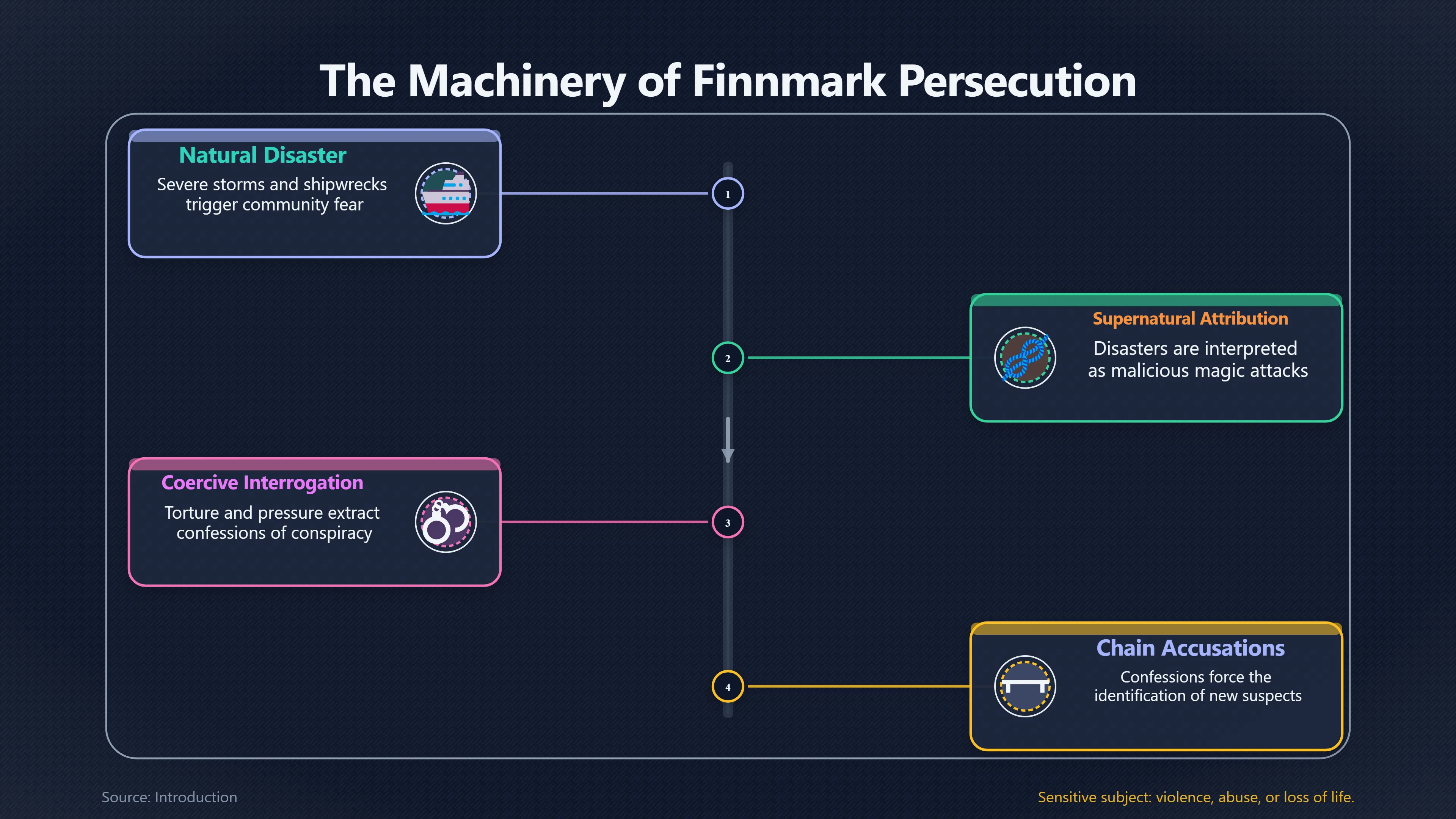
Finnmark’s economy depended on fishing in some of Europe’s most dangerous waters. Sudden storms, shipwrecks, failed catches and unexplained illness were part of everyday life, but they also demanded explanations in a society where supernatural forces were widely accepted as real. When disasters struck, neighbours could become suspects.
The most famous catalyst was the Christmas Eve storm of 1617. Around 40 fishermen drowned when an exceptionally violent storm overwhelmed boats off the coast. Several years later, during a major wave of prosecutions, women were accused of having magically raised the storm. According to confessions extracted during interrogation, witches had tied knots in ropes or otherwise manipulated the wind before releasing it to destroy the fleet. Such stories transformed a natural catastrophe into evidence of an organised supernatural attack on the community.[Store norske leksikon]snl.noStore norske leksikontrolldomsprosessene i Norge – Store norske leksikonJune 23, 2026…
This pattern repeated throughout the century. Livestock deaths, illnesses, spoiled food, damaged boats or unusual weather could all be interpreted as malicious magic if suspicion already surrounded an individual. The legal system did not merely record these beliefs; it reinforced them by treating them as plausible criminal allegations.
Courts, torture and chain prosecutions
The distinctive feature of the Finnmark trials was not simply belief in witchcraft but the way legal institutions converted suspicion into expanding prosecutions.
Officials worked within a European demonological framework that portrayed witches as members of a hidden network allied with Satan. Courts therefore expected accused people to confess not only to harmful magic but also to meetings with the Devil, flights through the air and participation in collective gatherings. Once this expectation became embedded in investigations, each confession became evidence against others.
Several mechanisms drove this process:
- Psychological pressure and torture: Although torture was legally restricted, it was employed in major Finnmark prosecutions, particularly when authorities sought complete confessions or the names of accomplices.
- The water ordeal: Suspects were bound and thrown into water. Floating was interpreted as proof that holy water rejected a witch, while sinking supposedly demonstrated innocence. The procedure was both dangerous and irrational, yet in Finnmark it became an accepted investigative tool. Roughly one-third of those executed there underwent the ordeal, and none escaped conviction after failing it.[Store norske leksikon]snl.noStore norske leksikonvannprøven – Store norske leksikonJune 23, 2026…
- Demand for accomplices: Courts rarely accepted an isolated confession. Accused people were expected to identify other witches, producing expanding chains of accusations.
- Acceptance of impossible testimony: Claims of meetings with Satan, magical travel and collective ceremonies were treated as evidence rather than fantasy or statements produced under coercion.
The result was a system in which investigations naturally expanded. Every execution created pressure for further arrests because authorities believed they were uncovering an organised conspiracy rather than isolated offences.
The 1662–63 mass prosecution
The most notorious example came during the winter of 1662–63 in eastern Finnmark. Within only a few months at least 19 women were condemned and executed.
Interrogations produced remarkably similar narratives. The accused described gatherings on the mountain of Domen outside Vardø, where Satan supposedly appeared, played a red violin and presided over dances and feasts. Modern historians regard these repeated stories as products of coercive questioning shaped by officials’ expectations rather than independent eyewitness testimony. Similar demonological imagery appeared across Europe because interrogators often steered suspects towards accepted ideas about witchcraft.[Store norske leksikon]snl.noStore norske leksikontrolldomsprosessene i Norge – Store norske leksikonJune 23, 2026…
The speed of the prosecutions illustrates how the machinery functioned. Confession led to accusation; accusation justified arrest; arrest produced further confessions under pressure; and each new statement reinforced official confidence that an enormous conspiracy was being uncovered.
Who was targeted?
Although both women and men appeared in Finnmark’s witch trials, the persecution was highly uneven.
Most of those executed in eastern Finnmark were Norwegian-speaking coastal women. In contrast, prosecutions in western Finnmark more often involved Sámi men accused because outsiders associated Sámi healing traditions, ritual knowledge and relationships with the landscape with supernatural power. Historians therefore see the trials as reflecting several overlapping prejudices rather than a single campaign against one community.[Store norske leksikon]snl.noStore norske leksikontrolldomsprosessene i Norge – Store norske leksikonJune 23, 2026…
Those who became vulnerable often shared characteristics such as:
- Living on the margins of small communities.
- Having difficult personal relationships or damaged reputations.
- Being widowed or economically insecure.
- Already being known for healing, folk remedies or unusual behaviour.
- Becoming associated with earlier accusations through family or neighbourhood connections.
Gender nevertheless remained the strongest overall pattern. During the worst periods virtually any woman in the fishing settlements of eastern Finnmark could become vulnerable once suspicion began to circulate.[Store norske leksikon]snl.noStore norske leksikontrolldomsprosessene i Norge – Store norske leksikonJune 23, 2026…

Why Finnmark became exceptionally lethal
Many European regions believed in witchcraft without producing persecution on Finnmark’s scale. Historians therefore emphasise the interaction of several factors rather than any single cause.
The region combined severe environmental insecurity with frontier politics. Danish-Norwegian authorities sought stronger religious discipline and administrative control in the far north at the same time that Lutheran ideas about diabolical conspiracies were spreading among educated officials.
Finnmark’s small settlements also amplified accusations. In communities where nearly everyone knew one another, rumours spread quickly, and accusations carried enormous social weight. Once courts accepted chain accusations, there were relatively few social barriers preventing investigations from engulfing whole neighbourhoods.
Legal procedure proved decisive. Modern scholarship consistently argues that torture, coercive interrogation and extraordinary evidential standards were among the principal reasons the Finnmark trials became so destructive. Without these judicial practices, isolated suspicions would have been far less likely to develop into large-scale persecutions.[Store norske leksikon]snl.noStore norske leksikonvannprøven – Store norske leksikonJune 23, 2026…

How Norway remembers the victims
Today the Finnmark trials are remembered less as stories of witches than as examples of institutional injustice.
The most visible memorial is the Steilneset Memorial in Vardø, designed by architect Peter Zumthor with an art installation by Louise Bourgeois. Standing close to the historic execution site, it commemorates those killed during the seventeenth-century persecutions. The memorial deliberately combines historical documentation with a reflective space that encourages visitors to consider how fear, legal authority and prejudice can reinforce one another.[Taylor & Francis Online]tandfonline.comOpen source on tandfonline.com.
Digitised court records and continuing research by Norwegian historians have also shifted public understanding. Rather than treating the trials as colourful folklore, scholarship increasingly examines them as products of judicial systems, religious ideology, gender inequality and state power.
What the Finnmark trials reveal about collective persecution
The Finnmark witch trials demonstrate that persecution does not require irrational crowds alone. Popular fears became deadly because institutions validated them.
The courts accepted extraordinary claims, relied on coercive interrogation, interpreted disasters through a supernatural framework and demanded ever-expanding lists of accomplices. This combination created a feedback loop in which every confession strengthened belief in an invisible conspiracy.
For historians of collective fear, Finnmark therefore represents more than an episode of witch hunting. It shows how shared beliefs, official authority and flawed legal procedures can transform ordinary misfortune into organised persecution, leaving a legacy that remains central to Norway’s understanding of justice, memory and the dangers of institutionalised panic.
Amazon book picks
Further Reading
Books and field guides related to Why Were Finnmark's Witch Trials So Deadly?. Use these as the next step if you want deeper reading beyond the article.
The witch-hunt in early modern Europe
Directly contextualises the Finnmark persecutions.


Endnotes
1.
Source: snl.no
Title: Store norske leksikontrolldomsprosessene i Norge – Store norske leksikon
Link:https://snl.no/trolldomsprosessene_i_Norge
Source snippet
June 23, 2026...
Published: June 23, 2026
2.
Source: snl.no
Title: Store norske leksikontrolldomsprosessene – Store norske leksikon
Link:https://snl.no/trolldomsprosessene
Source snippet
trolldomsprosessene – Store norske leksikonApril 1, 2026 — TROLLDOMSPROSESSENE Artikkelen finnes i enkel versjon i Lille norske * Begreps...
Published: April 1, 2026
3.
Source: snl.no
Title: Store norske leksikonvannprøven – Store norske leksikon
Link:https://snl.no/vannpr%C3%B8ven
Source snippet
June 23, 2026...
Published: June 23, 2026
4.
Source: tandfonline.com
Link:https://www.tandfonline.com/doi/full/10.1080/23257962.2023.2255829
5.
Source: lille.snl.no
Title: notrolldomsprosessene i Norge – Lille norske leksikon
Link:https://lille.snl.no/trolldomsprosessene_i_Norge
Source snippet
19 kvinner ble dømt og brent på bålet løpet av noen måneder i 1662–1663. Tresnitt av Domen Av Hans Hansen Lilienskiold. Lisens: fri I kri...
6.
Source: snl.no
Title: trolldom – Store norske leksikon
Link:https://snl.no/trolldom
Source snippet
Tysk fremstilling fra 1555. Bålstraff Av R. Decker. Lisens: Falt i det fri (Public domain) Utover 1400- og...
7.
Source: snl.no
Title: heks – Store norske leksikon
Link:https://snl.no/heks
Source snippet
Tegning av Theodor Kittelsen. Trollkjerring Av Theodor Kittelsen. Lisens: Falt i det fri (Public domain) Image En såkalt vannprøve...
8.
Source: snl.no
Title: Trolldomsprosessen i Salem – Store norske leksikon
Link:https://snl.no/Trolldomsprosessen_i_Salem
9.
Source: tandfonline.com
Link:https://www.tandfonline.com/doi/abs/10.1080/03468755.2021.2014953
Additional References
10.
Source: youtube.com
Title: Witches of Scotland | Episode 65 | Anya Bergman
Link:https://www.youtube.com/watch?v=wt6kwDajy-I
Source snippet
Danish Witch Trials, Ghost Stories, and Modern Magic in Denmark...
11.
Source: youtube.com
Title: Danish Witch Trials, Ghost Stories, and Modern Magic in Denmark
Link:https://www.youtube.com/watch?v=gVuiWaAqh_4
Source snippet
Inside Denmark's witch hunt museum | AFP...
12.
Source: link.springer.com
Link:https://link.springer.com/book/9783032108197
Source snippet
Memorial and Feminicide | Springer Nature LinkSeptember 24, 2026 — STEILNESET MEMORIAL AND FEMINICIDE * Book * Sep 2026 OVERVIEW Editors...
Published: September 24, 2026
13.
Source: nb.no
Link:https://www.nb.no/historier-fra-samlingen/de-fatale-magiryktene-om-alenemoren-marit/
14.
Source: varangermuseum.no
Link:https://www.varangermuseum.no/fagomrader/trolldomsprosessene-i-finnmark/
15.
Source: theguardian.com
Title: Norway’s witch trials: the woman killed for a fatal storm | | The Guardian
Link:https://www.theguardian.com/news/2021/apr/27/norways-witch-trials-the-woman-killed-for-a-fatal-storm
16.
Source: researchgate.net
Title: 376110148 Trolldomsprosessene i Finnmark og Steilneset minnested Vardo
Link:https://www.researchgate.net/publication/376110148_Trolldomsprosessene_i_Finnmark_og_Steilneset_minnested_Vardo
17.
Source: iflscience.com
Title: The Deadly Storm That Lead To The Execution Of 91 Women | IFLScience
Link:https://www.iflscience.com/the-17th-century-deadly-storm-that-led-to-the-execution-of-91-witches-65834
18.
Source: smithsonianmag.com
Title: The Hidden History of Norway’s Finnmark Witchcraft Trials
Link:https://www.smithsonianmag.com/history/how-a-sudden-winter-storm-in-1617-sparked-the-deadliest-witchcraft-trials-in-norwegian-history-180987919/
19.
Source: coastcontemporary.no
Title: Liv Helene Willumsen / The Witchcraft trials in Finnmark
Link:https://coastcontemporary.no/archive/2022/dr-liv-helene-willumsen
Topic Tree