Within Qatar Panics
Why Qatar's Supermarkets Emptied Overnight
The sudden border closure created a real supply threat, while uncertainty and crowd behaviour drove residents to clear supermarket shelves.
On this page
- The supply shock behind the fear
- How crowd behaviour reinforced the rush
- What the episode reveals about rational panic
Page outline Jump by section
Introduction
When Saudi Arabia and several other neighbouring states imposed a blockade on Qatar on 5 June 2017, supermarket shelves emptied with remarkable speed. The scenes were striking, but they were not simply an example of irrational mass hysteria. Qatar depended on imports for around 90% of its food, and roughly 40% of those imports had travelled through its only land border with Saudi Arabia. When that border suddenly closed, residents faced a genuine supply shock combined with profound uncertainty about how long disruption might last.[IISS]iiss.orgQatar food insecurityQatar food insecurityAugust 21, 2017…
The resulting rush to supermarkets illustrates an important mechanism of collective behaviour. Real risk, incomplete information and visible crowd behaviour combined to create a wave of panic buying. The episode has since become a key example of how quickly anxiety can spread through a modern, highly connected society even when long-term shortages are ultimately avoided.
The supply shock behind the fear
The supermarket rush began within hours of the diplomatic crisis. Residents learned that Qatar’s only land crossing with Saudi Arabia had been closed and that transport links with several neighbouring countries were being suspended. Since many fresh foods, especially dairy products and poultry, entered the country overland, consumers immediately questioned whether supplies would continue.[The National]thenationalnews.comOpen source on thenationalnews.com.
Photographs from Doha showed stripped dairy shelves and shoppers filling trolleys with milk, bottled water, rice and other essentials. News reports described queues forming at major supermarkets while many consumers bought far more than they normally would.[The National]thenationalnews.comOpen source on thenationalnews.com.
Unlike many episodes of panic buying, the initial concern rested on a genuine logistical vulnerability:
- Qatar imported nearly nine-tenths of its food.[iiss.org]iiss.orgQatar food insecurityQatar food insecurityAugust 21, 2017…
- A substantial share of imports crossed the Saudi land border.
- Many fresh products relied on rapid overland transport rather than long-distance shipping.
- At the moment the blockade began, neither consumers nor retailers knew how quickly alternative routes could be organised.[IISS]iiss.orgQatar food insecurityQatar food insecurityAugust 21, 2017…
In other words, people were responding to an authentic disruption, even though many overestimated its likely duration.
How crowd behaviour reinforced the rush
The speed with which supermarket shelves emptied cannot be explained by supply disruption alone. Crowd psychology played an equally important role.
Panic buying is driven by a feedback loop. When shoppers encounter empty shelves, they often interpret them as evidence that shortages are imminent. Even those who initially intended to buy only normal quantities may begin purchasing extra food because they fear returning later to find nothing available.
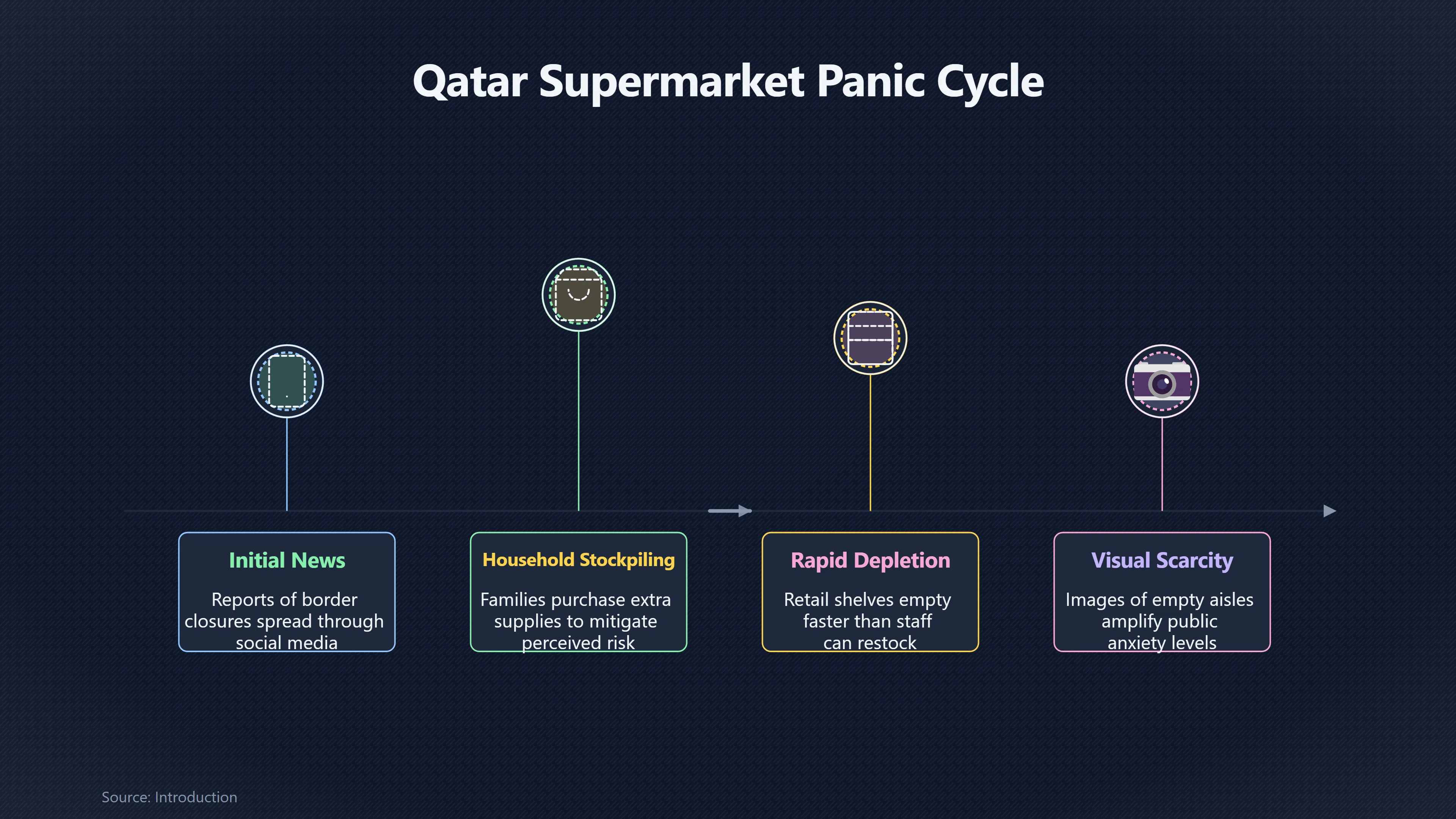
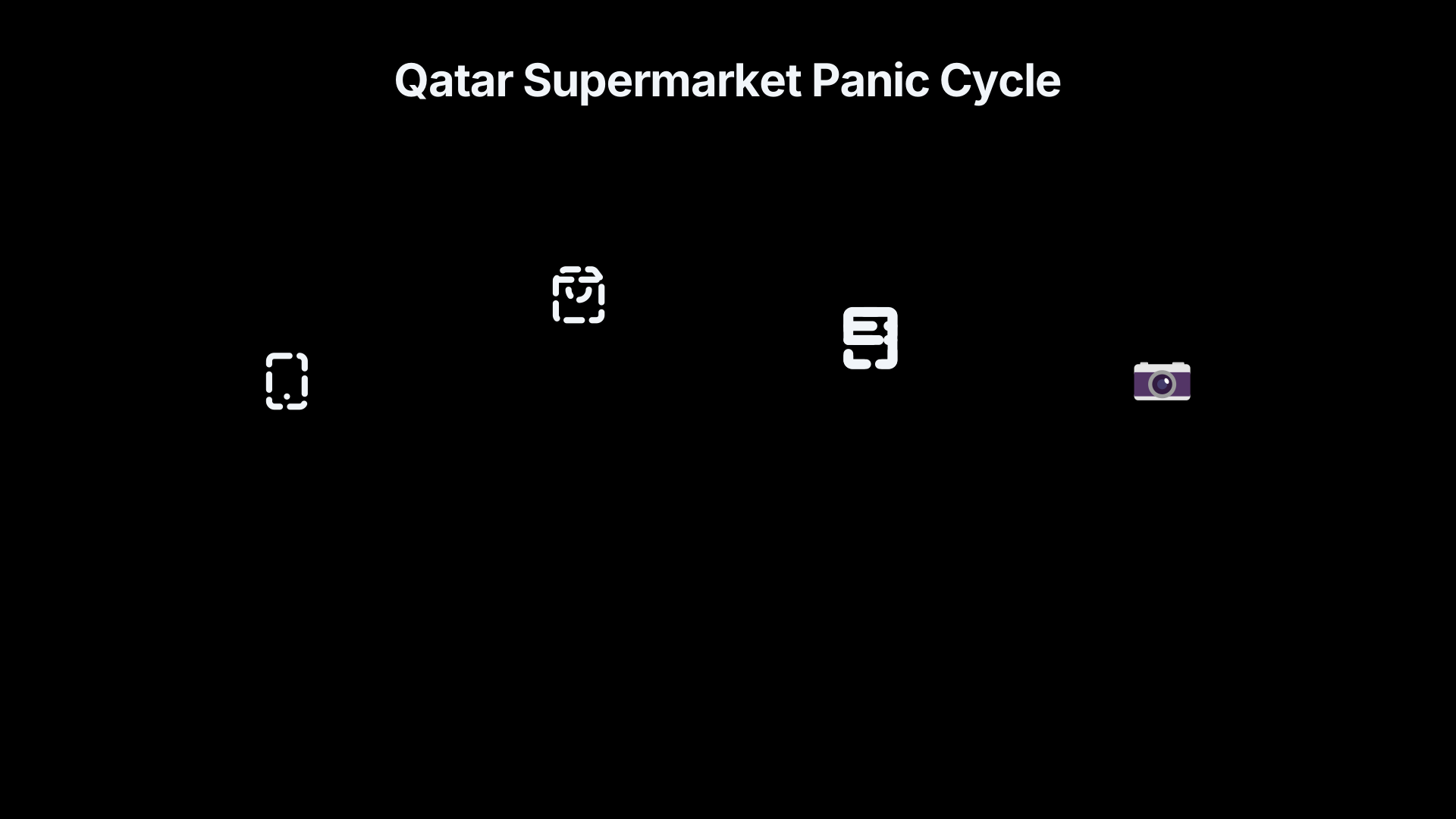
This creates a self-reinforcing cycle:
- News of potential shortages spreads.
- Some households buy additional supplies.
- Shelves empty faster than retailers can restock.
- Images of empty shelves circulate through news and social media.
- More people conclude they must stockpile immediately.
The visible scarcity therefore becomes more influential than the underlying supply position. Even where warehouses still contain inventory, retail shelves can appear empty because products are being purchased faster than staff can replenish them.
This mechanism has been documented repeatedly in behavioural research on disasters and supply disruptions, and the first days of the Qatar blockade closely matched that pattern. Media photographs of deserted dairy aisles became symbols of the crisis, further amplifying public concern.[thenationalnews.com]thenationalnews.comOpen source on thenationalnews.com.
Why the panic faded relatively quickly
Although the initial supermarket rush was dramatic, it proved short-lived.
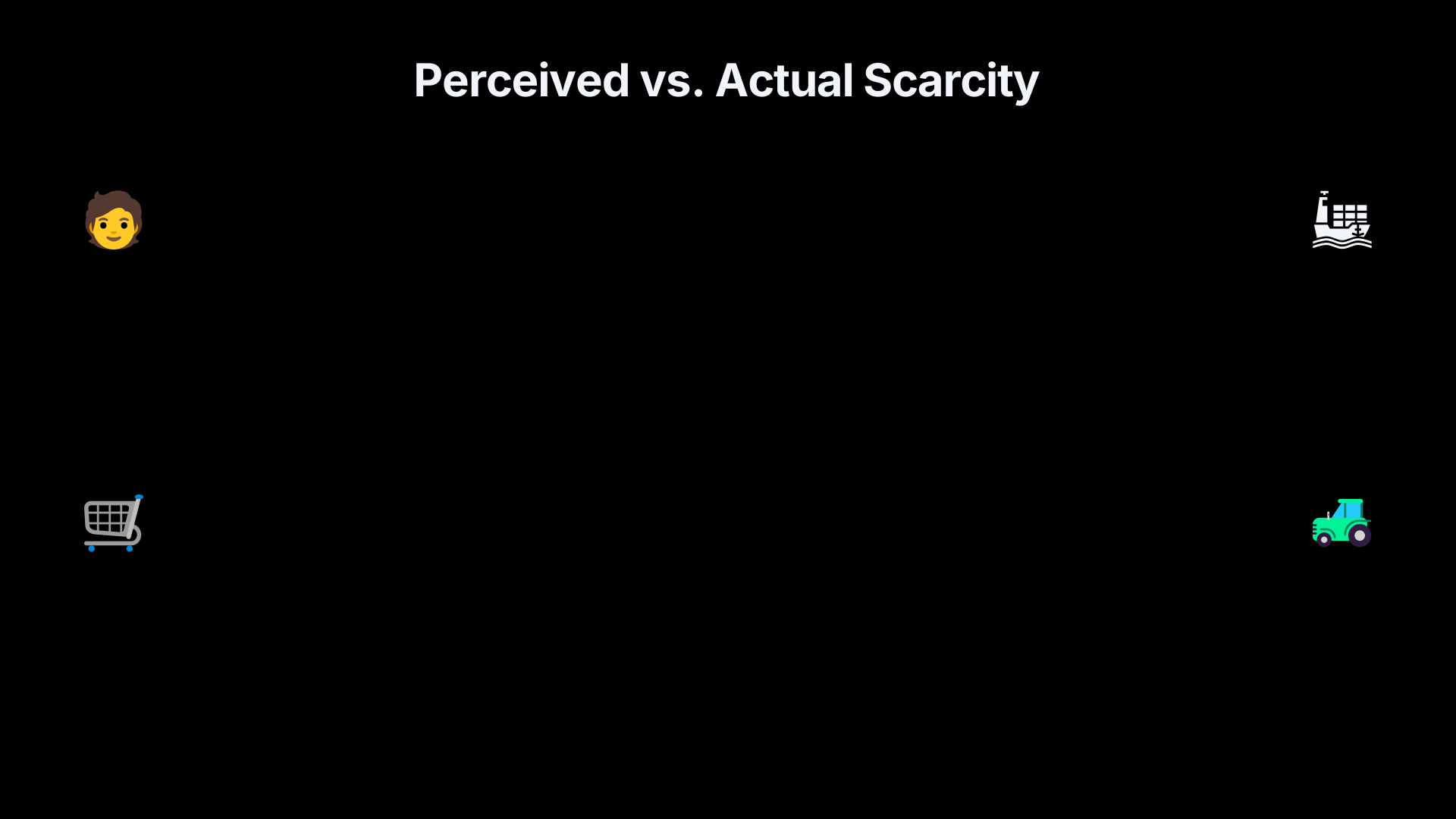
The Qatari government and private importers rapidly reorganised supply chains. New shipping routes were established, while Turkey and Iran quickly increased food exports to Qatar. Air freight also helped replace some perishable goods during the earliest phase of the crisis. Within days, many supermarket shelves had been replenished with products from different countries, even if familiar brands disappeared.[iiss.org]iiss.orgQatar food insecurityQatar food insecurityAugust 21, 2017…
The episode therefore demonstrates an important distinction between perceived scarcity and long-term scarcity. The immediate disruption was genuine, but Qatar’s financial resources, alternative trading partners and logistical capacity allowed it to replace many imports far faster than many residents had expected.
Over the following years, the blockade also accelerated investment in domestic food production, particularly dairy farming. Projects such as the rapid expansion of Baladna became widely cited as symbols of a broader drive for food security and reduced dependence on vulnerable import routes.[MDPI]mdpi.comDeveloping the Desert: How Qatar Achieved Dairy Self-Sufficiency Through BaladnaDeveloping the Desert: How Qatar Achieved Dairy Self-Sufficiency Through BaladnaDecember 22, 2024…
What the episode reveals about rational panic
The emptied supermarkets are often remembered as an example of “panic buying”, but that phrase can obscure the more complicated reality.
The first shoppers were reacting to credible information:
- a closed international border;
- interrupted transport routes;
- heavy national dependence on imported food; and
- uncertainty about government and commercial responses.
Those concerns were objectively reasonable. What became collectively inefficient was the scale of individual stockpiling. Once enough households began purchasing several weeks’ worth of food, normal retail distribution could no longer keep shelves full, creating shortages that were partly generated by consumer behaviour itself rather than by exhausted national supplies.
Social scientists sometimes describe this as rational behaviour producing collectively irrational outcomes. Each household attempts to reduce its own risk, yet the combined effect makes visible shortages more likely.
The Qatar case therefore occupies an important middle ground between genuine emergency and pure rumour. Unlike a moral panic or conspiracy scare, the triggering event was real. Unlike a prolonged famine, however, the worst fears did not materialise because supply systems adapted quickly.
Why the supermarket rush still matters
The blockade panic remains culturally significant because it exposed the psychological side of food security.
It demonstrated that modern supply chains depend not only on infrastructure but also on public confidence. Even wealthy countries with substantial purchasing power can experience temporary supermarket shortages if consumers lose confidence in the continuity of supply.
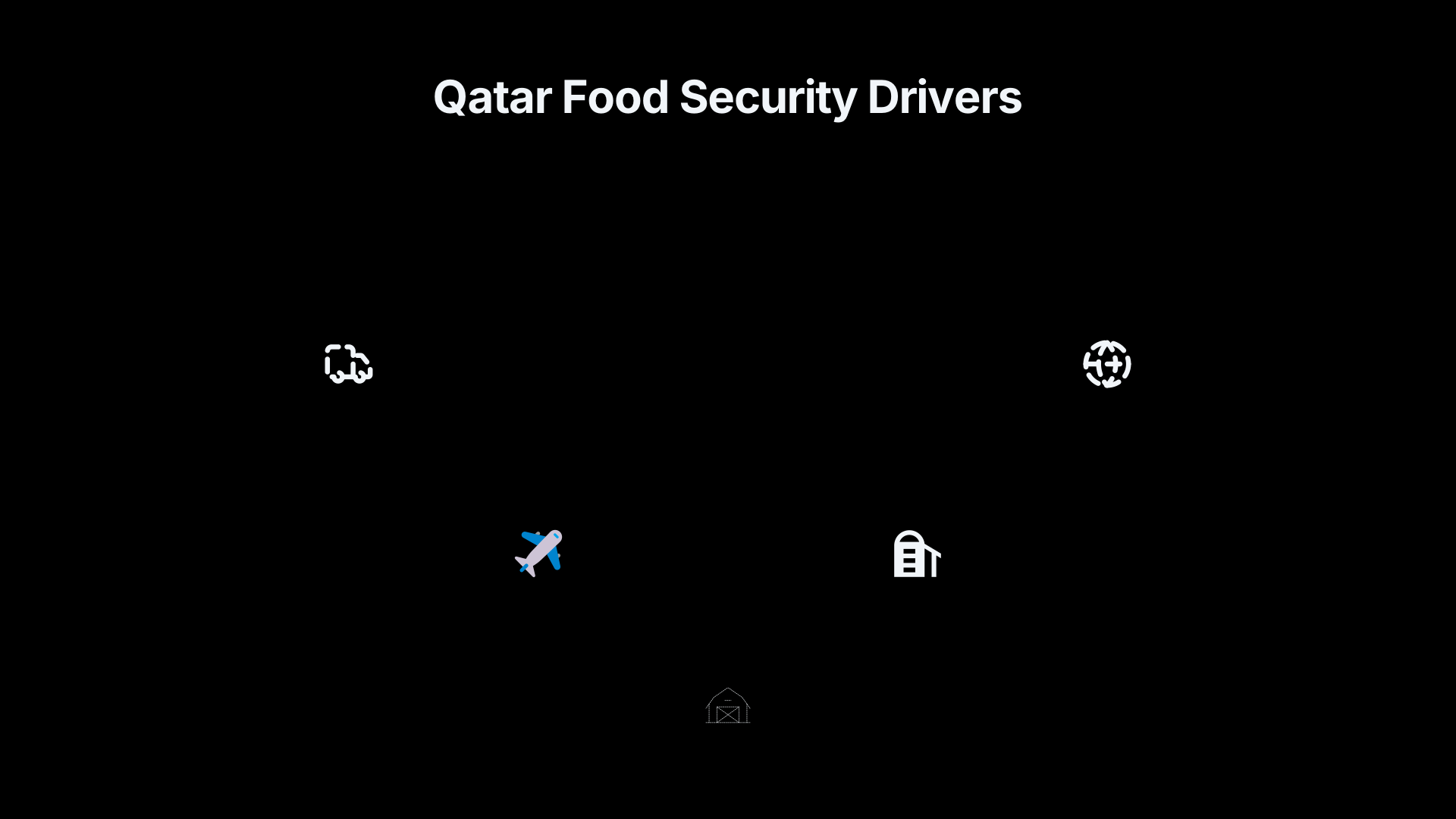
The experience also reshaped Qatar’s approach to resilience. Food security moved higher on the national agenda, with greater emphasis on diversified import routes, strategic reserves and expanded domestic production. Academic studies now frequently use the 2017 blockade as a case study in how geopolitical shocks reveal hidden vulnerabilities while also stimulating long-term adaptation.[edu.qa]elmi.hbku.edu.qaOpen source on edu.qa.
Within the wider history of collective fear in Qatar, the supermarket panic stands apart from conspiracy theories, supernatural beliefs or moral panics. It shows how uncertainty alone—combined with visible evidence of other people’s fear—can spread rapidly through ordinary consumer behaviour, even when the underlying crisis proves far more manageable than first imagined.
Amazon book picks
Further Reading
Books and field guides related to Why Qatar's Supermarkets Emptied Overnight. Use these as the next step if you want deeper reading beyond the article.
Extraordinary Popular Delusions and the Madness of Crowds
Rating: 4.0/5 from 5 Google Books ratings
Classic work on crowd behaviour and social contagion.

The Psychology of Pandemics
Explains panic buying and collective responses to uncertainty.

The Fear Factor: How One Emotion Connects Altruists, Psychopa...
Explores how fear shapes human decisions.
Endnotes
1.
Source: iiss.org
Title: Qatar food insecurity
Link:https://www.iiss.org/online-analysis/online-analysis/2017/08/qatar-food-insecurity/
Source snippet
Qatar food insecurityAugust 21, 2017...
Published: August 21, 2017
2.
Source: mdpi.com
Title: Developing the Desert: How Qatar Achieved Dairy Self-Sufficiency Through Baladna
Link:https://www.mdpi.com/2071-1050/16/24/11262
Source snippet
Developing the Desert: How Qatar Achieved Dairy Self-Sufficiency Through BaladnaDecember 22, 2024...
Published: December 22, 2024
3.
Source: mdpi.com
Title: Managing Food Imports for Food Security in Qatar
Link:https://www.mdpi.com/2227-7099/10/7/168
4.
Source: mdpi.com
Title: Impact of COVID-19 on Food Behavior and Consumption in Qatar
Link:https://www.mdpi.com/2071-1050/12/17/6973?type=check_update&version=1
5.
Source: thenationalnews.com
Link:https://www.thenationalnews.com/world/qatar-residents-rush-to-stock-up-food-supplies-as-border-closes-1.12571
6.
Source: theguardian.com
Link:https://www.theguardian.com/world/2017/jun/06/qatar-panic-buying-as-shoppers-stockpile-food-due-to-saudi-blockade
Source snippet
His comments shocked Qatar, a key US ally, and pleased Saudi Arabia, which has faced similar allegations. This support contrasted with th...
7.
Source: cbsnews.com
Title: CBS News Blockade hardship in Qatar? Not so much
Link:https://www.cbsnews.com/news/qatar-blockade-no-hardship/
Source snippet
CBS NewsBlockade hardship in Qatar? Not so much - CBS News...
8.
Source: elmi.hbku.edu.qa
Link:https://elmi.hbku.edu.qa/en/publications/food-security-strategy-to-enhance-food-self-sufficiency-and-overc/
9.
Source: research-portal.uea.ac.uk
Link:https://research-portal.uea.ac.uk/en/publications/a-rentier-state-under-blockade-qatars-water-energy-food-predicame/
10.
Source: journals.qu.edu.qa
Link:https://journals.qu.edu.qa/index.php/tajseer/article/view/3362
11.
Source: thenationalnews.com
Title: Full effects of sanctions on Qatar yet to take hold | The National
Link:https://www.thenationalnews.com/world/full-effects-of-sanctions-on-qatar-yet-to-take-hold-1.3369
12.
Source: theguardian.com
Link:https://www.theguardian.com/world/2017/jun/06/qatar-crisis-share-stories-of-life-as-the-blockade-takes-effect
13.
Source: researchportal.hbku.edu.qa
Link:https://researchportal.hbku.edu.qa/en/projects/food-security-and-migrant-workers-in-qatar-a-socio-economic-analy
Additional References
14.
Source: doi.org
Link:https://doi.org/10.3390/systems14010046
Source snippet
METHODOLOGY This study employs a qualitative longitudinal case-study design to analyze the evolution of Qatar’s food security strategies...
15.
Source: youtube.com
Title: Gulf Crisis: Border closure forcing Qatar to import food by air
Link:https://www.youtube.com/watch?v=MJ8cVmctvb4
Source snippet
Cows in the Desert? Qatar's Billion-Dollar Food Gamble That Worked...
16.
Source: youtube.com
Title: Qatar: Beyond the Blockade | Featured Documentary
Link:https://www.youtube.com/watch?v=Dc6n31wIuHI
Source snippet
Man to airlift 4000 dairy cows into Qatar to bypass UAE/Saudi Arabia blockade...
17.
Source: youtube.com
Title: Cows in the Desert? Qatar’s Billion-Dollar Food Gamble That Worked
Link:https://www.youtube.com/watch?v=dja4LHAINaE
Source snippet
Qatar: Beyond the Blockade | Featured Documentary...
18.
Source: youtube.com
Title: DZMM Tele Radyo: OFW confirms panic buying in Qatar
Link:https://www.youtube.com/watch?v=d0eBe4cio8o
Source snippet
Gulf Crisis: Border closure forcing Qatar to import food by air...
19.
Source: chathamhouse.org
Link:https://www.chathamhouse.org/2019/11/how-qatars-food-system-has-adapted-blockade
20.
Source: thepeninsulaqatar.com
Link:https://thepeninsulaqatar.com/article/06/06/2017/Ministry-reassures-residents-Enough-stock-of-food-products-and-prices-to-remain-stable
21.
Source: sciencedirect.com
Link:https://www.sciencedirect.com/science/article/pii/S0272696315000601
22.
Source: globaljournals.org
Link:https://globaljournals.org/scholarly-articles/food-security-as-correlate-of-interstate-conflict-a-case-study-of-the-state-of-qatar/
23.
Source: abc.net.au
Title: Qatar in ‘chaos’ as Arab powers halt food supply to country amid diplomatic rift
Link:https://www.abc.net.au/news/2017-06-06/arab-powers-halt-food-supply-to-qatar-amid-gulf-diplomatic-rift/8593506
Topic Tree