Within Cape Verde
Why Were the Rabelados Treated as Dangerous?
The Rabelados defended older Catholic practices but were cast as backward rebels under Portuguese colonial rule.
On this page
- A Catholic dispute begins on Santiago
- How church conflict became colonial repression
- From feared rebels to cultural guardians
Page outline Jump by section
Introduction
The Rabelados are one of the most distinctive religious communities in Cape Verde, but they are often misunderstood. They did not emerge as a new religion or as an anti-Christian movement. Instead, they were rural Catholics on the island of Santiago who believed they were preserving authentic Catholic tradition after church authorities introduced reforms during the 1940s. What began as an internal dispute over religious authority gradually became a colonial security issue. Portuguese officials and parts of the Catholic hierarchy came to regard these isolated believers as stubborn, rebellious and potentially dangerous, even though their primary concern was defending inherited forms of worship rather than overthrowing the state. Their story illustrates how religious disagreement can become a wider social fear when political power, colonial rule and questions of loyalty become intertwined.[edu.br]repositorio.unilab.edu.brRepositório Institucional: Rabelados: fenômeno sócio religioso de Cabo VerdeNovember 29, 2016…
A Catholic dispute begins on Santiago
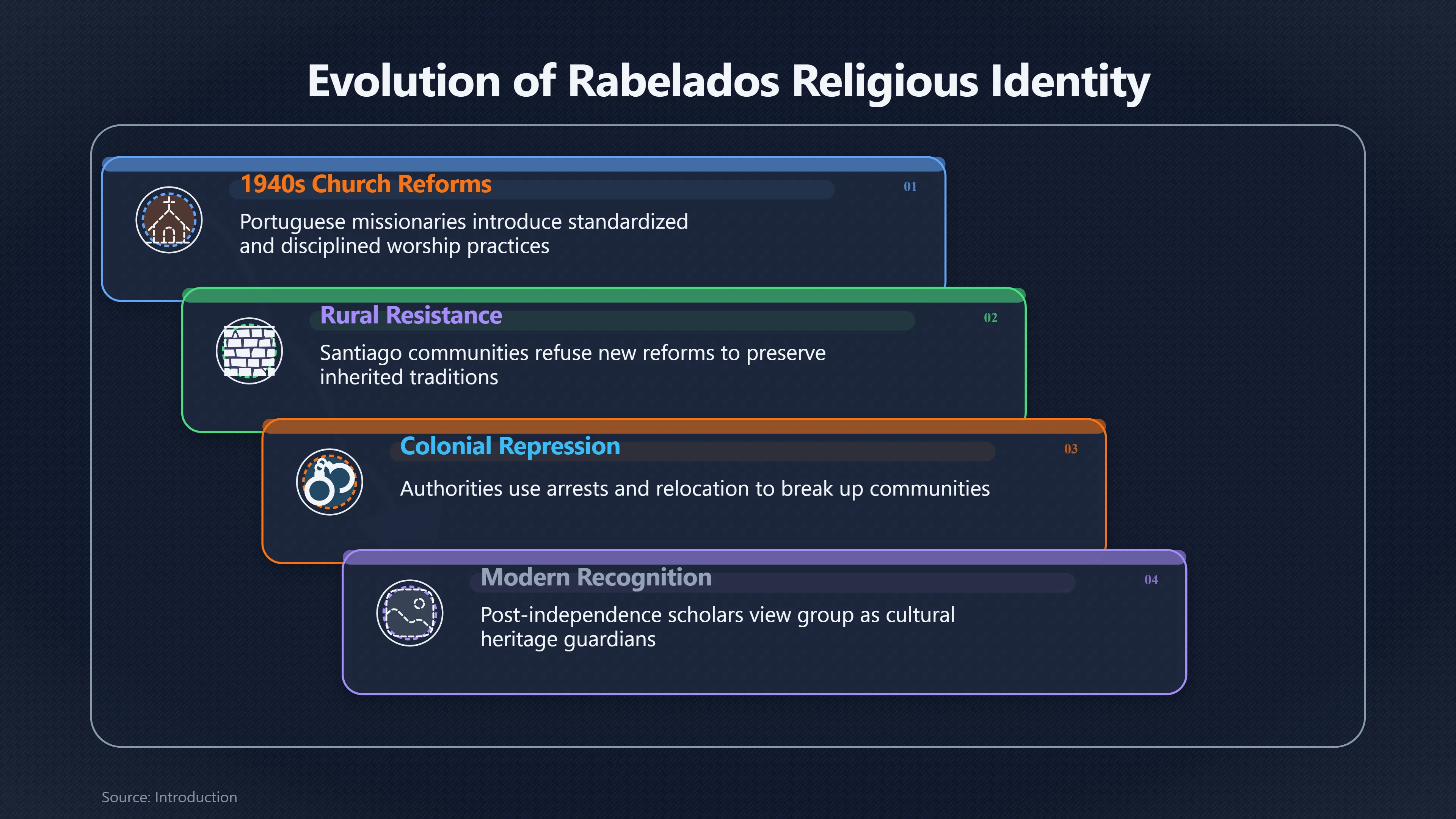
The origins of the Rabelados lie in changes introduced by the Catholic Church in Portuguese Cape Verde during the early 1940s. New missionaries arrived from Portugal and sought to standardise religious practice, replacing older local customs with forms of worship that church leaders considered more uniform and disciplined. These changes affected religious instruction, the celebration of Mass and the authority exercised by local clergy.[Cabo Verde]cabo-verde.cvCabo Verde The Rabelados of Santiago: Cape Verde’s Religious Rebels – Cabo VerdeCabo Verde The Rabelados of Santiago: Cape Verde’s Religious Rebels – Cabo Verde
Some rural communities on Santiago refused to accept these reforms. Rather than seeing themselves as innovators, they believed the opposite: that they were remaining faithful while church authorities had abandoned long-established practice. The name “Rabelados” derives from the Portuguese word for “rebels”, but this was a label applied because of their refusal to obey ecclesiastical authority rather than because they advocated political revolution.[Wikipedia]WikipediaOpen source on wikipedia.org.
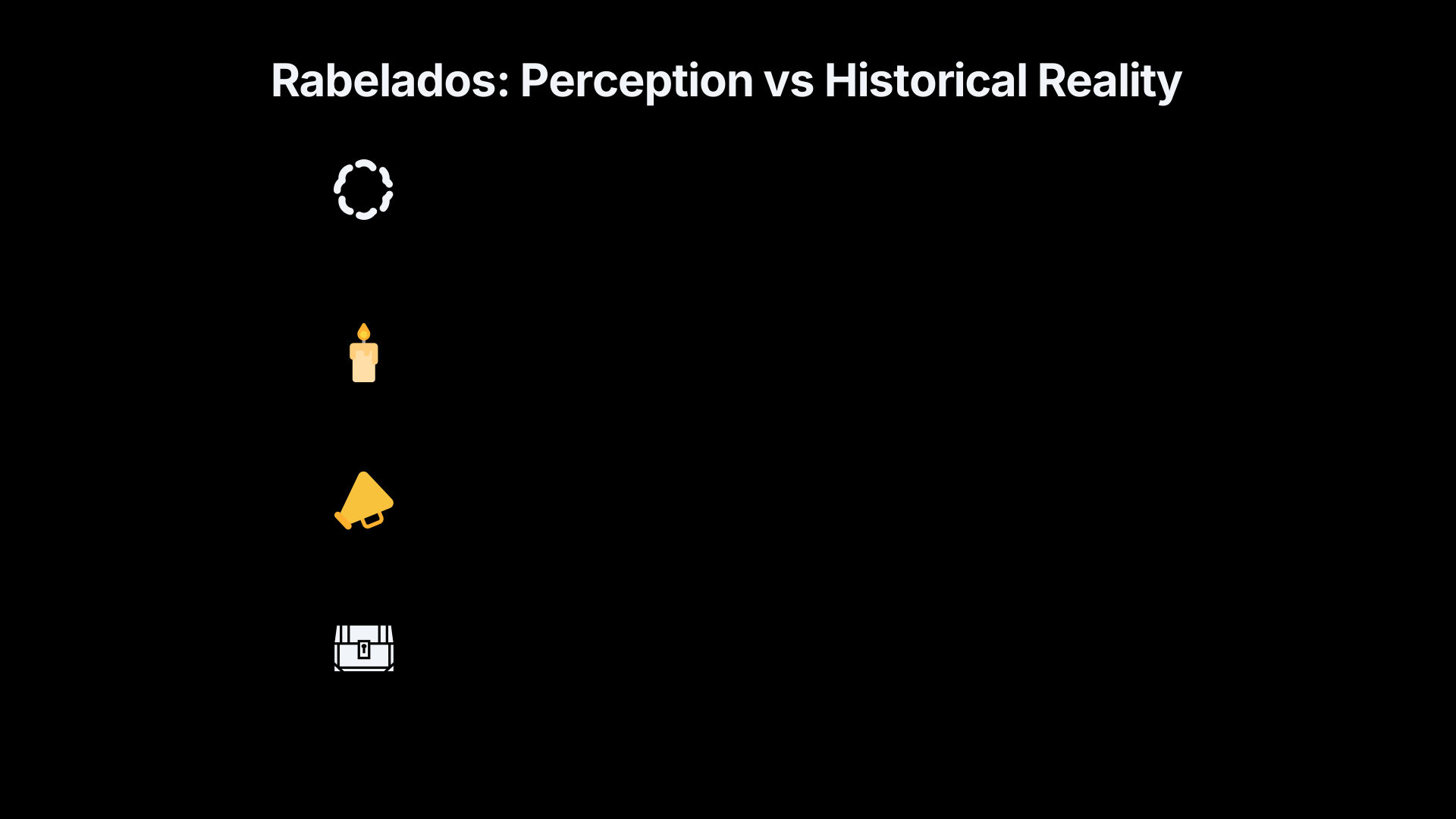
This distinction is important. The Rabelados remained deeply Catholic in belief. They preserved prayers, rituals and devotional practices that they regarded as the legitimate continuation of earlier Catholic tradition. Historians therefore generally describe the movement as a traditionalist Catholic community rather than an entirely separate religion.[repositorio.unilab.edu.br]repositorio.unilab.edu.brRepositório Institucional: Rabelados: fenômeno sócio religioso de Cabo VerdeNovember 29, 2016…
How church conflict became colonial repression
The dispute became far more serious because it unfolded under Portugal’s authoritarian colonial regime. Religious conformity and political stability were closely linked. Defying church authority could easily be interpreted by colonial officials as defying the colonial order itself.
Although the Rabelados were motivated primarily by religious conviction, officials increasingly portrayed them as socially disruptive. Their refusal to recognise newly appointed priests, their withdrawal from official religious life and their creation of semi-isolated communities encouraged suspicions that they represented a wider challenge to authority. The fear was not simply theological but political: any organised community operating outside recognised institutions could appear threatening in a colonial system that relied heavily on social control.[Inforpress]inforpress.cvOpen source on inforpress.cv.
The authorities responded with a mixture of coercion and social pressure. Historical accounts describe arrests, forced relocation to other islands, surveillance, public ridicule and efforts to break up the communities. Many families withdrew further into remote parts of Santiago, partly because isolation became one of the few ways to preserve their religious practices. Rather than eliminating the movement, repression strengthened its collective identity.[Wikipedia]WikipediaOpen source on wikipedia.org.
Unlike many episodes of religious panic, however, there is little evidence that the Rabelados posed a genuine organised political threat. Modern scholarship generally concludes that colonial fears exaggerated the danger by conflating religious nonconformity with political rebellion.[Inforpress]inforpress.cvOpen source on inforpress.cv.
Why the Rabelados were feared
The anxiety surrounding the Rabelados reflected several overlapping concerns rather than a single dramatic event.
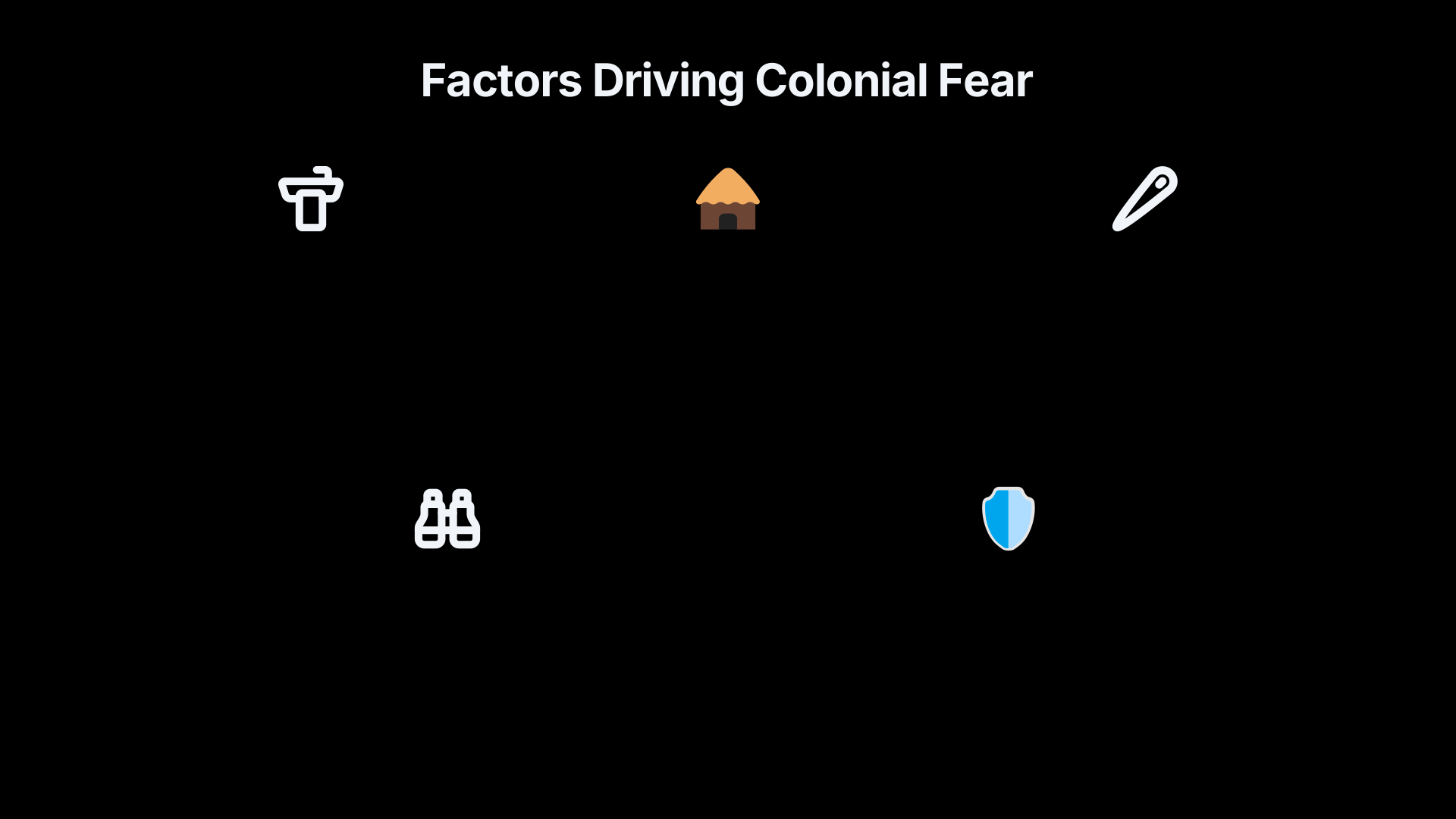
- Religious disobedience: Refusing the authority of bishops and newly appointed priests challenged the Church’s ability to impose uniform practice.
- Colonial control: Portuguese administrators viewed autonomous rural communities with suspicion because they lay outside normal channels of supervision.
- Cultural difference: Their distinctive clothing, rituals and social separation reinforced outside perceptions that they were strange or backward.
- Limited communication: Living in relatively isolated settlements encouraged rumours and misunderstanding, making outsiders more likely to imagine hidden intentions or dangerous beliefs than actually existed.[edu.br]repositorio.unilab.edu.brRepositório Institucional: Rabelados: fenômeno sócio religioso de Cabo VerdeNovember 29, 2016…
These factors created what historians recognise as a social scare rather than a case of mass hysteria. Fear spread not because of extraordinary supernatural claims or collective psychological contagion, but because religious dissent became interpreted through the language of colonial security and social order.
Were the Rabelados a “cult”?
Applying the label “cult” to the Rabelados is misleading. The term has often been used by outsiders to describe groups that reject mainstream institutions, but it obscures the historical reality.
The Rabelados did not introduce a radically new theology, predict an imminent apocalypse or organise around a charismatic prophet claiming unique revelation. Instead, they defended inherited Catholic customs and believed that official church reforms represented the true departure from orthodoxy. Their isolation resulted largely from conflict with church and colonial authorities rather than from a deliberate attempt to create an entirely separate religion.[edu.br]repositorio.unilab.edu.brRepositório Institucional: Rabelados: fenômeno sócio religioso de Cabo VerdeNovember 29, 2016…
Modern researchers therefore tend to describe them as a traditionalist Catholic community, a socio-religious movement or an example of popular Catholicism under colonial pressure, rather than using more sensational labels.[repositorio.unilab.edu.br]repositorio.unilab.edu.brINSTITUT O DE HUMANIDADES E LETRAS (IHLINSTITUTO DE HUMANIDADES E LETRAS (IHL)May 17, 2018…
From feared rebels to cultural guardians
Cape Verde’s independence transformed how the Rabelados were understood. As colonial interpretations lost authority, scholars, artists and cultural organisations increasingly re-examined the community’s history.
Rather than viewing them simply as obstinate rebels, many came to see them as preserving an important strand of Cape Verdean religious and cultural heritage. Researchers documented their oral traditions, music, communal organisation and distinctive artistic practices. Communities such as Espinho Branco gradually became known not only for their history of resistance but also for their contributions to Cape Verde’s cultural identity.[cabo-verde.cv]cabo-verde.cvCabo VerdeRabelados: a community that resists the changes of modernity – Cabo VerdeApril 19, 2024…
This shift did not erase the hardships experienced during the colonial period, but it changed the dominant public narrative. A community once associated with disorder and backwardness increasingly became recognised for its resilience and its determination to maintain traditions under sustained pressure.
Why the Rabelados remain important
The history of the Rabelados offers a valuable example of how minority religious communities can become objects of disproportionate fear without posing the threat imagined by authorities.
For readers interested in collective fears and contested beliefs, the episode illustrates several broader themes:
- religious disagreement can become politicised under authoritarian governments;
- labels such as “rebels” or “sects” often reflect the viewpoint of those in power rather than the community itself;
- social isolation may result from persecution as much as from deliberate separation; and
- later historical research can substantially revise earlier portrayals of supposedly dangerous groups.
Within Cape Verde’s history of religious conflict, the Rabelados therefore stand less as an example of mass hysteria than as a reminder that fears of religious rebellion are often shaped by political context as much as by the beliefs of the people being feared.[inforpress.cv]inforpress.cvOpen source on inforpress.cv.

Endnotes
1.
Source: repositorio.unilab.edu.br
Title: Repositório Institucional: Rabelados: fenômeno sócio religioso de Cabo Verde
Link:https://repositorio.unilab.edu.br/jspui/handle/123456789/661
Source snippet
November 29, 2016...
Published: November 29, 2016
2.
Source: cabo-verde.cv
Title: Cabo Verde The Rabelados of Santiago: Cape Verde’s Religious Rebels – Cabo Verde
Link:https://cabo-verde.cv/the-rabelados-of-santiago-cape-verdes-religious-rebels/
3.
Source: inforpress.cv
Link:https://www.inforpress.cv/en/livro-os-rebelados-da-ilha-de-santiago-resgata-estudo-confidencial-do-periodo-colonial
4.
Source: Wikipedia
Link:https://en.wikipedia.org/wiki/Rabelados
5.
Source: publication.codesria.org
Link:https://publication.codesria.org/index.php/pub/catalog/book/648
Source snippet
Os Rabelados de Santiago: Espinho Branco e Bacio: entre o "mito" de folclorizaçao e a (re)formulaçao identitaria | CODESRIA Boo...
6.
Source: repositorio.unilab.edu.br
Title: INSTITUT O DE HUMANIDADES E LETRAS (IHL)
Link:https://repositorio.unilab.edu.br/jspui/bitstream/123456789/661/1/2016_mono_esemedo.pdf
Source snippet
INSTITUTO DE HUMANIDADES E LETRAS (IHL)May 17, 2018...
Published: May 17, 2018
7.
Source: cabo-verde.cv
Link:https://cabo-verde.cv/rabelados-a-community-that-resists-the-changes-of-modernity/
Source snippet
Cabo VerdeRabelados: a community that resists the changes of modernity – Cabo VerdeApril 19, 2024...
Published: April 19, 2024
8.
Source: cabo-verde.cv
Title: Rabelados: una comunidad que resiste a los cambios de la modernidad – Cabo Verde
Link:https://cabo-verde.cv/es/rabelados-una-comunidad-que-resiste-a-los-cambios-de-la-modernidad/
Source snippet
* Rabelados: una comunidad que resiste a los cambios de la modernidad Image: Rabelados: una comunidad que resiste a los cambios de la mod...
9.
Source: cabo-verde.cv
Title: Rabelados: uma comunidade que resiste às mudanças da modernidade – Cabo Verde
Link:https://cabo-verde.cv/pt-pt/rabelados-uma-comunidade-que-resiste-as-mudancas-da-modernidade/
10.
Source: cabo-verde.cv
Link:https://cabo-verde.cv/fr/rabelados-une-communaute-qui-resiste-aux-changements-de-la-modernite/
11.
Source: youtube.com
Title: CABO VERDE
Link:https://www.youtube.com/watch?v=5CjEt01-aa4
Source snippet
Rebelados no Fim dos Tempos...
12.
Source: caboverde-info.com
Link:https://www.caboverde-info.com/eng/Identity/History/religion
Additional References
13.
Source: academic.oup.com
Title: Expand The Colonial Period * The Slave Trade * T
Link:https://academic.oup.com/edited-volume/61663/chapter-abstract/553469621
Source snippet
of Cabo Verde | Oxford Research Encyclopedia of African History | Oxford AcademicMay 22, 2024 —...
Published: May 22, 2024
14.
Source: youtube.com
Title: Os Rabelados de Bimbirim
Link:https://www.youtube.com/watch?v=2LWsx_CMhwQ
Source snippet
Cape Verde's "Rabelados" want to preserve thatched houses to attract tourists...
15.
Source: researchgate.net
Link:https://www.researchgate.net/publication/363874036_Remembering_the_Liberation_Struggles_in_Cape_Verde_A_Mnemohistory
16.
Source: bucountrytours.com
Link:https://www.bucountrytours.com/about-rabelados-community-island-cape-verde
17.
Source: saladeimprensa.ces.uc.pt
Link:https://saladeimprensa.ces.uc.pt/?col=canalces&id=26004
18.
Source: pure.knaw.nl
Title: nl The Origins of Slavery in Cape Verde and São Tomé and Príncipe
Link:https://pure.knaw.nl/portal/en/publications/the-origins-of-slavery-in-cape-verde-and-s%C3%A3o-tom%C3%A9-and-pr%C3%ADncipe/
19.
Source: pure.knaw.nl
Title: nl The Origins of Slavery in Cape Verde and São Tomé and Príncipe
Link:https://pure.knaw.nl/portal/nl/publications/the-origins-of-slavery-in-cape-verde-and-s%C3%A3o-tom%C3%A9-and-pr%C3%ADncipe/
20.
Source: youtube.com
Title: Rebelados no Fim dos Tempos
Link:https://www.youtube.com/watch?v=NWOQdPSvL70
Source snippet
I slept in the Rabelados tribe of Cape Verde...
21.
Source: youtube.com
Title: Cape Verde’s “Rabelados” want to preserve thatched houses to attract tourists
Link:https://www.youtube.com/watch?v=7qvBBdXmiQM
22.
Source: governo.cv
Title: Primeiro Ministro visita comunidade dos Rabelados
Link:https://www.governo.cv/primeiro-ministro-visita-comunidade-dos-rabelados/
Topic Tree