Within Guatemala Panics
How Guatemala Turned Villages Into Suspected Enemies
Counter-insurgency doctrine transformed whole Maya communities into suspected subversives and helped justify mass persecution.
On this page
- How civilians became classified as insurgent supporters
- The role of ethnicity, religion and community organisation
- Why panic language cannot replace the history of genocide
Page outline Jump by section
Introduction
During the most violent years of Guatemala’s civil war, fear of a hidden internal enemy became one of the central ideas shaping state policy. Rather than distinguishing consistently between armed guerrillas and civilians, sections of the military increasingly portrayed entire Maya communities as potential collaborators with the insurgency. In practice, this meant that villages, religious leaders, teachers, community organisers and even families could be treated as suspected enemies regardless of whether they had participated in armed rebellion.
This was not simply a case of wartime suspicion spreading through rumours. It was a doctrine embedded in counter-insurgency strategy that helped justify mass displacement, village destruction and widespread atrocities. Historians and Guatemala’s truth commission argue that understanding this process is essential because it explains how political fear merged with long-standing racial prejudice to produce genocidal violence against Indigenous civilians rather than only military operations against guerrilla forces.[UNDP]undp.orgGuatemala Memoria del Silencio | Programa De Las Naciones Unidas Para El DesarrolloFebruary 19, 2014…
How civilians became classified as insurgent supporters
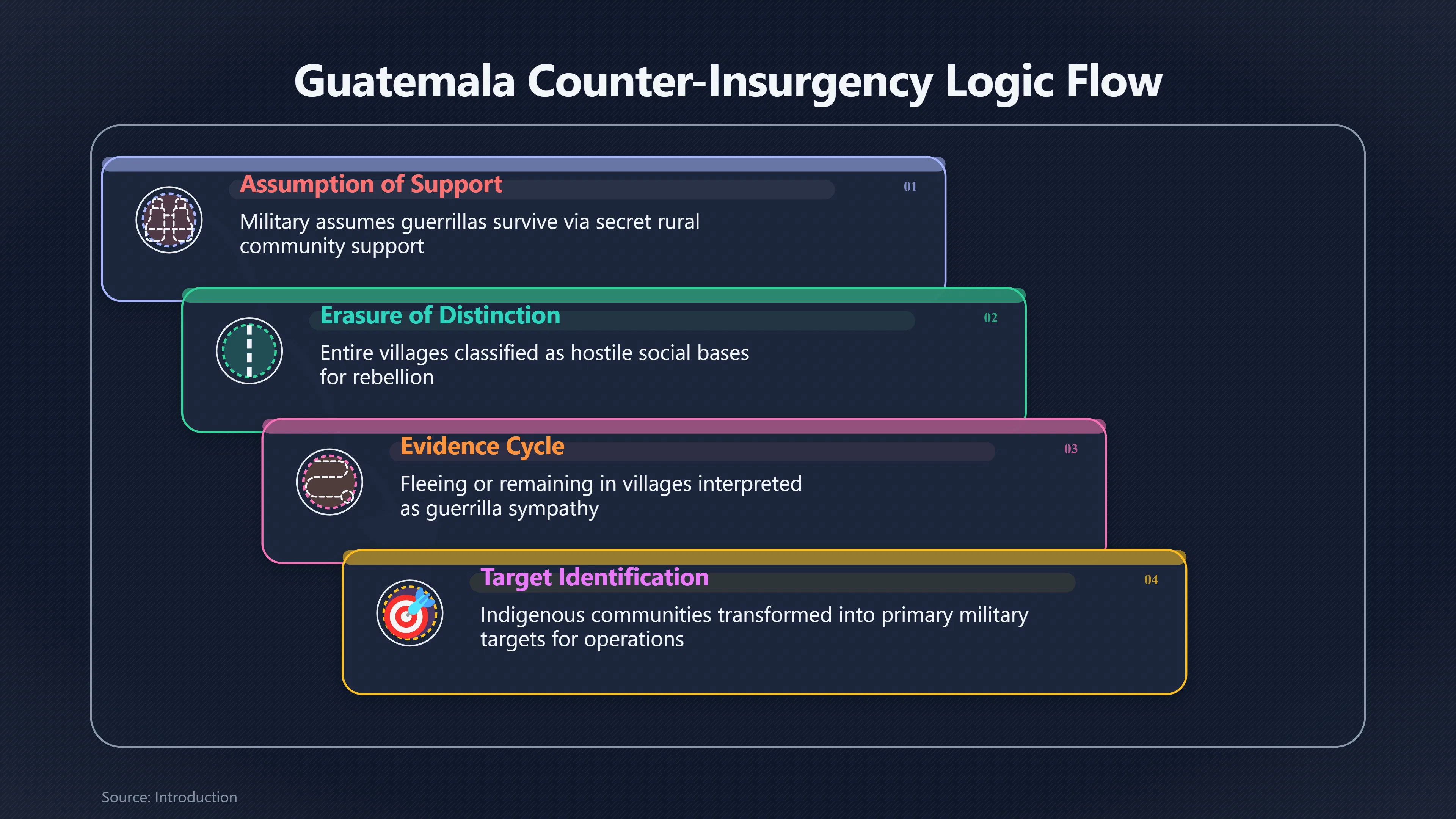
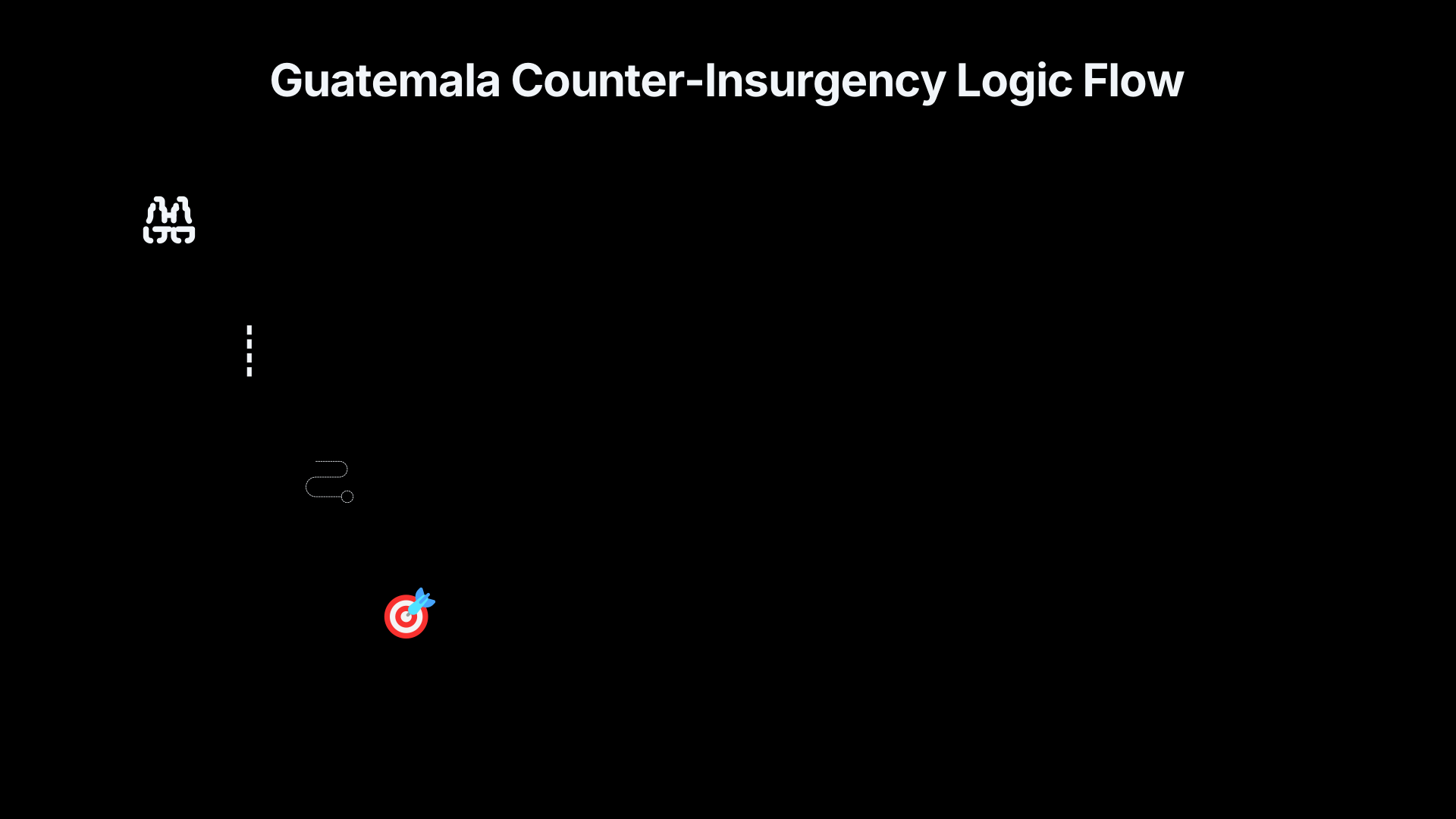
Guatemala’s civil war lasted from 1960 to 1996, but the most intense violence occurred between 1981 and 1983. During this period the army expanded a counter-insurgency strategy based on the assumption that guerrilla organisations could survive only because rural communities secretly supported them.
This reasoning erased the distinction between combatants and civilians. Instead of asking whether individuals had joined insurgent groups, military planners increasingly viewed entire communities as the “social base” of the rebellion. If a village was believed to have provided food, shelter or information—whether voluntarily or under coercion—it could be classified as hostile.
The Commission for Historical Clarification (CEH), Guatemala’s official truth commission, concluded that this logic transformed many Indigenous communities into military targets. It found that state forces committed the overwhelming majority of documented human-rights violations during the conflict and that acts of genocide were committed against several Maya groups during the counter-insurgency campaigns of the early 1980s.[UNDP]undp.orgGuatemala Memoria del Silencio | Programa De Las Naciones Unidas Para El DesarrolloFebruary 19, 2014…
The military’s approach also created a self-reinforcing cycle:
- fleeing violence became evidence of guerrilla sympathy;
- remaining in a village could likewise be interpreted as aiding insurgents;
- surviving relatives of suspected rebels could themselves become suspects;
- ordinary community organisation was often viewed through a security lens rather than a civilian one.
In many areas there was effectively no neutral position available to rural Maya civilians.
Why Maya identity became entangled with military suspicion
The violence cannot be explained simply as anti-communism. Guatemala’s truth commission and later scholarship argue that counter-insurgency overlapped with much older structures of racial discrimination against Indigenous peoples.
Most guerrilla fighters were not Indigenous villagers. Nevertheless, many military commanders increasingly treated Maya ethnicity, communal organisation and residence in particular regions as indicators of possible subversion. Villages in the western highlands and Ixil region became especially vulnerable because the army believed guerrilla influence was widespread there.
This mattered because suspicion extended beyond armed activity. Community assemblies, traditional authority, local cooperation and everyday village life could all be interpreted as evidence of hidden insurgent organisation. Rather than seeing Indigenous communities as populations caught between two armed forces, military doctrine often portrayed them as a concealed enemy embedded within the countryside.[Springer Nature Link]link.springer.comSpringer Nature LinkMemory of Silence: The Guatemalan Truth Commission Report | Springer Nature LinkApril 3, 2012…
Many historians therefore argue that political ideology and racialisation reinforced one another. Anti-communist language supplied the immediate justification, while longstanding prejudice made it easier for officials to imagine whole Indigenous populations as collectively dangerous.
Religion, community organisation and the search for “subversion”
Fear extended beyond ethnicity alone. Military intelligence frequently regarded independent forms of community leadership with suspicion.
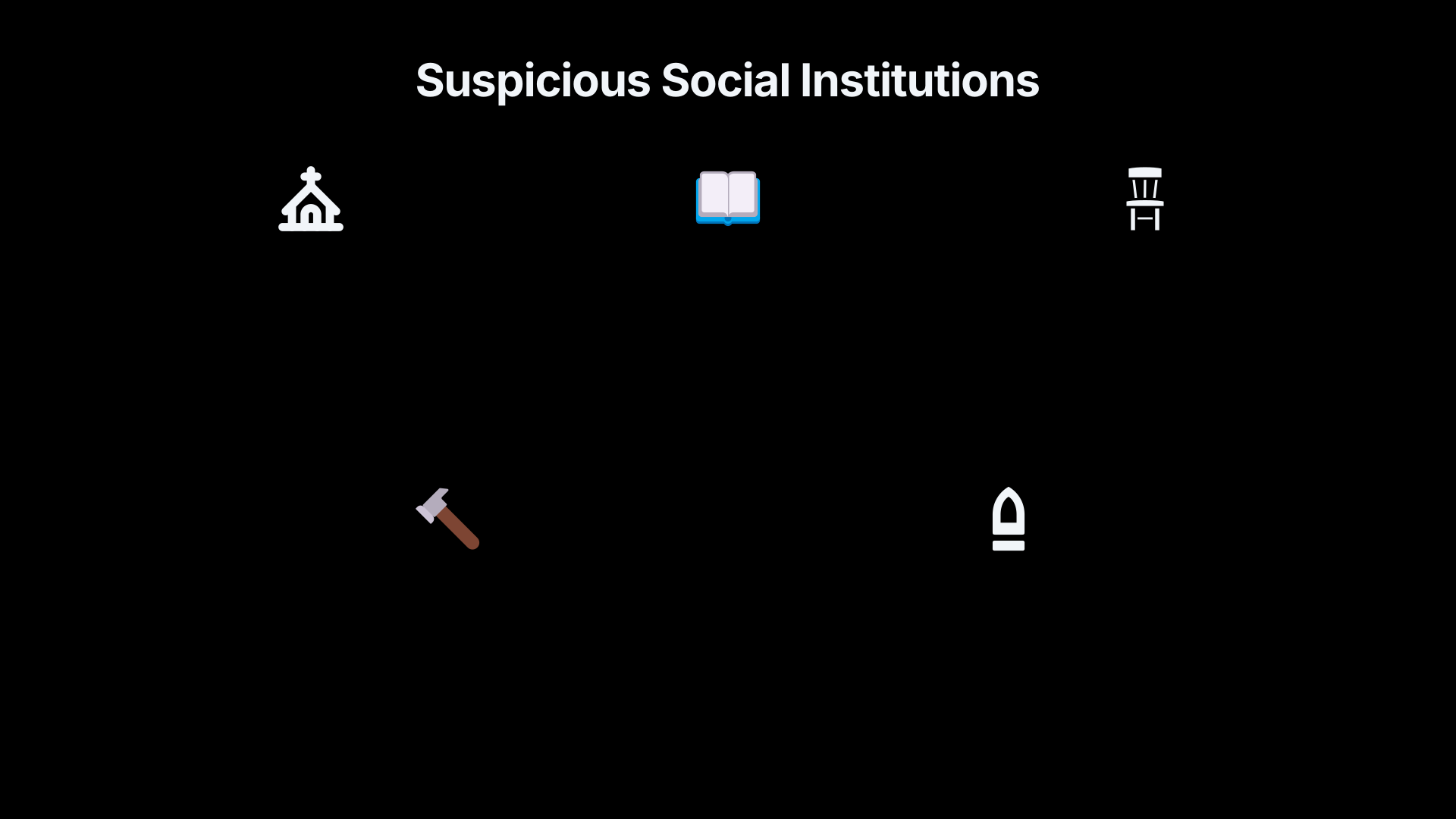
Catechists working within the Catholic Church, rural cooperatives, literacy campaigns and local development groups sometimes came under suspicion because they encouraged organisation outside state control. Liberation theology, which emphasised social justice and the rights of poor communities, was often interpreted by security forces as a pathway to communist influence even when participants rejected armed struggle.
Likewise, village leaders, teachers and respected elders could be accused of acting as intermediaries for guerrillas simply because they occupied positions of influence.
The result was that ordinary social institutions were increasingly viewed through the language of hidden conspiracy. This helped spread fear within communities themselves, as neighbours worried that any association with a suspected person might attract military attention.

Model villages and civilian patrols
Counter-insurgency did not rely only on military operations. It also attempted to reorganise civilian life.
Two important measures were:
- Civilian self-defence patrols (PACs). Hundreds of thousands of mostly rural men were compelled to participate in patrols intended to separate loyal civilians from suspected insurgents. Refusal could itself generate suspicion.
- Model villages. People displaced by scorched-earth campaigns were sometimes relocated into settlements under close military supervision. These communities allowed greater surveillance while disrupting traditional patterns of land use, family life and local authority.
Officially these policies were presented as security measures and protection against guerrilla influence. Critics and later investigations argued that they also institutionalised the assumption that rural Indigenous populations required constant monitoring because they were presumed vulnerable to—or already involved in—subversion.[UNDP]undp.orgGuatemala Memoria del Silencio | Programa De Las Naciones Unidas Para El DesarrolloFebruary 19, 2014…
Why this was not simply a “panic”
Describing these events only as a moral panic or collective fear risks understating what occurred.
There certainly was a powerful belief that a hidden enemy existed within Maya villages, and this belief spread through military institutions, political rhetoric and security planning. Yet it was not merely a spontaneous rumour or public delusion.
Several important distinctions matter:
- guerrilla organisations genuinely existed and conducted armed operations;
- some rural communities were caught between guerrilla forces and the army, sometimes assisting one side under coercion;
- the evidence does not support treating entire Maya populations as insurgents or willing collaborators;
- military doctrine frequently generalised from limited evidence to whole ethnic communities, producing indiscriminate violence.
For this reason, historians generally analyse the episode as an example of how exaggerated security thinking and racialised counter-insurgency transformed a real armed conflict into collective persecution of civilians rather than as a simple episode of mass hysteria.[University of Bristol]research-information.bris.ac.ukUniversity of BristolThe Origins and Dynamics of Genocide: Political Violence in Guatemala. - University of Bristol…
Why the language of panic cannot replace the history of genocide
The Commission for Historical Clarification concluded that state forces committed acts of genocide against identified Maya groups because violence intentionally targeted civilian populations on the basis of their ethnic identity within the framework of counter-insurgency. The report documented hundreds of massacres, widespread destruction of villages and patterns of violence that extended far beyond legitimate military objectives.[UNDP]undp.orgGuatemala Memoria del Silencio | Programa De Las Naciones Unidas Para El DesarrolloFebruary 19, 2014…
This conclusion remains politically contested inside Guatemala, but it has been highly influential internationally. The 2013 genocide conviction of former military ruler General Efraín Ríos Montt—later annulled on procedural grounds before a final judgment could be completed—brought worldwide attention to the evidence collected by survivors, forensic investigators and historians. Although the legal process remained incomplete, it reinforced scholarly arguments that the persecution of Maya civilians cannot be understood merely as collateral damage from civil war.[University of Bristol]research-information.bris.ac.ukUniversity of BristolThe Origins and Dynamics of Genocide: Political Violence in Guatemala. - University of Bristol…
Remembering this history is important because it demonstrates how fear of an invisible internal enemy can dissolve the distinction between armed opponents and ordinary civilians. Once entire communities are defined as potential threats rather than individual people with legal rights, suspicion itself becomes a mechanism of persecution. Guatemala’s experience remains one of the clearest modern examples of how counter-insurgency rhetoric, racial prejudice and collective fear combined to justify mass violence against Indigenous populations.

Endnotes
1.
Source: undp.org
Link:https://www.undp.org/es/guatemala/publicaciones/guatemala-memoria-del-silencio
Source snippet
Guatemala Memoria del Silencio | Programa De Las Naciones Unidas Para El DesarrolloFebruary 19, 2014...
Published: February 19, 2014
2.
Source: link.springer.com
Link:https://link.springer.com/book/10.1057/9781137011145
Source snippet
Springer Nature LinkMemory of Silence: The Guatemalan Truth Commission Report | Springer Nature LinkApril 3, 2012...
Published: April 3, 2012
3.
Source: link.springer.com
Link:https://link.springer.com/book/10.1057/978-1-137-39767-6
4.
Source: research-information.bris.ac.uk
Link:https://research-information.bris.ac.uk/en/publications/the-origins-and-dynamics-of-genocide-political-violence-in-guatem/
Source snippet
University of BristolThe Origins and Dynamics of Genocide: Political Violence in Guatemala. - University of Bristol...
5.
Source: academic.oup.com
Link:https://academic.oup.com/book/6763
Source snippet
OUP AcademicTerror in the Land of the Holy Spirit: Guatemala Under General Efrain Rios Montt, 1982-1983 | Oxford Academic...
Additional References
6.
Source: cambridge.org
Link:https://www.cambridge.org/core/books/abs/latin-american-experiences-with-truth-commission-recommendations-beyond-words-vol-ii/guatemalas-commission-of-historical-clarification-the-memory-of-silence-or-the-silence-of-memory/217EF54441DFC855515947E455BA5623
Source snippet
Latin American Experiences with Truth Commission Recommendations: Beyond Words Vol. IINovember 19, 2022 — GUATEMALA’S COMMISSION OF HISTO...
Published: November 19, 2022
7.
Source: impunitywatch.org
Title: English: Impact of the CEH on Guatemala’s armed conflict victims
Link:https://www.impunitywatch.org/publications/policy-brief-ceh-guatemala-english/
Source snippet
February 23, 2024 — POLICY BRIEF: IMPACT OF THE CEH REPORT ON VICTIMS OF THE ARMED CONFLICT IN GUATEMALA (ENGLISH) 23 February 2024 For m...
Published: February 23, 2024
8.
Source: fidh.org
Link:https://www.fidh.org/en/region/americas/guatemala/The-struggle-for-justice-The
Source snippet
The struggle for justice: The report entitled 'Remembrance of silence' or the truth restored...
9.
Source: research.kuleuven.be
Title: be Research Portal
Link:https://research.kuleuven.be/portal/en/project/3H170582
Source snippet
Ordinary Guatemalans and Collaboration during the Civil War, 1970-1985January 12, 2022 — BOUND BY BLOOD. ORDINARY GUATEMALANS AND COLLABO...
Published: January 12, 2022
10.
Source: youtube.com
Link:https://www.youtube.com/watch?v=ASH-WaG5P2M
Source snippet
3 Guatemalan Genocide Survivor Rosalina Tuyuc | USC Shoah Foundation...
11.
Source: youtube.com
Title: Guatemalan Genocide Survivor Rosalina Tuyuc | USC Shoah Foundation
Link:https://www.youtube.com/watch?v=d8oDD2xzjjg
Source snippet
4 Guatemala: The Dictatorship's Disappeared...
12.
Source: youtube.com
Title: Guatemala’s Mayans Live in Fear of Their Own Government
Link:https://www.youtube.com/watch?v=1UOyv6OOdEQ
Source snippet
2 Fear and the Fallout from the Guatemalan Civil War (2003)...
13.
Source: anthrosource.onlinelibrary.wiley.com
Link:https://anthrosource.onlinelibrary.wiley.com/doi/10.1111/jlca.12647?af=R
Source snippet
the Guatemalan civil war became a genocide: Revisiting the 2013 trial of General Efraín Ríos Montt - Stoll - 2022 - The Journal of Latin...
14.
Source: escholarship.org
Link:https://escholarship.org/uc/item/10x9x3bd
15.
Source: csmonitor.com
Link:https://www.csmonitor.com/1986/0626/oguat4.html
Topic Tree