When Fear Became Social Power in Ghana
Ghana’s history of collective fear is not one story of a nation repeatedly “losing its mind”. It is a more revealing history of how communities respond when illness, death, inequality, crime or rapid social change seem to demand an explanation.
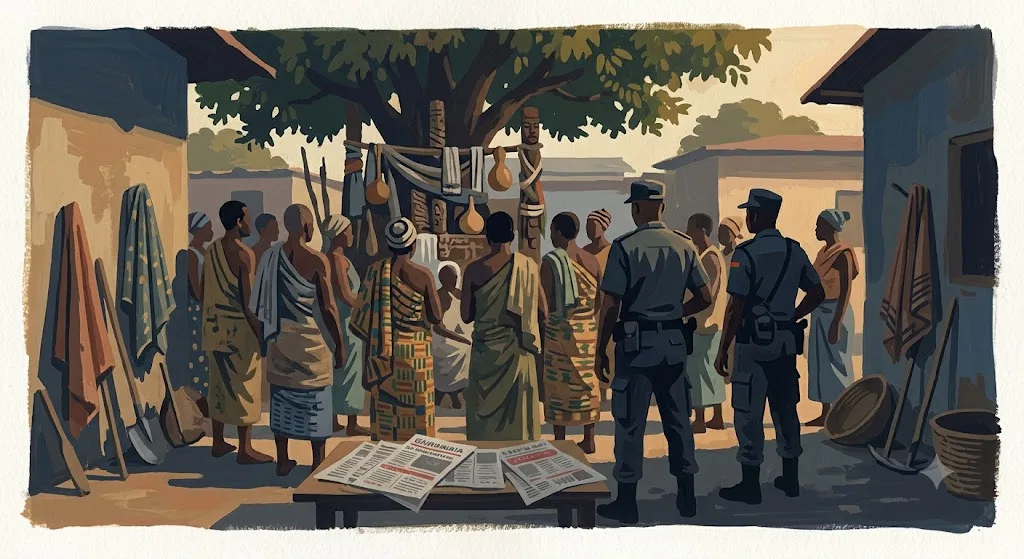
Page outline Jump by section
Introduction
These episodes are not interchangeable. Some involved genuine physical symptoms spreading through frightened groups. Others were moral panics, rumour epidemics or systems of persecution directed at vulnerable people. Ghana’s record therefore shows why labels such as “mass hysteria” and “cult” must be used carefully. The central question is usually not whether a whole population suddenly became irrational, but how an alarming belief became credible, who benefited from it, who was harmed, and what institutions did—or failed to do—when fear turned into action.
Witchcraft fear has the deepest roots
Belief in harmful supernatural power has existed within many Ghanaian societies for far longer than the modern state. It should not be confused with one fixed doctrine. Ideas about invisible attack, spiritual responsibility and ritual protection have varied between communities and have been reshaped by colonial government, Christianity, Islam, urbanisation and modern Pentecostal preaching. European officials and missionaries often compressed very different local practices into the single English category of “witchcraft”, obscuring distinctions between healing, divination, shrine worship, protection and alleged malevolent power.[rpl.hds.harvard.edu]rpl.hds.harvard.eduOpen source on harvard.edu.
During the late nineteenth and early twentieth centuries, several anti-witchcraft movements spread through the Gold Coast and Asante. Among the best known were Sakrabundi, Aberewa, Hwemeso, Tigare and Brekune. They were not simply mobs hunting supposed witches. They were organised religious movements offering medicines, oaths, cleansing ceremonies and protection from occult harm. People joined because these movements promised practical answers to illness, unexplained death, infertility, bad harvests and the social tensions created by new wealth and changing political authority.[worktribe.com]soas-repository.worktribe.comSOAS RepositorySAKRABUNDI AND ABEREWA, 1889–by J PARKER · Cited by 69 — witchcraft movement that rose to prominence in the Akan fore…
Aberewa became especially prominent in Asante in the first decade of the twentieth century. Its appeal rested partly on its claim to identify and neutralise witches, but also on a wider promise of moral renewal. Such movements could spread quickly through trading routes, kinship networks and travelling ritual specialists. Their ceremonies gave frightening misfortunes a comprehensible cause and offered participants something the colonial state often could not: an explanation, an offender and a remedy.[SOAS Repository]soas-repository.worktribe.comSOAS RepositorySAKRABUNDI AND ABEREWA, 1889–by J PARKER · Cited by 69 — witchcraft movement that rose to prominence in the Akan fore…
Colonial authorities responded inconsistently. Officials were concerned about extortion, forced confessions, poisoning allegations and the power of shrine leaders, yet they also recognised that local courts and communities treated supernatural wrongdoing as socially real. By the late 1920s and early 1930s, the administration was trying to restrict witch-finding oracles while deciding how accusations should be handled under colonial law. The result was not the disappearance of witchcraft belief but a continuing conflict between official rules of evidence and local demands for spiritual justice.[jstor.org]jstor.orgwitches, oracles, and colonial law: evolving anti-witchcraft…by N Gray · 2001 · Cited by 58 — On February 22, 1930, The Gold Coas…
This history matters because it shows that anti-witchcraft movements were neither timeless survivals nor simple eruptions of ignorance. They adapted to modern pressures. Scholars have connected their popularity to insecurity surrounding money, status and mobility: when some people prospered unexpectedly and others suffered unexplained setbacks, suspicions of hidden acquisition or occult theft offered a moral language for inequality.[OpenEdition Journals]journals.openedition.orgOpenEdition JournalsMoney, Wealth, and Witchcraft Suspicion in Colonial Asanteby WC Olsen · Cited by 34 — Witch finding cults were ritual…
Accusations became a system of exile
The most serious continuing consequence of witchcraft fear in Ghana is the banishment of accused people, particularly older women, to settlements commonly called “witch camps” in the north. The term can be misleading. These are not official prisons, and many residents describe them as places where they found refuge from threatened assault or killing. Yet safety is purchased through exile, poverty and separation from family. A person may technically be free to leave while being unable to return home without serious danger. Researchers therefore describe the camps as both sanctuaries and places of effective confinement.[researchgate.net]researchgate.netResearch Gate An anthropological study of “witch camps” and humanResearch Gate An anthropological study of “witch camps” and human
Gambaga is the best-known settlement and is often said to date from the eighteenth century. Other camps have operated at places including Gnani, Kukuo, Kpatinga and Gushegu. Numbers vary because residents move, camps close or change status, and surveys use different definitions. What is consistent is the demographic pattern: accused people are disproportionately poor, older, widowed or socially isolated women, often with limited access to formal education, income and legal protection.[researchgate.net]researchgate.netResearch Gate An anthropological study of “witch camps” and humanResearch Gate An anthropological study of “witch camps” and human
Accusations frequently follow a death, illness, dream, family dispute or economic crisis. A respected diviner, religious figure or relative may identify a supposed culprit. Once suspicion becomes public, ordinary misfortunes can be reinterpreted as confirming evidence: a quarrel becomes motive, an unusual remark becomes a confession, and an independent older woman becomes someone believed capable of hidden harm. The allegation can then resolve several social problems at once by explaining a tragedy, redirecting anger and removing a person who has become dependent or inconvenient.
That process resembles a witch panic, but it is rarely a single dramatic outbreak. It is better understood as recurring persecution supported by a shared explanatory system. The belief may be sincerely held by accusers; that does not make the accusation verifiable or the resulting violence acceptable. United Nations guidance stresses this distinction: freedom of religion and belief does not protect beatings, banishment, torture, deprivation or killing committed because someone has been labelled a witch.[OHCHR]ohchr.orgaccusations of witchcraft and ritual attacksaccusations of witchcraft and ritual attacks
Children can also be accused or harmed indirectly. Some accompany banished mothers or grandmothers and lose access to stable schooling, housing and family support. Others have been blamed for deaths, persistent illness, unusual behaviour or household misfortune. A review of Ghanaian cases found that accused children commonly came from poor or rural backgrounds and that national prevalence data remained inadequate.[Taylor & Francis Online]tandfonline.comOpen source on tandfonline.com.
The camps have placed Ghana in a difficult policy position. Closing them without securing residents’ safety can return women to the same communities from which they fled. Leaving them open can normalise banishment and relieve the state of responsibility for protection and reintegration. Ghana established a committee in 2014 to assess closures and support reintegration; Bonyase camp was subsequently closed, but international bodies continued to raise concerns about the safety and welfare of former residents and accompanying children.[United Nations Digital Library System]digitallibrary.un.orgOpen source on un.org.

A killing changed the national debate
On 23 July 2020, Akua Denteh, a 90-year-old woman in Kafaba in the Savannah Region, was publicly assaulted and killed after being accused of witchcraft. The attack was filmed, and the circulation of the footage transformed an offence that might once have remained locally concealed into a national scandal. Two women were later sentenced to 12 years’ imprisonment in connection with her death.[MyJoyOnline]myjoyonline.comMy Joy Online Murderers of Akua Denteh sentenced to 12 yearsMy Joy Online Murderers of Akua Denteh sentenced to 12 years
The case became important not because it was Ghana’s first witchcraft-related killing, but because it exposed the social machinery of accusation. Denteh was not harmed by an invisible force or an unknowable crowd. She was named, subjected to a supposed process of spiritual identification and attacked in public while others were present. The incident demonstrated how a supernatural claim could acquire the force of a verdict before police, courts or medical evidence became involved.
Parliament passed legislation in 2023 intended to prohibit witch-finding practices and the naming or labelling of another person as a witch. The bill did not receive presidential assent before the end of that administration. It was subsequently revived as a political issue, and in June 2026 the government said it was considering adopting a renewed anti-witchcraft accusation bill. As of July 2026, campaigners were therefore still pressing for a clear statutory prohibition and stronger protection for survivors.[amnestyghana.org]amnestyghana.orgOpen source on amnestyghana.org.
Legislation alone cannot dissolve a belief system. It can, however, change what follows an accusation. Clear offences may deter public naming, coercive “tests”, expulsion and abuse; prosecutions can signal that supernatural suspicion is not a licence for violence. Effective reform also requires secure housing, social protection, education, accessible healthcare and negotiated reintegration, because poverty and dependence make accused people easier to remove and harder to restore to community life.[amnesty.org]amnesty.orgghana witchcraft accusationsghana witchcraft accusations
The 1997 genital-theft panic
In January 1997, Accra experienced a striking rumour panic centred on claims that strangers could cause men’s genitals to shrink or disappear through touch, a handshake or an apparently ordinary encounter. Suspected “snatchers” were attacked, and contemporary reports recorded seven deaths. The episode was part of a wider pattern found in several West African countries, but the Ghanaian outbreak became one of the most frequently studied examples.[Sage Journals]journals.sagepub.comOpen source on sagepub.com.
The victims who believed themselves attacked were not necessarily pretending. Panic can produce genuine bodily sensations: cold, muscular contraction, heightened self-monitoring, altered perception and a powerful conviction that something physical has changed. Once a frightening explanation becomes socially available, an ambiguous sensation may be interpreted as proof of an assault. The accused stranger then appears to be the obvious cause.
Researchers have debated whether such episodes should be described as a culture-shaped panic disorder, a form of mass psychogenic illness or a rumour-driven moral crisis. No single label captures the whole chain. The initial bodily alarm may be psychophysiological; the identification of a “thief” is culturally framed; and the violence depends on crowd dynamics, rumour and the failure to verify the allegation before punishment begins.[PubMed]pubmed.ncbi.nlm.nih.govOpen source on nih.gov.
The panic also reflected the anxieties of city life. Encounters between strangers, crowded markets and transport, economic insecurity and fear of occult crime created an environment in which a claim could spread rapidly. News coverage helped make the supposed method of attack widely recognisable. Every report taught more people what symptoms to notice and whom to suspect.
This episode is one of Ghana’s clearest cases of contagious belief producing immediate collective violence. It also offers a warning about the term “mass hysteria”. The people killed were not harmed by an abstract psychological syndrome. They were harmed because a frightening bodily interpretation became a criminal accusation and crowds treated suspicion as proof.
Ghosts, fainting and a school outbreak
On 3 July 2018, about 20 students at Nungua Senior High School in Accra collapsed or behaved unusually. Some reported seeing ghosts or deceased students. They were taken to LEKMA Hospital, where a physician described most of the cases as hysteria. The students were treated and discharged, and calm had returned to the school by the following day.[com.gh]graphic.com.ghnungua shs students collapse claim to be seeing ghostnungua shs students collapse claim to be seeing ghost
The limited public record makes certainty impossible. Reports did not provide a detailed environmental investigation, laboratory results or a formal epidemiological study. It is therefore safer to describe the incident as an apparent mass psychogenic episode rather than a conclusively proven one.
Mass psychogenic illness refers to the rapid spread of real symptoms within a socially connected group when no sufficient toxic, infectious or structural cause is found. Fainting, dizziness, trembling, breathlessness and altered behaviour can spread through observation, expectation and anxiety. Schools are common settings because pupils share routines, stresses, rumours and close visual contact.
In Nungua, the ghost interpretation appears to have supplied a narrative around the symptoms. One student’s fear or collapse could make others scan themselves for signs of danger. Reports that dead pupils had appeared would increase alarm, especially if the story circulated through dormitories or friendship groups. The cultural explanation and the bodily response could then reinforce one another: symptoms made the ghost story feel credible, while the ghost story made further symptoms more likely.
The hospital response helped shorten the episode. Students were removed from the immediate setting, medically assessed and reassured, and reports soon emphasised recovery. That pattern differs sharply from witchcraft accusations, where fear may continue for years because the community locates danger in an alleged person rather than in a temporary stress response.
“Sakawa” and the occult image of cybercrime
From around 2007, Ghanaian newspapers and popular culture increasingly discussed “sakawa”, a label associated with internet fraud allegedly enhanced by occult ritual. Rumours described young men seeking spiritual assistance to manipulate foreign victims, sometimes through disturbing sacrifices or bizarre ritual obligations. Anthropologist Alice Armstrong characterised the resulting reaction as a nationwide epidemic of rumours rather than a transparent description of how every fraudster actually operated.[University College London]ucl.ac.ukOpen source on ucl.ac.uk.
The criminal foundation was real: online fraud existed and caused genuine harm. The occult superstructure was harder to verify. Stories about sudden wealth, ritual power and hidden sacrifice combined observable facts—young men, computers, scams and conspicuous consumption—with older ideas about wealth obtained through morally dangerous means.
Sakawa rumours flourished because they explained an unsettling contradiction. Young people with few conventional opportunities sometimes appeared to acquire money quickly through a technology many adults did not fully understand. The idea that digital persuasion required supernatural assistance made a new crime legible through familiar moral categories. It also expressed resentment about unemployment, consumerism, migration, global inequality and the perceived rewards of dishonesty.
Films and other popular media did more than report the phenomenon. They helped create its visual language: the flashy fraudster, the demanding ritual specialist and the inevitable supernatural punishment. Academic work on Ghanaian video films argues that these portrayals became culturally important in their own right, regardless of whether particular ritual claims could be substantiated.[ResearchGate]researchgate.netResearch Gate Sakawa Rituals and Cyberfraud in Ghanaian PopularResearch Gate Sakawa Rituals and Cyberfraud in Ghanaian Popular
Sakawa is therefore best understood as both crime discourse and moral panic. Treating every occult detail as fact risks reproducing rumour. Treating the entire phenomenon as fantasy ignores real cybercrime and the possibility that some offenders may themselves consult religious specialists. The historically important point is how the stories converted difficult questions about technology and unequal wealth into a drama of spiritual corruption.
Prophecies, panic and the limits of state control
Public prophecy has become another arena in which Ghanaian authorities try to separate religious expression from harmful alarm. Watch-night services on 31 December often include predictions about the coming year. Controversy has arisen when prominent religious figures announce the supposed deaths of named individuals, impending disasters or threats to national leaders.
In December 2021, the Ghana Police Service warned religious leaders to communicate prophecies in ways that did not infringe the rights of others or create public fear and panic. Similar cautions were issued ahead of later New Year services. Police officials stressed that they were not outlawing prophecy itself but objecting to public messages likely to cause anxiety, threaten reputations or provoke disorder.[myjoyonline.com]myjoyonline.comOpen source on myjoyonline.com.
The dispute exposes a genuine tension. For believers, prophecy may be an important religious practice and warning people can be understood as a moral duty. For those named, however, an announcement of death or catastrophe can produce distress, reputational damage and intense media attention. The prediction may also become self-protecting: if nothing happens, followers may credit prayer with averting it; if a loosely similar event occurs, it may be treated as confirmation.
This is not a classic mass psychogenic illness because the main symptoms are social rather than bodily. It is closer to a recurring moral and media panic, driven by authority, repetition and uncertainty. Radio, television and social media can detach a prophecy from its original sermon and circulate its most alarming sentence nationwide. State intervention then amplifies the controversy further, turning a religious utterance into a debate over public safety and freedom of belief.

What Ghana’s cases have in common
These episodes differ in scale and evidence, but several mechanisms recur.
Misfortune demands an agent. Illness, death, poverty and abrupt changes in wealth are difficult to tolerate as random or structurally caused. Witchcraft, occult crime and spiritual attack identify someone who can be blamed.
Existing beliefs shape new fears. Internet fraud was interpreted through ideas about dangerous wealth; a school fainting outbreak acquired a ghost narrative; bodily panic became proof of genital theft. New events spread faster when they fit a familiar cultural script.
Authority makes claims travel. Diviners, preachers, doctors, journalists, police officers and filmmakers do not have equal roles, but each can legitimise an interpretation. A rumour repeated by a recognised figure is harder to dismiss than one whispered by an unknown person.
Media both exposes and amplifies. The filming of Akua Denteh’s killing created pressure for justice. Yet repeated coverage of ghost attacks, occult rituals or alarming prophecies can also supply audiences with the imagery and vocabulary through which the next scare will be understood.
Fear follows social fault lines. Older women, widows, poor children, strangers and conspicuously wealthy young men become symbolic figures onto whom wider tensions are projected. Collective belief is rarely socially neutral.
The symptoms or fears can be sincere without the accusation being true. A fainting pupil may be genuinely unwell. A man in a genital-theft panic may genuinely experience alarming sensations. A bereaved family may genuinely believe a relative caused a death. Humane analysis takes the distress seriously while refusing to treat supernatural blame as evidence.
Why the history still matters
Ghana’s record challenges two easy explanations. The first is that collective scares are merely relics of “traditional” society. Anti-witchcraft movements adapted to colonial government; witchcraft accusations coexist with courts and smartphones; cybercrime rumours belong to the internet age; school outbreaks and media-driven prophecies are thoroughly modern.
The second mistake is to assume that education or official denial will automatically end such beliefs. A frightening account survives when it answers emotional and social needs better than the available alternative. Telling a family that a death had no malicious cause may be medically reasonable but emotionally unsatisfying. Closing a camp without providing protection does not remove the fear that sent its residents there. Condemning occult rumours without addressing cybercrime and youth exclusion leaves the underlying anxiety intact.
The most effective responses therefore distinguish belief from harmful conduct. Medical investigation and calm communication are appropriate when groups develop unexplained symptoms. Fraud should be prosecuted through evidence rather than occult storytelling. Religious freedom can be respected while threats, defamation and panic-inducing claims are constrained. Above all, accusations of witchcraft must not be allowed to function as informal convictions carrying punishment without proof.
Ghana’s strange and often painful history of scares is ultimately a history of explanation under pressure. Collective fear became most dangerous when a vivid story outran verification and when institutions allowed an accused person to bear the cost. Its lasting lesson is not that belief itself can be abolished, but that uncertainty must be managed without turning vulnerable people into evidence, enemies or sacrifices.
Amazon book picks
Further Reading
Books and field guides related to When Fear Became Social Power in Ghana. Use these as the next step if you want deeper reading beyond the article.
Witchcraft, Violence, and Democracy in South Africa
First published 2005. Subjects: Witchcraft, africa, Witchcraft, Political aspects.

The Penguin book of witches
First published 2014. Subjects: Witchcraft, History, Witchcraft, europe.
The fear
First published 2011. Subjects: Politics and government, Social conditions, Economic conditions, Mugabe, robert gabriel, 1924-2019, Zimba...
Endnotes
1.
Source: rpl.hds.harvard.edu
Link:https://rpl.hds.harvard.edu/religion-context/case-studies/violence-peace/witch-camps-ghana
2.
Source: journals.openedition.org
Link:https://journals.openedition.org/etudesafricaines/155?file=1
Source snippet
OpenEdition JournalsMoney, Wealth, and Witchcraft Suspicion in Colonial Asanteby WC Olsen · Cited by 34 — Witch finding cults were ritual...
3.
Source: jstor.org
Link:https://www.jstor.org/stable/3097485
Source snippet
witches, oracles, and colonial law: evolving anti-witchcraft...by N Gray · 2001 · Cited by 58 — On February 22, 1930, The Gold Coas...
Published: February 22, 1930
4.
Source: journals.openedition.org
Link:https://journals.openedition.org/etudesafricaines/18387
5.
Source: researchgate.net
Title: Research Gate An anthropological study of “witch camps” and human
Link:https://www.researchgate.net/publication/325185415_An_anthropological_study_of_witch_camps_and_human_rights_in_northern_Ghana
6.
Source: ohchr.org
Title: accusations of witchcraft and ritual attacks
Link:https://www.ohchr.org/sites/default/files/2022-12/PAP-Guidelines-EN.pdf
7.
Source: ohchr.org
Link:https://www.ohchr.org/en/women/harmful-practices
8.
Source: ohchr.org
Title: committee rights child examines report ghana
Link:https://www.ohchr.org/en/press-releases/2015/05/committee-rights-child-examines-report-ghana
9.
Source: myjoyonline.com
Title: My Joy Online Murderers of Akua Denteh sentenced to 12 years
Link:https://www.myjoyonline.com/murderers-of-akua-denteh-sentenced-to-12-years-imprisonment/
10.
Source: chraj.gov.gh
Link:https://chraj.gov.gh/2025/03/05/chraj-wants-criminal-offences-amendment-bill-2022-assented-to-to-ban-witchcraft-accusation/
11.
Source: citinewsroom.com
Title: govt considers adopting anti witchcraft bill to criminalise accusations
Link:https://www.citinewsroom.com/2026/06/govt-considers-adopting-anti-witchcraft-bill-to-criminalise-accusations/
12.
Source: amnesty.org
Title: ghana witchcraft accusations
Link:https://www.amnesty.org/en/latest/news/2025/04/ghana-witchcraft-accusations/
13.
Source: citinewsroom.com
Title: 20 nungua shs students collapse rushed to hospital
Link:https://www.citinewsroom.com/2018/07/20-nungua-shs-students-collapse-rushed-to-hospital/
14.
Source: citinewsroom.com
Title: calm returns to nungua shs after ghost scare
Link:https://www.citinewsroom.com/2018/07/calm-returns-to-nungua-shs-after-ghost-scare/
15.
Source: researchgate.net
Title: Research Gate Sakawa Rituals and Cyberfraud in Ghanaian Popular
Link:https://www.researchgate.net/publication/271934427_Sakawa_Rituals_and_Cyberfraud_in_Ghanaian_Popular_Video_Movies
16.
Source: myjoyonline.com
Link:https://www.myjoyonline.com/police-cautions-against-prophecies-that-cause-fear-and-panic-ahead-of-watchnight-services/
17.
Source: citinewsroom.com
Link:https://www.citinewsroom.com/2023/07/two-women-jailed-for-lynching-90-year-old-akua-denteh-over-witchcraft-allegations/
18.
Source: tbinternet.ohchr.org
Title: Download Draft.aspx
Link:https://tbinternet.ohchr.org/_layouts/15/TreatyBodyExternal/DownloadDraft.aspx?key=qfsmRyMDCeIP5BNoAwNa0wEVl4RjMkJRKjc%2FADYEm03l+2vJ6GIx5RRgboQvsBnc
19.
Source: tbinternet.ohchr.org
Title: Download Draft.aspx
Link:https://tbinternet.ohchr.org/_layouts/15/TreatyBodyExternal/DownloadDraft.aspx?key=7VIwMePlv4yhNS3aov0TW0xXe7XlWXoXkBYxOKYV6bBwEB26oBEbzfEhEdI6S1rz
20.
Source: tbinternet.ohchr.org
Title: Download Draft.aspx
Link:https://tbinternet.ohchr.org/_layouts/15/TreatyBodyExternal/DownloadDraft.aspx?key=wWCTsQghJykiUqDvDk+7d+GUhmMh4xWkWHNYMkQcuU2BF%2FXMb3BvvjiZhc0f1yEM
21.
Source: docstore.ohchr.org
Title: Files Handler.ashx
Link:https://docstore.ohchr.org/SelfServices/FilesHandler.ashx?enc=aPG3l5tOnIiPM32nkt%2FmmvWBbRFzkWoGn9%2BL2Uz3%2FJhhgQqpBHF6oJr95Hh7iH3EwjlWcd2e36yMndysCocJsw%3D%3D
22.
Source: ohchr.org
Title: Albinism Worldwide Report 2021 EN
Link:https://www.ohchr.org/sites/default/files/2022-12/Albinism-Worldwide-Report-2021-EN.pdf
23.
Source: uprdoc.ohchr.org
Link:https://uprdoc.ohchr.org/uprweb/downloadfile.aspx?file=EnglishTranslation&filename=10625
24.
Source: docstore.ohchr.org
Title: Files Handler.ashx
Link:https://docstore.ohchr.org/SelfServices/FilesHandler.ashx?enc=CgcdBVdF5owhOeQVutdu%2FhorCYRuPXNog6IoB%2B9roNaPVjvRQRPsCmxKtJxT8qCsnpMuTxwGj5%2B7prmY9ZHKOFmtM8Xtu%2BZAaV%2FiN%2F2Ujk8%3D
25.
Source: researchgate.net
Link:https://www.researchgate.net/publication/279447812_A_Historical_narrative_of_the_British_Colonial_Administration%27s_Clamp_down_on_Witch_finding_Shrines_among_the_Asante_People_of_the_Gold_Coast
26.
Source: researchgate.net
Title: 361420118 Becoming a Sakawa Boy Magic and modernity in Ghana
Link:https://www.researchgate.net/publication/361420118_Becoming_a_Sakawa_Boy_Magic_and_modernity_in_Ghana
27.
Source: researchgate.net
Link:https://www.researchgate.net/publication/392936814_An_Exploration_of_the_Prophet_and_Prophecy_in_Contemporary_Ghanaian_Christianity_in_Light_of_Old_Testament_Theology
28.
Source: researchgate.net
Title: 7652865 Accusations of Genital Theft A Case from Northern Ghana
Link:https://www.researchgate.net/publication/7652865_Accusations_of_Genital_Theft_A_Case_from_Northern_Ghana
29.
Source: researchgate.net
Link:https://www.researchgate.net/publication/7652866_Understanding_Genital-Shrinking_Epidemics_in_West_Africa_Koro_Juju_or_Mass_Psychogenic_Illness
30.
Source: researchgate.net
Link:https://www.researchgate.net/publication/395792956_Methodological_and_Ethical_Reflections_on_Researching_With_Children_of_Accused_Witches_in_Ghanaian_Witches%27_Camps
31.
Source: ugspace.ug.edu.gh
Link:https://ugspace.ug.edu.gh/items/cb832457-34c8-422c-a63a-9307a19dabe2
32.
Source: soas-repository.worktribe.com
Link:https://soas-repository.worktribe.com/OutputFile/419321
Source snippet
SOAS RepositorySAKRABUNDI AND ABEREWA, 1889–by J PARKER · Cited by 69 — witchcraft movement that rose to prominence in the Akan fore...
33.
Source: scholarlypublishingcollective.org
Link:https://scholarlypublishingcollective.org/msup/jwah/article/9/2/41/386601/Antiwitchcraft-Movements-in-Colonial
Source snippet
Scholarly Publishing CollectiveAntiwitchcraft Movements in Colonial Asante1 Sept 2023 — Examples of these movements include Sakrabundi, A...
34.
Source: catalogue.leidenuniv.nl
Link:https://catalogue.leidenuniv.nl/discovery/fulldisplay/alma9939071518602711/31UKB_LEU%3AUBL_V1
Source snippet
anti-witchcraft movements within African religions while largely ignoring the effects of colonial laws outlawing...Read more...
35.
Source: pulitzercenter.org
Title: banished and forgotten story women exiled over witchcraft
Link:https://pulitzercenter.org/stories/banished-and-forgotten-story-women-exiled-over-witchcraft
36.
Source: digitallibrary.un.org
Title: CEDAW C SR.1254 EN
Link:https://digitallibrary.un.org/record/791852/files/CEDAW_C_SR.1254-EN.pdf?ln=ru
37.
Source: tandfonline.com
Link:https://www.tandfonline.com/doi/full/10.1080/15426432.2025.2559627
38.
Source: digitallibrary.un.org
Link:https://digitallibrary.un.org/record/1654477/files/CEDAW_C_GHA_CO_6-7_Add-1-EN.pdf
39.
Source: gna.org.gh
Title: murderers of akua denteh sentenced to 12 years imprisonment
Link:https://gna.org.gh/2023/07/murderers-of-akua-denteh-sentenced-to-12-years-imprisonment/
40.
Source: amnestyghana.org
Link:https://amnestyghana.org/civil-society-and-parliamentarians-renew-call-for-passage-of-anti-witchcraft-accusations-bill/
41.
Source: ghanaiantimes.com.gh
Title: govt considers adoption of anti witchcraft accusation bill
Link:https://ghanaiantimes.com.gh/govt-considers-adoption-of-anti-witchcraft-accusation-bill/
42.
Source: amnestyghana.org
Link:https://amnestyghana.org/ghana-branded-for-life/
43.
Source: journals.sagepub.com
Link:https://journals.sagepub.com/doi/10.1177/1354067X07073651
44.
Source: pubmed.ncbi.nlm.nih.gov
Link:https://pubmed.ncbi.nlm.nih.gov/16108202/
45.
Source: graphic.com.gh
Title: nungua shs students collapse claim to be seeing ghost
Link:https://www.graphic.com.gh/news/general-news/nungua-shs-students-collapse-claim-to-be-seeing-ghost.html
46.
Source: ucl.ac.uk
Link:https://www.ucl.ac.uk/social-historical-sciences/sites/social_historical_sciences/files/082011.pdf
47.
Source: asaaseradio.com
Title: 2025 dont spread fear inducing prophecies ghana police warns as new year nears
Link:https://asaaseradio.com/2025-dont-spread-fear-inducing-prophecies-ghana-police-warns-as-new-year-nears/
48.
Source: graphic.com.gh
Link:https://www.graphic.com.gh/news/politics/igp-dampare-on-why-he-will-not-allow-prophecies-to-create-national-fear-and-panic.html
49.
Source: digitallibrary.un.org
Link:https://digitallibrary.un.org/record/818182
50.
Source: un.org
Link:https://www.un.org/womenwatch/daw/cedaw/cedaw36/cc/Ghana/0648072E.pdf
51.
Source: digitallibrary.un.org
Title: CCPR C SR.3274 EN
Link:https://digitallibrary.un.org/record/862269/files/CCPR_C_SR.3274-EN.pdf
52.
Source: digitallibrary.un.org
Title: A HRC 37 57 Add 2 FR
Link:https://digitallibrary.un.org/record/1473377/files/A_HRC_37_57_Add-2-FR.pdf
53.
Source: digitallibrary.un.org
Title: CCPR C SR.3275 EN
Link:https://digitallibrary.un.org/record/862270/files/CCPR_C_SR.3275-EN.pdf
54.
Source: digitallibrary.un.org
Title: A HRC 12 NGO 11 EN
Link:https://digitallibrary.un.org/record/665491/files/A_HRC_12_NGO_11-EN.pdf
55.
Source: digitallibrary.un.org
Link:https://digitallibrary.un.org/record/626859/files/A_HRC_WG.6_2_L.2-EN.pdf
56.
Source: instagram.com
Link:https://www.instagram.com/reel/DYu8WXHgvZw/
57.
Source: x.com
Link:https://x.com/archeohistories/status/2037119801110434158
58.
Source: graphic.com.gh
Title: ghana news two jailed for lynching 90 year old woman
Link:https://www.graphic.com.gh/news/general-news/ghana-news-two-jailed-for-lynching-90-year-old-woman.html
59.
Source: pmc.ncbi.nlm.nih.gov
Link:https://pmc.ncbi.nlm.nih.gov/articles/PMC3588562/
Additional References
60.
Source: gs.uwpress.org
Title: Governing States“Fetishism” in the Gold Coast
Link:https://gs.uwpress.org/content/18/1/90
Source snippet
Fuller, Chief Commissioner of the Ashanti, first encountered the anti-witchcraft movement called Aberewa, he was impressed by its injunct...
61.
Source: youtube.com
Title: Witchcraft Accusations in Ghana with John Azumah
Link:https://www.youtube.com/watch?v=HuXREurd5C0
Source snippet
Ghana: Accused of witchcraft, hundreds of women banished to camps • FRANCE 24 English...
62.
Source: youtube.com
Title: Inside Ghana’s last ‘witch camps’ • FRANCE 24 English
Link:https://www.youtube.com/watch?v=didjLZkEoRI
Source snippet
What Happens If You're Accused Of Being A Witch In Ghana?...
63.
Source: youtube.com
Title: What Happens If You’re Accused Of Being A Witch In Ghana?
Link:https://www.youtube.com/watch?v=6cc11qj88kg
Source snippet
Witchcraft Accusations in Ghana with John Azumah...
64.
Source: academia.edu
Link:https://www.academia.edu/10574448/Child_witch_hunts_in_contemporary_Ghana
65.
Source: academia.edu
Link:https://www.academia.edu/3590062/Occult_Melodramas_Spectral_Affect_and_West_African_Video_Film
66.
Source: facebook.com
Link:https://www.facebook.com/100087085099776/posts/a-man-from-ghana-has-sparked-global-attention-after-claiming-that-the-world-will/821916077387888/
67.
Source: facebook.com
Link:https://www.facebook.com/univers1057fm/photos/about-20-students-of-the-nungua-senior-high-school-in-accra-have-been-rushed-to-/1940896289296549/
68.
Source: modernghana.com
Link:https://www.modernghana.com/news/1020142/akua-denteh-last-witch-to-be-murdered-in-ghana.html
69.
Source: sciencepublishinggroup.com
Link:https://www.sciencepublishinggroup.com/article/10.11648/j.frontiers.20250504.12
Topic Tree
Follow this branch
Related pages 192
- Antigua and Barbuda
- Argentina Belief Scares
- Azerbaijan Belief
- Bahrain Beliefs
- North Korea
- +187 more in sidebar