When Belief Shaped Venezuela's Public Life
Venezuela’s history does not offer a neat catalogue of famous witch trials, dancing plagues or medically documented outbreaks of “mass hysteria”. The evidence is more fragmented and, in some respects, more revealing.
Page outline Jump by section
Introduction
Three episodes stand out. The María Lionza tradition shows how trance, healing and spirit communication can become a national religious culture rather than an outbreak of collective irrationality. The reported Marian apparitions at Betania demonstrate how extraordinary testimony can spread while remaining subject to institutional scrutiny. The Caracas earthquake of 1812 reveals how authorities can turn catastrophe into a fear-inducing political message. More recently, the quasi-religious language surrounding Hugo Chávez illustrates how collective devotion, political charisma and state mythmaking can overlap without making every supporter a brainwashed follower.
Together, these cases show why labels matter. “Cult”, “panic”, “possession” and “mass hysteria” often tell us as much about journalists, officials and hostile observers as about the people being described.
María Lionza: religion mistaken for hysteria
The religious world centred on María Lionza is Venezuela’s clearest example of a large, emotionally intense collective-belief tradition. Followers visit sacred sites around Sorte Mountain in Yaracuy, seek healing or guidance and communicate with spirits through mediums. Ceremonies may involve trance, tobacco smoke, ritual cleansing, drumming and walking over hot coals. To outsiders, especially those encountering dramatic images without context, such practices can look like uncontrolled frenzy or dangerous occultism.
Anthropologists describe something much more organised. María Lionza devotion developed through a mixture of Indigenous traditions, Catholic imagery, African-derived religious practices and forms of spiritism associated with communication with the dead. Although its precise origins are disputed, scholars generally place its recognisably modern growth in the early twentieth century, with expansion into Venezuelan cities from roughly the 1930s onwards.[cambridge.org]cambridge.orgCambridge University Press & AssessmentMagic in the Postcolonial Americas (Chapter 19)Venezuelan cult of María Lionza, which includes Neg…
The figure of María Lionza is commonly joined by Guaicaipuro, an Indigenous resistance leader, and Negro Felipe, a Black warrior spirit. They form a symbolic trio representing Indigenous, European-influenced and African elements of Venezuelan identity. The wider spiritual world is open-ended: Catholic saints, independence heroes, healers, criminals and figures drawn from popular culture may enter its courts of spirits. Researchers therefore treat the tradition not as a fixed church with a single doctrine but as a flexible religious network whose rituals and spirit categories change with Venezuelan society.[jstor.org]jstor.orgReligious cults centred on spirit possession do not always need to be non- conservative, counter-hegemonic…
That flexibility helps explain both the movement’s resilience and the suspicion directed towards it. Trance can be interpreted by participants as communication with a spirit, by clinicians as an altered state of consciousness, and by hostile observers as deception, possession or insanity. None of those descriptions should automatically be accepted as a complete explanation. Anthropological studies stress that possession follows learned ritual expectations: mediums acquire recognised ways of speaking, moving and embodying particular spirits within communities that understand those signals.[JSTOR]jstor.orgReligious cults centred on spirit possession do not always need to be non- conservative, counter-hegemonic…
The most visually striking ceremony is the fire dance performed during annual gatherings near Sorte. Participants cross embers and sometimes make contact with burning wood as an expression of spiritual protection and ancestral connection. In 2024, the Venezuelan state recognised the ceremony as part of the country’s cultural heritage, presenting it as a national tradition rather than a deviant sectarian practice.[Reuters]reuters.comVenezuela recognizes fiery ritual honoring goddess as cultural heritageParticipants engage in various intense acts such as running barefoot over hot coals and beating themselves with burning wood. This ceremo…
This recognition does not settle every argument. Practitioners disagree over authority, correct ritual practice and the growing influence of commercial healers. Environmental damage and large crowds at sacred sites have also produced practical concerns. Yet the María Lionza tradition is best understood as a diverse popular religion. Calling it “mass hysteria” erases its history, while casually calling it a “cult” imports assumptions of coercive leadership that do not fit a decentralised movement with no universally recognised human leader.
Betania and the making of a miracle site
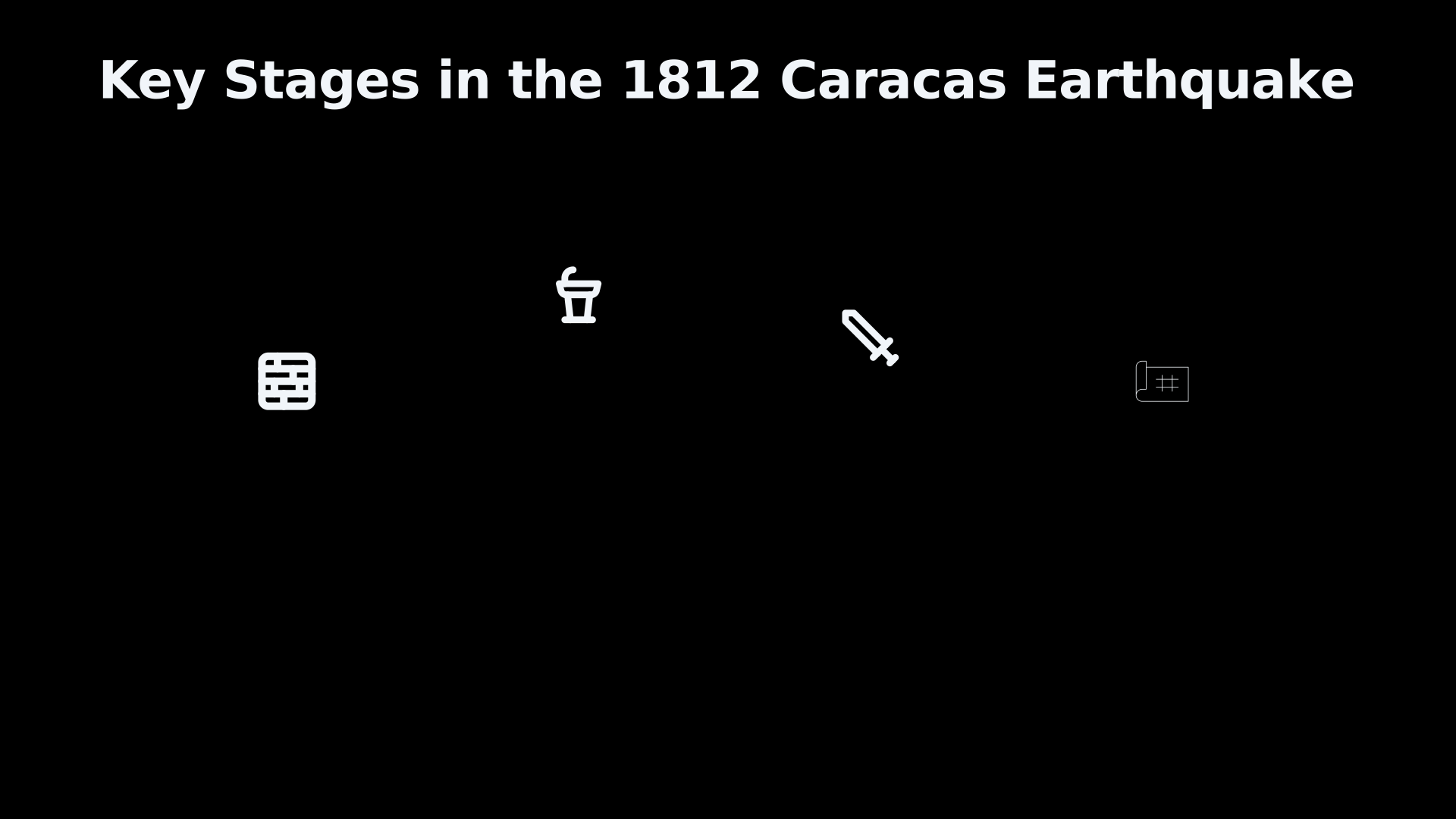
The reported apparitions at Finca Betania, in Miranda state, offer a different form of contagious belief. Beginning in the 1970s, María Esperanza de Bianchini said that she experienced visions of the Virgin Mary at the rural property. For several years, the claims remained largely confined to her family and a small devotional circle. The turning point came on 25 March 1984, when a crowd gathered after Mass and numerous people reported seeing a female figure near a waterfall.
A pastoral account by Bishop Pío Bello Ricardo states that about 150 people were present and that more than 100 signed testimony saying that they had witnessed the apparition. Some described only a fleeting shape or light; others interpreted the figure specifically as the Virgin Mary. The variety is important. It suggests neither a single, identical hallucination nor straightforward proof that a supernatural being appeared. It records a group of people interpreting an ambiguous and emotionally charged event within a shared Catholic framework.[EWTN Global Catholic Television Network]ewtn.comOn Sunday, March 25th of 1984, approximately 150 people got together in Finca Betania…
The bishop investigated the claims, interviewed witnesses and eventually issued a favourable judgement in 1987, permitting devotion connected with the site. His conclusion was a religious ruling about whether the reported experiences were compatible with Catholic faith and practice. It was not a scientific demonstration that the apparition had occurred exactly as witnesses believed. Later devotional accounts report that hundreds of statements were examined, although figures differ depending on whether oral interviews, written declarations or individual witnesses are being counted.[EWTN Global Catholic Television Network]ewtn.comOn Sunday, March 25th of 1984, approximately 150 people got together in Finca Betania…
Betania therefore sits in an awkward category. It was not a panic: there was no central threat, persecuted enemy or wave of fear. Nor was it merely a private vision, because testimony spread through a crowd and helped transform a farm into a pilgrimage destination. The most useful comparisons are with other apparition movements, where expectation, prayer, landscape, testimony and institutional endorsement combine to create a durable sacred place.
Psychological explanations do not require assuming that witnesses were dishonest. People in groups can influence one another’s attention and interpretation, especially when they expect a meaningful event. A flash of sunlight, mist, movement among trees or another uncertain visual stimulus may be perceived differently once someone announces that a holy figure is present. Memory can also become more definite as witnesses discuss an event afterwards. These mechanisms are plausible, but the surviving evidence does not allow a retrospective clinical diagnosis.
The Catholic response also distinguishes Betania from a free-floating miracle panic. Church authorities did not simply accept every associated claim. They evaluated testimony and judged whether the devotion encouraged conventional Catholic teaching. That process can strengthen belief by giving it official legitimacy, but it also acts as a filter against unrestricted prophecy or an independent movement forming around a visionary.
When an earthquake became a political omen
On Holy Thursday, 26 March 1812, a devastating earthquake struck Caracas and other parts of Venezuela while the struggle for independence from Spain was under way. Buildings collapsed, religious services were disrupted and thousands of people may have died, although historical death estimates vary considerably.
The timing gave the disaster immediate symbolic power. Royalist clergy and political supporters reportedly presented the earthquake as divine punishment for rebellion against the Spanish Crown. Because it struck on one of the most sacred days of the Christian calendar, the claim could be made to sound providential rather than merely opportunistic: God, they argued, had visibly condemned the independence movement.[wikipedia.org]Wikipedia1812 Caracas earthquake1812 Caracas earthquake
This was not mass psychogenic illness. The destruction was physically real. The collective-belief element lay in the interpretation imposed upon it. In a society where sermons, religious ritual and political authority were closely connected, supernatural explanations could shape morale and behaviour as effectively as military propaganda.
The independence leader Simón Bolívar became associated with a defiant response, commonly remembered as a declaration that, if nature opposed the revolution, the revolution would fight nature as well. Historians caution that famous versions of such statements are often polished by later retelling. What matters socially is that the earthquake became part of a contest over meaning: royalists cast it as divine judgement, while republicans had to prevent natural disaster from being accepted as proof of political illegitimacy.
Modern historical and geological work undermines the providential reading by examining construction quality, building maintenance and the uneven distribution of damage. Rogelio Altez’s research argues that destruction varied substantially according to the vulnerability of structures rather than according to the political loyalties of their occupants.[researchgate.net]researchgate.netResearch Gate New interpretations of the social and material impactsResearch Gate New interpretations of the social and material impacts
The episode is an unusually clear example of disaster interpretation operating like a moral panic. An actual catastrophe was connected to a supposed collective sin; religious authority supplied the explanation; political enemies were implicitly blamed; and frightened survivors faced pressure to read physical destruction as a supernatural verdict. The panic was not about whether the earthquake existed, but about what people were persuaded that it meant.

Chávez, charisma and political religion
The language of “cult” appears frequently in discussions of Hugo Chávez, who governed Venezuela from 1999 until his death in 2013. Used carelessly, the description reduces millions of supporters to irrational devotees. Used more precisely, it identifies the deliberate construction of a political identity around a charismatic leader presented as the embodiment of the nation, the poor and the unfinished mission of Simón Bolívar.
Chávez cultivated a direct relationship with supporters through speeches, television appearances and emotionally charged narratives of redemption, betrayal and national rebirth. His political project promised not simply a change of government but a moral and historical transformation. Scholars have described this as “political religion” or “missionary politics”: secular power expressed through symbols, rituals and ideas normally associated with sacred leadership.[ulisboa.pt]ics.ulisboa.ptInstituto de Comunicação e Society The Missionary Politics of Hugo ChávezInstituto de Comunicação e Society The Missionary Politics of Hugo Chávez
This appeal was not manufactured from nothing. Chávez gained loyalty by addressing communities that felt excluded by Venezuela’s established parties and by directing oil-funded programmes towards poorer citizens. His supporters’ attachment could therefore be grounded in material benefits, political participation and class identity as well as personal charisma. Accounts that treat the movement solely as mass delusion miss those reasons.[Dissent Magazine]dissentmagazine.orgOpen source on dissentmagazine.org.
After Chávez died, government rhetoric intensified his symbolic presence. He was described as the “eternal commander”; his signature and eyes appeared on walls and campaign material; and official language sometimes placed him alongside Bolívar or used imagery of resurrection and immortality. Anthropologist Lucia Michelutti argues that Chavista politics interacted with Venezuela’s existing traditions of embodied charisma and popular religion, rather than merely copying a conventional personality cult from elsewhere.[JSTOR]jstor.orgOpen source on jstor.org.
The distinction between devotion and coercion is essential. Supporters were not members of a closed religious sect. They did not share a single theology, live communally or surrender all personal decision-making to a private leader. Nevertheless, the sacred treatment of Chávez could discourage internal criticism by turning disagreement with the leader into apparent betrayal of the people or revolution.
Political fear developed alongside this veneration. Government officials repeatedly described opponents, activists and foreign powers as participants in destabilisation plots. Some conspiracies and coup attempts in Venezuelan history were real, so allegations cannot be dismissed merely because they concerned secret coordination. The moral-panic pattern arises when broad or poorly substantiated claims are used to treat ordinary dissent as evidence of an enemy network. Amnesty International and other observers have documented arrests justified through sweeping conspiracy accusations, while research on Venezuelan online influence operations shows that organised political messaging has involved both government and opposition actors.[amnesty.org]amnesty.orgInternational Venezuela: Increase in 'witch-hunt' of dissidents amidstInternational Venezuela: Increase in 'witch-hunt' of dissidents amidst
Venezuela’s political religion therefore combined genuine social allegiance, organised symbolism, historical myth and fear of internal enemies. Calling it simply a “cult” may express opposition, but it does not explain why the movement persuaded people or how its emotional power survived Chávez himself.
Where the evidence is weakest
Claims about Venezuelan satanic panics, mass school possessions and widespread psychogenic outbreaks circulate online, but reliable documentation is surprisingly poor. Search results frequently confuse Venezuela with cases in Peru, Colombia, Mexico or the Dominican Republic, while social-media clips repeat claims without naming institutions, medical findings or responsible authorities.
That absence should not be filled with dramatic speculation. A credible diagnosis of mass psychogenic illness normally requires investigators first to exclude toxins, infection and environmental hazards. Common patterns include rapid spread through a close-knit group, symptoms such as dizziness, fainting or hyperventilation, and recovery without evidence of a shared physical cause. Schools are common settings because pupils can observe one another closely and may be experiencing the same pressures.[sajp.org.za]sajp.org.zaOpen source on sajp.org.za.
Reports that children “saw the Devil” or became “possessed” are not themselves medical evidence. Such language may reflect local religious interpretation, sensational reporting or adults imposing a supernatural narrative on anxiety, illness or imitation. Conversely, dismissing every unexplained school episode as hysteria can conceal heat exposure, malnutrition, chemical contamination or untreated disease.
The same caution applies to alleged satanic crime. Ritual objects or unconventional beliefs do not prove the existence of an organised network committing secret atrocities. International experience with the satanic panic shows how suggestive questioning, repeated media claims and institutional anxiety can generate elaborate allegations without corroborating physical evidence. Venezuela undoubtedly has violent crime, religious conflict and occult practices, but those facts should not be combined into a single hidden-cult narrative unless a specific case is supported by police records, court evidence and independent reporting.
What Venezuela’s cases reveal
Venezuela’s most important collective-belief episodes do not support the idea that crowds simply lose their minds. They show several different processes that are often confused:
- Religious participation: María Lionza ceremonies are socially learned forms of devotion, healing and identity, not automatically symptoms of psychological disorder.
- Collective interpretation: At Betania, people in a devotional crowd interpreted an uncertain visual experience through shared Catholic expectations.
- Fear-based political persuasion: After the 1812 earthquake, royalists used religious meaning to turn a natural disaster into an argument against independence.
- Charismatic mobilisation: Chavismo fused material politics, historical memory and sacred imagery around a leader without becoming a conventional religious sect.
- Rumour and hostile labelling: Claims of possession, satanism or secret cult activity can spread faster than verifiable evidence, particularly when children, crime or unfamiliar rituals are involved.
The most persistent theme is the struggle over who has the authority to name an experience. A medium may call a trance spiritual contact; a priest may call it dangerous; a doctor may examine it as dissociation; a journalist may describe it as hysteria; and the state may later declare it cultural heritage. Each label changes how the public responds.
Venezuela’s history therefore rewards careful distinctions rather than sensational categories. Collective belief can provide healing, solidarity and political participation. It can also be exploited to stigmatise minorities, sanctify leaders, frighten disaster survivors or justify repression. The decisive questions are not simply whether many people believed something unusual, but who promoted the belief, what evidence existed, whose interests it served and what consequences followed.

Amazon book picks
Further Reading
Books and field guides related to When Belief Shaped Venezuela's Public Life. Use these as the next step if you want deeper reading beyond the article.
The devil and commodity fetishism in South America
Explores belief, ritual and social change in Latin America.

Comandante: Hugo Chávez's Venezuela
First published 2014. Subjects: Presidents, Venezuela, politics and government, Venezuela, foreign relations.
Endnotes
1.
Source: cambridge.org
Link:https://www.cambridge.org/core/books/cambridge-history-of-magic-and-witchcraft-in-the-west/magic-in-the-postcolonial-americas/069174C370F4167D7D510A227CAD699A
Source snippet
Cambridge University Press & AssessmentMagic in the Postcolonial Americas (Chapter 19)Venezuelan cult of María Lionza, which includes Neg...
2.
Source: jstor.org
Link:https://www.jstor.org/stable/2661219
Source snippet
Religious cults centred on spirit possession do not always need to be non- conservative, counter-hegemonic...
3.
Source: jstor.org
Link:https://www.jstor.org/stable/3875685
Source snippet
Rethinking "Mestizaje": Ideology and Lived Experienceby P Wade · 2005 · Cited by 506 — 3' The 'cult' of [Maria Lionza]({{ 'maria-lionza/' | relative_url }}), which emerged...
4.
Source: cambridge.org
Link:https://www.cambridge.org/core/books/afrolatin-american-studies/afrolatin-american-religions/1B9FBBE1957B5A853B558F4D14409CC1
Source snippet
Cambridge University Press & AssessmentAfro-Latin American Religions (Chapter 12)Popular Catholic saints – such as Rosa Egipcíaca and Esc...
5.
Source: jstor.org
Title: readings of a draft of this paper, as did the referees for Cultural Anthropology
Link:https://www.jstor.org/stable/656664
Source snippet
The Politics of Discursive Authority inby CL Briggs · 1996 · Cited by 542 — cult of Maria Lionza, a goddess of nature who is herself...
6.
Source: reuters.com
Title: Venezuela recognizes fiery ritual honoring goddess as cultural heritage
Link:https://www.reuters.com/world/americas/venezuela-recognizes-fiery-ritual-honoring-goddess-cultural-heritage-2024-10-14/
Source snippet
Participants engage in various intense acts such as running barefoot over hot coals and beating themselves with burning wood. This ceremo...
Published: October 14, 2024
7.
Source: ewtn.com
Link:https://www.ewtn.com/catholicism/library/pastoral-instruction-on-the-apparitions-of-the-blessed-virgin-in-finca-betania-3647
Source snippet
On Sunday, March 25th of 1984, approximately 150 people got together in Finca Betania...
8.
Source: Wikipedia
Title: 1812 Caracas earthquake
Link:https://en.wikipedia.org/wiki/1812_Caracas_earthquake
Published: January 19, 2009
9.
Source: saber.ucv.ve
Link:https://saber.ucv.ve/jspui/handle/10872/23360
10.
Source: researchgate.net
Title: Research Gate New interpretations of the social and material impacts
Link:https://www.researchgate.net/publication/286300410_New_interpretations_of_the_social_and_material_impacts_of_the_1812_earthquake_in_Caracas_Venezuela
Published: October 1, 2010
11.
Source: academia.edu
Link:https://www.academia.edu/12551459/New_interpretations_of_the_social_and_material_impacts_of_the_1812_earthquake_in_Caracas_Venezuela
12.
Source: researchgate.net
Link:https://www.researchgate.net/publication/227616975_The_Missionary_Politics_of_Hugo_Chavez
13.
Source: jstor.org
Link:https://www.jstor.org/stable/26177924
14.
Source: amnesty.org
Title: International Venezuela: Increase in ‘witch-hunt’ of dissidents amidst
Link:https://www.amnesty.org/en/latest/news/2017/04/venezuela-aumenta-caza-de-brujas-contra-disidencia-en-medio-de-crisis-politica-2/
Published: April 26, 2017
15.
Source: sajp.org.za
Link:https://sajp.org.za/index.php/sajp/article/view/1671/2648
16.
Source: apothecaries.org
Link:https://www.apothecaries.org/wp-content/uploads/2019/06/Mass-psychogenic-illness-and-how-to-respond.pdf
17.
Source: Wikipedia
Title: Moral panic
Link:https://en.wikipedia.org/wiki/Moral_panic
18.
Source: Wikipedia
Title: List of mass panic cases
Link:https://en.wikipedia.org/wiki/List_of_mass_panic_cases
19.
Source: Wikipedia
Title: Satanic panic
Link:https://en.wikipedia.org/wiki/Satanic_panic
20.
Source: Wikipedia
Title: Doomsday cult
Link:https://en.wikipedia.org/wiki/Doomsday_cult
21.
Source: Wikipedia
Title: Betania, Venezuela
Link:https://en.wikipedia.org/wiki/Betania%2C_Venezuela
Published: November 21, 1987
22.
Source: Wikipedia
Title: Hugo Chávez’s cult of personality
Link:https://en.wikipedia.org/wiki/Hugo_Ch%C3%A1vez%27s_cult_of_personality
23.
Source: amnesty.ca
Link:https://amnesty.ca/human-rights-news/venezuela-detentions-on-the-rise-amid-witch-hunt-against-opposition/
24.
Source: cambridge.org
Link:https://www.cambridge.org/core/journals/religion-and-american-culture/article/forum-the-religious-situation-1968-part-2/C580AAF2962321D9BB7ED48512C8E842
25.
Source: resolve.cambridge.org
Link:https://resolve.cambridge.org/core/services/aop-cambridge-core/content/view/4DEA241F9A95F2EB82BCAA57131D6235/9789048513963c7_p215-248_CBO.pdf/the-permeable-boundary-media-imaginaries-in-candombles-public-performance-of-authenticity.pdf
26.
Source: resolve.cambridge.org
Link:https://resolve.cambridge.org/core/services/aop-cambridge-core/content/view/FE84BB5B5D30BCB392A52D8BDD53BA8B/9789048513963bib_p273-294_CBO.pdf/bibliography.pdf
27.
Source: cambridge.org
Title: The Modern West (Part VI)
Link:https://www.cambridge.org/core/books/cambridge-history-of-magic-and-witchcraft-in-the-west/modern-west/DF8024C262C714DC419C4CD0C3D7DAB2
28.
Source: cambridge.org
Link:https://www.cambridge.org/core/services/aop-cambridge-core/content/view/E954CE7F832374780AD710D40370D63E/S0023879100041571a.pdf/social_sciences.pdf
29.
Source: cambridge.org
Title: Culture (Part III)
Link:https://www.cambridge.org/core/books/afrolatin-american-studies/culture/E4231830CFED67E87F8303F2229BC699
30.
Source: jstor.org
Link:https://www.jstor.org/stable/673445
31.
Source: jstor.org
Link:https://www.jstor.org/content/pdf/oa_book_monograph/10.2307/j.ctt46n286.pdf
32.
Source: jstor.org
Title: spirit possession,
Link:https://www.jstor.org/stable/3805466
33.
Source: jstor.org
Title: Visualizing the sacred
Link:https://www.jstor.org/stable/3805333
34.
Source: jstor.org
Link:https://www.jstor.org/stable/20024206
35.
Source: jstor.org
Link:https://www.jstor.org/stable/3033456
36.
Source: mcdreeamie.medium.com
Title: mass hysteria moral panic lessons from the dancing plagues and momo fd26e74e18fd
Link:https://mcdreeamie.medium.com/mass-hysteria-moral-panic-lessons-from-the-dancing-plagues-and-momo-fd26e74e18fd
37.
Source: researchgate.net
Link:https://www.researchgate.net/publication/292145151_Deconstructing_a_Modern_Witch_Hunt_Satanic_Cults_Ritual_Abuse_and_Moral_Panic
Published: May 2016
38.
Source: researchgate.net
Link:https://www.researchgate.net/publication/249735212_Conspiracy_or_Consensus_Reconsidering_the_Moral_Panic
39.
Source: researchgate.net
Link:https://www.researchgate.net/publication/309580702_The_earthquakes_of_the_March_26th_1812_in_Venezuela_New_contributions_and_evidences_on_these_effects
Published: March 1812
40.
Source: 2021-2025.state.gov
Link:https://2021-2025.state.gov/reports/2023-report-on-international-religious-freedom/venezuela/
41.
Source: state.gov
Link:https://www.state.gov/report/custom/77cca254de
42.
Source: history.com
Title: mysterious illnesses mass hysteria
Link:https://www.history.com/articles/mysterious-illnesses-mass-hysteria
43.
Source: ics.ulisboa.pt
Title: Instituto de Comunicação e Society The Missionary Politics of Hugo Chávez
Link:https://www.ics.ulisboa.pt/en/file/4900/download?token=uFhf2bOe
Published: March 5, 2015
44.
Source: dissentmagazine.org
Link:https://dissentmagazine.org/article/venezuela-under-chavez-some-truths-are-not-all-that-complicated/
45.
Source: apnews.com
Link:https://apnews.com/article/35d063ba9ba3e08399c02cb572d78e5b
Additional References
46.
Source: arxiv.org
Link:https://arxiv.org/abs/2210.11673
47.
Source: pmc.ncbi.nlm.nih.gov
Link:https://pmc.ncbi.nlm.nih.gov/articles/PMC7396040/
48.
Source: pmc.ncbi.nlm.nih.gov
Link:https://pmc.ncbi.nlm.nih.gov/articles/PMC7201200/
49.
Source: hozana.org
Link:https://hozana.org/en/miracles-and-apparitions/marian-apparitions/betania
Published: November 21, 1987
50.
Source: newyorker.com
Link:https://www.newyorker.com/magazine/2016/11/14/venezuela-a-failing-state
51.
Source: americamagazine.org
Title: Venezuela’s Catholic Church leads post-earthquake humanitarian
Link:https://www.americamagazine.org/politics-society/dispatches/2026/07/09/catholic-church-venezuela-earthquakes-fe-y-alegria-jesuits/
Published: July 9, 2026
52.
Source: asociacionvenezolanadesociologia.org
Link:https://asociacionvenezolanadesociologia.org/wp-content/uploads/2023/10/The-Uses-of-Conspiracy-Theories-for-the-Construction-of-a-Political-Religion-in-Venezuela.pdf
53.
Source: bertelsmann-stiftung.de
Title: UD Conspiracy Mentality 2023 en
Link:https://www.bertelsmann-stiftung.de/fileadmin/files/UD_Conspiracy-Mentality_2023_en.pdf
54.
Source: brewminate.com
Title: Apocalyptic Movements Through History
Link:https://brewminate.com/apocalyptic-movements-history-end-times-cults-beliefs/
Published: April 20, 2026
55.
Source: britsoccrim.org
Link:https://www.britsoccrim.org/volume3/004.pdf
Topic Tree
Follow this branch
Related pages 192
- Antigua and Barbuda
- Argentina Belief Scares
- Azerbaijan Belief
- Bahrain Beliefs
- North Korea
- +187 more in sidebar