Within Belarus
How Did Every New Faith Become a Sect?
Real crimes by a few movements helped turn the word sect into a sweeping label for many peaceful and unfamiliar religions.
On this page
- Why the post Soviet religious market changed
- How violent groups shaped wider fears
- Who was harmed by catch all labelling
Page outline Jump by section
Introduction
After the collapse of the Soviet Union, Belarus experienced a rapid change in its religious landscape. For the first time in decades, foreign missionaries, new Christian denominations, Eastern spiritual groups and alternative religious movements were able to operate more openly. That genuine increase in religious diversity coincided with widespread public anxiety about unfamiliar beliefs. As a result, the word sect became a catch-all label applied to a remarkably broad range of groups, from organisations with documented histories of coercion to peaceful religious minorities that simply fell outside the country’s officially recognised traditions.
This was less a panic about one particular movement than a wider moral panic about religious change itself. Real abuses by a handful of destructive organisations elsewhere in the former Soviet Union helped convince many Belarusians that almost any unfamiliar faith might be dangerous. Politicians, educators and state media often reinforced that impression, while scholars of religion and human rights organisations argued that the label “sect” blurred important distinctions and encouraged discrimination rather than careful assessment.[Refworld]refworld.orgUSCIRF Annual Report 2009 - The Commission's Watch List: Belarus | RefworldMay 1, 2009…
Why the post-Soviet religious market changed
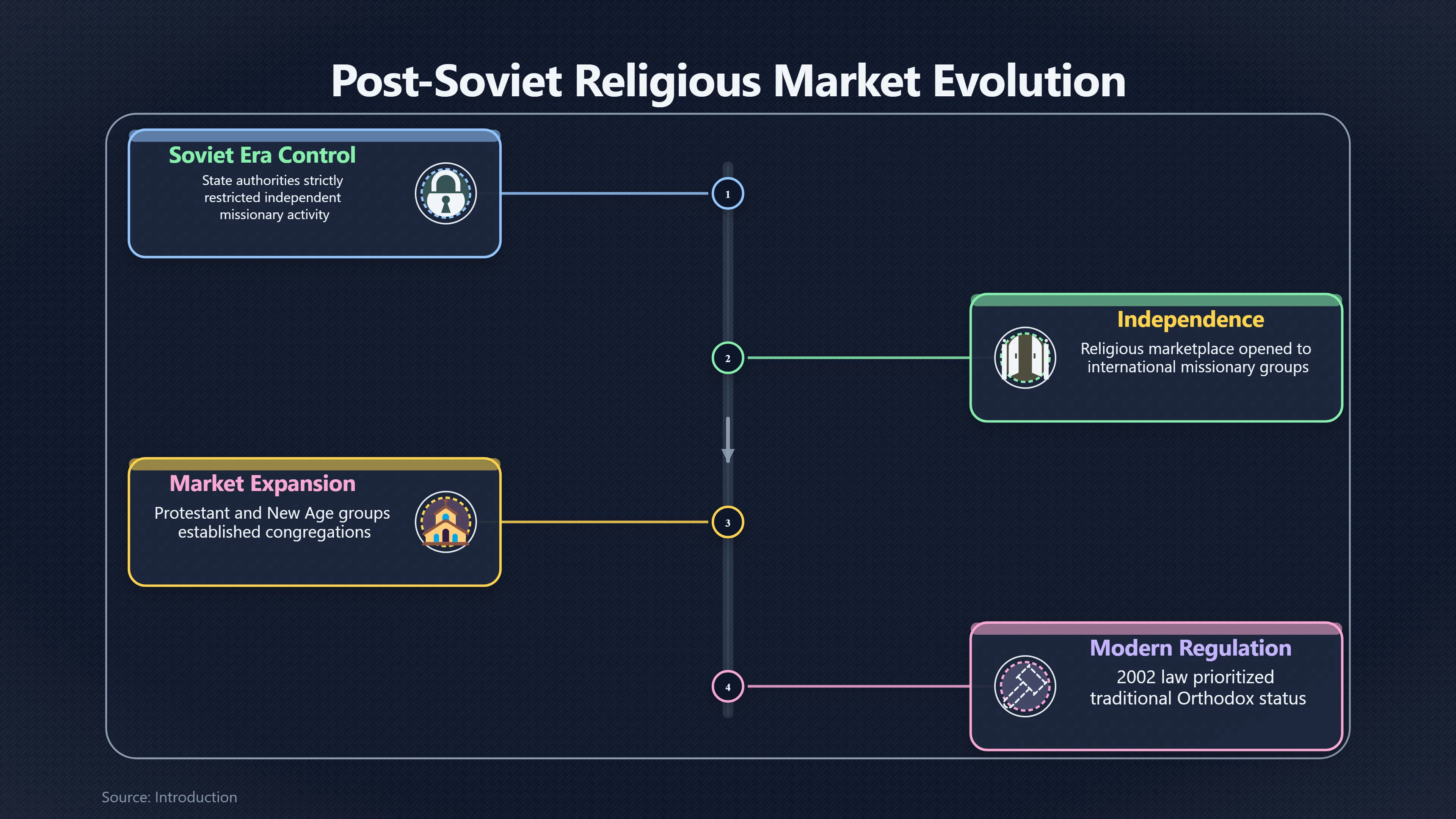
For most of the Soviet period, organised religion operated under tight state control. Orthodox, Catholic and other established communities survived, but missionary activity, independent religious publishing and public evangelism were heavily restricted. Independence in 1991 transformed that environment almost overnight.
Belarus suddenly became part of a wider international religious marketplace. Evangelical Protestant churches expanded their activities, Jehovah’s Witnesses increased public preaching, Hare Krishna devotees became more visible, and missionaries from North America, Western Europe and Asia established congregations or educational projects. Small meditation groups, New Age movements and other spiritual organisations also appeared.
For many Belarusians, these groups represented unfamiliar ideas arriving at a time of economic hardship and political uncertainty. The collapse of Soviet ideology left an ideological vacuum just as society was experiencing inflation, unemployment and rapid social change. In that atmosphere, unfamiliar religions were often interpreted not simply as different beliefs but as potential threats to national identity or family stability.
Unlike countries with long traditions of religious pluralism, Belarus had relatively little recent experience of open competition between faiths. Many people therefore relied on sensational media reports or official warnings rather than direct experience when judging new movements.
How violent groups shaped wider fears
The fear itself did not emerge from nowhere. During the 1990s, several high-profile international incidents involving religious movements received extensive media coverage across the former Soviet Union.
Among the best known were:
- the deadly confrontation involving the Branch Davidians in Waco in 1993;
- the Tokyo subway sarin gas attack carried out by Aum Shinrikyo in 1995;
- reports of mass suicides involving the Order of the Solar Temple and later Heaven’s Gate.
These dramatic events created the impression that unconventional religious movements were inherently manipulative or violent. Russian media, widely consumed in Belarus, repeatedly discussed “destructive sects”, often presenting very different organisations as if they shared similar characteristics.
At the same time, some genuinely abusive movements did exist within the post-Soviet region. Cases involving financial exploitation, psychological manipulation or charismatic leaders claiming supernatural authority received considerable publicity. Those real examples made broader warnings appear plausible, even when directed towards peaceful religious minorities with no comparable record.
The result was a process familiar to students of moral panics: evidence drawn from a small number of exceptional cases became a framework for judging an entire category of unrelated groups.
How the label “sect” expanded
One striking feature of Belarusian public discourse was that sect rarely functioned as a precise religious category.
Instead, the label came to include groups with very different beliefs and histories, including:
- recently established Protestant churches;
- Jehovah’s Witnesses;
- Hare Krishna communities;
- small charismatic Christian congregations;
- meditation and spiritual self-help groups;
- organisations viewed as foreign or insufficiently rooted in Belarusian tradition.
Many of these communities had no history of violence or criminal behaviour in Belarus. Nevertheless, simply being unfamiliar could become grounds for suspicion.
Religious studies scholars have long criticised this approach because it replaces evidence-based assessment with guilt by association. Modern academic research generally distinguishes between questions such as:
- whether a movement commits crimes;
- whether members can leave freely;
- whether leaders use coercion;
- whether ordinary religious beliefs differ from the majority.
Those are separate questions, yet public debate often collapsed them into a single emotionally charged word: sect.
How official policy reinforced public fears
Belarusian authorities increasingly promoted a distinction between “traditional” religions and other groups.
The 2002 religion law recognised the special historical role of the Belarusian Orthodox Church while giving privileged status to several long-established faiths. Registration requirements became stricter, and unregistered religious activity faced legal restrictions. Human rights organisations argued that these policies reinforced public suspicion towards newer religious communities by implying that unfamiliar beliefs were inherently less legitimate.[ecoi.net]ecoi.netUSDOS – US Department of State (Author): “2023 Report on International Religious Freedom: Belarus”, Document #2111825 - ecoi.netJune 26…
Educational materials also reflected this atmosphere. International observers documented school textbooks warning pupils to “beware of sects”, with some editions explicitly describing groups such as Jehovah’s Witnesses, Seventh-day Adventists, Hare Krishnas and various Protestant movements using language that critics regarded as prejudicial rather than educational. State-controlled media likewise frequently contrasted “traditional” religions with allegedly dangerous “sects”.[Refworld]refworld.orgUSCIRF Annual Report 2009 - The Commission's Watch List: Belarus | RefworldMay 1, 2009…
This did not mean every official regarded all minority religions as equally threatening. Rather, the institutional framework encouraged officials to view unfamiliar organisations through a security lens instead of primarily as questions of religious freedom.
Who was harmed by catch-all labelling?
The broad use of the term had practical consequences beyond public opinion.
Peaceful minority communities often faced:
- greater difficulty obtaining legal registration;
- suspicion from landlords and employers;
- reluctance from parents whose children wished to join;
- negative media coverage unrelated to any proven misconduct;
- association with crimes committed by completely different organisations.
Forum 18 has documented cases in which officials questioned whether certain beliefs were “known in Belarus” when considering registration applications, illustrating how unfamiliarity itself could become an administrative obstacle.[forum18.org]forum18.orgForum 18: BELARUS: Order not to register new religious communities?11 December 2018December 11, 2018…
Scholars of religion argue that this environment created a paradox. The more unusual a religious group appeared, the more likely it was to be viewed through stereotypes rather than investigated on its actual conduct.
Separating legitimate concern from moral panic
The post-Soviet experience does not mean every warning about religious movements was unfounded.
Some organisations have exploited followers financially, isolated members from families or exercised extreme psychological control. Governments have a legitimate interest in preventing fraud, abuse, violence and other criminal acts regardless of whether they occur inside religious organisations.
The problem arises when behavioural evidence is replaced by labels.
Modern approaches used by religious studies researchers, psychologists and human rights organisations tend to ask practical questions:
- Are members free to leave?
- Is there evidence of coercion or abuse?
- Have criminal offences been committed?
- Are children protected?
- Is financial activity transparent?
These questions focus on observable conduct rather than theological difference. That distinction is widely regarded as a more reliable safeguard both against genuine abuse and against unjustified discrimination.

Why the panic still matters
The post-Soviet panic over “sects” shaped Belarusian attitudes towards religious diversity for decades. It influenced legislation, education and public discussion long after the initial surge of new religious movements had subsided.
Recent restrictions on religious organisations have been driven primarily by broader political repression rather than by fears of new spiritual movements alone. Nevertheless, the older language of protecting society from dangerous “sects” has remained available as a framework for justifying tighter state oversight of religious life.[USCIRF]uscirf.govBelarus Country Update | USCIRFBelarus Country Update | USCIRF…
For historians and sociologists, the episode illustrates how moral panics often emerge from a mixture of genuine risks and exaggerated generalisations. A small number of destructive movements undoubtedly existed, but treating almost every unfamiliar faith as a potential “sect” obscured important differences between criminal organisations, controversial religious groups and peaceful minority communities. That distinction remains central to understanding both Belarus’s post-Soviet religious history and wider debates about religious freedom across Eastern Europe.
Amazon book picks
Further Reading
Books and field guides related to How Did Every New Faith Become a Sect?. Use these as the next step if you want deeper reading beyond the article.

Combating cult mind control
Addresses manipulation while distinguishing different groups.
The Oxford handbook of new religious movements
Balanced overview of new religious movements.
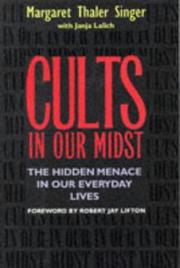
Cults in Our Midst
Explains why societies become anxious about new religious movements.
Bloodlands
First published 2010. Subjects: Massacres, Genocide, World War, 1939-1945, Holocaust, Jewish (1939-1945), Atrocities.
Endnotes
1.
Source: refworld.org
Link:https://www.refworld.org/reference/annualreport/uscirf/2009/en/68070
Source snippet
USCIRF Annual Report 2009 - The Commission's Watch List: Belarus | RefworldMay 1, 2009...
Published: May 1, 2009
2.
Source: forum18.org
Title: Forum 18 Analyses: Belarus
Link:https://www.forum18.org/analyses.php?region=16
3.
Source: ecoi.net
Link:https://www.ecoi.net/en/document/2111825.html
Source snippet
USDOS – US Department of State (Author): “2023 Report on International Religious Freedom: Belarus”, Document #2111825 - ecoi.netJune 26...
4.
Source: forum18.org
Title: Forum 18: BELARUS: Order not to register new religious communities?
Link:https://www.forum18.org/archive.php?article_id=2436
Source snippet
11 December 2018December 11, 2018...
Published: December 11, 2018
5.
Source: uscirf.gov
Title: Belarus Country Update | USCIRF
Link:https://www.uscirf.gov/publications/belarus-country-update
Source snippet
Belarus Country Update | USCIRF...
6.
Source: uscirf.gov
Title: Troubled by New Religion Law in Belarus | USCIRF
Link:https://www.uscirf.gov/news-room/releases-statements/uscirf-troubled-new-religion-law-belarus
Source snippet
January 4, 2024 — USCIRF TROUBLED BY NEW RELIGION LAW IN BELARUS Jan 4, 2024 USCIRF Troubled by New Religion Law in Belarus Washington, D...
Published: January 4, 2024
7.
Source: forum18.org
Link:https://www.forum18.org/archive.php?article_id=2945
Source snippet
The new Religion Law requires that religious teaching of children and adults, sharing faith and publishing religious literature does not...
8.
Source: uscirf.gov
Title: releases report religious freedom belarus
Link:https://www.uscirf.gov/news-room/releases-statements/uscirf-releases-report-religious-freedom-belarus
9.
Source: forum18.org
Title: Forum 18: BELARUS: Repressive draft Religion Law awaits second reading
Link:https://www.forum18.org/archive.php?article_id=2868
10.
Source: ecoi.net
Link:https://www.ecoi.net/de/dokument/2011043.html
11.
Source: refworld.org
Link:https://www.refworld.org/reference/annualreport/usdos/2011/en/82486
12.
Source: refworld.org
Link:https://www.refworld.org/docid/4e734cb464.html
13.
Source: refworld.org
Link:https://www.refworld.org/country%2C%2CUSDOS%2C%2Cblr%2C%2C4cf2d0b369%2C0.html
14.
Source: refworld.org
Link:https://www.refworld.org/reference/annualreport/uscirf/2008/en/58918
15.
Source: refworld.org
Link:https://www.refworld.org/reference/annualreport/usdos/2007/en/5511
16.
Source: refworld.org
Link:https://www.refworld.org/reference/annualreport/usdos/2006/en/36400
17.
Source: refworld.org
Link:https://www.refworld.org/reference/annualreport/usdos/2004/en/18992
18.
Source: refworld.org
Link:https://www.refworld.org/reference/annualreport/usdos/2002/en/32012
19.
Source: uscirf.gov
Link:https://www.uscirf.gov/publication/belarus-country-update
20.
Source: journal-socjournal.ru
Link:https://www.journal-socjournal.ru/index.php/socjour/article/view/8089
21.
Source: osce.org
Link:https://www.osce.org/country/belarus
Additional References
22.
Source: researchgate.net
Link:https://www.researchgate.net/publication/378172695_UNCONVENTIONAL_RELIGIOSITY_AMONG_THE_ORTHODOX_POPULATION_OF_THE_BSSR_IN_THE_1930s_BASED_ON_THE_MATERIALS_FROM_THE_STATE_ARCHIVES_OF_THE_REPUBLIC_OF_BELARUS
Source snippet
(PDF) UNCONVENTIONAL RELIGIOSITY AMONG THE ORTHODOX POPULATION OF THE BSSR IN THE 1930s (BASED ON THE MATERIALS FROM THE STATE ARCHIVES O...
23.
Source: youtube.com
Title: UKRAINE: GREAT WHITE BROTHERHOOD CULT: TRIAL BEGINS
Link:https://www.youtube.com/watch?v=xPM_c1TAAbc
Source snippet
They Buried Themselves Alive For The End Of The World...
24.
Source: researchgate.net
Link:https://www.researchgate.net/publication/352847434_The_Anti-Cult_Discourse_of_Print_Media_Problematization_of_the_Role_of_the_Anti-Cult_Movement
25.
Source: journals.rcsi.science
Link:https://journals.rcsi.science/2313-2272/article/view/323031
26.
Source: journals.rudn.ru
Link:https://journals.rudn.ru/sociology/article/view/33929/ru_RU
27.
Source: cambridge.org
Title: Religious affiliation and the politics of post-Soviet identity: (Chapter 17)
Link:https://www.cambridge.org/core/books/abs/soviet-and-postsoviet-identities/religious-affiliation-and-the-politics-of-postsoviet-identity/E6660EB4A0B19D57D76F22518D43FD10
28.
Source: discovery.ucl.ac.uk
Title: ucl.ac.uk Religion and Social Capital: the Case of Protestants in Belarus
Link:https://discovery.ucl.ac.uk/id/eprint/10155477/
29.
Source: youtube.com
Title: The Anti-Cult Movement in Russia
Link:https://www.youtube.com/watch?v=Vc9bkR-PgdQ
Source snippet
Terrifying sects and cults of the USSR and Russia...
30.
Source: youtube.com
Title: They Buried Themselves Alive For The End Of The World
Link:https://www.youtube.com/watch?v=2EmkokT0o44
Source snippet
The Anti-Cult Movement in Russia...
31.
Source: youtube.com
Title: Terrifying sects and cults of the USSR and Russia
Link:https://www.youtube.com/watch?v=gVTAj6CrVqE
Source snippet
Contemplative History of Modern Russia...
Topic Tree