Within Iceland Panics
Why Iceland Burned Accused Witches
Imported law, local quarrels and religious authority turned accusations of magic into executions in seventeenth-century Iceland.
On this page
- How continental witch law reached Iceland
- Why the accused were mostly men
- How courts ended the executions
Page outline Jump by section
Introduction
Iceland’s witch hunts were brief by European standards, but they reveal with unusual clarity how legal systems, religious authority and local conflict could combine to produce deadly persecution. Between 1625 and 1683, 21 people were executed for practising magic, almost all of them men. Rather than emerging from uncontrolled mob violence, the Icelandic prosecutions were driven by courts that absorbed ideas from continental Europe while applying them to local disputes over illness, livestock losses, reputation and personal rivalry. The result was a judicial process that transformed rumours and accusations into capital crimes. Although Iceland never experienced the vast witch panics seen in parts of Germany or Scotland, its trials demonstrate how imported legal ideas and determined officials could create a machinery of persecution even in a small, scattered society.[Galdrasyning]galdrasyning.isThe Witch-hunts in Iceland – Galdrasýning á StröndumThe Witch-hunts in Iceland – Galdrasýning á Ströndum…
How continental witch law reached Iceland
For centuries, Icelanders lived with beliefs that magic could heal, protect or harm. Magical signs, charms and handwritten spell books circulated alongside orthodox Christianity. What changed in the seventeenth century was not the existence of magical belief but the legal meaning attached to it.
Following the Protestant Reformation, Iceland remained under the Danish Crown. Clergymen, sheriffs and other officials increasingly received education in Denmark and northern Germany, where European demonological literature portrayed harmful magic as a grave religious and criminal offence. These ideas filtered into Icelandic legal culture through sermons, legal practice and learned writings rather than through popular folklore alone.[Galdrasyning]galdrasyning.isThe Witch-hunts in Iceland – Galdrasýning á StröndumThe Witch-hunts in Iceland – Galdrasýning á Ströndum…
Yet Iceland never adopted continental demonology wholesale. Court records show that accusations usually centred on practical acts:
- causing illness to neighbours or livestock;
- possessing grimoires or magical manuscripts;
- using magical signs or runes;
- cursing individuals during local disputes.
Explicit accusations of organised devil worship, witches’ sabbaths or satanic conspiracies—the hallmarks of many central European witch hunts—appear only rarely in Icelandic records. The legal framework became more severe, but the accusations themselves remained rooted in everyday conflicts.[Galdrasyning]galdrasyning.isThe Witch-hunts in Iceland – Galdrasýning á StröndumThe Witch-hunts in Iceland – Galdrasýning á Ströndum…
The machinery of persecution was judicial, not mob-driven
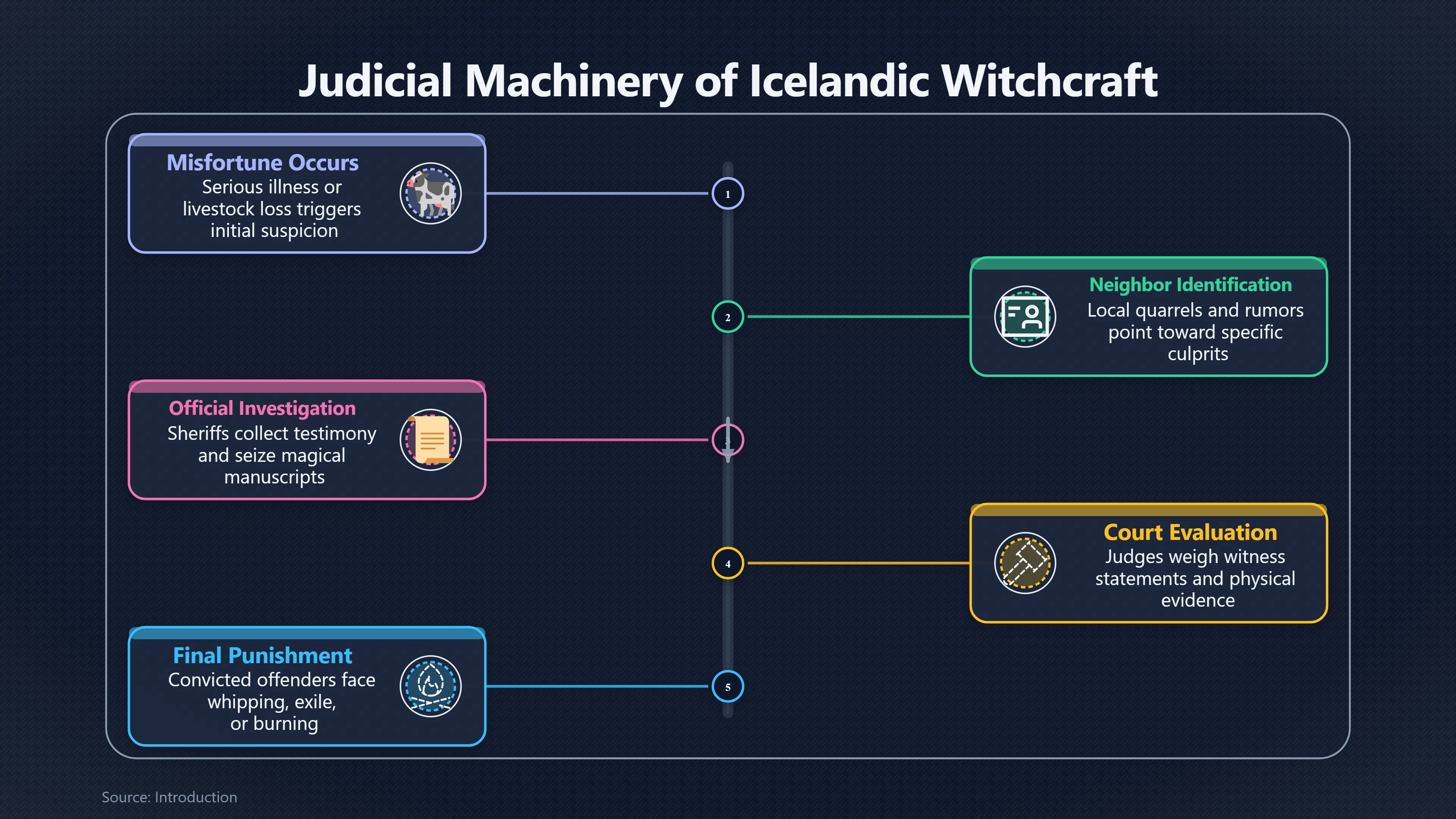
The Icelandic witch hunts were neither spontaneous outbreaks of panic nor simple reflections of widespread superstition. They depended upon a chain of institutions that converted suspicion into execution.
Typically, a prosecution followed a recognisable sequence:
- A misfortune demanded explanation. Serious illness, unexplained deaths, livestock losses or persistent bad luck raised suspicion.
- Neighbours identified a possible culprit. Existing quarrels, rumours or reputations for magical knowledge often directed suspicion towards particular individuals.
- Local officials investigated. Sheriffs collected testimony and seized magical books or written charms when available.
- The courts evaluated the evidence. Witness statements, confessions and the possession of magical texts became legally significant.
- Authorities imposed punishment. Convicted offenders could receive whipping, exile or, in the most serious cases, execution by burning.
This process meant that elite officials were indispensable. Ordinary villagers might accuse, but judges and clergy decided whether accusations became capital cases. Modern historians therefore see Iceland’s witch hunts as products of interaction between local fears and state authority rather than examples of uncontrolled communal violence.[Galdrasyning]galdrasyning.isThe Witch-hunts in Iceland – Galdrasýning á StröndumThe Witch-hunts in Iceland – Galdrasýning á Ströndum…
Why the accused were mostly men
Perhaps the most striking feature of Iceland’s witch hunts is that almost every executed person was male.
Across much of Europe, roughly three-quarters of those accused of witchcraft were women. Iceland was an exceptional case. Around 90% of those prosecuted were men, and among the confirmed executions only one woman—Þuríður Ólafsdóttir in 1678—was burned for witchcraft.[Galdrasyning]galdrasyning.isThe Witch-hunts in Iceland – Galdrasýning á StröndumThe Witch-hunts in Iceland – Galdrasýning á Ströndum…
Historians explain this unusual pattern through Iceland’s own traditions of magical knowledge rather than through any absence of misogyny.
Several factors mattered:
- Literacy was overwhelmingly male. Many magical practices depended on reading or copying manuscripts, an activity associated with educated men.
- Magic was linked to learned knowledge. Icelandic concepts of magical expertise emphasised specialised learning rather than exclusively female folk practice.
- Clergy and educated laymen occupied ambiguous positions. Men who possessed magical books or claimed unusual knowledge could attract suspicion even while similar learning was respected in other contexts.
- Local expectations differed from continental stereotypes. Although European demonology often portrayed women as especially susceptible to the Devil, Icelandic courts more commonly associated dangerous magical knowledge with men.
This did not mean women escaped suspicion entirely. Women appeared among the accused and in rumours about magical practices, but the legal focus fell overwhelmingly upon men because Icelandic ideas about who possessed magical expertise differed from those elsewhere in Europe.[galdrasyning.is]galdrasyning.isThe Witch-hunts in Iceland – Galdrasýning á StröndumThe Witch-hunts in Iceland – Galdrasýning á Ströndum…

The Kirkjuból affair shows how accusations became convictions
The most famous Icelandic witch trial demonstrates how personal conviction, religious authority and judicial procedure reinforced one another.
In the mid-1650s, the Reverend Jón Magnússon became convinced that prolonged illness and disturbing events affecting his household resulted from sorcery. He accused two members of his congregation—a father and son, both named Jón Jónsson—of attacking him through magic.
During the investigation:
- both men admitted possessing magical books;
- confessions included claims about using magical symbols and spells;
- their admissions became decisive evidence;
- both were convicted and burned in 1656.
The story did not end there. Convinced that supernatural attacks continued, the minister accused another family member, Þuríður Jónsdóttir. This prosecution failed. She successfully challenged the accusation and ultimately received compensation after the court concluded that the previous allegations had been unjustified.
The Kirkjuból affair illustrates both the power and the limits of the persecution system. Clerical authority could initiate prosecutions, but courts did not automatically accept every accusation. Judicial scepticism sometimes emerged, especially as enthusiasm for witch prosecutions declined later in the century.[Wikipedia]WikipediaKirkjuból witch trialKirkjuból witch trial
Why the persecutions never became a continental-style mass panic
Compared with parts of Germany, Switzerland or Scotland, Iceland’s witch hunts remained numerically limited.
Several characteristics restrained the scale:
- Iceland’s total population was only around 50,000.
- Roughly 170 people are known to have been accused across approximately 130 recorded cases.
- Many defendants were acquitted or received lesser punishments.
- There is no convincing evidence that Icelandic courts routinely employed judicial torture to extract confessions.
These differences mattered. In many European witch hunts, torture generated chains of accusations that rapidly expanded prosecutions. Iceland’s more limited judicial practices reduced the likelihood of self-reinforcing mass accusations, even though executions still occurred.[Galdrasyning]galdrasyning.isThe Witch-hunts in Iceland – Galdrasýning á StröndumThe Witch-hunts in Iceland – Galdrasýning á Ströndum…
How courts ended the executions
The end of Iceland’s witch hunts came through legal change rather than through a sudden collapse of belief in magic.
The last execution for witchcraft occurred in 1683. Soon afterwards, Danish authorities required that capital sentences for sorcery receive confirmation from higher judicial authorities in Copenhagen before they could be carried out. These higher courts proved markedly more sceptical about witchcraft prosecutions and declined to endorse further death sentences.[Galdrasyning]galdrasyning.isGaldramál og galdrabrennur – Galdrasýning á StröndumGaldramál og galdrabrennur – Galdrasýning á Ströndum…
The consequences became increasingly visible:
- executions ceased after 1683;
- attempted prosecutions became less successful;
- by 1719, Iceland’s national assembly criticised a sheriff for wasting the court’s time with a witchcraft accusation.
The shift did not mean that belief in magic disappeared. Magical manuscripts, folk healing and stories about supernatural forces continued to exist within Icelandic culture. What changed was the willingness of courts to treat such beliefs as grounds for execution.[Galdrasyning]galdrasyning.isGaldramál og galdrabrennur – Galdrasýning á StröndumGaldramál og galdrabrennur – Galdrasýning á Ströndum…
Why the Icelandic witch hunts still matter
The Icelandic witch hunts are often remembered because they reversed Europe’s usual gender pattern, but their deeper historical importance lies elsewhere.
They demonstrate that persecution depended less on universal fear than on institutions capable of converting suspicion into legal certainty. Imported legal theories, Lutheran religious discipline, ambitious local officials and ordinary neighbourhood conflicts together produced a system in which accusations of magic could become capital crimes.
The episode also challenges popular images of witch hunts as irrational mob violence. Iceland’s experience shows that persecution could proceed through orderly legal procedures, written evidence and official authority. Courts, clergy and sheriffs supplied the machinery that transformed local disputes into judicial killings.
For historians, Iceland therefore offers an important comparative case. Its relatively small number of executions, unusual focus on male defendants and well-preserved court records make it easier to see how European ideas about witchcraft were adapted to local conditions rather than simply imposed unchanged. The result is a clearer understanding of how collective belief, institutional power and legal procedure combined to produce persecution in one of Europe’s smallest early modern societies.[galdrasyning.is]galdrasyning.isThe Witch-hunts in Iceland – Galdrasýning á StröndumThe Witch-hunts in Iceland – Galdrasýning á Ströndum…
Amazon book picks
Further Reading
Books and field guides related to Why Iceland Burned Accused Witches. Use these as the next step if you want deeper reading beyond the article.
Extraordinary Popular Delusions and the Madness of Crowds
Rating: 4.0/5 from 5 Google Books ratings
Provides wider context for historical panics.
The witch-hunt in early modern Europe
Authoritative overview of European witch persecutions.


Endnotes
1.
Source: galdrasyning.is
Title: The Witch-hunts in Iceland – Galdrasýning á Ströndum
Link:https://galdrasyning.is/en/the-witch-hunts-in-iceland/
Source snippet
The Witch-hunts in Iceland – Galdrasýning á Ströndum...
2.
Source: Wikipedia
Title: Witch trials in Iceland
Link:https://en.wikipedia.org/wiki/Witch_trials_in_Iceland
3.
Source: galdrasyning.is
Title: Galdramál og galdrabrennur – Galdrasýning á Ströndum
Link:https://galdrasyning.is/en/galdramal-og-galdrabrennur/
Source snippet
Galdramál og galdrabrennur – Galdrasýning á Ströndum...
4.
Source: Wikipedia
Title: Kirkjuból witch trial
Link:https://en.wikipedia.org/wiki/Kirkjub%C3%B3l_witch_trial
5.
Source: galdrasyning.is
Title: the executed
Link:https://galdrasyning.is/en/the-executed/
6.
Source: galdrasyning.is
Link:https://galdrasyning.is/en/viskubrunnur/
7.
Source: galdrasyning.is
Link:https://galdrasyning.is/en/galdrasyning-a-holmavik/
8.
Source: galdrasyning.is
Link:https://galdrasyning.is/en/um-okkur/
9.
Source: shop.galdrasyning.is
Title: is Angurgapi
Link:https://shop.galdrasyning.is/products/angurgapi-the-witch-hunts-in-iceland
Additional References
10.
Source: flickr.com
Title: The Executed, Museum of Icelandic Sorcery and Witchcraft ~… | Flickr
Link:https://www.flickr.com/photos/61550823%40N02/54796949859/
Source snippet
September 18, 2025 — THE EXECUTED, MUSEUM OF ICELANDIC SORCERY AND WITCHCRAFT ~ HÖFÐAGATA 14, 510 HÓLMAVÍK, ICELAND [Input] [Input] THE E...
Published: September 18, 2025
11.
Source: historiska.se
Title: Among the collections of the Swedish History Museum are two
Link:https://historiska.se/en/explore-history/history-hub/two-icelandic-books-of-black-magic/
Source snippet
Two Icelandic books of black magic - Historiska museetNovember 10, 2025 — TWO ICELANDIC BOOKS OF BLACK MAGIC Magical beliefs were part of...
Published: November 10, 2025
12.
Source: guidetoiceland.is
Title: Top 7 Most Infamous Icelanders of History | Guide to Iceland
Link:https://guidetoiceland.is/history-culture/the-top-7-most-infamous-icelanders-of-history
Source snippet
Photo from Wikimedia, Creative Commons, by an unknown artist. No edits made. Icelandic history includes a long tradition of sorcery...
13.
Source: guidetoiceland.is
Title: Witchcraft and Magic in Iceland | Guide to Iceland
Link:https://guidetoiceland.is/history-culture/witchcraft-in-iceland
Source snippet
May 12, 2026 — ICELANDIC WITCHCRAFT: HISTORY OF THE AGE OF FIRE & WITCH TRIALS Last updated: May 12, 2026 Image: Xiaochen Tian By Xiaoche...
Published: May 12, 2026
14.
Source: reddit.com
Link:https://www.reddit.com/r/AskHistorians/comments/1p3v91s/why_were_male_witches_more_common_in_some_parts/
Source snippet
Why were male witches more common in some parts of Europe during the witch trials?...
15.
Source: youtube.com
Title: The Reykjavik Confessions: A case of false memories
Link:https://www.youtube.com/watch?v=dfipCqxa210
Source snippet
People Convicted Of Murder Even Though A Body Was Never Found...
16.
Source: en-academic.com
Link:https://en-academic.com/dic.nsf/enwiki/9769412
17.
Source: scancan.net
Link:https://scancan.net/index.php/scancan/article/view/266
18.
Source: everything.explained.today
Link:https://everything.explained.today/Kirkjub%C3%B3l_witch_trial/
19.
Source: youtube.com
Title: The Suspicious Case Of The Reykjavik Confessions
Link:https://www.youtube.com/watch?v=nR7XoejxsGo
Source snippet
The Reykjavik Confessions: A case of false memories...
Topic Tree