Within Costa Rica Panics
Who Became Costa Rica's Modern Folk Devils?
Disease fears and Satanism claims turned gay men and heavy-metal fans into symbols of hidden danger and moral collapse.
On this page
- HIV fear and persecution of gay men
- Heavy metal and the Satanism scare
- Media labelling, policing and public humiliation
Page outline Jump by section
Introduction
During the 1980s and early 1990s, two very different groups became symbols of public anxiety in Costa Rica: gay men during the emergence of HIV/AIDS, and heavy-metal fans during a brief but intense Satanism scare. Neither group posed the broad social threat that many headlines and public statements implied. Instead, both became what sociologists call “folk devils” – visible minorities onto whom wider fears about disease, morality, youth culture and social change were projected.
These episodes are among Costa Rica’s clearest examples of moral panic rather than mass hysteria. HIV/AIDS was a genuine public-health emergency, and some crimes associated with vandalism or drug use occurred within youth culture just as they did elsewhere. The panic arose when those real concerns were transformed into sweeping claims that entire communities represented hidden danger or moral collapse. Historians now view these episodes as important examples of how media coverage, policing and public opinion combined to stigmatise already vulnerable groups while often obscuring the real issues.[sa.cr]scielo.sa.crCosta RicaLa criminalización de la diversidad sexual y el inicio del activismo gay en Costa Rica, 1985-1989May 31, 2015…
HIV Fear and the Persecution of Gay Men
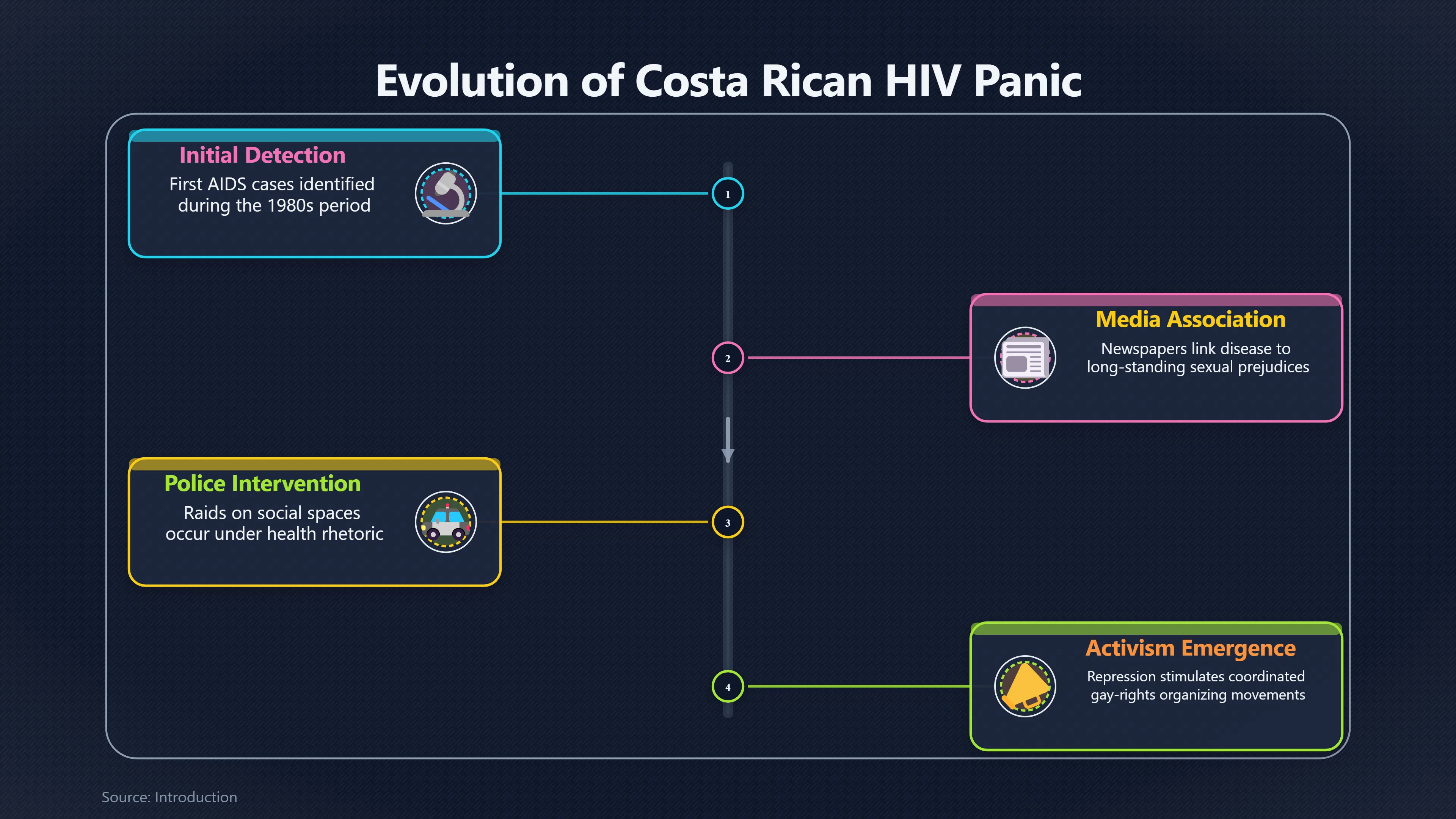
Costa Rica identified its first AIDS cases during the 1980s, as countries around the world struggled to understand a frightening new disease. Medical authorities faced a rapidly evolving epidemic with limited scientific knowledge, while newspapers frequently presented HIV alongside long-standing prejudices against homosexuality.
The disease quickly became associated with gay men because the earliest documented cases in Costa Rica, as elsewhere in much of the Americas, were concentrated among men who had sex with men. Epidemiological studies confirmed that this reflected the early pattern of transmission rather than the nature of the virus itself. As surveillance improved, increasing heterosexual and perinatal transmission demonstrated that HIV was never confined to one community.[PubMed]pubmed.ncbi.nlm.nih.govPub Med The epidemiology of AIDS and HIV infection in Costa RicaThe epidemiology of AIDS and HIV infection in Costa Rica - PubMed…
The social consequences, however, extended far beyond medical reality. Historian José Daniel Jiménez Bolaños argues that the arrival of HIV accelerated an existing process of criminalising sexual diversity rather than creating it from nothing. Public discussion increasingly portrayed gay men not simply as people at greater medical risk but as threats to public morality. Newspaper reporting frequently blurred the distinction between illness, sexuality and criminality, encouraging public support for discriminatory policies.[SciELO Costa Rica]scielo.sa.crCosta RicaLa criminalización de la diversidad sexual y el inicio del activismo gay en Costa Rica, 1985-1989May 31, 2015…
Police raids on places where gay men socialised became an especially visible feature of the period. These operations were often justified through public-health rhetoric but also reflected broader efforts to remove homosexuality from public life. Contemporary scholarship notes that many citizens accepted or even applauded these actions because fear of AIDS merged with older religious and cultural prejudices.[SciELO Costa Rica]scielo.sa.crCosta RicaLa criminalización de la diversidad sexual y el inicio del activismo gay en Costa Rica, 1985-1989May 31, 2015…
Ironically, the persecution also helped stimulate organised activism. As discrimination intensified, Costa Rica saw the emergence of more coordinated gay-rights organising, with activists challenging both police practices and media stereotypes. Historians therefore see the late 1980s not only as a period of repression but also as a turning point in the country’s LGBT rights movement.[SciELO Costa Rica]scielo.sa.crCosta RicaLa criminalización de la diversidad sexual y el inicio del activismo gay en Costa Rica, 1985-1989May 31, 2015…
Heavy Metal and the Satanism Scare
A different moral panic emerged in 1992, centred on Costa Rica’s growing heavy-metal scene. Although inspired by international fears linking rock music to Satanism, the Costa Rican episode developed its own local dynamics.
The immediate catalyst was controversy surrounding a heavy-metal concert. Some politicians, religious voices and sections of the media portrayed metal fans as potential Satanists whose music supposedly encouraged violence, occult practices and social disorder. Black clothing, long hair, band logos and album artwork became symbols of supposed moral danger rather than simply expressions of musical taste.[Revistas UCR]archivo.revistas.ucr.ac.crRevistas UCRLa inolvidable edadRevistas UCRLa inolvidable edad
The response extended beyond rhetoric. Contemporary accounts and later historical research describe police intervention that included arrests without clear cause, searches of private homes and the confiscation of records, clothing and printed material associated with heavy-metal culture. Critics argued that these measures treated appearance itself as evidence of criminality.[crai.iis.ucr.ac.cr]crai.iis.ucr.ac.crDetalles de: Satanismo, rock y juventud / › CRAI/IIS KohaDetalles de: Satanismo, rock y juventud / › CRAI/IIS Koha
Researchers studying the episode describe it as a classic moral panic. The metal community was transformed into a symbolic enemy whose supposed beliefs mattered more than the behaviour of individual members. The overwhelming majority of fans were ordinary young people participating in a global musical subculture rather than organised Satanists, yet public discussion often collapsed those distinctions.[Revistas UCR]archivo.revistas.ucr.ac.crRevistas UCRLa inolvidable edadRevistas UCRLa inolvidable edad
Costa Rica’s experience also reflected wider international trends. Across North America and parts of Latin America during the late 1980s and early 1990s, heavy metal became associated with unfounded claims about occult conspiracies, ritual crime and hidden Satanic networks despite weak supporting evidence.[Office of Justice Programs]ojp.govOpen source on ojp.gov.
How the Media Created Modern Folk Devils
Although the two panics concerned different communities, they shared remarkably similar mechanisms.
In both cases, visible identity markers became shorthand for hidden danger:
- Gay identity became associated with disease, immorality and contamination.
- Heavy-metal fashion became associated with Satanism and criminality.
- Individual incidents were treated as evidence about entire populations.
- Public fears were amplified through repeated media coverage and official statements.
- Police action reinforced the impression that extraordinary threats existed.
Historical studies of Costa Rican newspapers show that homosexuality had already been framed as a topic for crime reporting before the AIDS crisis. HIV strengthened these existing narratives rather than replacing them. Likewise, heavy-metal coverage often relied on stereotypes imported from international Satanism scares while paying little attention to the everyday experiences of local fans.[una.ac.cr]repositorio.una.ac.crLa sexualidad como suceso. Análisis de la percepción periodística de la homosexualidad entre mediados de 1965 y finales de 1980…
Policing, Public Humiliation and Lasting Consequences
Neither panic produced the sustained violence seen in some historical persecutions elsewhere, but both had significant human costs.
For gay men, the consequences included public shaming, discrimination, fear of arrest and barriers to seeking healthcare at precisely the moment when effective public-health communication was most needed. Stigma complicated HIV prevention because many people avoided testing or discussion for fear of social consequences. Researchers examining Costa Rica’s HIV history argue that later prevention efforts increasingly shifted away from moral judgement towards education and support as understanding of the disease improved.[SciELO Costa Rica]scielo.sa.crSciELO Costa RicaEntre la ciencia y la cultura: La conformación de discursos médicos sobre la homosexualidad en el contexto del surgimien…
For heavy-metal fans, the panic reinforced suspicion of youth subcultures. Young people could attract police attention simply because of their appearance or musical interests. Although the panic faded within months, it remained an important memory within Costa Rica’s alternative music scene and has since become a case study in how rapidly moral entrepreneurs can construct a symbolic threat from a relatively small cultural movement.[crai.iis.ucr.ac.cr]crai.iis.ucr.ac.crDetalles de: Satanismo, rock y juventud / › CRAI/IIS KohaDetalles de: Satanismo, rock y juventud / › CRAI/IIS Koha

Why These Episodes Still Matter
Today these episodes are remembered less because they exposed genuine hidden dangers than because they reveal how societies respond to uncertainty.
The HIV crisis demonstrates how a real epidemic can become entangled with existing prejudice. Fear of infection was understandable, but the identification of gay men as collective villains deepened discrimination while offering little help in controlling the disease.
The 1992 metal panic illustrates a similar process in another setting. A youth subculture that challenged conventional ideas about appearance and music became a convenient symbol of fears about moral decline, despite little evidence that metal fans represented an organised social menace.
Taken together, these episodes show that Costa Rica’s modern moral panics often centred not on imaginary events but on real anxieties attached to the wrong targets. Disease, youth culture and rapid social change were genuine concerns. The lasting historical lesson is how easily those concerns became attached to visible minorities whose difference made them convenient symbols of broader cultural unease.
Amazon book picks
Further Reading
Books and field guides related to Who Became Costa Rica's Modern Folk Devils?. Use these as the next step if you want deeper reading beyond the article.


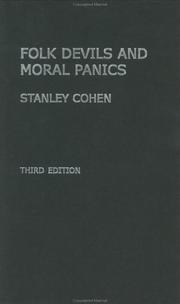
Folk Devils and Moral Panics the Creation of the Mods and Roc...
First published 1972. Subjects: Youth, great britain, Deviant behavior, Case studies, Subculture, Young adults.

Endnotes
1.
Source: archivo.revistas.ucr.ac.cr
Title: Revistas UCRLa inolvidable edad
Link:https://archivo.revistas.ucr.ac.cr/index.php/dialogos/article/download/34767/34443?inline=1
2.
Source: repositorio.una.ac.cr
Link:https://repositorio.una.ac.cr/items/e80a2ce4-a57b-4e16-baf2-82b8488ac1f5
Source snippet
La sexualidad como suceso. Análisis de la percepción periodística de la homosexualidad entre mediados de 1965 y finales de 1980...
3.
Source: crai.iis.ucr.ac.cr
Title: Detalles de: Satanismo, rock y juventud / › CRAI/IIS Koha
Link:https://crai.iis.ucr.ac.cr/bib/46370
4.
Source: scielo.sa.cr
Link:https://www.scielo.sa.cr/scielo.php?pid=S2215-24662016000100060&script=sci_arttext
Source snippet
Costa RicaLa criminalización de la diversidad sexual y el inicio del activismo gay en Costa Rica, 1985-1989May 31, 2015...
Published: May 31, 2015
5.
Source: pubmed.ncbi.nlm.nih.gov
Title: Pub Med The epidemiology of AIDS and HIV infection in Costa Rica
Link:https://pubmed.ncbi.nlm.nih.gov/8339112/
Source snippet
The epidemiology of AIDS and HIV infection in Costa Rica - PubMed...
6.
Source: pubmed.ncbi.nlm.nih.gov
Link:https://pubmed.ncbi.nlm.nih.gov/8574148/
Source snippet
HIV/AIDS in Costa Rica: epidemiological and sociological features, 1993 - PubMed...
7.
Source: scielo.sa.cr
Link:https://www.scielo.sa.cr/scielo.php?pid=S2215-41752017000100419&script=sci_arttext
Source snippet
SciELO Costa RicaEntre la ciencia y la cultura: La conformación de discursos médicos sobre la homosexualidad en el contexto del surgimien...
8.
Source: revistas.uned.ac.cr
Link:https://revistas.uned.ac.cr/index.php/rupturas/article/view/1121
Source snippet
La criminalización de la diversidad sexual y el inicio del activismo gay en Costa Rica, 1985-1989 | Revista Rupturas...
9.
Source: ojp.gov
Link:https://www.ojp.gov/ncjrs/virtual-library/abstracts/satanism-myth-and-reality-contemporary-moral-panic
10.
Source: ojp.gov
Title: Office of Justice Programs Satanism Scare | Office of Justice Programs
Link:https://ojp.gov/ncjrs/virtual-library/abstracts/satanism-scare
11.
Source: scielo.sa.cr
Link:https://www.scielo.sa.cr/scielo.php?pid=S2215-24662021000200175&script=sci_arttext
12.
Source: revistas.ucr.ac.cr
Link:https://revistas.ucr.ac.cr/index.php/rdialogos/user/setLocale/en?source=%2Findex.php%2Frdialogos%2Farticle%2Fview%2F766%3FarticlesBySimilarityPage%3D8
13.
Source: revistas.ucr.ac.cr
Link:https://revistas.ucr.ac.cr/index.php/rdialogos/article/view/766
14.
Source: ojp.gov
Link:https://ojp.gov/ncjrs/virtual-library/abstracts/newspapers-and-antisatanism-movement-content-analysis
15.
Source: ojp.gov
Link:https://www.ojp.gov/ncjrs/virtual-library/abstracts/stoners-drugs-demons-and-delinquency
16.
Source: pubmed.ncbi.nlm.nih.gov
Link:https://pubmed.ncbi.nlm.nih.gov/12315654/
17.
Source: scielo.sa.cr
Link:https://www.scielo.sa.cr/scielo.php?lng=en&nrm=iso&pid=S2215-24662016000100060&script=sci_abstract&tlng=es
18.
Source: scielo.sa.cr
Link:https://www.scielo.sa.cr/scielo.php?pid=S2215-24662016000100060&script=sci_abstract
Additional References
19.
Source: researchgate.net
Link:https://www.researchgate.net/publication/342723774_Satanismo_y_eventos_paranormales_en_el_Diario_Extra_durante_la_decada_de_1990_Muestras_del_sensacionalismo_y_la_optica_neoconservadora_en_la_prensa_escrita_costarricense
Source snippet
Satanismo y eventos paranormales en el Diario Extra, durante la década de 1990. Muestras del sensacionalismo y la óptica neoc...
20.
Source: youtube.com
Link:https://www.youtube.com/watch?v=u06KYdaxRoQ
Source snippet
Historias de algunos de los primeros movimientos de la diversidad sexual en Costa Rica...
21.
Source: youtube.com
Link:https://www.youtube.com/watch?v=dJsrsjihLVg
Source snippet
Panico satanico años 90 metal Rey Rata - Pánico Satánico ft. Dj Scorpio 69 (Lyrics Video) [Darkwave / Post Punk Mexicano] 🦇🇲🇽 Rey Rata...
22.
Source: youtube.com
Title: M.Sc. José Daniel Jiménez Bolaños, Director de la revista
Link:https://www.youtube.com/watch?v=o0QgiMLkesk
Source snippet
¡En vivo! Diversidad Sexual e Identidad de Género desde la perspectiva jurídica y humanista...
23.
Source: youtube.com
Link:https://www.youtube.com/watch?v=ZpGGIasLNW0
Source snippet
El pánico satánico de los 80 y 90...
24.
Source: youtube.com
Title: El pánico satánico de los 80 y 90
Link:https://www.youtube.com/watch?v=2zGaPHUFmGQ
Source snippet
Documental - La historia oculta del #VIH...
25.
Source: kimuk.conare.ac.cr
Title: KUCR a04cb3ac49e5ca4dcd69cbf25394968c
Link:https://kimuk.conare.ac.cr/Record/KUCR_a04cb3ac49e5ca4dcd69cbf25394968c
26.
Source: tandfonline.com
Link:https://www.tandfonline.com/doi/abs/10.1080/02732173.1992.9981984
27.
Source: catalogosiidca.csuca.org
Link:https://catalogosiidca.csuca.org/Record/UCR.000563523
28.
Source: journals.sagepub.com
Link:https://journals.sagepub.com/doi/10.1177/009164719202000317
Topic Tree