How Fear and Rumour Spread in Bhutan
Bhutan does not have a well-documented history of classic witch trials, organised “cult” violence or large outbreaks of mass psychogenic illness comparable with better-known cases elsewhere.
Page outline Jump by section
Introduction
These episodes matter because they show how collective fear develops within Bhutan’s particular setting: small, closely connected communities; strong religious traditions; rapid modernisation; and a media system transformed by near-universal use of social platforms. They also demonstrate why supernatural belief, religious devotion and cultural conservation should not automatically be called hysteria. The central question is usually not whether Bhutanese people are unusually credulous, but how uncertainty, trusted social networks and official authority shape what becomes believable.
What the evidence does — and does not — show
The available record is unusually thin. English-language newspapers, academic journals and public-health literature do not reveal a recognised Bhutanese equivalent of the Salem witch trials, the Tanganyika laughter epidemic or the recurring school possession outbreaks documented in Nepal and parts of South-East Asia. That absence should not be converted into an invented national tradition of “mass hysteria”.
There are several possible reasons for the gap. Bhutan had a small and tightly controlled media environment for much of the twentieth century, while many local experiences circulated through oral accounts rather than newspapers or clinical reports. Behaviour described within a community as spirit disturbance, misfortune or ritual pollution may never have entered medical literature. Conversely, supernatural stories later presented as historical incidents may be folklore rather than evidence of a collective crisis.
This distinction is especially important because Bhutanese religious life includes protective rituals, sacred landscapes, prophecies, spirit narratives and accounts of miraculous religious figures. Such beliefs are ordinary parts of a living religious culture. They become relevant to the history of panic only when a perceived threat spreads widely, alters behaviour, provokes coercion or prompts an organised response from authorities.
“Cult” is similarly unreliable as a neutral category. Bhutan’s documented religious disputes usually concern registration, conversion, proselytising and cultural preservation rather than isolated authoritarian communities of the kind commonly described as cults. The label is more often used polemically by opponents than established through evidence about a group’s structure or conduct.
The eastern Bhutan headhunter scare
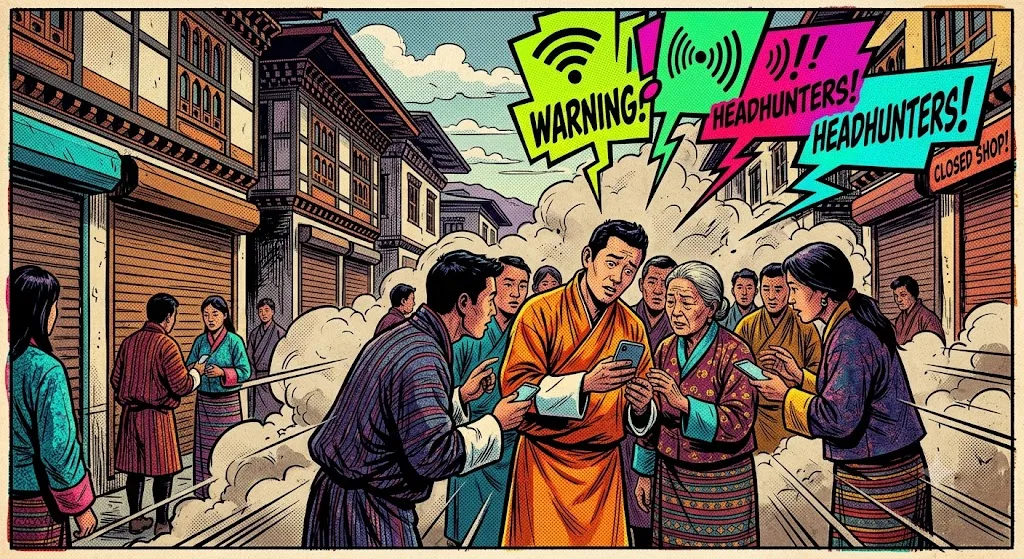
Bhutan’s clearest documented rumour panic began in eastern districts in 2018. Stories circulated that strangers were collecting human heads, allegedly for use as offerings connected with major construction projects. In Trashigang, Kuensel reported shops closing early, normally busy streets becoming quiet and residents restricting their movements. The alarm spread even though officials had no confirmed case of anyone being abducted or beheaded.[kuenselonline.com]kuenselonline.comHeadhunter rumor goes viral in eastern BhutanHeadhunter rumor goes viral in eastern Bhutan. 1;. News. Headhunter rumor goes viral in east…
The rumour drew strength from a recognisable South Asian story pattern: the belief that bridges, dams or large buildings require human sacrifice to secure their foundations. Such tales often appear during periods of rapid construction, when distant contractors, unfamiliar workers and unexplained economic change enter rural life. The Bhutanese version gained additional credibility through repetition between relatives and neighbours. A warning from someone personally trusted could feel more persuasive than an official denial.
The panic had real social effects even without a real headhunter. People avoided travelling alone, parents worried about children and businesses closed before dark. This is what makes the case more than an amusing piece of folklore. A rumour became socially true in its consequences: daily life changed because enough people acted as though the danger might exist.
Later Bhutanese media-literacy material used the incident as an example of how fear can validate itself. Once quiet streets, nervous conversations and unusual precautions became visible, they appeared to confirm that something dangerous must be happening. The Journalists’ Association of Bhutan’s disinformation toolkit described the scare as a case in which public panic helped give an unsupported story the appearance of reality.[jab.bt]jab.btCombating DisinformationSource details in endnotes.
The episode is best classified as a rumour panic, not mass psychogenic illness. There was no reported cluster of shared bodily symptoms requiring a medical explanation. Nor was it a witch hunt, because no established group of accused individuals was subjected to trials or systematic persecution. Its closest parallels are child-abduction scares, organ-theft rumours and construction-sacrifice legends elsewhere in South Asia.
Why rumours travel quickly in Bhutan
The headhunter scare emerged during a major change in Bhutanese communication. Television and the internet arrived relatively late, but social media then spread rapidly. Information that had once moved mainly through family, village and official channels could suddenly pass between districts within minutes.
Research and media organisations have repeatedly warned that Bhutan’s high social-media use creates favourable conditions for misinformation. The Bhutan Media Foundation reported that Facebook and word of mouth were leading channels through which respondents encountered false or misleading claims. More recent foundation reporting indicates that roughly nine in ten Bhutanese use at least one social platform, making online networks a central part of public information rather than a marginal influence.[BMF]bmf.btRising social media consumption sparks call for…4 Sept 2025 — The study also shows that about 90 per cent of Bhutanese are active u…
Several features make a rumour especially powerful in this environment:
- Personal trust: Messages often arrive through relatives, colleagues or community groups rather than anonymous sources.
- Small social distance: A claim about an event in another district may still appear to come from someone only one or two connections away.
- Uneven verification: Local journalists and officials may take time to reach remote areas, while an alarming voice message travels instantly.
- Cultural familiarity: A story resembling an older legend can feel plausible before evidence is checked.
- Visible reactions: Closed shops, fearful parents or police enquiries can be misread as proof that the original claim was accurate.
These mechanisms are not uniquely Bhutanese. Research on online rumours shows that users often support or repeat uncertain information before its truth has been established, while corrections commonly arrive after a story has already acquired emotional force.[arXiv]arxiv.orgAnalysing How People Orient to and Spread Rumours in Social Media by Looking at Conversational ThreadsNovember 23, 2015… What is distinctive in Bhutan is the speed with which digital communication has been layered onto intimate, trust-based social networks.
Bhutanese commentators have also recorded false reports about the deaths of public figures and religiously charged misinformation that caused anxiety among Buddhist audiences. These incidents are less thoroughly documented than the headhunter scare, so they should be treated as examples of a broader pattern rather than major national panics in their own right.[Digital Empowerment Foundation, DEF]defindia.orgDigital Empowerment Foundation, DEFGlimpses of digital change in BhutanThere have been plenty of instances of misinformation, which caused panic amongst devout Buddhists.Read more…
Pandemic fear, false cures and vaccine rumours
COVID-19 created the conditions in which health information, spiritual protection, political trust and personal fear could become tightly entangled. Bhutan’s overall public-health response was internationally praised, but officials and journalists still had to manage rumours about infection, quarantine and vaccination.
A study of COVID-19 misinformation in Bhutan found that false news affected government communication and required officials to devote effort to correction and public reassurance. Bhutanese press-freedom reporting likewise described gossip and social-media rumour as powerful forces during the pandemic, particularly when restrictions prevented journalists from travelling freely and verifying events in person.[Bhimdeli College]bjom.rim.edu.btOpen source on edu.bt.
Accounts published by Bhutan’s Ministry of Health describe false claims circulating during the vaccination campaign, including assertions about what people had to avoid before receiving a dose. Authorities countered uncertainty through frequent briefings, direct public communication and highly visible vaccination programmes.[moh.gov.bt]moh.gov.btOpen source on moh.gov.bt.
These episodes are better understood as a health-information scare than a single outbreak of mass panic. Some worries were reasonable: COVID-19 was a real disease, and vaccines can produce genuine side effects. The problem arose when unsupported claims blurred distinctions between ordinary reactions, dangerous events and coincidence. Bhutan’s later vaccine-safety guidelines emphasised surveillance partly because credible monitoring helps authorities distinguish genuine adverse events from unrelated illnesses and preserve public confidence.[moh.gov.bt]moh.gov.btNational Guideline on Surveillance of Adverse EventsNational Guideline on Surveillance of Adverse Events
Religious practice was not merely a source of misinformation. Monastic institutions, rituals and trusted religious figures could also support public calm and collective action. Treating every protective ceremony as superstition would miss how communities combine biomedical guidance with moral and spiritual forms of reassurance. The more useful question is whether a claim discourages necessary care, targets a scapegoat or creates fear unsupported by evidence.

Religion, conversion and the fear of cultural loss
Bhutan’s most persistent collective religious anxiety concerns not a secretive sect but the perceived danger that outside religions could weaken national identity. Buddhism is recognised constitutionally as Bhutan’s spiritual heritage, while the king is described as protector of all religions. The constitution also guarantees freedom of conscience and prohibits compelling conversion by coercion or inducement.[U.S. Department of State]2021-2025.state.govOpen source on state.gov.
In practice, the boundary between protecting cultural heritage and restricting minority religion has remained disputed. Religious organisations must register, public gatherings may require official approval and proselytising is restricted. Reports on religious freedom describe Christians worshipping mainly in private, encountering difficulties registering organisations and sometimes facing pressure from local authorities or communities.[ecoi.net]ecoi.netOpen source on ecoi.net.
This can produce the structure of a moral panic. Conversion is sometimes represented not simply as an individual change of belief but as evidence of foreign intrusion, financial inducement or cultural betrayal. The feared harm is collective: the loss of inherited religion, national unity and customary obligations. Christians and advocates of religious freedom, by contrast, argue that ordinary worship and voluntary conversion are too easily interpreted as organised subversion.
The evidence does not support describing Bhutanese Christianity itself as a cult movement. Christian communities are diverse, and allegations made by advocacy organisations must be weighed alongside constitutional protections, official accounts and independent rights reporting. Nor should every concern about aggressive proselytising be dismissed as irrational. Coercion and exploitation can occur in religious recruitment. The difficulty lies in separating demonstrated misconduct from a generalised fear of minority belief.
The social consequences fall most heavily on converts. In close communities, changing religion can affect family rituals, funerals, inheritance expectations and participation in local festivals. Conflict may therefore arise from everyday relationships rather than a centrally organised state campaign. This helps explain why formal constitutional tolerance can coexist with informal suspicion.
Reincarnation and political legitimacy
One of Bhutan’s most consequential histories of collective belief concerns the reincarnations of the country’s seventeenth-century founder. After his death, authorities concealed the event for decades, maintaining that he remained in retreat while orders continued to be issued in his name. Later, different reincarnation lineages were recognised, associated with his body, speech and mind. Rival claimants became entangled with political factions and struggles over authority.[Wikipedia]WikipediaHistory of BhutanHistory of Bhutan
It would be misleading to call this episode mass hysteria. Reincarnation was not an eccentric fringe belief but part of the recognised political and religious system of Himalayan Buddhism. Claims were evaluated through institutions, teachers, signs, lineages and political alliances. Belief supplied a legitimate language for succession in much the same way that bloodline, divine right or constitutional inheritance did in other monarchies.
Yet the history belongs within a wider account of contagious belief because recognition had material consequences. Accepting one claimant could determine control of monasteries, estates, offices and political loyalty. The multiplication of rival incarnations helped sustain prolonged factional competition before the establishment of hereditary monarchy in 1907.
Modern readers should therefore avoid two opposite mistakes. One is to treat reincarnation claims as straightforward supernatural fact beyond historical examination. The other is to portray Bhutanese actors as victims of collective delusion. Historians instead examine who recognised each claimant, which institutions benefited, how rival accounts were communicated and how spiritual legitimacy interacted with political power.
Spirits, possession and the limits of medical labels
Neighbouring Nepal has produced well-studied school outbreaks involving fainting, shouting, trembling and possession-like behaviour. Researchers have often interpreted these as mass psychogenic illness: genuine physical and psychological symptoms spreading through a group without an identified toxic or infectious cause. Studies link such incidents with stress, social contagion and culturally available ways of expressing distress.[PMC]pmc.ncbi.nlm.nih.govOpen source on nih.gov.
Comparable Bhutanese outbreaks may have occurred locally, but the accessible evidence does not justify presenting one as an established national case. Stories about haunted places, spirit attacks or disturbed students require basic questions before they can be classified:
- Were several people affected within a defined period?
- Were medical, environmental and infectious causes investigated?
- Did symptoms spread through observation, conversation or expectation?
- Were accounts recorded at the time, or only as later folklore?
- Did ritual intervention calm the group, prolong alarm or simply coexist with recovery?
Mass psychogenic illness does not mean that sufferers are pretending. Symptoms such as fainting, paralysis, shaking, breathlessness and altered awareness can be real even when no pathogen or poison is responsible. The older term “mass hysteria” is increasingly avoided because it is dismissive and has historically been used to belittle women and young people.
At the same time, diagnosis must not become a reflex. A cluster should first be examined for contaminated food, carbon monoxide, infection, drugs, heat, dehydration or other physical hazards. Declaring an event psychological too early can be as dangerous as assuming possession.
What Bhutan’s cases reveal
Bhutan’s history in this field is not dominated by spectacular cults or mass convulsions. Its most revealing episodes sit in the borderland between folklore, religious authority, public anxiety and digital misinformation.
The 2018 headhunter scare shows how an old narrative can become operational through modern communication. People did not need direct evidence once trusted warnings and visible public reactions began reinforcing one another. The pandemic demonstrated a similar mechanism in a different register: genuine danger created a market for claims that were emotionally compelling but medically uncertain. Religious disputes show how fear can attach itself to minorities when cultural continuity is treated as fragile. Reincarnation politics, meanwhile, illustrates that collective belief can organise institutions and legitimacy without being either pathological or fraudulent.
The principal lesson is one of classification. A rumour panic is not a medical epidemic. A protective ritual is not automatically superstition. A minority religion is not a cult merely because opponents call it one. A political use of sacred authority is not necessarily evidence that believers were deceived. Clear distinctions make Bhutan’s social history less sensational, but far more illuminating.
Amazon book picks
Further Reading
Books and field guides related to How Fear and Rumour Spread in Bhutan. Use these as the next step if you want deeper reading beyond the article.

Beyond the sky and the earth
First published 1999. Subjects: Description and travel, Nonfiction, Travel, Bhutan, description and travel, Women travelers.
Bhutan: A History
Provides essential context for social change, belief and public life.
Endnotes
1.
Source: kuenselonline.com
Link:https://kuenselonline.com/news/headhunter-rumor-goes-viral-in-eastern-bhutan
Source snippet
Headhunter rumor goes viral in eastern BhutanHeadhunter rumor goes viral in eastern Bhutan. 1;. News. Headhunter rumor goes viral in east...
2.
Source: facebook.com
Link:https://www.facebook.com/Kuensel/posts/headhunter-rumor-goes-viral-in-eastern-bhutan-its-7pm-most-shops-in-trashigang-t/1933952089973014/
Source snippet
Headhunter rumor goes viral in eastern Bhutan It's 7pm....Headhunter rumor goes viral in eastern Bhutan It's 7pm. Most shops in...
3.
Source: jab.bt
Title: Combating Disinformation
Link:https://www.jab.bt/wp-content/uploads/2022/10/Combating-Disinformation.pdf
Source snippet
A ToolkitEastern Bhutan,” Kuensel Online (Kuensel, 2018), [https://kuenselonline.com/](https://kuenselonline.com/) headhunter-rumor-goes-viral-in-eastern-bhutan/...
4.
Source: bmf.bt
Link:https://www.bmf.bt/rising-social-media-consumption-sparks-call-for-media-literacy-education-in-the-country/
Source snippet
Rising social media consumption sparks call for...4 Sept 2025 — The study also shows that about 90 per cent of Bhutanese are active u...
5.
Source: Wikipedia
Title: Bhutan Media Foundation
Link:https://en.wikipedia.org/wiki/Bhutan_Media_Foundation
6.
Source: arxiv.org
Link:https://arxiv.org/abs/1511.07487
Source snippet
Analysing How People Orient to and Spread Rumours in Social Media by Looking at Conversational ThreadsNovember 23, 2015...
Published: November 23, 2015
7.
Source: arxiv.org
Title: arXiv Detection and Resolution of Rumours in Social Media: A Survey
Link:https://arxiv.org/abs/1704.00656
8.
Source: defindia.org
Title: Digital Empowerment Foundation, DEFGlimpses of digital change in Bhutan
Link:https://defindia.org/glimpses-of-digital-change-in-bhutan/
Source snippet
There have been plenty of instances of misinformation, which caused panic amongst devout Buddhists.Read more...
9.
Source: moh.gov.bt
Link:https://moh.gov.bt/wp-content/uploads/2025/01/The-Peoples-Pandemic-How-the-Himalayan-Kingdom-of-Bhutan-staged-a-world-class-response-to-COVID-19.pdf
10.
Source: moh.gov.bt
Title: National Guideline on Surveillance of Adverse Events
Link:https://moh.gov.bt/wp-content/uploads/2025/09/B5_National-AEFI-Surveillance-Guideline.pdf
11.
Source: 2021-2025.state.gov
Link:https://2021-2025.state.gov/reports/2022-report-on-international-religious-freedom/bhutan/
12.
Source: ecoi.net
Link:https://www.ecoi.net/en/document/2111828.html
13.
Source: Wikipedia
Title: History of Bhutan
Link:https://en.wikipedia.org/wiki/History_of_Bhutan
14.
Source: Wikipedia
Title: Zhabdrung Rinpoche
Link:https://en.wikipedia.org/wiki/Zhabdrung_Rinpoche
15.
Source: pmc.ncbi.nlm.nih.gov
Link:https://pmc.ncbi.nlm.nih.gov/articles/PMC7368451/
16.
Source: facebook.com
Title: the haunting of upper taba thimphuin the quiet hills of upper taba thimphu an ol
Link:https://www.facebook.com/100075972516070/posts/the-haunting-of-upper-taba-thimphuin-the-quiet-hills-of-upper-taba-thimphu-an-ol/588556517020094/
17.
Source: facebook.com
Link:https://www.facebook.com/recordnepal/posts/accounts-of-bhut-pret-lagyo-or-spirit-possession-are-common-in-nepal-including-e/3073736796029665/
18.
Source: facebook.com
Link:https://www.facebook.com/vomaustralia/posts/bhutan-many-bhutanese-churches-meet-in-secret-pray-that-they-will-find-ways-to-b/975719777920469/
19.
Source: facebook.com
Link:https://www.facebook.com/groups/WABmail/posts/2322921754414680/
20.
Source: facebook.com
Link:https://www.facebook.com/tcpbhutan/posts/29628whoever-is-that-lady-spreading-that-fake-superstitious-claims-claiming-tert/3100429613409444/
21.
Source: facebook.com
Link:https://www.facebook.com/groups/bhutaneseforums/posts/2530352737417455/
22.
Source: facebook.com
Link:https://www.facebook.com/Sleekjamaicanews/posts/in-a-case-where-superstition-overcame-alertness-to-a-real-life-emergency-a-22-ye/1064425902361332/
23.
Source: facebook.com
Link:https://www.facebook.com/theofficialcleona/posts/in-the-entire-tripwhich-was-extremely-beautiful-peaceful-and-filled-with-so-many/10162863047289542/
24.
Source: facebook.com
Title: manga prophecy panic ryo tatsuki dubbed new baba vanga predicts terrifying glob
Link:https://www.facebook.com/EconomicTimes/posts/-manga-prophecy-panic-ryo-tatsuki-dubbed-new-baba-vanga-predicts-terrifying-glob/1152009630288277/
25.
Source: facebook.com
Link:https://www.facebook.com/jakarhss/posts/scary-stories-from-bhutansecond-in-series-in-publishing-the-book-this-time-scary/1370737149731661/
26.
Source: facebook.com
Link:https://www.facebook.com/theofficialnamgayzam/posts/fact-over-fake-follow-journalists-association-of-bhutan-and-bhutan-media-foundat/2874302512649732/
27.
Source: facebook.com
Link:https://www.facebook.com/Kuensel/photos/headhunter-rumor-goes-viral-in-eastern-bhutan-its-7pm-most-shops-in-trashigang-t/1933952059973017/
28.
Source: facebook.com
Link:https://www.facebook.com/groups/111684952250172/posts/1196503143768342/
29.
Source: facebook.com
Link:https://www.facebook.com/drukyuldaily/posts/we-bhutanese-are-too-careless-on-choosing-what-to-like-comment-and-share-one-pos/1586509750146043/
30.
Source: facebook.com
Title: 𝗚𝗼𝘃𝗲𝗿𝗻𝗺𝗲𝗻𝘁 𝘁𝗼 𝗶𝗻𝘁𝗿𝗼𝗱𝘂𝗰𝗲 𝗰𝗼𝘂𝗻𝘁𝗿𝘆 𝘀𝗽𝗲𝗰𝗶𝗳𝗶𝗰 𝘀𝗼𝗰𝗶𝗮𝗹 𝗺𝗲𝗱𝗶𝗮 𝗿𝘂𝗹𝗲𝘀 𝘁𝗼 𝗰𝘂𝗿𝗯 𝗼𝗻𝗹𝗶𝗻𝗲 𝗺𝗶𝘀𝘂𝘀
Link:https://www.facebook.com/bhutanbroadcastingservice/posts/%F0%9D%97%9A%F0%9D%97%BC%F0%9D%98%83%F0%9D%97%B2%F0%9D%97%BF%F0%9D%97%BB%F0%9D%97%BA%F0%9D%97%B2%F0%9D%97%BB%F0%9D%98%81-%F0%9D%98%81%F0%9D%97%BC-%F0%9D%97%B6%F0%9D%97%BB%F0%9D%98%81%F0%9D%97%BF%F0%9D%97%BC%F0%9D%97%B1%F0%9D%98%82%F0%9D%97%B0%F0%9D%97%B2-%F0%9D%97%B0%F0%9D%97%BC%F0%9D%98%82%F0%9D%97%BB%F0%9D%98%81%F0%9D%97%BF%F0%9D%98%86-%F0%9D%98%80%F0%9D%97%BD%F0%9D%97%B2%F0%9D%97%B0%F0%9D%97%B6%F0%9D%97%B3%F0%9D%97%B6%F0%9D%97%B0-%F0%9D%98%80%F0%9D%97%BC%F0%9D%97%B0%F0%9D%97%B6%F0%9D%97%AE%F0%9D%97%B9-%F0%9D%97%BA%F0%9D%97%B2%F0%9D%97%B1%F0%9D%97%B6%F0%9D%97%AE-%F0%9D%97%BF%F0%9D%98%82%F0%9D%97%B9%F0%9D%97%B2%F0%9D%98%80-%F0%9D%98%81%F0%9D%97%BC-%F0%9D%97%B0%F0%9D%98%82%F0%9D%97%BF%F0%9D%97%AF-%F0%9D%97%BC%F0%9D%97%BB%F0%9D%97%B9%F0%9D%97%B6%F0%9D%97%BB%F0%9D%97%B2-%F0%9D%97%BA%F0%9D%97%B6%F0%9D%98%80%F0%9D%98%82%F0%9D%98%80/1663348252129829/
31.
Source: facebook.com
Title: Thimphu Confession Page Namgay Zam, was charged with criminal #defamation
Link:https://www.facebook.com/tcpbhutan/posts/34958this-is-regarding-the-highlight-that-has-created-chaos-among-bhutanese-in-r/3483160398469695/
32.
Source: facebook.com
Link:https://www.facebook.com/TheBhutaneseNewspaper/videos/the-education-minister-responded-expressing-strong-belief-that-bullying-incident/2096921654575674/
33.
Source: facebook.com
Link:https://www.facebook.com/theofficialnamgayzam/posts/fact-checked-find-more-facts-on-the-pages-of-journalists-association-of-bhutan-a/2876505015762815/
34.
Source: Wikipedia
Title: Mass psychogenic illness
Link:https://en.wikipedia.org/wiki/Mass_psychogenic_illness
35.
Source: Wikipedia
Title: Modern witch hunts
Link:https://en.wikipedia.org/wiki/Modern_witch_hunts
36.
Source: Wikipedia
Title: List of dates predicted for apocalyptic events
Link:https://en.wikipedia.org/wiki/List_of_dates_predicted_for_apocalyptic_events
37.
Source: moh.gov.bt
Title: Guideline for Management of Mpox 3rd edition Sep2024 final
Link:https://moh.gov.bt/wp-content/uploads/2025/03/Guideline-for-Management-of-Mpox_3rd-edition_Sep2024_final.pdf
38.
Source: moh.gov.bt
Link:https://moh.gov.bt/wp-content/uploads/2025/01/NSP-IV-v4-Bhutan-15Dec23.pdf
39.
Source: jab.bt
Title: traditional vs social media trust under scrutiny
Link:https://www.jab.bt/traditional-vs-social-media-trust-under-scrutiny/
40.
Source: persecution.org
Title: christians worship without churches in a tiny asian hermit kingdom
Link:https://persecution.org/2025/07/07/christians-worship-without-churches-in-a-tiny-asian-hermit-kingdom/
41.
Source: moice.gov.bt
Title: Regulation on Working Conditions 2022
Link:https://www.moice.gov.bt/wp-content/uploads/2022/06/Regulation-on-Working-Conditions-2022.pdf
42.
Source: kuenselonline.com
Link:https://kuenselonline.com/index.php/dz/news/headhunter-rumor-goes-viral-in-eastern-bhutan
43.
Source: 2021-2025.state.gov
Link:https://2021-2025.state.gov/reports/2017-report-on-international-religious-freedom/bhutan/
44.
Source: bmf.bt
Title: launches toolkit to tackle misinformation online 2
Link:https://www.bmf.bt/bmf-launches-toolkit-to-tackle-misinformation-online-2/
45.
Source: persecution.com
Link:https://www.persecution.com/globalprayerguide/bhutan/
46.
Source: bjom.rim.edu.bt
Link:https://bjom.rim.edu.bt/index.php/bjom/article/view/9
47.
Source: pmc.ncbi.nlm.nih.gov
Link:https://pmc.ncbi.nlm.nih.gov/articles/PMC9210177/
48.
Source: pmc.ncbi.nlm.nih.gov
Link:https://pmc.ncbi.nlm.nih.gov/articles/PMC2878595/
49.
Source: pmc.ncbi.nlm.nih.gov
Link:https://pmc.ncbi.nlm.nih.gov/articles/PMC12889253/
50.
Source: pmc.ncbi.nlm.nih.gov
Link:https://pmc.ncbi.nlm.nih.gov/articles/PMC11572540/
51.
Source: ebsco.com
Link:https://www.ebsco.com/research-starters/social-sciences-and-humanities/mass-hysteria
Additional References
52.
Source: cpa.ca
Link:https://cpa.ca/docs/File/Students/MindPad/articles/2014_4%284%29_Beatson.pdf
53.
Source: opendoorsuk.org
Link:https://www.opendoorsuk.org/persecution/world-watch-list/bhutan/
54.
Source: instagram.com
Link:https://www.instagram.com/p/DZ7f9vKEhZ6/
55.
Source: baptistpress.com
Link:https://www.baptistpress.com/resource-library/news/bhutan-represses-christians-as-day-of-prayer-approaches/
56.
Source: opendoors.org
Link:https://www.opendoors.org/en-US/persecution/countries/bhutan/
57.
Source: opendoorsus.org
Link:https://www.opendoorsus.org/en-US/persecution/countries/bhutan/
58.
Source: instagram.com
Link:https://www.instagram.com/p/DM12EGrJB8N/
59.
Source: reddit.com
Link:https://www.reddit.com/r/Buddhism/comments/1aqwo8t/buddhisms_doomsday_prophecy/
60.
Source: thesouthasiacollective.org
Link:https://thesouthasiacollective.org/wp-content/uploads/2020/12/SASM2020-Bhutan.pdf
61.
Source: reddit.com
Link:https://www.reddit.com/r/bhutan/comments/1iglfpe/do_you_guys_believe_in_black_magic/
Topic Tree
Follow this branch
Related pages 192
- Antigua and Barbuda
- Argentina Belief Scares
- Azerbaijan Belief
- Bahrain Beliefs
- North Korea
- +187 more in sidebar