When Fear and Belief Swept Across India
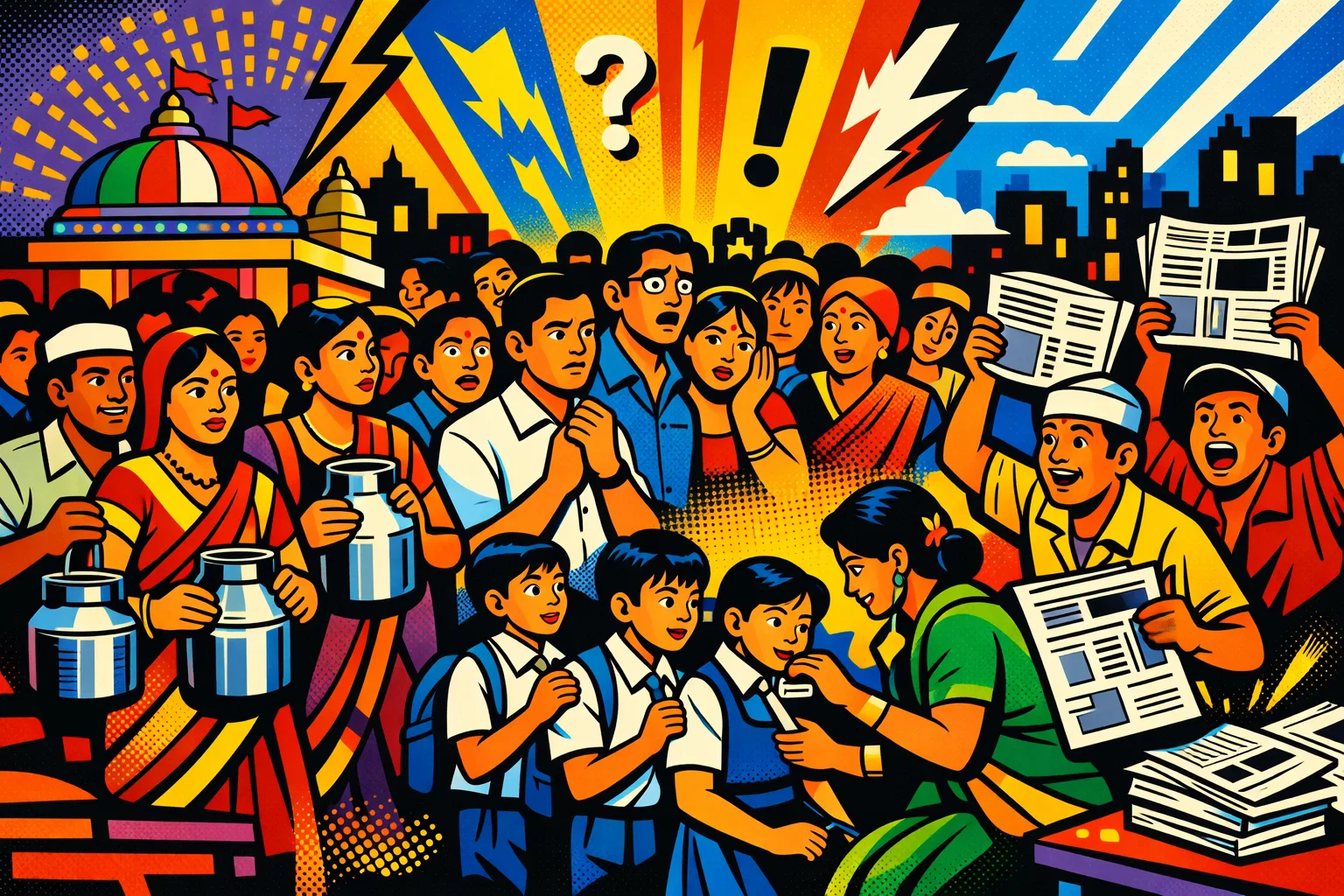
India’s history of collective fear and contagious belief is not one story but several different kinds of event that are often misleadingly grouped together as “mass hysteria”.
Page outline Jump by section
Introduction
The distinctions matter. A school fainting outbreak is not the same as a lynching, and a rapidly shared miracle claim is not evidence that worshippers were irrational or mentally ill. Some episodes began with genuine illness, bereavement or unusual natural events. Others drew strength from poverty, gender inequality, distrust of officials, sensational reporting or new communications technology. The clearest lesson is that collective belief becomes dangerous not simply because many people accept an extraordinary claim, but when uncertainty combines with social pressure, weak verification and permission to act against an alleged threat.
What does “mass hysteria” mean in India?
The phrase has been used so loosely that it can conceal more than it explains. In clinical literature, researchers increasingly prefer mass psychogenic illness or mass sociogenic illness: clusters of real symptoms that spread through a connected group even though investigators find no infectious, toxic or environmental cause sufficient to explain them. The symptoms are not necessarily invented. Anxiety and expectation can produce fainting, shaking, nausea, breathlessness and other genuine physical distress.[PMC]pmc.ncbi.nlm.nih.govMH often occurs among otherwiseMass hysteria attack rates in children and adolescents - PMCby G Zhao · 2021 · Cited by 10 — Recorded MH outbreaks have occurred in di…
A moral panic is different. It occurs when a person, group or behaviour is presented as an urgent threat to society and the response becomes disproportionate to the available evidence. Rumours about child kidnappers, witchcraft or mysterious attackers can take this form, particularly when outsiders or already marginalised people become targets.
Miracle enthusiasm belongs to another category again. Large numbers of people may interpret an unusual event through an established religious tradition without displaying illness or fear. The central questions are then how the report travelled, what witnesses thought they saw and whether ordinary physical processes could reproduce the effect.
Nor should every closed or unconventional religious community be called a “cult”. The term is frequently used by opponents, police, journalists or former members and may imply manipulation before coercion has been demonstrated. More precise descriptions—religious movement, spiritual organisation, high-control group or apocalyptic community—are usually better unless the evidence concerns identifiable abuse or domination.
When unexplained illness spreads through a group
India has produced several well-documented examples of mass psychogenic illness, particularly in schools and tightly connected communities. These cases show why authorities must investigate possible infection or poisoning before attributing symptoms to stress.
In July 2007, pupils at three schools in Burdwan district, West Bengal, developed symptoms including fainting, headache, dizziness and abnormal movements. A medical investigation concluded that the outbreak was psychogenic after examining its pattern, the concentration of cases among pupils and the lack of a physical cause capable of accounting for the spread. Contemporary reporting described fears involving ghosts, but the clinical study treated the episode as an outbreak of illness shaped by observation, anxiety and group contact rather than supernatural attack.[PubMed]pubmed.ncbi.nlm.nih.govAn investigation into a mass psychogenic illness at…by OP Singh · 2009 · Cited by 5 — This investigation of the outbreak of mass…
An earlier village outbreak near Baruipur in West Bengal began after two members of one family died on the same day. Other relatives and neighbours subsequently reported similar symptoms and were admitted to hospital. Investigators found no corresponding infectious epidemic, and the patients recovered quickly. The authors interpreted the episode as mass psychogenic illness triggered by the shock of the deaths and fear that an unknown disease was spreading.[PMC]pmc.ncbi.nlm.nih.govPMCAn epidemic of mass hysteria in a village in West Bengalby AN Chowdhury · 2005 · Cited by 24 — This is a report of an outbreak of mass hysteria, attributed to an unknown infectious disease…
These outbreaks commonly follow a recognisable pattern:
- An alarming event, smell, illness or collapse creates a plausible threat.
- Symptoms appear in a closely connected group whose members can see or hear about one another.
- Attention to normal bodily sensations increases.
- Anxiety produces further symptoms, apparently confirming that the danger is spreading.
- Dramatic explanations, including poisoning or spirit possession, circulate before medical tests are complete.
The diagnosis must remain one of exclusion. Declaring an outbreak “psychological” too early can cause authorities to miss contamination or infection and can make sufferers feel dismissed. The most effective response combines medical assessment, calm communication, separation from the immediate scene when appropriate and reassurance that symptoms are real but usually temporary. Research on anxiety-related clusters also warns that emotionally charged public responses can prolong an incident.[PMC]pmc.ncbi.nlm.nih.govAnxiety-related adverse events following immunization (AEFI)by A Loharikar · 2017 · Cited by 76 — Anxiety-related reactions occurring…
The Monkey Man and the anatomy of an urban scare
In May 2001, parts of Delhi and neighbouring areas became preoccupied with reports of a nocturnal attacker generally described as a monkey-like man. Accounts varied markedly. The supposed creature was short or tall, hairy or helmeted, animal-like or mechanical, and was variously said to possess claws, glowing eyes or metal equipment.
The inconsistency did not prevent the rumour from spreading. Residents slept on rooftops during hot weather, neighbourhood patrols formed, and police received repeated reports. Some people were injured while fleeing perceived attacks, while others died after falling from buildings in panic. A medical board examining alleged victims found injuries but no coherent pattern establishing that a single creature had caused them. A later medical study described the event as an outbreak of mass hysteria in East Delhi.[PubMed]pubmed.ncbi.nlm.nih.govInitial reports alleged that some monkey like creature attacked…
The panic was credible to many residents because it attached itself to ordinary urban pressures. Delhi already contained monkeys capable of scratching or frightening people. Night-time visibility was poor in crowded districts, power cuts were common, and many residents slept outdoors or on roofs. A sudden movement, animal or stranger could therefore become the seed for a sighting.
Press repetition gave the rumour a more stable public identity than the witness accounts themselves possessed. Each new report appeared to confirm that “the Monkey Man” existed even though descriptions conflicted. The label turned unrelated falls, scratches, pranks and misidentifications into episodes within one continuing story.
The case illustrates an important feature of rumour panics: people need not hallucinate the same object. Instead, they interpret ambiguous events through a shared expectation. Once residents had been warned that an attacker was nearby, an unclear shape or physical sensation could be understood as evidence of its presence.
Miracles that travelled faster than explanations
The milk-drinking statues of 1995
On 21 September 1995, reports spread that statues of the deity Ganesha were accepting spoonfuls of milk. People queued at temples across India, and similar claims soon emerged among Hindu communities abroad. The episode spread through telephone calls, personal networks and broadcast media with remarkable speed, years before social media became central to public life.[Wikipedia]WikipediaGanesha drinking milk miracleGanesha drinking milk miracle
Witnesses observed that milk placed against a statue appeared to vanish from the spoon. Scientists and sceptical investigators reproduced the effect and explained that surface tension and capillary action could draw a small quantity of liquid along the statue’s surface, after which it ran down or collected below. Colouring added to milk helped demonstrate its path over the material rather than into the statue.[Wikipedia]WikipediaGanesha drinking milk miracleGanesha drinking milk miracle
Calling the event a “mass delusion” is too blunt. Many participants were testing a specific public claim for themselves. Their interpretation was religious, but the visible disappearance of milk was a real, repeatable effect. What was mistaken was the proposed cause, not necessarily the observation.
The episode also exposed a recurring tension in Indian public life. Scientific organisations and rationalist campaigners regarded rapid explanations as necessary to prevent exploitation and waste. Believers could regard the event as meaningful even after hearing a physical account, because a mechanism does not automatically settle a theological interpretation. The event therefore sits at the boundary between experiment, devotional experience and media spectacle.
Mumbai’s “sweet” seawater
A similar but more hazardous episode occurred in August 2006, when thousands gathered at Mahim Creek in Mumbai after claims that the seawater had turned sweet and possessed curative or miraculous qualities. People drank and bottled water despite warnings that the creek was polluted. Contemporary estimates suggested that about 5,000 people gathered overnight.[The Guardian]theguardian.comThe Guardian'Miracle' creek draws thousands | World newsThe Guardian'Miracle' creek draws thousands | World news
Scientists and officials offered natural explanations. Heavy monsoon rainfall and freshwater entering the coastal area could temporarily reduce salinity near the surface. Authorities’ immediate concern was not the sincerity of the belief but the danger of drinking contaminated water.
The contrast with the 1995 milk episode is revealing. Both involved a physical effect that ordinary people could apparently verify, followed by a religious interpretation and rapid crowd formation. Yet the public-health risk at Mahim required a firmer official response. Debunking alone was insufficient; authorities also had to warn people away from a genuine environmental hazard.
Witch accusations are persecution, not a mysterious epidemic
Violence associated with witchcraft accusations remains one of the most serious subjects in India’s collective-belief history. It should not be reduced to an exotic story about superstition. Research in states including Jharkhand shows that accusations frequently operate within existing disputes over land, inheritance, illness, family power, caste, gender and access to resources. Women—especially widows, older women and those with limited social protection—are disproportionately vulnerable.[nih.gov]pmc.ncbi.nlm.nih.govOpen source on nih.gov.
An illness or death may provide the immediate explanation for an accusation, but the subsequent targeting is often organised rather than spontaneous. A person can be branded responsible for misfortune, socially isolated, assaulted, dispossessed or killed. Healers, local powerbrokers or relatives may reinforce the allegation, while fear of supernatural retaliation discourages neighbours from intervening.
Official figures capture only part of the harm. A parliamentary answer recorded murders and culpable homicides attributed to witchcraft across several states between 2013 and 2015, with particularly high totals in Odisha during those years. Such tables count deaths recorded under particular criminal categories, not the wider range of humiliation, banishment, sexual violence, assault or property seizure connected with accusations.[Digital Sansad]sansad.inOpen source on sansad.in.
Several states have enacted specific legislation against witch-hunting or harmful supernatural practices, but India has lacked a comprehensive national law devoted to witch-hunting. A private member’s bill introduced in Parliament in 2022 explicitly identified this gap, although existing homicide, assault and other criminal laws can still be applied.[Digital Sansad]sansad.inDigital Sansad THE PREVENTION AND PROHIBITION OF WITCHDigital Sansad THE PREVENTION AND PROHIBITION OF WITCH
The legal debate concerns more than punishment. Special laws can name the offence, criminalise public branding and encourage victim protection. Critics nevertheless warn that legislation will achieve little without policing, healthcare, education, secure land rights and support for survivors. Socio-legal research therefore treats witch-hunting as a form of structural and gendered violence rather than simply a mistaken belief awaiting scientific correction.[Partners for Law in Development - PLD]pldindia.orgPartners for Law in DevelopmentPartners for Law in Development
How kidnapping rumours became lethal
Between 2017 and 2018, false warnings about child kidnappers circulated through WhatsApp and other channels across several Indian states. Messages often claimed that organised gangs had entered a district to abduct children or remove organs. Some used unrelated photographs, manipulated footage or genuine videos stripped of their original context.
The messages turned unfamiliar people into potential threats. Travellers, migrant workers, nomadic communities, transgender people and others perceived as outsiders were confronted or attacked. In Rainpada, Maharashtra, five men from a nomadic community were killed in July 2018 after being suspected of child kidnapping. In Bidar district, Karnataka, an engineer was killed and his companions seriously injured after an encounter involving children was interpreted through existing abduction rumours.[perspectivia.net]perspectivia.netOn Whats App, Rumours and LynchingsOn Whats App, Rumours and Lynchings
These incidents were not caused by technology alone. Child-safety fears, mistrust of strangers, weak confidence in policing and existing prejudice created the social conditions in which a forwarded message could appear credible. Some rumours were adapted to name local places, giving generic misinformation the appearance of neighbourhood intelligence.
WhatsApp’s design nevertheless accelerated the process. Encrypted group messaging allowed alarming claims to circulate through trusted networks of relatives and acquaintances, while videos seemed to provide direct visual proof. Because recipients often could not see where a message originated, repetition could be mistaken for confirmation from several independent sources.
Following the killings, WhatsApp labelled forwarded messages and restricted forwarding in India, while police and state authorities used announcements, patrols, public meetings and temporary communications restrictions to counter rumours. Academic analysis has shown that already-debunked material can continue circulating in encrypted groups, demonstrating why correction rarely travels as effectively as the original warning.[arXiv]arxiv.orgOpen source on arxiv.org.
This was a moral panic with identifiable victims, not merely a curious internet craze. The feared child-abduction conspiracy was unsupported, but the crowd violence was real. Describing the perpetrators as irrational can also obscure the role of prejudice, impunity and deliberate incitement.
Burari: why tragedy should not become a “cult” story
The deaths of eleven members of one family in Burari, Delhi, on 1 July 2018 became one of India’s most widely discussed cases of shared belief. Ten family members were found hanging, while the oldest woman was found dead in another part of the house. Investigators recovered notebooks containing detailed instructions that closely resembled the arrangement at the scene.
Police and psychological commentators proposed that one family member had developed beliefs involving communication with his deceased father and that these ideas gradually became authoritative within the household. The case has often been described through the concepts of shared delusion or shared psychosis. Relatives disputed some official interpretations, and no living participant could explain what the family understood would happen during the final ritual.[Wikipedia]WikipediaBurari deathsBurari deaths
The “cult” label is therefore unhelpful. There was no demonstrated public movement recruiting outsiders, and the evidence concerns a private family system. Nor can a retrospective media diagnosis establish precisely what every individual believed. The notebooks and scene support the conclusion that the deaths followed a planned ritual, but they cannot fully reveal consent, doubt or pressure within the household.
Later documentaries and dramas transformed the case into a cultural reference point for hidden family trauma and shared belief. That attention has encouraged discussion of mental health, but it has also produced supernatural speculation and voyeuristic retelling. The responsible interpretation is narrower: Burari demonstrates how authority, grief, secrecy and spiritual conviction may reinforce one another inside an apparently ordinary family, while leaving important psychological questions unresolved.
Why these episodes spread
India’s great size and diversity make any single national explanation impossible. Even so, the most prominent cases repeatedly involve several interacting forces.
Existing cultural stories make uncertainty legible. A fainting pupil may be interpreted through ideas about possession; an unexplained scratch may become evidence of a prowling creature; a change in water may become a miracle. These explanations are rarely invented from nothing. They draw on familiar religious, medical or folkloric frameworks.
Trusted networks can outrun institutions. Telephone calls spread the milk miracle, neighbourhood conversation sustained the Monkey Man scare, and encrypted groups carried kidnapping warnings. Information received from relatives or neighbours may feel more trustworthy than a distant official denial.
Visible reactions become evidence. Queues outside a temple suggest that a miracle has occurred. A school evacuation appears to confirm poisoning. A crowd chasing a stranger seems to prove that someone has identified a kidnapper. People take their cues from the behaviour of others, especially when the underlying situation is ambiguous.
Stress shapes both symptoms and interpretation. Bereavement, school pressure, overcrowding, insecure work and fear of crime can increase bodily distress and vigilance. Stress does not automatically create a panic, but it can make threatening explanations feel convincing.
Marginalised people carry the greatest risk. Witch accusations often target socially vulnerable women. Kidnapping rumours have fallen on migrants, nomadic people and strangers. In these cases, collective fear does not affect everyone equally; it follows existing lines of power.
Media attention can stabilise an unstable story. Repetition gives a name and apparent coherence to scattered reports. Yet responsible reporting can also limit harm by comparing accounts, identifying contradictions and publishing prompt corrections.

What authorities have learnt—and still get wrong
The strongest response begins by treating the reported danger seriously without endorsing the most frightening explanation. Medical clusters require testing for infection, food poisoning and environmental exposure. Alleged attacks require ordinary forensic investigation. Miracle claims can be examined through transparent demonstrations. Rumours of crime should be checked against police records before warnings are amplified.
Officials also need to communicate uncertainty. Saying that “nothing happened” can alienate people who have experienced real symptoms, injuries or unusual physical effects. A better explanation separates observation from cause: pupils became ill, but no toxin was found; milk left the spoon, but it travelled over the statue’s surface; the seawater was less salty, but drinking it remained unsafe.
Punishment becomes essential when belief is turned against a victim. Witch-hunting, lynching and coercive spiritual practices are not solved merely by promoting scepticism. They require protection, prompt policing, prosecution and attention to the economic or gendered disputes hidden beneath the accusation.
India’s rationalist and anti-superstition movements have played an important role in public demonstrations, education and campaigning against exploitative practices. Maharashtra’s 2013 law against human sacrifice and other harmful practices was a major result of such activism, although later legal criticism has focused on implementation and the need for effective rules and trained enforcement.[Vidhi Legal Policy]vidhilegalpolicy.inthe maharashtra anti superstition actthe maharashtra anti superstition act
What these stories reveal about India
India’s episodes of contagious belief are memorable because they combine ancient explanatory traditions with modern systems of communication. A rumour may involve a witch, miracle or supernatural attacker, yet spread through television, mobile phones and encrypted messaging. Modernity does not remove collective belief; it changes its speed, scale and visual power.
The cases also resist easy divisions between educated and uneducated, urban and rural, religious and secular. The milk miracle reached metropolitan professionals as well as temple communities. The Monkey Man belonged to the national capital. Digital kidnapping rumours travelled through modern smartphones while drawing on old fears of outsiders.
Most importantly, the label “mass hysteria” should never become a way to mock participants or avoid investigation. Some outbreaks involve psychogenic symptoms. Some are religious interpretations of observable effects. Some are organised persecutions disguised as supernatural defence. Others are rumours that become vehicles for prejudice and violence.
Understanding the differences changes the response. Ill people need medical care and reassurance. Miracle claims need careful testing rather than ridicule. Rumours need rapid, trusted correction. Victims of witch-hunting and mob violence need protection and justice. The enduring importance of these episodes lies not in proving that crowds are foolish, but in showing how ordinary people try to make sense of uncertainty—and how institutions, media and neighbours can either contain that uncertainty or turn it into harm.
Amazon book picks
Further Reading
Books and field guides related to When Fear and Belief Swept Across India. Use these as the next step if you want deeper reading beyond the article.
Extraordinary Popular Delusions and the Madness of Crowds
Rating: 4.0/5 from 5 Google Books ratings
Frames many Indian examples of collective fear.

Endnotes
1.
Source: pmc.ncbi.nlm.nih.gov
Title: MH often occurs among otherwise
Link:https://pmc.ncbi.nlm.nih.gov/articles/PMC8829737/
Source snippet
Mass hysteria attack rates in children and adolescents - PMCby G Zhao · 2021 · Cited by 10 — Recorded MH outbreaks have occurred in di...
2.
Source: pmc.ncbi.nlm.nih.gov
Link:https://pmc.ncbi.nlm.nih.gov/articles/PMC10874769/
Source snippet
Anxiety-related adverse events following immunization (AEFI)by A Loharikar · 2017 · Cited by 76 — Anxiety-related reactions occurring...
3.
Source: pmc.ncbi.nlm.nih.gov
Title: PMCAn epidemic of mass hysteria in a village in West Bengal
Link:https://pmc.ncbi.nlm.nih.gov/articles/PMC2918293/
Source snippet
by AN Chowdhury · 2005 · Cited by 24 — This is a report of an outbreak of mass hysteria, attributed to an unknown infectious disease...
4.
Source: wired.com
Link:https://www.wired.com/2001/06/monkey-business-2
5.
Source: Wikipedia
Title: Ganesha drinking milk miracle
Link:https://en.wikipedia.org/wiki/Ganesha_drinking_milk_miracle
6.
Source: Wikipedia
Title: 2006 Mumbai sweet seawater incident
Link:https://en.wikipedia.org/wiki/2006_Mumbai_sweet_seawater_incident
7.
Source: pmc.ncbi.nlm.nih.gov
Link:https://pmc.ncbi.nlm.nih.gov/articles/PMC10958086/
8.
Source: pldindia.org
Title: Partners for Law in Development
Link:https://pldindia.org/wp-content/uploads/2013/03/Witch-hunting_in_India.pdf
9.
Source: sansad.in
Link:https://sansad.in/getFile/loksabhaquestions/annex/11/AU2778.pdf?source=pqals
10.
Source: sansad.in
Title: Digital Sansad THE PREVENTION AND PROHIBITION OF WITCH
Link:https://sansad.in/getFile/BillsTexts/RSBillTexts/Asintroduced/24%20E%20258%20Session1213202280605PM.pdf?source=legislation
11.
Source: perspectivia.net
Title: On Whats App, Rumours and Lynchings
Link:https://perspectivia.net/servlets/MCRFileNodeServlet/pnet_derivate_00006008/arun_whatsapp.pdf
12.
Source: wired.com
Link:https://www.wired.com/story/how-whatsapp-fuels-fake-news-and-violence-in-india
13.
Source: arxiv.org
Link:https://arxiv.org/abs/2006.02471
14.
Source: Wikipedia
Title: Burari deaths
Link:https://en.wikipedia.org/wiki/Burari_deaths
15.
Source: Wikipedia
Title: List of mass panic cases
Link:https://en.wikipedia.org/wiki/List_of_mass_panic_cases
16.
Source: Wikipedia
Title: Mass psychogenic illness
Link:https://en.wikipedia.org/wiki/Mass_psychogenic_illness
17.
Source: Wikipedia
Title: Witch hunts in India
Link:https://en.wikipedia.org/wiki/Witch_hunts_in_India
18.
Source: Wikipedia
Title: Monkey man of Delhi
Link:https://en.wikipedia.org/wiki/Monkey-man_of_Delhi
19.
Source: Wikipedia
Title: Indian Whats App lynchings
Link:https://en.wikipedia.org/wiki/Indian_WhatsApp_lynchings
20.
Source: Wikipedia
Link:https://en.wikipedia.org/wiki/Maharashtra_Prevention_and_Eradication_of_Human_Sacrifice%2C_other_Inhuman_and_Aghori_Practices_and_Black_Magic_Act%2C_2013
21.
Source: pubmed.ncbi.nlm.nih.gov
Link:https://pubmed.ncbi.nlm.nih.gov/19806834/
Source snippet
An investigation into a mass psychogenic illness at...by OP Singh · 2009 · Cited by 5 — This investigation of the outbreak of mass...
22.
Source: pubmed.ncbi.nlm.nih.gov
Link:https://pubmed.ncbi.nlm.nih.gov/12944693/
Source snippet
Initial reports alleged that some monkey like creature attacked...
23.
Source: theguardian.com
Title: The Guardian’Miracle’ creek draws thousands | World news
Link:https://www.theguardian.com/world/2006/aug/20/india.tracymcveigh
24.
Source: theguardian.com
Link:https://www.theguardian.com/world/2018/jul/15/india-police-arrest-25-people-after-latest-whatsapp-mob-lynching-child-kidnapping-rumours
25.
Source: vidhilegalpolicy.in
Title: the maharashtra anti superstition act
Link:https://vidhilegalpolicy.in/blog/the-maharashtra-anti-superstition-act/
26.
Source: pmc.ncbi.nlm.nih.gov
Link:https://pmc.ncbi.nlm.nih.gov/articles/PMC7396040/
27.
Source: pmc.ncbi.nlm.nih.gov
Link:https://pmc.ncbi.nlm.nih.gov/articles/PMC3828262/
28.
Source: pmc.ncbi.nlm.nih.gov
Link:https://pmc.ncbi.nlm.nih.gov/articles/PMC7368451/
29.
Source: pmc.ncbi.nlm.nih.gov
Link:https://pmc.ncbi.nlm.nih.gov/articles/PMC5992694/
30.
Source: pmc.ncbi.nlm.nih.gov
Link:https://pmc.ncbi.nlm.nih.gov/articles/PMC7704439/
31.
Source: pmc.ncbi.nlm.nih.gov
Link:https://pmc.ncbi.nlm.nih.gov/articles/PMC6356045/
32.
Source: prezi.com
Title: Mass Hysteria
Link:https://prezi.com/kssxrk3qlln9/mass-hysteria/
33.
Source: facebook.com
Link:https://www.facebook.com/groups/246702936383719/posts/1501235814263752/
34.
Source: unbelievable-facts.com
Title: mass hysteria
Link:https://unbelievable-facts.com/2017/02/mass-hysteria.html/3
35.
Source: fiftytwo.in
Link:https://fiftytwo.in/story/milk/
36.
Source: ncrb.gov.in
Link:https://www.ncrb.gov.in/uploads/nationalcrimerecordsbureau/custom/1701607577CrimeinIndia2022Book1.pdf
Additional References
37.
Source: telegraphindia.com
Link:https://www.telegraphindia.com/west-bengal/no-ghost-but-girls-fainting-spree-shuts-down-school/cid/699336
Source snippet
Telegraph IndiaNo ghost, but girls' fainting spree shuts down school17 Jul 2007 — Burdwan, July 17: The sudden illness of some two dozen...
38.
Source: youtube.com
Title: Mass Hysteria in Govt School, Students Seen Crying, Shouting & Banging Heads
Link:https://www.youtube.com/watch?v=dQ9VKeOnZfo
Source snippet
How the news of milk-drinking idols STUNNED an entire religion...
39.
Source: youtube.com
Title: How the news of milk-drinking idols STUNNED an entire religion
Link:https://www.youtube.com/watch?v=eoMyxbG1ITM
Source snippet
Hysteria amid reports of "monkey man" attacking sleepers...
40.
Source: historysnob.com
Link:https://www.historysnob.com/war-and-historical-events/20-chilling-cases-mass-hysteria-throughout-history
41.
Source: researchgate.net
Link:https://www.researchgate.net/publication/403000443_Orchestrated_Panic_and_Manufactured_Scarcity_A_Multidisciplinary_Analysis_of_Mass_Hysteria_the_COVID-19_Infodemic_and_the_2026_LPG_Crisis
42.
Source: semanticscholar.org
Link:https://www.semanticscholar.org/paper/A-study-on-mass-hysteria-%28monkey-men%29-victims-in-Verma-Srivastava/e1a74975708eda31d3a57fa2a0b71d3eb2e53b34
43.
Source: testbook.com
Link:https://testbook.com/ias-preparation/anti-superstition-and-black-magic-act
44.
Source: cedawsouthasia.org
Link:https://cedawsouthasia.org/wp-content/uploads/2013/02/WH-Report-.pdf
45.
Source: facebook.com
Link:https://www.facebook.com/groups/613870175328566/posts/4651598868222323/
46.
Source: socialscienceresearch.org
Link:https://socialscienceresearch.org/index.php/GJHSS/article/view/3085/1-Indian-Idols-Drinking-Milk_html
Topic Tree
Follow this branch
Related pages 192
- Antigua and Barbuda
- Argentina Belief Scares
- Azerbaijan Belief
- Bahrain Beliefs
- North Korea
- +187 more in sidebar