Within Myanmar
Was Saya San's Revolt Really Mass Delusion?
The Saya San revolt joined rural hardship with Buddhist kingship, prophecy and claims of supernatural protection.
On this page
- The rural crisis behind the uprising
- Kingship, prophecy and protective magic
- How colonial records shaped the story
Page outline Jump by section
Introduction
Was Saya San’s revolt really an episode of mass delusion? The short answer is no. The rebellion that spread across rural Burma between 1930 and 1932 certainly drew on prophecy, royal symbolism and beliefs in supernatural protection, but reducing it to irrational enthusiasm misses both its political purpose and its social roots. For thousands of cultivators facing collapsing rice prices, mounting debt and the loss of land under British colonial rule, the language of Buddhist kingship offered a way to explain injustice and imagine its reversal. Modern historians increasingly argue that the movement should be understood as an anti-colonial uprising expressed through religious ideas rather than as a simple case of collective irrationality.[Cambridge University Press & Assessment]cambridge.orgCambridge University Press & AssessmentGenealogy of a Rebellion Narrative: Law, Ethnology and Culture in Colonial Burma | Journal of Sout…
The rebellion remains important because it sits at the intersection of political resistance and collective belief. It demonstrates how hopes for a restored moral order can become inseparable from practical struggles over taxation, land and colonial authority, while also illustrating how official records can shape later understandings of supposedly “irrational” movements.
The rural crisis behind the uprising
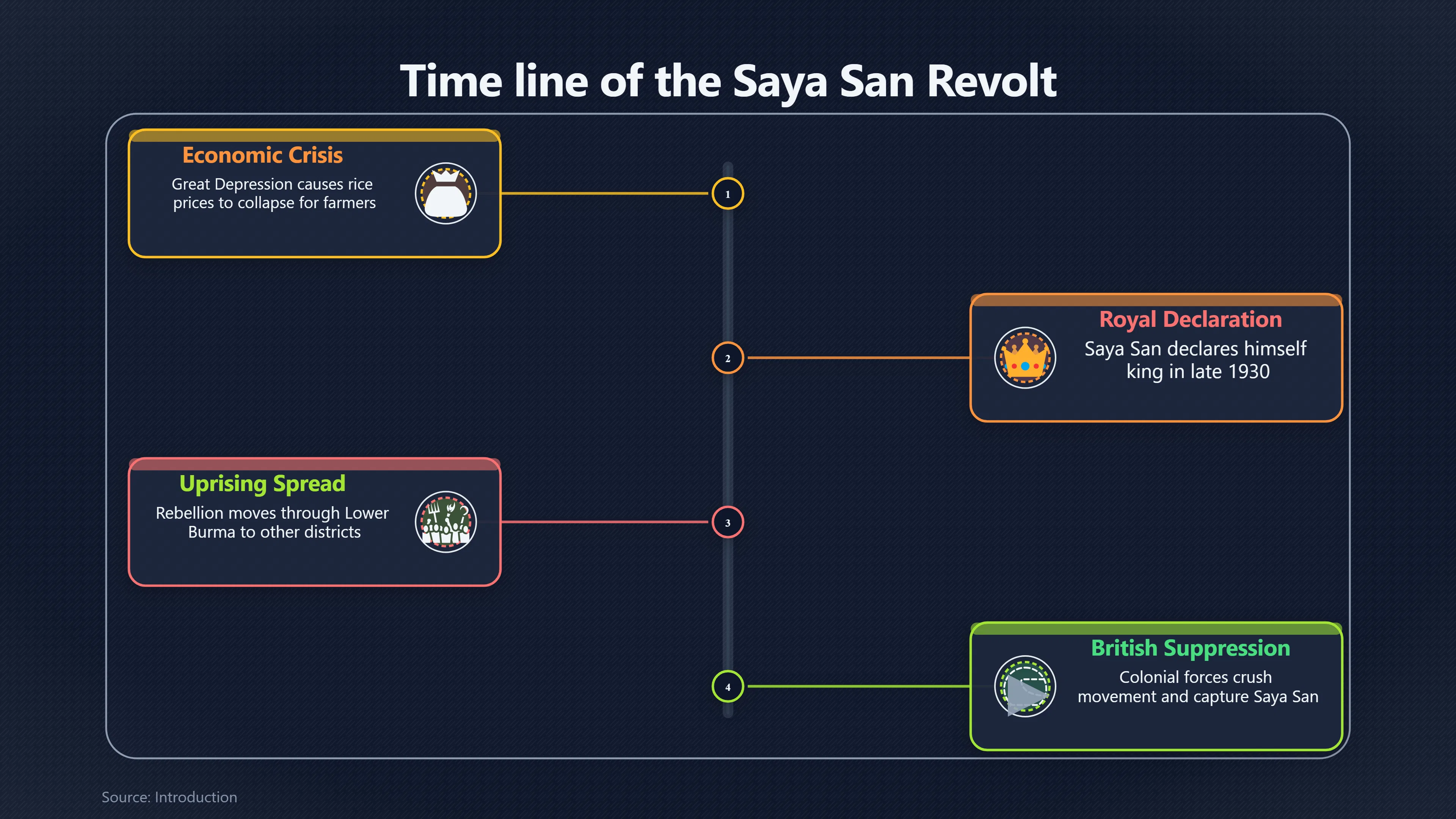
The revolt emerged during one of the most difficult periods experienced by rural Burma under British rule. The global Great Depression caused rice prices to collapse just as many cultivators were already burdened by debt, taxes and mortgages. Large numbers of farmers lost their land or became tenants and labourers, while colonial legal systems often favoured moneylenders in disputes over debt and foreclosure. These economic pressures did not create the rebellion by themselves, but they created an audience ready for a movement promising both justice and liberation.[Wikipedia]WikipediaSaya SanSaya San
Saya San himself had been active in nationalist circles before the revolt. In late 1930 he declared himself a king, established a symbolic royal court and launched an uprising that spread through parts of Lower Burma before reaching other districts. Although British forces eventually crushed the movement, resistance continued well into 1932 after Saya San’s capture and execution.[Wikipedia]WikipediaSaya SanSaya San
What distinguished the rebellion from an ordinary tax revolt was that economic grievances were framed through familiar religious and political traditions. Rather than separating material hardship from spiritual ideas, many villagers understood them as parts of the same crisis: unjust government was also a sign that the moral order had been overturned.
Kingship, prophecy and protective magic
One reason the Saya San rebellion is often described as “millenarian” is that it promised not merely political change but the restoration of a righteous world. Millenarian movements expect an imminent transformation of society, often led by a divinely favoured or morally legitimate ruler. In Burma, memories of the monarchy abolished by Britain in 1885 remained powerful, and expectations that a rightful Buddhist king would return circulated long before the rebellion.
Saya San deliberately adopted royal symbolism. Ceremonies proclaimed him king, a ceremonial capital was established, officials were appointed and supporters were encouraged to see the movement as restoring legitimate authority rather than creating something entirely new. This imagery mattered because Burmese kingship had long been associated with protecting Buddhism and maintaining cosmic as well as political order.[Bibliovault]bibliovault.orgThe Return of the Galon King: History, Law, and Rebellion in Colonial Burma (9780896802766): Maitrii Aung-Thwin and Maitrii Au…
Belief in supernatural protection also played a visible role. Colonial accounts describe followers wearing protective tattoos, charms and amulets believed to reduce vulnerability in battle. Such practices were not invented for the rebellion. Protective magic already formed part of wider Burmese religious culture and had long existed alongside orthodox Buddhist practice.
Modern historians caution against treating these beliefs as evidence that participants had abandoned rational judgement. Several points are worth keeping in mind:
- Protective rituals often strengthened courage and group identity rather than replacing military planning.
- Many participants joined because of debt, taxation and resentment of colonial rule, not simply because they expected miraculous victory.
- Religious symbols helped organise scattered rural communities around a shared vision of legitimate authority.
The movement therefore combined practical rebellion with sacred meaning instead of forcing a choice between the two.
Was this really a case of collective delusion?
The rebellion has sometimes appeared in discussions of mass belief because many participants accepted extraordinary claims about prophecy or supernatural protection. Yet most historians reject describing the entire movement as mass hysteria or collective delusion.
Several features distinguish it from classic episodes of contagious irrational belief.
First, the grievances were concrete. Falling agricultural prices, land dispossession and colonial administration produced genuine hardship that can be independently documented. The rebellion was not built upon an imaginary threat.[Cambridge University Press & Assessment]cambridge.orgCambridge University Press & AssessmentGenealogy of a Rebellion Narrative: Law, Ethnology and Culture in Colonial Burma | Journal of Sout…
Second, religious expectations were embedded within an existing political culture. The restoration of righteous kingship drew upon established traditions rather than sudden, inexplicable fantasies.
Third, participants acted strategically as well as symbolically. Rebels attacked police stations, sought weapons, organised local leadership and targeted representatives of colonial authority. These actions reveal organised political objectives alongside spiritual expectations.
For these reasons, scholars increasingly describe the revolt as an anti-colonial movement expressed through millenarian language rather than a psychological contagion comparable to episodes of mass panic or psychogenic illness.[Cambridge University Press & Assessment]cambridge.orgCambridge University Press & AssessmentStructuring revolt: Communities of interpretation in the historiography of the Saya San rebellion…
How colonial records shaped the story
Much of what later generations know about Saya San comes from records created by the colonial government while suppressing the uprising. This has become one of the most important debates surrounding the rebellion.
British officials portrayed the movement as evidence that Burmese peasants were unusually susceptible to superstition and manipulation. Official reports emphasised magical beliefs, royal pretensions and supposed irrationality while giving less weight to structural economic problems and the political consequences of colonial rule. Some reports even described Burmese villagers as naturally excitable or excessively superstitious, language that reflected colonial assumptions rather than objective analysis.[Wikipedia]WikipediaSaya SanSaya San
Historian Maitrii Aung-Thwin has argued that historians should pay close attention to how these archives were produced. Court proceedings, police investigations and counter-insurgency legislation were designed to identify leaders, establish criminal conspiracies and justify emergency powers. The archive therefore did not simply record the rebellion; it also helped construct the standard narrative through which later scholars interpreted it.[Cambridge University Press & Assessment]cambridge.orgCambridge University Press & AssessmentGenealogy of a Rebellion Narrative: Law, Ethnology and Culture in Colonial Burma | Journal of Sout…
This does not mean the surviving records are false. Rather, it means they reflect the priorities of the authorities who created them. Questions such as whether Saya San personally directed every local uprising, or how central magical belief really was to ordinary participants, remain subjects of historical debate because the available evidence is filtered through colonial institutions.

Why the rebellion still matters
The Saya San rebellion remains one of the clearest examples of how political resistance and religious imagination can reinforce one another during periods of severe social stress.
Its lasting significance lies in several areas:
- It illustrates how economic hardship can become intertwined with sacred ideas about justice and legitimate authority.
- It warns against dismissing religiously framed protest as mere irrationality without examining underlying political and social conditions.
- It demonstrates how colonial archives can shape historical memory, influencing generations of scholarship long after the events themselves.
- It offers a useful comparison with other anti-colonial movements across Asia where prophecy, kingship and visions of moral renewal accompanied organised resistance.
Rather than being remembered simply as a strange episode of magical thinking, the revolt is better understood as a movement in which Buddhist kingship, anti-colonial nationalism and rural economic grievances became inseparable. The beliefs that animated many followers were genuine and historically important, but they were part of a wider struggle over power, legitimacy and survival rather than evidence of a society gripped by collective delusion.[cambridge.org]cambridge.orgCambridge University Press & AssessmentStructuring revolt: Communities of interpretation in the historiography of the Saya San rebellion…
Amazon book picks
Further Reading
Books and field guides related to Was Saya San's Revolt Really Mass Delusion?. Use these as the next step if you want deeper reading beyond the article.

Prophets of rebellion
Includes the 1930–32 Burma rebellion as a major case study and examines how millenarian belief, political grievances and colonial disrupt...
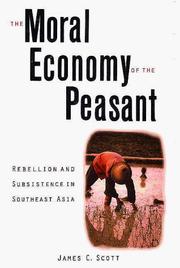
The Moral Economy of the Peasant
Explains how threats to subsistence, taxation and disruption of customary obligations can drive peasant rebellion, providing a powerful f...
The Return of the Galon King: History, Law, and Rebellion in...
Directly reassesses the colonial legal records and inherited narrative that portrayed Saya San’s followers as irrational, while examining...
The River of Lost Footsteps: A Personal History of Burma
Places British colonialism, Burmese kingship, nationalism and twentieth-century upheaval within a readable account of the country’s longe...
Endnotes
1.
Source: cambridge.org
Link:https://www.cambridge.org/core/journals/journal-of-southeast-asian-studies/article/abs/genealogy-of-a-rebellion-narrative-law-ethnology-and-culture-in-colonial-burma/2B8CEDA0133D14CD2C6623C7AF3765B1
Source snippet
Cambridge University Press & AssessmentGenealogy of a Rebellion Narrative: Law, Ethnology and Culture in Colonial Burma | Journal of Sout...
2.
Source: bibliovault.org
Link:https://www.bibliovault.org/BV.book.epl?ISBN=9780896802766
Source snippet
The Return of the Galon King: History, Law, and Rebellion in Colonial Burma (9780896802766): Maitrii Aung-Thwin and Maitrii Au...
3.
Source: Wikipedia
Title: Saya San
Link:https://en.wikipedia.org/wiki/Saya_San
4.
Source: cambridge.org
Link:https://www.cambridge.org/core/journals/journal-of-southeast-asian-studies/article/abs/structuring-revolt-communities-of-interpretation-in-the-historiography-of-the-saya-san-rebellion/1ABF0569043B0A9B7278F72179C4AB59
Source snippet
Cambridge University Press & AssessmentStructuring revolt: Communities of interpretation in the historiography of the Saya San rebellion...
5.
Source: nus.academia.edu
Title: Maitrii Aung Thwin
Link:https://nus.academia.edu/MaitriiAungThwin
Source snippet
Aung-Thwin - National University of SingaporeDownload British counter -insurgency narratives and the construction of a twentieth century...
Additional References
6.
Source: researchgate.net
Link:https://www.researchgate.net/publication/232013802_Structuring_revolt_Communities_of_interpretation_in_the_historiography_of_the_Saya_San_rebellion
Source snippet
Structuring revolt: Communities of interpretation in the historiography of the Saya San rebellion | Request PDFJune 1, 2008 — STRUCTURING...
Published: June 1, 2008
7.
Source: nuspress.nus.edu.sg
Link:https://nuspress.nus.edu.sg/collections/mainland-southeast-asia/products/the-return-of-the-galon-king
Source snippet
Return of the Galon King: History, Law, and Rebellion in Colonial – NUS PressTHE RETURN OF THE GALON KING: HISTORY, LAW, AND REBELLION IN...
8.
Source: researchgate.net
Link:https://www.researchgate.net/publication/290887947_The_return_of_the_galon_king_History_law_and_rebellion_in_colonial_burma
Source snippet
The return of the galon king: History, law, and rebellion in colonial burma | Request PDFJanuary 1, 2010 — THE RETURN OF THE GALON KING...
Published: January 1, 2010
9.
Source: ari.nus.edu.sg
Title: the return of the galon king history law and rebellion in colonial burma
Link:https://ari.nus.edu.sg/publications/the-return-of-the-galon-king-history-law-and-rebellion-in-colonial-burma/
Source snippet
Return of the Galon King: History, Law and Rebellion in Colonial Burma » Asia Research Institute, NUSJanuary 12, 2011 — BOOKS Image THE R...
Published: January 12, 2011
10.
Source: books.google.gy
Title: gy The Return of the Galon King: History, Law, and Rebellion in Colonial Burma
Link:https://books.google.gy/books?id=U37wBgAAQBAJ
Source snippet
Return of the Galon King: History, Law, and Rebellion in Colonial Burma - Maitrii Aung-Thwin - Google BooksJanuary 1, 2011 — THE RETURN O...
Published: January 1, 2011
11.
Source: youtube.com
Title: Why Are Buddhist Monks Turning Violent against rohingya?
Link:https://www.youtube.com/watch?v=SyGIqWQ-tFg
Source snippet
How Buddhist nationalism in Sri Lanka and [Myanmar]({{ 'when-belief-and-fear-changed-myanmar/' | relative_url }}) shatters the global myth of Buddhism as peaceful...
12.
Source: youtube.com
Title: The State of Buddhism and Buddhist Nationalism After the Coup in Myanmar
Link:https://www.youtube.com/watch?v=5Hd3apLxxp0
Source snippet
Why Are Buddhist Monks Turning Violent against rohingya?...
13.
Source: youtube.com
Title: Racial Capitalism and Interspecies Empire in Colonial Myanmar
Link:https://www.youtube.com/watch?v=NqBth9qrXGM
Source snippet
The State of Buddhism and Buddhist Nationalism After the Coup in Myanmar...
14.
Source: deepblue.lib.umich.edu
Link:https://deepblue.lib.umich.edu/items/1e233c3f-7eb9-48d4-bb37-29d7416e1bd3
Source snippet
AUTHORS Aung-Thwin, Maitrii Victoriano DATE 2001 FILES Image: Restricted to current U-M faculty...
15.
Source: search.worldcat.org
Link:https://search.worldcat.org/title/The-return-of-the-Galon-king-%3A-history-law-and-rebellion-in-colonial-Burma/oclc/495780028
Source snippet
return of the Galon king: history, law, and rebellion in colonial Burma | WorldCat.orgImage: Front cover image for The return of the Gal...
Topic Tree