When Fear Spreads Faster Than Evidence
North Macedonia does not have a well-documented national history of spectacular witch trials, dancing plagues or large apocalyptic sects.
Page outline Jump by section
Introduction
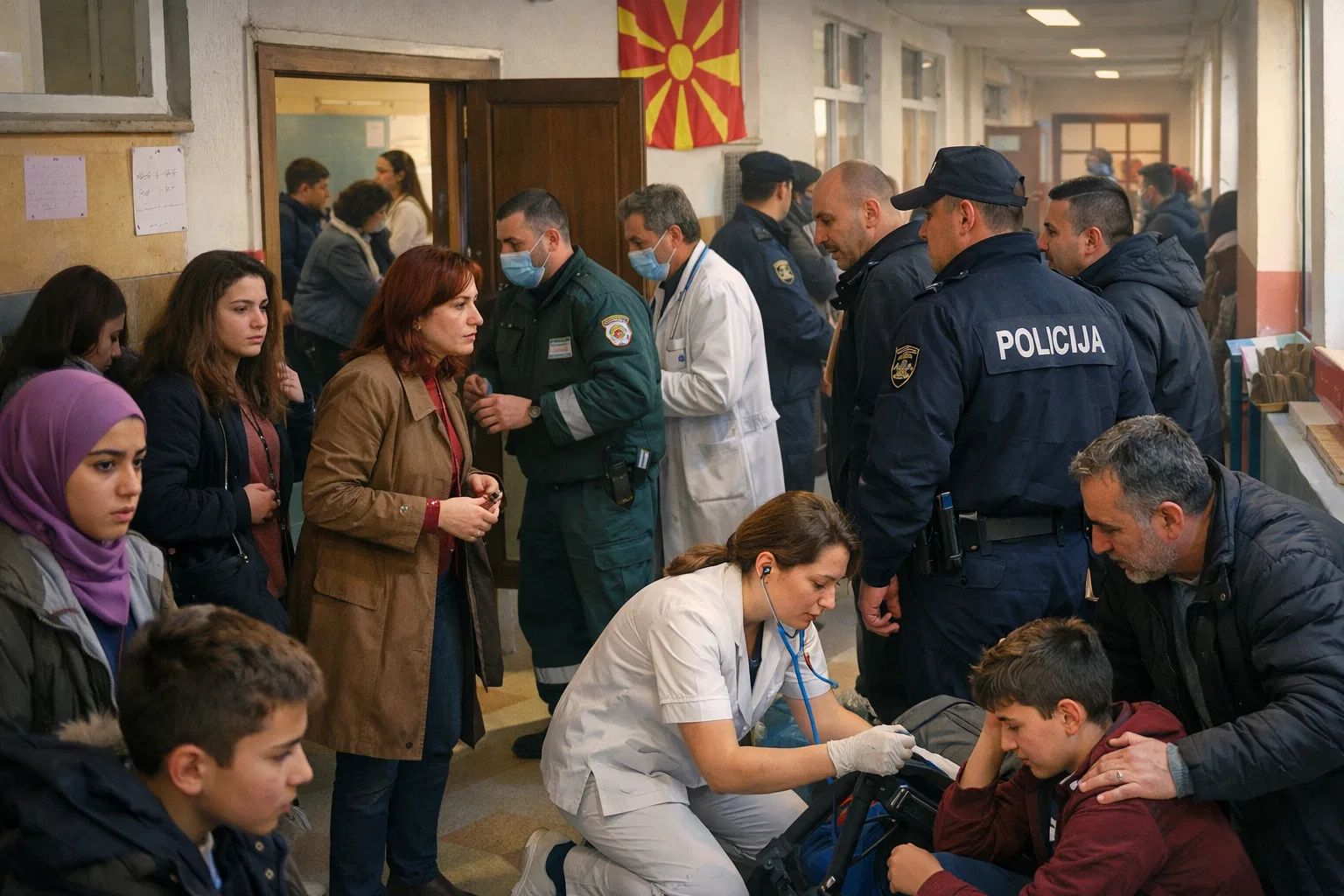
Two school poisoning scares, in Kumanovo in 2005 and Gostivar in 2014, are especially revealing. In both, mostly ethnic Albanian pupils reported symptoms associated with toxic exposure, while investigations struggled to identify a physical agent. Disagreement over whether the events involved poison, psychological contagion or manipulation became inseparable from memories of conflict and discrimination. More recent moral panics over sexuality education, gender and vaccination show the same underlying problem: when trust is weak, frightening explanations can spread faster than careful evidence.
The school poisoning scares
Kumanovo, 2005
On 30 November 2005, dozens of pupils at the Bajram Sabani secondary school in Kumanovo developed apparent poisoning symptoms. Eighty-four students were reportedly taken to hospital, with 24 transferred to the toxicology department in Skopje. Most of those affected were ethnic Albanians. Initial reports described breathing difficulties, nausea, dizziness and fainting, while pupils and parents suspected that an unidentified gas had been released inside the school.[Institute for War & Peace Reporting]iwpr.netmacedonia albanian students poisoning scareInstitute for War & Peace ReportingMacedonia: Albanian Students in Poisoning Scare6 Sept 2005 — The scare began on November 30, when 84 s…
The episode immediately acquired an ethnic meaning. North Macedonia had emerged only four years earlier from an armed conflict between state forces and an ethnic Albanian insurgency. Schools, language rights and public institutions remained politically sensitive, particularly in mixed towns such as Kumanovo. A mysterious illness affecting Albanian pupils was therefore not interpreted simply as a medical event. For many families, it appeared to fit a larger history of vulnerability and unequal treatment.
Available reporting does not establish that a toxic substance was found. Nor does it provide enough clinical evidence to diagnose mass psychogenic illness with confidence. That term describes real physical symptoms spreading through a group without an identified toxic, infectious or structural cause, often in a setting of intense anxiety. It should be used only after plausible environmental and medical explanations have been investigated, not as a quick synonym for exaggeration or pretence.
The Kumanovo case also carried the shadow of the disputed 1990 Kosovo school illnesses, when thousands of ethnic Albanian students reported fainting, convulsions and other symptoms. Serbian and Yugoslav authorities frequently described those events as hysteria or political theatre, while Albanian doctors and communities alleged deliberate poisoning. International medical assessments did not produce a universally accepted explanation, and the controversy became part of the political memory preceding the Kosovo war. Although the 2005 North Macedonian incident was far smaller, that history made neutral interpretation extremely difficult.[wikipedia.org]WikipediaKosovo student poisoningKosovo student poisoning
Gostivar, 2014
A similar scare occurred at an economics secondary school in Gostivar on 14 February 2014. Students and staff complained of nausea, breathing problems and other symptoms after reports that an unknown gas had been released. Contemporary accounts gave varying totals, but approximately 30 students and several teachers or employees were treated, with some transferred to the toxicology clinic in Skopje.[vijesti.me]en.vijesti.mevijesti.meMacedonia: Students were poisoned by gasFebruary 15, 2014 — 15 Feb 2014 — 28 students and seven teachers were admitted to the G…
Police sealed the area, medical teams examined those affected and senior political figures visited patients. This visible emergency response was understandable, because an actual chemical exposure had to be excluded. It also reinforced the public impression that a deliberate attack might have occurred before investigators had established a cause.
Forensic examinations subsequently failed to identify traces of toxic substances on the affected students or staff. Police said that no evidence of gas poisoning had been found, but local officials and some families disputed the conclusion. Gostivar’s mayor said that he had personally experienced symptoms at the school and resisted suggestions that the incident was fabricated or imagined.[Balkan Insight]balkaninsight.comOpen source on balkaninsight.com.
The dispute demonstrates why “mass hysteria” can be an inflammatory label. It may be heard as an accusation that frightened young people were lying, even though psychogenic symptoms are involuntary and physically experienced. Conversely, declaring an attack before laboratory results are available can spread fear, encourage more people to reinterpret ordinary sensations as signs of poisoning and deepen communal suspicion.
The most careful conclusion is narrower than either side’s early claims. People at the Gostivar school experienced symptoms, but investigators did not confirm a toxic agent. The evidence available publicly does not prove a staged incident, deliberate poisoning or a formally diagnosed psychogenic outbreak. What is clearly documented is a poisoning scare whose meaning expanded rapidly because it occurred among Albanian pupils in a society where unexplained school illnesses already carried a powerful ethnic history.
Why poisoning rumours carried such force
The Kumanovo and Gostivar episodes were not isolated from North Macedonia’s social structure. Religious affiliation, ethnicity, language and geography overlap to a considerable degree: most ethnic Macedonians are Orthodox Christians, while most ethnic Albanians are Muslim. The country’s 2001 conflict was primarily political and ethnic rather than a war over theology, but religious identity often remains a visible marker of community membership.[ecoi.net]ecoi.netOpen source on ecoi.net.
This overlap can make an ambiguous emergency feel like an attack on a whole community. Several pressures increase that risk:
- Memories of earlier violence and exclusion. Communities judge new events through remembered experiences, including the Kosovo poisoning controversy and North Macedonia’s own armed conflict.
- Low confidence in institutions. Contradictory statements from police, politicians, doctors and local officials encourage people to choose the explanation offered by figures they already trust.
- Symptoms that resemble toxic exposure. Dizziness, nausea, shortness of breath, tingling and fainting can result from chemicals, infection, panic, overbreathing or several causes at once.
- Rapid social observation. In a school, pupils see others become distressed, hear rumours about gas and become highly attentive to their own bodies.
- Politicised media coverage. Reports of “poisoned students” are memorable and urgent, while negative laboratory findings arrive later and rarely receive the same attention.
None of these factors proves a psychological origin. They explain why rumours can spread and why a scientifically unresolved event may harden into competing communal truths. The first duty of authorities is to investigate possible toxins and provide treatment. The second is to communicate uncertainty without implying either that an attack definitely occurred or that patients invented their distress.
From poison scares to moral panics about children
North Macedonia’s most visible recent moral panic has concerned comprehensive sexuality education. A pilot programme was prepared through cooperation between education authorities and the health and rights organisation HERA, following a government decision in 2019. Opponents circulated claims that very young children would be exposed to sexually explicit teaching, that pupils would be encouraged to change gender, or that foreign material represented the curriculum planned for Macedonian classrooms. Fact-checkers found that some widely shared images came from other countries and did not show the national programme.[vistinomer.mk]vistinomer.mkTruthmeterВо С. Македонија нема сексуално образование за децаTruthmeterВо С. Македонија нема сексуално образование за деца
The controversy fits the classic structure of a moral panic. Children were presented as being in immediate danger; campaigners attributed hidden or extreme intentions to teachers and civil-society organisations; isolated images were detached from their source; and complex educational proposals were reduced to emotionally powerful claims about innocence, sexuality and parental control.
This does not mean that every objection was irrational. Parents can reasonably ask what is taught, at what age, by whom and under what safeguards. A moral panic develops when the public debate becomes disproportionate to the documented material and when opponents are portrayed not merely as mistaken but as conspirators seeking to corrupt children.
International research defines comprehensive sexuality education as age-appropriate teaching about bodies, relationships, consent, health and safety. It does not require giving the same information to a six-year-old and a sixteen-year-old. UNESCO’s reviews have found no evidence that such education makes young people sexually active earlier; well-designed programmes can improve knowledge and safer decision-making.[UN Women]unwomen.orgOpen source on unwomen.org.
By 2023 and 2024, opposition had widened from one school programme into a broader anti-gender mobilisation. Reporting and regional analysis described coalitions of parents, conservative organisations and religious actors opposing sexuality education, legal gender-recognition proposals and LGBT inclusion. The Macedonian Orthodox Church publicly entered parts of this debate, increasing its reach and legitimacy among believers.[gmfus.org]gmfus.orgOpen source on gmfus.org.
The language of child protection is central to these campaigns. It converts a dispute about policy into a struggle between innocence and corruption, making compromise harder. LGBT people, teachers and activists can become “folk devils”: symbolic villains blamed for a much wider unease about family change, declining authority, demographic insecurity and Western influence.
Pandemic rumours and vaccine fear
COVID-19 created another environment in which uncertainty, fear and distrust could circulate together. North Macedonia faced both limited early vaccine availability and later difficulty persuading some high-risk groups to be vaccinated. A study of 1,003 essential workers found that 56 per cent expressed some level of COVID-19 vaccine hesitancy, although hesitancy ranged from uncertainty to outright refusal and should not be equated automatically with conspiracy belief.[PMC]pmc.ncbi.nlm.nih.govPMCEssential Workers' COVID-19 Vaccine HesitancyPMCEssential Workers' COVID-19 Vaccine Hesitancy
Concerns included the speed of vaccine development, possible side effects and distrust of the health system. Some were ordinary questions arising during an unprecedented emergency; others were reinforced by misleading online narratives. UNICEF introduced a system for detecting and responding to vaccine misinformation, while United Nations campaigns promoted vaccination through public information and community outreach. One programme reported that measured trust in vaccines rose from 56 per cent in December 2020 to 69 per cent in June 2021.[The United Nations in North Macedonia]northmacedonia.un.orgCOVID 19 MPTF 2021 FINAL Report North MacedoniaCOVID 19 MPTF 2021 FINAL Report North Macedonia
North Macedonia’s experience illustrates why the word “panic” needs care. Fear of a disease during a deadly pandemic is not a moral panic, and concern about a new treatment is not automatically delusional. The relevant collective-belief history lies in the way unsupported claims can transform uncertainty into certainty: that the virus is fabricated, that vaccines alter identity or fertility, or that public-health measures are evidence of a hidden plan.
The World Health Organization has found that health misinformation can worsen distress, encourage harmful behaviour and weaken confidence in medical authorities. Yet access problems, political polarisation and previous institutional failures also affect vaccine uptake. Treating every hesitant person as irrational can strengthen the very distrust that misinformation exploits.[OBS]eurohealthobservatory.who.intOpen source on who.int.
Folk belief is not the same as a witch panic
Macedonian traditional culture contains extensive beliefs about witches, vampires, spirits, fairies and protective or harmful magic. Folklorists have documented healers who use prayers, ritual knowledge, plants and inherited practices, as well as stories in which illness or misfortune is attributed to supernatural beings or malicious neighbours.[ResearchGate]researchgate.netResearch Gate(PDF) Supernatural Beings in Macedonian BeliefsResearch Gate(PDF) Supernatural Beings in Macedonian Beliefs
These traditions should not be mistaken for evidence of organised witch persecution. Folk healing may coexist with Orthodox Christianity or Islam without forming a separate movement. Belief in the evil eye, magical harm or spirit activity can provide a cultural language for explaining illness and bad luck, but that does not by itself produce trials, mobs or a moral panic.
The distinction matters because later retellings often impose a Western European witch-hunt model on Balkan folklore. The surviving evidence for North Macedonia is much stronger on oral tradition and household practice than on large, centrally organised campaigns against alleged witches. Individual accusations and social stigma may have existed, particularly in village disputes, but there is no securely documented Macedonian equivalent of the mass prosecutions associated with parts of Germany, Scotland or colonial New England.
Folk healers also occupy an ambiguous position. They may be regarded as trusted specialists, harmless keepers of custom, religiously questionable practitioners or exploiters, depending on the observer. Calling them a “cult” would obscure these differences and incorrectly suggest a unified organisation with a leader, doctrine and membership.

Religious minorities and the danger of the cult label
North Macedonia is religiously diverse, although Orthodox Christianity and Sunni Islam predominate. Smaller communities include Catholics, Protestants, Jehovah’s Witnesses, Jews, members of Sufi traditions and other Christian groups. The constitution provides for freedom of religion, but reports have recorded disputes over registration, property, building permission and unequal institutional treatment.[state.gov]2021-2025.state.govnorth macedonianorth macedonia
In such a setting, “sect” or “cult” can function less as a description of conduct than as a hostile label for unfamiliar religion. A small missionary church may be controversial without being coercive. Conversely, an established religious organisation can exercise harmful power despite never being called a cult. Size, foreign origin and unusual theology are therefore poor tests.
A more useful assessment asks whether a group uses deception, isolates members, controls intimate relationships, extracts money through pressure, punishes dissent or enables abuse. Public authorities should investigate unlawful conduct, not decide whether a belief appears strange. This approach protects both religious freedom and people who may genuinely face coercion.
The country’s strongest documented religious tensions have generally involved identity, legal recognition and relations between institutions rather than secret apocalyptic communities. North Macedonia should therefore not be presented as a hidden centre of cult activity. The historical evidence supports a more restrained account: small religions can be stigmatised in a society where faith and ethnicity are closely connected, but hostile labelling is not proof of danger.
What the evidence really shows
North Macedonia’s collective-fear history is best understood through ambiguity. In the school scares, symptoms were real but the alleged poison was not established. In the sexuality-education controversy, genuine questions about schools were mixed with false claims and imported images. During COVID-19, legitimate uncertainty coexisted with conspiracy narratives. Traditional supernatural belief survived, but evidence for major witch persecutions is sparse.
Across these episodes, the same sequence repeatedly appears:
- An uncertain event affects a socially sensitive subject, often children, health or communal identity.
- A frightening explanation circulates before evidence is complete.
- Existing ethnic, religious or political mistrust determines which explanation people accept.
- Media attention and official intervention make the danger feel larger and more certain.
- Later corrections fail to erase the first dramatic account.
The lesson is not that North Macedonians are unusually prone to hysteria. Similar processes occur wherever institutions lack trust and fast-moving claims offer moral clarity. What is distinctive is the local combination of ethnic memory, closely linked religious identities, contested education reforms and a fragmented information environment.
The poisoning scares remain culturally important because they expose the human cost of unresolved suspicion. A dismissive psychological label can feel like discrimination; an unsupported allegation of attack can inflame relations between communities. The responsible position lies between those extremes: take symptoms and fears seriously, investigate physical causes thoroughly, publish findings clearly and resist turning uncertainty into a weapon against either patients or minorities.
Amazon book picks
Further Reading
Books and field guides related to When Fear Spreads Faster Than Evidence. Use these as the next step if you want deeper reading beyond the article.
Extraordinary Popular Delusions and the Madness of Crowds
Rating: 4.0/5 from 5 Google Books ratings
Relevant to recurring public scares.
Imagined communities
Explains how identity and shared narratives shape public reactions.
Endnotes
1.
Source: Wikipedia
Title: Kosovo student poisoning
Link:https://en.wikipedia.org/wiki/Kosovo_student_poisoning
2.
Source: en.vijesti.me
Link:https://en.vijesti.me/world-a/balkan/245572/Macedonian-students-were-poisoned-by-gas
Source snippet
vijesti.meMacedonia: Students were poisoned by gasFebruary 15, 2014 — 15 Feb 2014 — 28 students and seven teachers were admitted to the G...
Published: February 15, 2014
3.
Source: time.mk
Link:https://time.mk/c/06b7e6cf4d/pacientite-so-simptomi-na-truenje-se-vo-stabilna-sostojba-osummina-od-14-ja-napustile-toksikologija.html
Source snippet
МКД - 14.02.2014. Шеснаесет ученици и двајца професори биле пренесени во...Read more...
4.
Source: ecoi.net
Link:https://www.ecoi.net/en/document/2111934.html
5.
Source: ecoi.net
Link:https://www.ecoi.net/en/document/2091886.html
6.
Source: meta.mk
Title: vo s makedonija nema seksualno obrazovanie za deca od 0 do 4 godini
Link:https://meta.mk/vo-s-makedonija-nema-seksualno-obrazovanie-za-deca-od-0-do-4-godini/
7.
Source: unesco.org
Title: new paper busts myths about comprehensive sexuality education
Link:https://www.unesco.org/en/articles/new-paper-busts-myths-about-comprehensive-sexuality-education
8.
Source: gmfus.org
Link:https://www.gmfus.org/sites/default/files/2025-06/The%20Anti%20Gender%20Movement%20as%20a%20Threat%20to%20Democracy%20in%20the%20Western%20Balkans.pdf
9.
Source: ilga-europe.org
Link:https://www.ilga-europe.org/files/uploads/2024/02/2024_north_macedonia.pdf
10.
Source: pmc.ncbi.nlm.nih.gov
Title: PMCEssential Workers’ COVID-19 Vaccine Hesitancy
Link:https://pmc.ncbi.nlm.nih.gov/articles/PMC8950427/
11.
Source: eurohealthobservatory.who.int
Link:https://eurohealthobservatory.who.int/news-room/articles/item/north-macedonia-country-snapshot-public-health-agencies-and-services-in-the-response-to-covid-19
12.
Source: who.int
Link:https://www.who.int/europe/news/item/01-09-2022-infodemics-and-misinformation-negatively-affect-people-s-health-behaviours–new-who-review-finds
13.
Source: researchgate.net
Title: Research Gate(PDF) Supernatural Beings in Macedonian Beliefs
Link:https://www.researchgate.net/publication/368849241_Supernatural_Beings_in_Macedonian_Beliefs
14.
Source: 2021-2025.state.gov
Title: north macedonia
Link:https://2021-2025.state.gov/reports/2021-report-on-international-religious-freedom/north-macedonia/
15.
Source: state.gov
Title: north macedonia
Link:https://www.state.gov/reports/2020-report-on-international-religious-freedom/north-macedonia
16.
Source: 2021-2025.state.gov
Title: north macedonia
Link:https://2021-2025.state.gov/reports/2018-report-on-international-religious-freedom/north-macedonia/
17.
Source: 2021-2025.state.gov
Link:https://2021-2025.state.gov/report/custom/39fe60db31/
18.
Source: Wikipedia
Title: Witch trials in the early modern period
Link:https://en.wikipedia.org/wiki/Witch_trials_in_the_early_modern_period
19.
Source: Wikipedia
Title: List of mass panic cases
Link:https://en.wikipedia.org/wiki/List_of_mass_panic_cases
20.
Source: Wikipedia
Title: Satanic panic
Link:https://en.wikipedia.org/wiki/Satanic_panic
21.
Source: Wikipedia
Title: List of Marian apparitions
Link:https://en.wikipedia.org/wiki/List_of_Marian_apparitions
22.
Source: Wikipedia
Title: Freedom of religion in North Macedonia
Link:https://en.wikipedia.org/wiki/Freedom_of_religion_in_North_Macedonia
23.
Source: time.mk
Link:https://www.time.mk/c/d14bdb2f37/nastavata-vo-gostivarskoto-ekonomsko-uciliste-se-odviva-normalno.html
24.
Source: time.mk
Link:https://time.mk/c/ceeb479c1a/toksicno-ili-ideolosko-truenje-vo-gostivar.html
25.
Source: state.gov
Title: North Macedonia
Link:https://www.state.gov/reports/2018-report-on-international-religious-freedom/north-macedonia
26.
Source: state.gov
Title: North Macedonia
Link:https://www.state.gov/reports/2019-report-on-international-religious-freedom/north-macedonia
27.
Source: state.gov
Link:https://www.state.gov/reports/2016-report-on-international-religious-freedom/macedonia
28.
Source: 2021-2025.state.gov
Link:https://2021-2025.state.gov/report/custom/e7282f2ee4/
29.
Source: 2021-2025.state.gov
Link:https://2021-2025.state.gov/reports/2021-report-on-international-religious-freedom/monaco/
30.
Source: 2021-2025.state.gov
Link:https://2021-2025.state.gov/report/custom/595918cc4e/
31.
Source: 2021-2025.state.gov
Link:https://2021-2025.state.gov/reports/2023-report-on-international-religious-freedom/monaco/
32.
Source: 2021-2025.state.gov
Link:https://2021-2025.state.gov/report/custom/b46254ce2e/
33.
Source: 2009-2017.state.gov
Link:https://2009-2017.state.gov/j/drl/rls/hrrpt/2005/61662.htm
34.
Source: history.com
Title: what was satanic panic 1980s
Link:https://www.history.com/articles/what-was-satanic-panic-1980s
35.
Source: jpacademy.gov.mk
Link:https://jpacademy.gov.mk/wp-content/uploads/filr/5660/%D0%97%D0%91%D0%98%D0%A0%D0%9A%D0%90%20%D0%9D%D0%90%20%D0%A0%D0%95%D0%A4%D0%95%D0%A0%D0%95%D0%9D%D0%A2%D0%9D%D0%98%20%D0%9F%D0%A0%D0%95%D0%A1%D0%A3%D0%94%D0%98%20%D0%9D%D0%90%20%D0%95%D0%92%D0%A0%D0%9E%D0%9F%D0%A1%D0%9A%D0%98%D0%9E%D0%A2%20%D0%A1%D0%A3%D0%94%20%D0%97%D0%90%20%D0%A7%D0%9E%D0%92%D0%95%D0%9A%D0%9E%D0%92%D0%98%20%D0%9F%D0%A0%D0%90%D0%92%D0%90%20%D0%92%D0%9E%20%D0%92%D0%A0%D0%A1%D0%9A%D0%90%20%D0%A1%D0%9E%20%D0%A7%D0%9B%D0%95%D0%9D%203%2C%205%2C%206%20%D0%98%208.pdf
36.
Source: researchgate.net
Title: 379814362 STATE OF HATE Far right Extremism in Europe
Link:https://www.researchgate.net/publication/379814362_STATE_OF_HATE_Far-right_Extremism_in_Europe
37.
Source: researchgate.net
Link:https://www.researchgate.net/publication/353827164_The_anti-gender_movement_a_view_of_the_problem_in_the_context_of_its_impact_on_the_EU_educational_system
38.
Source: portal.mdt.gov.mk
Link:https://portal.mdt.gov.mk/post-body-files/magazin-stit-file-xebe.pdf
39.
Source: extranet.who.int
Title: fyr macedonia 2018 annex 1 health report 2016
Link:https://extranet.who.int/fctcapps/sites/default/files/2023-04/fyr_macedonia_2018_annex-1_health_report_2016.pdf
40.
Source: iwpr.net
Title: macedonia albanian students poisoning scare
Link:https://iwpr.net/global-voices/macedonia-albanian-students-poisoning-scare
Source snippet
Institute for War & Peace ReportingMacedonia: Albanian Students in Poisoning Scare6 Sept 2005 — The scare began on November 30, when 84 s...
41.
Source: scholar.lib.vt.edu
Link:https://scholar.lib.vt.edu/VA-news/ROA-Times/issues/1990/rt9003/900328/03280325.htm
Source snippet
The U.S.-based Helsinki Watch human rights organization...Read more...
42.
Source: balkaninsight.com
Link:https://balkaninsight.com/2014/02/17/macedonia-mysterious-poisoning-sparks-ethnic-jitters/btj/
Source snippet
mass poisonings of Albanian students over the past two decades since Macedonia's independence.Read more...
43.
Source: balkaninsight.com
Link:https://balkaninsight.com/2014/02/19/macedonia-mayor-defies-police-mass-poisoning-report/btj/
44.
Source: vistinomer.mk
Title: TruthmeterВо С. Македонија нема сексуално образование за деца
Link:https://vistinomer.mk/vo-s-makedonija-nema-seksualno-obrazovanie-za-deca-od-0-do-4-godini/
45.
Source: unwomen.org
Link:https://www.unwomen.org/sites/default/files/2021-11/Journey-towards-comprehensive-sexuality-education-Global-status-report-en.pdf
46.
Source: ba.boell.org
Link:https://ba.boell.org/en/2024/04/19/anti-gender-mobilizations-north-macedonia-transnational-tool-kit-domestic-actors-against
47.
Source: pubmed.ncbi.nlm.nih.gov
Link:https://pubmed.ncbi.nlm.nih.gov/35334980/
48.
Source: northmacedonia.un.org
Title: COVID 19 MPTF 2021 FINAL Report North Macedonia
Link:https://northmacedonia.un.org/sites/default/files/2022-07/COVID-19%20MPTF%202021%20FINAL%20Report%20North%20Macedonia.pdf
49.
Source: pmc.ncbi.nlm.nih.gov
Link:https://pmc.ncbi.nlm.nih.gov/articles/PMC9838387/
50.
Source: pmc.ncbi.nlm.nih.gov
Link:https://pmc.ncbi.nlm.nih.gov/articles/PMC9683553/
51.
Source: pmc.ncbi.nlm.nih.gov
Link:https://pmc.ncbi.nlm.nih.gov/articles/PMC9421549/
52.
Source: facebook.com
Link:https://www.facebook.com/groups/178231545874060/posts/1861768050853726/
Additional References
53.
Source: dwp-balkan.org
Title: the poisonings that envenomed my life
Link:https://dwp-balkan.org/the-poisonings-that-envenomed-my-life/
Source snippet
DWP-BALKAN“The poisonings that envenomed my life”3 Jul 2020 — Students testified that the poisoning had occurred only in the annex where...
54.
Source: youtube.com
Link:https://www.youtube.com/watch?v=gaeM_qYE32U
Source snippet
Kumanovo bloodshed: Balkans tension or internal political intrigue?...
55.
Source: youtube.com
Title: Kumanovo bloodshed: Balkans tension or internal political intrigue?
Link:https://www.youtube.com/watch?v=hhxBt_HgWPA
Source snippet
Inside the Fake News Factory of Macedonia...
56.
Source: hera.org.mk
Link:https://hera.org.mk/wp-content/uploads/2022/09/EN-Deklaraczija.pdf
57.
Source: inach.net
Link:https://www.inach.net/global-pulse-brief-metamorphosis-cyber-hate-and-disinformation-in-north-macedonia-report/
58.
Source: reddit.com
Link:https://www.reddit.com/r/pagan/comments/ho0hmz/does_anyone_here_still_believe_in_the_european/
59.
Source: balkanweb.com
Link:https://www.balkanweb.com/en/Dozens-of-Albanian-students-and-professors-are-poisoned-by-gas-in-Skopje/
60.
Source: telegrafi.com
Link:https://telegrafi.com/en/throw-gas-in-the-school-and-poison-the-Albanian-students-of-Gostivar/
61.
Source: instagram.com
Link:https://www.instagram.com/reel/DNRqcY7K25l/?hl=en
62.
Source: amnesty.org
Link:https://www.amnesty.org/en/location/europe-and-central-asia/western-central-and-south-eastern-europe/north-macedonia/report-north-macedonia/
Topic Tree
Follow this branch
Related pages 192
- Antigua and Barbuda
- Argentina Belief Scares
- Azerbaijan Belief
- Bahrain Beliefs
- North Korea
- +187 more in sidebar