How Fear Became Contagious in Singapore
Singapore’s history of collective fear is not dominated by witch trials or a single notorious doomsday sect.
Page outline Jump by section
Introduction
These cases matter because they show that a highly organised, medically advanced city is no less vulnerable to contagious belief than anywhere else. Fear spread through newspapers, workplaces, religious networks and, later, messaging apps. Yet the label “mass hysteria” can conceal as much as it explains. Some incidents were mass psychogenic illness, in which genuine symptoms spread without an identified physical cause. Others were moral panics, political disputes, genuine crimes, public-health emergencies or contested religious movements. Singapore’s experience is therefore best understood not as a collection of irrational curiosities, but as a history of uncertainty, rapid social change and competing authorities.
The 1967 genital-retraction panic
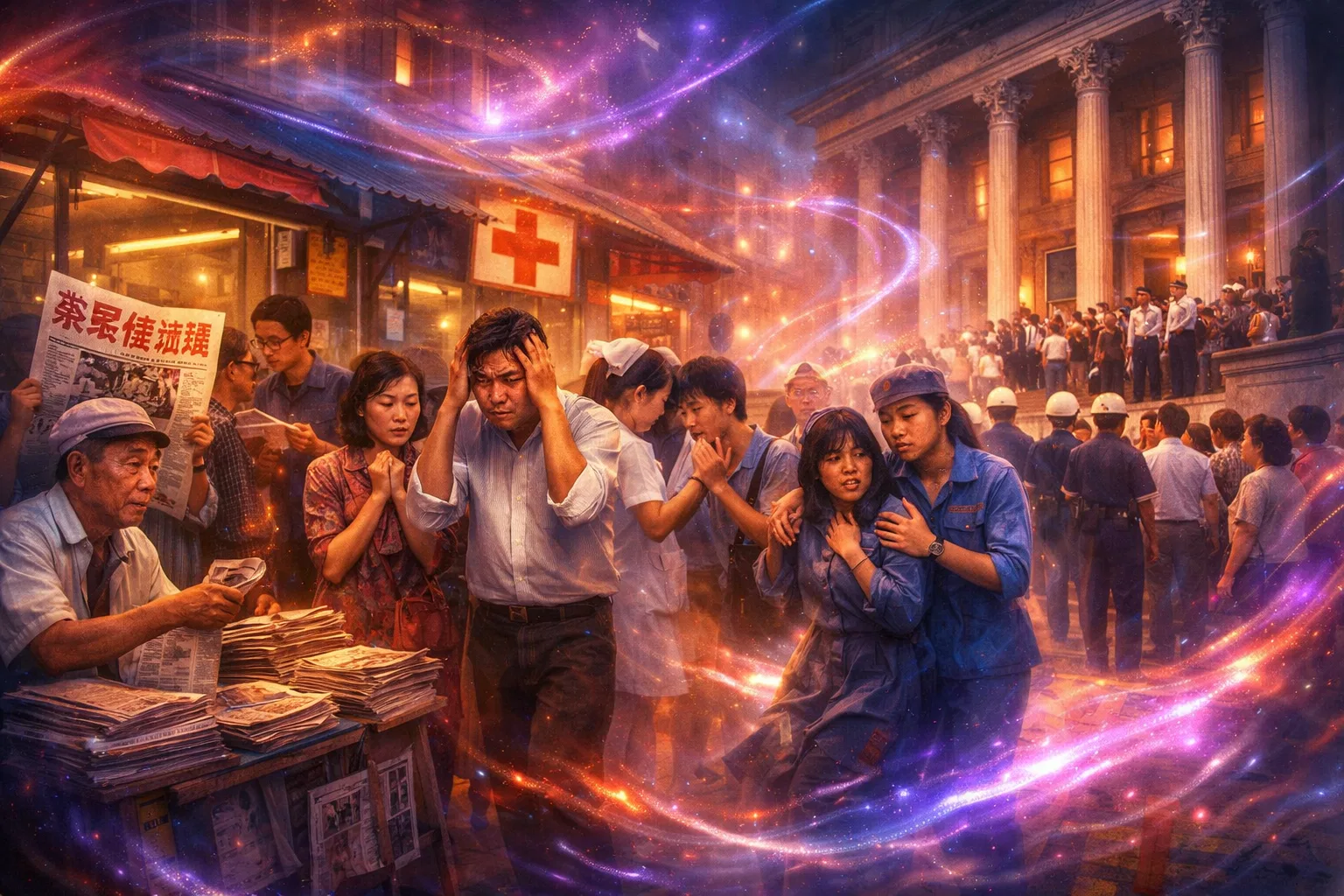
Singapore’s best-documented episode of contagious belief began in late October 1967. A newspaper report linked cases of genital retraction anxiety to pork from pigs vaccinated against swine fever. A further story reportedly claimed that a vaccinated pig had died after its penis retracted. The suggestion that contaminated pork could cause the same fate in humans travelled quickly through Singapore’s Chinese community.[smj.org.sg]smj.org.sgHistory of Koro in SingaporeThe 1967 Koro epidemic in Singapore. In October 1967, there was an outbreak of koro in. Singapore that lasted…
Affected men became convinced that their penises were shrinking or being pulled into the abdomen and that complete retraction might cause death. Some relatives helped them hold or clamp the organ in place, creating a risk of physical injury. The symptoms and terror were real, even though doctors found no process capable of making the organ disappear into the body.[sma.org.sg]smj.sma.org.sgTHE KORO "EPIDEMIC" IN SINGAPOREby CGA Leng · 1969 — syndrome. Previously, it was suggested that Koro was a panic state arising out of a…
The outbreak lasted about ten days. A later medical history counted 469 cases, overwhelmingly among ethnic Chinese men, although exact totals vary depending on which hospitals and reports are included. At the peak, one hospital unit reportedly saw 97 patients in a single day.[smj.org.sg]smj.org.sgHistory of Koro in SingaporeThe 1967 Koro epidemic in Singapore. In October 1967, there was an outbreak of koro in. Singapore that lasted…
Why the fear made sense to those affected
Doctors commonly described the condition as koro, a pattern of acute anxiety associated in parts of East and Southeast Asia with the belief that genital retraction can cause death, impotence or loss of vitality. Calling it a “culture-bound syndrome”, however, risks suggesting that culture simply made people irrational. Later researchers have offered a more useful explanation: people interpreted ambiguous bodily sensations through beliefs already available to them, then reinforced one another’s interpretations through observation, conversation and alarming reports.[Ovid]ovid.com1363461507074967~a conceptual history of koroA Conceptual History of Koro: Transcultural Psychiatryby C Buckle · 2007 · Cited by 38 — Koro is a culture-bound syndrome characteri…
The pork rumour gave the anxiety an immediate trigger. It connected food safety, modern veterinary medicine and an intimate bodily fear. Once men heard that others had developed the condition, ordinary changes caused by cold, touch, posture or anxiety could be misread as evidence that the rumour was true. Seeking help at a hospital then placed frightened people among many others expressing the same belief.
The authorities responded with unusually direct public communication. Medical organisations and the Ministry of Health stated through newspapers and television that pork consumption was not causing genital retraction and that fear was the central mechanism. Contemporary reports show doctors attempting to break the rumour by explaining the body’s anatomy and publicly rejecting the supposed connection with vaccinated pigs. The case numbers then fell rapidly.[eResources]eresources.nlb.gov.sge Resources Newspaper SGNewspaperSG - The Straits Times, 7 November 1967Singapore koro "epidemic"' a retraction of the male sexual organ. This was thei…
This makes the outbreak an important early example of crisis communication in Singapore. Official reassurance did not merely tell people to remain calm; it attacked the rumour’s specific causal claim. The episode is still remembered because it demonstrates how a private bodily anxiety can become a city-wide social fact when medical uncertainty, familiar beliefs and fast-moving news converge.
When factory floors became sites of possession
During the 1970s, Singapore recorded repeated outbreaks among young female workers in factories. Those affected screamed, fainted, struggled, entered trance-like states or claimed that spirits were speaking through them. Newspapers usually called the incidents “mass hysteria”. Medical researchers preferred terms such as “epidemic hysteria”, while many workers and families understood them as spirit possession.[smj.sma.org.sg]smj.sma.org.sgEPIDEMI C HYSTERIA (A PSYCHIATRIC INVESTIGATIONEPIDEMI C HYSTERIA (A PSYCHIATRIC INVESTIGATION
One closely studied outbreak occurred in a large television-assembly factory. Researchers recorded 90 episodes involving 84 people over eight days. The cases occurred almost entirely among young Malay women, despite the factory having a multiracial workforce. A separate psychiatric investigation of 25 affected workers likewise found that all were Malay women.[smj.sma.org.sg]smj.sma.org.sgOpen source on sma.org.sg.
The pattern appeared elsewhere. In October 1973, about a dozen women at the Pon Pon food factory became ill, leading the company to close for the day. In 1977, roughly 30 women in the Telecommunications Authority’s operations room began screaming and struggling with colleagues who tried to calm them. At Woodsville Secondary School in 1979, dozens of younger students were affected and taken for observation.[straitstimes.com]straitstimes.comThe Straits Times Past 'mass hysteria' cases in SingaporeThe Straits Times Past 'mass hysteria' cases in Singapore
Illness, possession or workplace protest?
A mass psychogenic illness is an outbreak in which real symptoms spread through a connected group but investigations do not find an adequate toxic, infectious or structural cause. Anxiety, expectation, social observation and physical stress can all contribute. The diagnosis should be made carefully, because chemical exposure, heat, infection and poor ventilation must first be considered rather than dismissed.[OUP Academic]academic.oup.comOpen source on oup.com.
Early clinical accounts concentrated on personality, emotional vulnerability and contagious behaviour. That approach established that the episodes were not caused by a mysterious factory poison, but it could also portray the workers as individually unstable. The gendered word “hysteria”, with its long history of treating women’s distress as irrational, made that problem worse.
Anthropologist Aihwa Ong offered a broader interpretation of similar possession outbreaks among Malay factory women in Singapore and Malaysia. She linked them to the rapid movement of young women from family-regulated village life into repetitive industrial labour governed by supervisors, production targets and multinational management. Spirit possession could express fear and distress in a form understood by workers and families while temporarily interrupting factory discipline.[jstor.org]jstor.orgOpen source on jstor.org.
This does not mean that every episode was a conscious protest. A worker in a trance was not necessarily pretending or making a calculated political statement. Rather, possession supplied a culturally meaningful language for experiences that might otherwise be difficult to voice: exhaustion, conflict with supervisors, anxiety about female respectability, separation from family and discomfort in an unfamiliar industrial environment.
Management responses revealed the competition between explanations. Factories sought medical assistance, removed affected workers or suspended production. Traditional healers were sometimes invited to cleanse the workplace or expel spirits. Reports from Singapore and neighbouring Malaysia suggest that such ceremonies reassured some participants but could also confirm that a supernatural threat was present, prolonging attention and expectation around the outbreak.[sabrizain.org]sabrizain.orgOpen source on sabrizain.org.
The lasting importance of these incidents lies in this clash of frameworks. To doctors, they were psychogenic outbreaks. To workers, they might be encounters with spirits. To employers, they were disruptions to production. To social historians, they reveal the hidden emotional costs of Singapore’s rapid industrialisation.
A custody case that became a religious crisis
The Maria Hertogh riots of December 1950 were not an example of mass psychogenic illness. They were an outbreak of communal violence shaped by religious grievance, sensational reporting and colonial mistrust.
Maria Hertogh was born to Dutch-Eurasian Catholic parents but had been raised during the Japanese occupation by a Malay-Muslim foster mother, Aminah. A bitter custody struggle followed the return of Maria’s birth parents. The case became much more than a disagreement over guardianship: many Muslims saw it as a test of whether colonial courts respected Islamic family life and Maria’s upbringing, while others framed it as the restoration of a European child to her biological parents.[NLB]nlb.gov.sgNLBMaria Hertogh riotsNLBMaria Hertogh riots
Press photographs of Maria in a Catholic convent were especially inflammatory. Newspapers in different languages emphasised competing religious and emotional interpretations, while activists organised public support around the case. Some Muslim publications also urged restraint, but those warnings failed to prevent crowds gathering outside the court when the custody decision went against Aminah.[NLB]nlb.gov.sgNLBMaria Hertogh riotsNLBMaria Hertogh riots
Violence continued from 11 to 13 December. Eighteen people were killed and 173 injured; vehicles and property were attacked, and Europeans and Eurasians were assaulted in the streets. More than a thousand people were arrested for rioting or related offences, while hundreds more were detained under emergency regulations.[NLB]nlb.gov.sgNLBMaria Hertogh riotsNLBMaria Hertogh riots
It would be misleading to reduce the riots to a crowd delusion. The custody dispute was real, the religious and legal grievances were real, and colonial institutions had deep legitimacy problems. Yet the escalation followed a pattern familiar from moral panics: a complicated case became a symbolic battle between whole communities; emotionally powerful images displaced legal detail; and each new report appeared to confirm that a sacred identity was under attack.
The official inquiry blamed several factors, including the court decisions, the decision to place Maria temporarily in a convent, political agitation and sensational press coverage. The episode had a lasting influence on Singaporean journalism and government policy. Newspapers became more cautious about material likely to inflame racial or religious passions, while later governments treated communal harmony as an area requiring close legal and administrative control.[NLB]nlb.gov.sgNLBMaria Hertogh riotsNLBMaria Hertogh riots
New religious movements and the problem with the word “cult”
Singapore has tightly regulated religious organisations whose activities are considered threats to public order, family welfare or the legal registration system. Public discussion often describes such groups as “cults”, but that word can blur important distinctions between unconventional belief, coercive conduct and simple nonconformity.
In 1982, the government dissolved the local Unification Church, officially known at the time as the Holy Spirit Association for the Unification of World Christianity. Authorities said its continued existence was prejudicial to public welfare and good order, with concerns focusing particularly on recruitment practices and the disruption of families. A related organisation was dissolved in 1990 after being described by the government as a front for the banned movement.[UPI]upi.comGovernment dissolves alleged Moonie front groupGovernment dissolves alleged Moonie front group
The neutral term “new religious movement” is often more useful unless there is clear evidence of fraud, coercion, violence or abusive control. A movement may have an unconventional founder, apocalyptic theology or intense communal expectations without being criminal. Conversely, familiar religious language does not excuse deceptive recruitment or exploitation. The important questions are what the group actually does, whether members can leave freely, how money and authority are controlled, and whether laws have been broken.
A more recent case involved the Singapore chapter of the South Korean Shincheonji Church of Jesus. In February 2020, the Ministry of Home Affairs announced an investigation into an unregistered local chapter. The timing attracted intense attention because a Shincheonji congregation had been connected to a major COVID-19 cluster in South Korea, but Singapore’s official action centred on the chapter’s registration status and alleged concealment of its activities rather than on its theology alone.[Ministry of Home Affairs]mha.gov.sgOpen source on mha.gov.sg.
In November 2020, police arrested 21 people suspected of being members of an unlawful society. The government said the group had continued activities after being warned to cease. Describing this simply as a “cult crackdown” misses the central legal issue: Singapore acted through the Societies Act against an unregistered organisation. Whether the law’s breadth is justified is a separate debate from whether the movement’s beliefs are true or unusual.[Ministry of Home Affairs]mha.gov.sgOpen source on mha.gov.sg.
These cases illustrate a recurring Singaporean approach. Religious freedom is recognised, but organisations are expected to register, avoid political subversion and operate within rules designed to protect public order. Supporters see this as pragmatic prevention in a religiously diverse society. Critics warn that official descriptions of dangerous or deceptive groups can be accepted too readily when independent evidence is limited.
When the state defines the hidden threat
The alleged “Marxist conspiracy” of 1987 shows how the structure of a social scare can also emerge in political life. In May that year, Singapore’s Internal Security Department arrested 16 people under the Internal Security Act, followed by further arrests in June. The government alleged that the detainees belonged to a Marxist network seeking to infiltrate social, religious and professional organisations as part of a long-term plan to undermine the state.[NLB]nlb.gov.sgNLBMarxist conspiracyNLBMarxist conspiracy
The detainees included church workers, lawyers, graduates and people involved in social organisations. They were held without trial for periods ranging from about a month to three years. Government statements presented the network as a concealed ideological threat whose individual activities could appear harmless when viewed separately but became dangerous when understood as part of a coordinated plan.[NLB]nlb.gov.sgNLBMarxist conspiracyNLBMarxist conspiracy
That account has remained strongly contested. An International Commission of Jurists mission concluded that it had found no evidence of a Marxist conspiracy or imminent threat, arguing that the detainees’ activities fell within legitimate civil and social engagement. Former detainees have also withdrawn statements that they said were made under pressure.[International Commission of Jurists]icj.orgOpen source on icj.org.
Calling the episode a moral panic does not settle whether officials genuinely believed the security assessment. It instead draws attention to the form of the claim: an invisible network, gradual infiltration, apparently respectable fronts and a future catastrophe that pre-emptive detention was said to have prevented. Such allegations are difficult for outsiders to test because the strongest evidence is often classified, while the absence of an attempted uprising can be presented either as proof that intervention worked or as evidence that the threat was exaggerated.
The episode remains culturally significant because it demonstrates the power of official labelling. “Marxist”, like “cult”, can function both as a descriptive term and as a category that gathers diverse people into a single threatening story. The dispute is therefore not only about the politics of the 1980s, but about who is entitled to define danger when public evidence is incomplete.
Disease scares in the age of messaging apps
Singapore’s encounters with SARS in 2003 and COVID-19 from 2020 were genuine public-health emergencies, not imaginary epidemics. Fear was often proportionate to a real and uncertain danger. Yet actual disease can still produce rumour cascades, scapegoating and behaviour that worsens shortages.
On 7 February 2020, Singapore raised its disease alert level for COVID-19. Supermarkets were rapidly stripped of rice, noodles, toilet paper and other essentials. Images of empty shelves circulated online, encouraging more people to buy before supplies disappeared. Reports suggested that anxiety was also influenced by scenes of shortages elsewhere, particularly Hong Kong.[CNA]channelnewsasia.combig read in short what make sporeans panic buying amid covid 19 outbreak 5687361big read in short what make sporeans panic buying amid covid 19 outbreak 5687361
Research examining public reactions in Singapore found fear and concern to be the most common theme, with panic buying and hoarding another major response. A later study reported that fear, perceived scarcity and peer pressure were associated with a substantially greater likelihood of panic buying.[PMC]pmc.ncbi.nlm.nih.govOpen source on nih.gov.
Panic buying is not necessarily the product of a bizarre false belief. It can arise from individually understandable decisions that become collectively damaging. A shopper may reason that everyone else is about to buy extra supplies, so buying early is prudent. When thousands make the same calculation, shelves empty and the original fear appears justified.
The government countered the run with public assurances that food and essential-goods supply chains remained intact. This resembled the response to the 1967 genital-retraction panic in one important respect: officials attempted to identify and contradict the precise belief driving behaviour. The difference was that COVID-19 involved a real external hazard, so communication had to reduce unnecessary alarm without encouraging complacency.
Research into a large Singapore-based COVID-19 Telegram group also complicates the idea that social media users simply accepted every rumour. Government-identified misinformation appeared relatively rarely in the dataset, and many participants reacted sceptically when it appeared. Digital networks can transmit fear quickly, but they can also carry correction, mockery and collective fact-checking.[arXiv]arxiv.orgOpen source on arxiv.org.

What Singapore’s cases have in common
The strongest lesson from Singapore is not that crowds are easily fooled. It is that people interpret uncertainty through the institutions, stories and relationships available to them.
In 1967, a food rumour activated an existing fear about bodily retraction. In the factories, distress took the form of possession within groups of young women experiencing industrial discipline and rapid social change. In the Maria Hertogh case, a custody dispute became a symbol of religious humiliation under colonial law. During COVID-19, people copied the precautionary buying of neighbours because empty shelves made scarcity visible.
Several recurring forces shaped these episodes:
- Trusted social proof: Seeing relatives, colleagues or other shoppers react made a threat feel more credible.
- Ambiguous evidence: Bodily sensations, trance states, legal decisions and supermarket shortages could support several interpretations.
- Compressed communities: Factories, schools, court crowds and messaging groups allowed emotion and explanation to circulate rapidly.
- Authority competition: Doctors, religious specialists, newspapers, activists and government agencies offered rival accounts of what was happening.
- Underlying pressure: Industrialisation, colonial resentment, communal insecurity, political conflict and epidemic uncertainty gave rumours emotional force.
- Labels with consequences: Terms such as “hysteria”, “possession”, “cult” and “conspiracy” did not merely describe events; they shaped who was believed, treated, regulated or detained.
Singapore’s relatively strong state capacity has often enabled rapid containment. Public broadcasts helped end the 1967 panic; workplaces could be closed and medically investigated; religious organisations could be dissolved; and emergency messages could be distributed quickly during a pandemic. The same capacity raises questions about proportionality, particularly when the threat is ideological or religious rather than medical.
Why these episodes still matter
The old expression “mass hysteria” suggests a temporary collapse of reason. Singapore’s history points to a more careful conclusion. Collective scares usually grow where evidence is incomplete but the stakes feel high. People do not abandon reasoning altogether; they reason socially, watching what others do and fitting new information into familiar stories.
That distinction has practical consequences. Mocking sufferers can increase shame and mistrust. Treating possession claims only as superstition may overlook workplace distress. Treating every unconventional religion as a cult can justify prejudice. Treating all public concern as panic can conceal genuine danger, while treating every rumour as plausible can magnify harm.
The most effective responses in Singapore have combined factual correction with an understanding of why the fear was persuasive. The least satisfactory have relied on labels that close debate rather than clarify evidence. Across the genital-retraction epidemic, factory possession outbreaks, religious controversies and modern disease scares, the central question remains the same: not simply why people believed something strange, but what conditions made that belief useful, credible or frightening at that particular moment.
Amazon book picks
Further Reading
Books and field guides related to How Fear Became Contagious in Singapore. Use these as the next step if you want deeper reading beyond the article.
Extraordinary Popular Delusions and the Madness of Crowds
Rating: 4.0/5 from 5 Google Books ratings
Foundational work on collective delusions and panics.

The Psychology of Pandemics
Explains fear contagion, rumours and collective behaviour.
From Third World to First : The Singapore Story
Provides historical context for modern Singapore.
Gustave Bon Classics: the Crowd a Study of the Popular Mind
Useful background for mass fear episodes.
Endnotes
1.
Source: smj.org.sg
Link:https://www.smj.org.sg/sites/default/files/3808/3808smj14.pdf
Source snippet
History of Koro in SingaporeThe 1967 Koro epidemic in Singapore. In October 1967, there was an outbreak of koro in. Singapore that lasted...
Published: October 1967
2.
Source: smj.sma.org.sg
Link:https://smj.sma.org.sg/1004/1004smj5.pdf
Source snippet
THE KORO "EPIDEMIC" IN SINGAPOREby CGA Leng · 1969 — syndrome. Previously, it was suggested that Koro was a panic state arising out of a...
3.
Source: ovid.com
Title: 1363461507074967~a conceptual history of koro
Link:https://www.ovid.com/journals/tpsy/fulltext/10.1177/1363461507074967~a-conceptual-history-of-koro
Source snippet
A Conceptual History of Koro: Transcultural Psychiatryby C Buckle · 2007 · Cited by 38 — Koro is a culture-bound syndrome characteri...
4.
Source: pmc.ncbi.nlm.nih.gov
Link:https://pmc.ncbi.nlm.nih.gov/articles/PMC9946797/
Source snippet
Koro Syndrome: Epidemiology, Psychiatric and Physical Risk...by YN Strong · 2023 · Cited by 15 — Sporadic, non-cultural Koro is seen...
5.
Source: smj.sma.org.sg
Title: EPIDEMI C HYSTERIA (A PSYCHIATRIC INVESTIGATION)
Link:https://smj.sma.org.sg/1601/1601smj5.pdf
6.
Source: smj.sma.org.sg
Link:https://smj.sma.org.sg/1701/1701smj4.pdf
7.
Source: academic.oup.com
Link:https://academic.oup.com/epirev/article-pdf/19/2/233/6727528/19-2-233.pdf
8.
Source: jstor.org
Link:https://www.jstor.org/stable/645484
9.
Source: sabrizain.org
Link:https://www.sabrizain.org/malaya/library/minahkaran.pdf
10.
Source: nlb.gov.sg
Title: NLBMaria Hertogh riots
Link:https://www.nlb.gov.sg/main/article-detail?cmsuuid=fbc266c5-4f6f-49d8-b77e-d37e20742087
11.
Source: nlb.gov.sg
Title: NLBMaria Hertogh (Nadra)
Link:https://www.nlb.gov.sg/main/article-detail?cmsuuid=af47a065-758c-4ee7-b699-a845403ff484
12.
Source: upi.com
Title: Government dissolves alleged Moonie front group
Link:https://www.upi.com/Archives/1990/07/01/Government-dissolves-alleged-Moonie-front-group/4791646804800/
13.
Source: nlb.gov.sg
Title: NLBMarxist conspiracy
Link:https://www.nlb.gov.sg/main/article-detail?cmsuuid=9dbd8046-cf53-44f1-b6c0-59169e5a82c8
14.
Source: channelnewsasia.com
Title: big read in short what make sporeans panic buying amid covid 19 outbreak 5687361
Link:https://www.channelnewsasia.com/singapore/big-read-in-short-what-make-sporeans-panic-buying-amid-covid-19-outbreak-5687361
15.
Source: time.com
Link:https://time.com/5802293/coronavirus-covid19-singapore-hong-kong-taiwan/
16.
Source: pmc.ncbi.nlm.nih.gov
Link:https://pmc.ncbi.nlm.nih.gov/articles/PMC7454786/
17.
Source: arxiv.org
Link:https://arxiv.org/abs/2010.10113
18.
Source: history.com
Title: what was satanic panic 1980s
Link:https://www.history.com/articles/what-was-satanic-panic-1980s
19.
Source: upi.com
Title: Singapore: 3 religious groups banned
Link:https://www.upi.com/Archives/1996/01/18/Singapore-3-religious-groups-banned/1762821941200/
20.
Source: youtube.com
Title: Episode 71. Frenzy – The Turmoil of Mass Psychogenic Illness
Link:https://www.youtube.com/watch?v=e2AdorYLDF8
Source snippet
Koro - Shrinking Penis Syndrome - What is it? Short Documentary...
21.
Source: youtube.com
Link:https://www.youtube.com/watch?v=VjDQ28pnRZk
Source snippet
[TRAILER] The screaming schoolgirls of Kelantan | The Unsolved Mysteries of South-east Asia Ep 5...
22.
Source: eresources.nlb.gov.sg
Title: e Resources Newspaper SG
Link:https://eresources.nlb.gov.sg/newspapers/digitised/issue/newpaper20011015-1
Source snippet
NewspaperSG - The New Paper, 15 October 200115 Oct 2001 — Oct 29,1967, a newspaper reported that some people, after eating pork...
23.
Source: eresources.nlb.gov.sg
Title: e Resources Newspaper SG
Link:https://eresources.nlb.gov.sg/newspapers/digitised/issue/straitstimes19671107-1
Source snippet
NewspaperSG - The Straits Times, 7 November 1967Singapore koro "epidemic"' a retraction of the male sexual organ. This was thei...
24.
Source: eresources.nlb.gov.sg
Title: e Resources Newspaper SG
Link:https://eresources.nlb.gov.sg/newspapers/digitised/issue/easternsun19671105-1
25.
Source: straitstimes.com
Title: The Straits Times Past ‘mass hysteria’ cases in Singapore
Link:https://www.straitstimes.com/singapore/from-the-straits-times-archives-past-mass-hysteria-cases-in-singapore
26.
Source: eresources.nlb.gov.sg
Title: e Resources Newspaper SG
Link:https://eresources.nlb.gov.sg/newspapers/digitised/issue/straitstimes19771021-1
27.
Source: eresources.nlb.gov.sg
Title: e Resources Newspaper SG
Link:https://eresources.nlb.gov.sg/newspapers/digitised/issue/singmonitor19830406-1
28.
Source: anthrosource.onlinelibrary.wiley.com
Link:https://anthrosource.onlinelibrary.wiley.com/doi/10.1525/ae.1988.15.1.02a00030
29.
Source: Wikipedia
Title: Mass psychogenic illness
Link:https://en.wikipedia.org/wiki/Mass_psychogenic_illness
30.
Source: biblioasia.nlb.gov.sg
Link:https://biblioasia.nlb.gov.sg/all-sections/vol-21-issue-4-jan-mar-2026-straits-times-180-anniversary/
31.
Source: mha.gov.sg
Link:https://www.mha.gov.sg/media-room/newsroom/investigations-into-shincheonji-church-of-jesus-the-temple-of-the-tabernacle-of-the-testimony-in-singapore/
32.
Source: mha.gov.sg
Link:https://www.mha.gov.sg/media-room/newsroom/21-members-of-unregistered-local-chapter-of-the-shincheonji-church-of-jesus-the-temple-of-the-tabernacle-of-the-testimony-arrested-under-the-societies-act/
33.
Source: icj.org
Link:https://www.icj.org/international-mission-of-jurists-to-singapore-dismisses-allegations-of-marxist-conspiracy/
34.
Source: straitstimes.com
Title: panic buying driven by fear perceived lack of supplies and peer pressure ntu
Link:https://www.straitstimes.com/singapore/consumer/panic-buying-driven-by-fear-perceived-lack-of-supplies-and-peer-pressure-ntu
35.
Source: Wikipedia
Title: Moral panic
Link:https://en.wikipedia.org/wiki/Moral_panic
36.
Source: Wikipedia
Title: Unification Church
Link:https://en.wikipedia.org/wiki/Unification_Church
37.
Source: biblioasia.nlb.gov.sg
Title: people 2025 8 felix cheong author poet graphic novels
Link:https://biblioasia.nlb.gov.sg/all-sections/people-2025-8-felix-cheong-author-poet-graphic-novels/
38.
Source: eresources.nlb.gov.sg
Title: nlb.gov.sg Newspaper S G
Link:https://eresources.nlb.gov.sg/newspapers/digitised/issue/straitstimes20020127-1
39.
Source: eresources.nlb.gov.sg
Title: nlb.gov.sg Newspaper S G
Link:https://eresources.nlb.gov.sg/newspapers/digitised/issue/straitstimes19671108-1
40.
Source: eresources.nlb.gov.sg
Title: nlb.gov.sg Newspaper S G
Link:https://eresources.nlb.gov.sg/newspapers/digitised/issue/singherald19710327-1
41.
Source: eresources.nlb.gov.sg
Title: nlb.gov.sg Newspaper S G
Link:https://eresources.nlb.gov.sg/newspapers/digitised/issue/newpaper19991001-1
42.
Source: eresources.nlb.gov.sg
Title: straitstimes19551113 1
Link:https://eresources.nlb.gov.sg/newspapers/digitised/issue/straitstimes19551113-1
43.
Source: eresources.nlb.gov.sg
Title: straitstimes19591210 1
Link:https://eresources.nlb.gov.sg/newspapers/digitised/issue/straitstimes19591210-1
44.
Source: eresources.nlb.gov.sg
Title: straitsbudget19501221 1
Link:https://eresources.nlb.gov.sg/newspapers/digitised/issue/straitsbudget19501221-1
45.
Source: eresources.nlb.gov.sg
Title: nlb.gov.sg Newspaper S G
Link:https://eresources.nlb.gov.sg/newspapers/digitised/issue/singmonitor19830406-2
46.
Source: eresources.nlb.gov.sg
Title: nlb.gov.sg Newspaper S G
Link:https://eresources.nlb.gov.sg/newspapers/digitised/issue/singstandard19501218-1
47.
Source: eresources.nlb.gov.sg
Title: maltribune19370621 1
Link:https://eresources.nlb.gov.sg/newspapers/digitised/issue/maltribune19370621-1
48.
Source: eresources.nlb.gov.sg
Title: straitstimes19591204 1
Link:https://eresources.nlb.gov.sg/newspapers/digitised/issue/straitstimes19591204-1
49.
Source: eresources.nlb.gov.sg
Title: straitstimes19711102 1
Link:https://eresources.nlb.gov.sg/newspapers/digitised/issue/straitstimes19711102-1
50.
Source: exhibitions.nlb.gov.sg
Title: nlb.gov.sgthe news gallery
Link:https://exhibitions.nlb.gov.sg/files/newsgallery/nlb_exhibition_guide_english.pdf
51.
Source: eresources.nlb.gov.sg
Title: straitstimes19721014 1
Link:https://eresources.nlb.gov.sg/newspapers/digitised/issue/straitstimes19721014-1
52.
Source: eresources.nlb.gov.sg
Title: nlb.gov.sg Newspaper S G
Link:https://eresources.nlb.gov.sg/newspapers/digitised/issue/singstandard19501221-1
53.
Source: nlb.gov.sg
Title: article detail
Link:https://www.nlb.gov.sg/main/article-detail?cmsuuid=B-a68c84bb-40b7-46ad-83aa-38cc3e86b540
54.
Source: pmc.ncbi.nlm.nih.gov
Link:https://pmc.ncbi.nlm.nih.gov/articles/PMC7201200/
55.
Source: pubmed.ncbi.nlm.nih.gov
Link:https://pubmed.ncbi.nlm.nih.gov/1197502/
56.
Source: thecityanthropologist.com
Link:https://www.thecityanthropologist.com/copy-of-a-voice-6
57.
Source: ebsco.com
Title: moral panic
Link:https://www.ebsco.com/research-starters/social-sciences-and-humanities/moral-panic
Additional References
58.
Source: journals.sagepub.com
Link:https://journals.sagepub.com/doi/pdf/10.1177/002076409404000105
Source snippet
Sage JournalsThe Social Psychology of 'Epidemic' Koroby RE Bartholomew · 1994 · Cited by 47 — koro as a psychiatric syndrome exacerbated...
59.
Source: govinsider.asia
Link:https://govinsider.asia/intl-en/article/fake-news-lessons-from-lee-kuan-yew
60.
Source: researchgate.net
Link:https://www.researchgate.net/publication/266733398Fuming_and_fogging_memories_Civil_society_and_state_in_communication_of_heritage_in_Singapore_in_the_cases_of_the_Singapore_Memories_Project_and_the%27Marxist_Conspiracy%27_of_1987
61.
Source: facebook.com
Link:https://www.facebook.com/HISTORYasia/posts/koro-syndrome-is-a-psychiatric-disorder-where-a-person-fears-that-his-or-her-gen/10157447316178754/
62.
Source: simplypsychology.org
Link:https://www.simplypsychology.org/folk-devils-and-moral-panics-cohen-1972.html
63.
Source: aaets.org
Link:https://www.aaets.org/traumatic-stress-library/sociological-views-on-the-controversial-issue-of-satanic-ritual-abuse-three-faces-of-the-devil
64.
Source: whatsworthreading.com
Link:https://www.whatsworthreading.com/spirits-of-resistance.html
65.
Source: academia.edu
Link:https://www.academia.edu/122345088/Spirits_of_Resistance_and_Capitalist_Discipline_Second_Edition_Factory_Women_in_Malaysia
66.
Source: amazon.co.uk
Link:https://www.amazon.co.uk/Spirits-Resistance-Capitalist-Discipline-Anthropology/dp/0887063810?tag=searcht-20
67.
Source: researchgate.net
Link:https://www.researchgate.net/publication/15193023The_Social_Psychology_of%27Epidemic%27_Koro
Topic Tree
Follow this branch
Related pages 192
- Antigua and Barbuda
- Argentina Belief Scares
- Azerbaijan Belief
- Bahrain Beliefs
- North Korea
- +187 more in sidebar