When Fear and Belief Swept Through Colombia
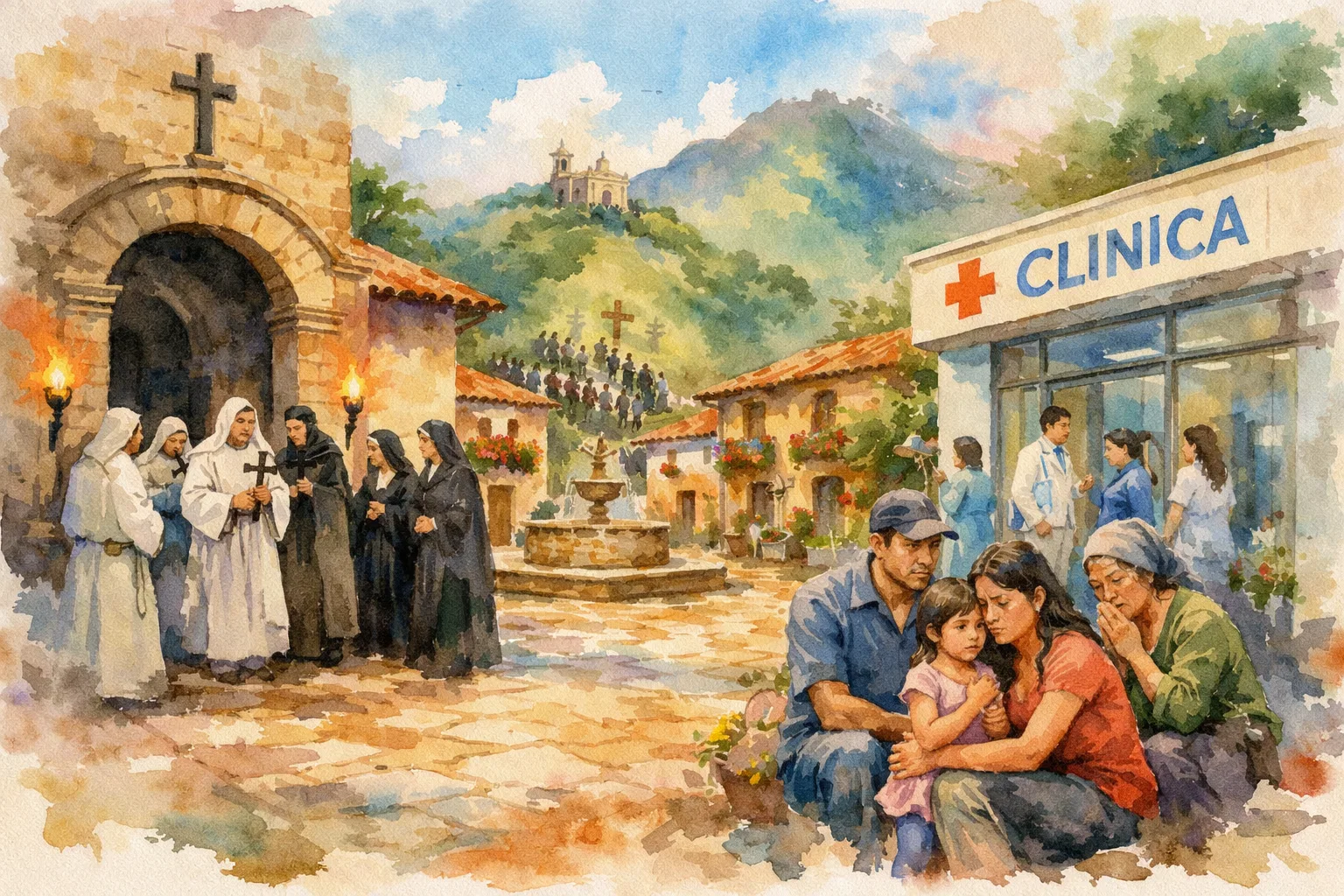
Colombia’s history of collective fear and contagious belief is not a simple catalogue of bizarre episodes. Its most revealing cases show how supernatural ideas, medical uncertainty, racial hierarchy, political violence and distrust of institutions can reinforce one another.
Page outline Jump by section
Introduction
These events do not all belong in the same category. Some were persecutions created by powerful institutions. Some involved sincere religious communities described as “cults” by worried relatives or reporters. Others were outbreaks of real physical symptoms for which investigators found no common toxic or infectious cause. Colombia’s experience therefore offers a useful warning: calling something “mass hysteria” can illuminate social contagion, but it can also dismiss suffering, conceal inequality or turn uncertainty into an unjustifiably confident diagnosis.
Witchcraft became a language of colonial control
The Spanish Inquisition established a tribunal in Cartagena in 1610. Because Cartagena was a major slave-trading port, inquisitors encountered a society in which European Catholicism existed alongside African healing traditions, Indigenous knowledge, household remedies, divination and popular magic. Officials interpreted many of these practices through a Christian demonological framework: unfamiliar medicines or rituals could be recast as evidence of a pact with the devil.[Cambridge University Press & Assessment]cambridge.orgCambridge University Press & AssessmentCartagena de Indias (Chapter 14)One of the ringleaders named in Cartagena's 1633 witchcraft prosec…
Witchcraft prosecutions were therefore shaped as much by race, gender and slavery as by theology. Research on the tribunal’s first half-century has identified 56 people tried for witchcraft, 52 of whom were of African descent. Most defendants were women. The figures do not indicate a spontaneous popular witch craze comparable to some European panics. Instead, they reveal a legal and social system that treated African-descended women as especially plausible sources of hidden danger.[University of Texas at Austin]sites.utexas.eduUniversity of Texas at AustinEnchantments and Entanglements: The Life of an Accused…August 12, 2025 — 12 Aug 2025 — The crime of witch…
Paula de Eguiluz and the making of a “witch”
The best-known defendant, Paula de Eguiluz, was an enslaved African-descended woman taken from Cuba to Cartagena for trial in 1624. Witnesses associated her with healing, love magic, unexplained movement and the death of an infant she had reportedly treated. Inquisitors pressed her to confess within a narrative they already understood: nocturnal gatherings, demonic agreements and supernatural harm. Scholars argue that her testimony changed as she learnt how the tribunal expected a repentant witch to speak.[utexas.edu]sites.utexas.eduUniversity of Texas at AustinEnchantments and Entanglements: The Life of an Accused…August 12, 2025 — 12 Aug 2025 — The crime of witch…
She was convicted, publicly whipped, ordered to work for two years in a hospital and permanently exiled from Cuba. She later built a life in Cartagena as a healer and washerwoman, but faced two further trials. During the proceedings she alternately presented herself as a deceived sinner, a knowledgeable healer and a loyal Christian. Her ability to work within the inquisitors’ assumptions helped her survive, but accusations gathered around other women in her social network.[University of Texas at Austin]sites.utexas.eduUniversity of Texas at AustinEnchantments and Entanglements: The Life of an Accused…August 12, 2025 — 12 Aug 2025 — The crime of witch…
The surviving records cannot tell readers whether every reported remedy, charm or ceremony occurred exactly as witnesses described it. They do show how an institution could manufacture coherence from gossip, medical misfortune and culturally unfamiliar practices. “Witchcraft” was not merely a belief held by frightened neighbours. It was an official category that converted racial prejudice and social anxiety into interrogation, imprisonment, confiscation and corporal punishment.
Popular devotion is not automatically a dangerous “cult”
Colombia also contains forms of collective supernatural belief that have not produced a panic and should not be confused with coercive sects. A striking example appears in Puerto Berrío, a town beside the Magdalena River that received the bodies of many unidentified victims during Colombia’s armed conflict. Local residents began caring for graves marked only as unidentified persons, sometimes symbolically adopting an anonymous dead person, giving the individual a name, decorating the grave and asking the soul for protection or favours.
Researchers describe this as a devotion to souls in purgatory operating partly within and partly beyond formal Catholic authority. The local Church has generally tolerated or facilitated the practice, although its bargains with the dead, personalised rituals and flexible beliefs are not reducible to official doctrine.[Springer]link.springer.coma case study of catholicism and popular religion in Colombiaby L Bastidas Meneses · 2021 · Cited by 10 — This article analyzes th…
The devotion matters because it reverses the erasure created by political violence. Bodies that arrived without names or recognised families acquire caretakers, identities and social relationships. The dead may be approached as intercessors, but they are also restored to human memory. Interpreting the practice merely as superstition would miss its work of mourning in a community marked by disappearances, river-borne corpses and institutional failure.[Springer]link.springer.coma case study of catholicism and popular religion in Colombiaby L Bastidas Meneses · 2021 · Cited by 10 — This article analyzes th…
This case also shows why the word “cult” requires care. In the academic study of religion, a cult may simply mean an organised devotion. In everyday journalism, however, the term often implies manipulation, isolation or danger. Puerto Berrío’s grave practices are better understood as popular religion and vernacular memorial culture, not as evidence of a controlling organisation.
The Stella Maris UFO alarm
In July 1999, reports emerged that dozens of members of a Cartagena-based group known as the Stella Maris Church had left for the Sierra Nevada de Santa Marta. Relatives said the followers expected a catastrophic event and believed extraterrestrials would collect them from high ground. Estimates varied, but contemporary reports commonly referred to between roughly 60 and 100 absent members.[The Guardian]theguardian.comThe Guardian Cult goes to await spaceship rescue | World newsThe Guardian Cult goes to await spaceship rescue | World news
The story appeared especially alarming because it followed the 1997 deaths associated with Heaven’s Gate in the United States. Relatives accused Stella Maris leader Rogelio Perea of separating followers from their families and obtaining their property. Other people close to the movement said the journey was an ordinary spiritual retreat and that relatives and the media were exaggerating it. Police acknowledged reports of the group’s departure but said they had no evidence that members had been forced to travel or that a mass suicide was planned.[WIRED]wired.comUFO Cult Disappears in ColombiaUFO Cult Disappears in Colombia
The episode therefore contains two stories that should not be collapsed into one. There was apparently a small religious movement combining esoteric or Gnostic ideas with apocalyptic and extraterrestrial expectations. There was also a public scare constructed under conditions of limited information. Contemporary coverage documented family fear and extraordinary claims, but it did not establish that the followers intended collective self-destruction.
Stella Maris is culturally important because it demonstrates how quickly the template of the “UFO death cult” could be applied after Heaven’s Gate. Once the group disappeared into mountainous terrain, absence itself became evidence of possible catastrophe. Journalists, relatives and officials were trying to assess a genuine safeguarding concern, yet the most frightening interpretation travelled further than the available proof.
The Carmen de Bolívar illness changed national health policy
Colombia’s most consequential modern outbreak of collective illness began in 2014 in El Carmen de Bolívar, a municipality on the Caribbean coast. Adolescent girls reported fainting, weakness, headaches, numbness, rapid heartbeat, breathing difficulty and other symptoms. Many families connected the illnesses to the human papillomavirus vaccine, which had been administered through Colombia’s school vaccination programme to prevent infections that can cause cervical and other cancers. Videos of girls collapsing, convulsing or arriving at hospital circulated through television news and social media.[PMC]pmc.ncbi.nlm.nih.govOpen source on nih.gov.
The cluster began with a relatively small number of cases and grew dramatically. Investigators examined 517 girls reporting multiple symptoms. The epidemiological assessment did not find a common organic illness or evidence that the vaccine was causing the outbreak. Public-health researchers consequently described the event as a probable mass psychogenic illness or mass stress response: genuine, involuntary symptoms spreading through a socially connected population under conditions of fear and intense attention.[PMC]pmc.ncbi.nlm.nih.govOpen source on nih.gov.
“Psychogenic” does not mean that the girls were pretending. Stress, expectation and observation can produce disabling physical experiences without a shared infection, toxin or identifiable vaccine injury. Symptoms may spread when people see others becoming unwell, hear repeated descriptions of danger and begin closely monitoring their own bodies. Adolescents in tightly connected schools can be particularly vulnerable to this form of amplification.
Yet the official explanation did not settle the dispute. Families felt that authorities were telling them their daughters’ suffering was imaginary. Some scholars and clinicians argued that greater uncertainty should have been acknowledged and that the investigation’s limits deserved more attention. Later social research has examined how gender, poverty, Colombia’s history of political violence and strained relations between peripheral communities and central government shaped the conflict over diagnosis.[tandfonline.com]tandfonline.comOpen source on tandfonline.com.
El Carmen de Bolívar had endured displacement, deprivation and severe violence. Against that background, official reassurance did not arrive in a vacuum. Families were being asked to trust institutions that many residents believed had previously ignored or failed them. Describing the outbreak solely as misinformation therefore misses a central point: rumours gain force when they attach themselves to existing experiences of exclusion.
Why the outbreak spread so effectively
Several elements reinforced one another:
- A believable sequence: vaccination had occurred before the reported illnesses, making a causal connection intuitively compelling even though timing alone could not prove it.
- Visible and frightening symptoms: fainting, shaking and paralysis-like episodes made the danger seem immediate.
- A cohesive population: pupils, parents and neighbours could observe cases and share interpretations rapidly.
- Media repetition: distressing footage gave the alleged vaccine reaction a recognisable visual form.
- Institutional mistrust: official statements were judged through memories of neglect and violence.
- Gendered dismissal: language suggesting emotional contagion was easily heard as another claim that adolescent girls were unreliable witnesses to their own bodies.
The public-health consequences were severe. Colombia had achieved very high HPV-vaccination coverage after introducing the school-based programme. Research summarising national figures reports that coverage fell from about 98 per cent for the first dose and 88 per cent for the full course in 2012 to approximately 14 per cent and 5 per cent respectively by 2016. School-based delivery was halted, and rebuilding confidence became a long-term national challenge.[hpvworld.com]hpvworld.comOpen source on hpvworld.com.
This made the episode more than a local medical mystery. A crisis of explanation contributed to reduced protection against preventable cancers. It also showed that technically accurate safety statements can fail when authorities do not address humiliation, fear and the social history behind distrust.
Spirit-board stories and school fainting scares
Colombian schools have also experienced smaller outbreaks in which pupils collapsed, vomited, shook or suffered anxiety after alleged use of spirit boards. In 2022, 11 pupils aged between 13 and 17 at a school in Hato, Santander, were taken for treatment after being found unwell; reports connected the episode to an attempt to contact the dead. In 2023, officials at a school in Galeras, Sucre, reported 28 possible cases of severe anxiety among female pupils amid claims that spirit-board activity was involved.[www.ndtv.com]ndtv.comwww.ndtv.com11 Children In Colombia Collapse At School After Playingwww.ndtv.com11 Children In Colombia Collapse At School After Playing
The evidence available publicly is not strong enough to establish a single medical explanation for every such incident. Nor does the timing prove that a board, ritual or belief caused the symptoms. Early news reports often repeat frightened community interpretations before clinical investigation is complete. International retellings then strip away cautious phrases such as “possible cases” or “allegedly”, turning an uncertain school-health event into a tale of supernatural attack.
Nevertheless, the supernatural explanation can influence the outbreak even when no paranormal force is involved. A spirit board supplies a shared expectation of danger. Ordinary dizziness, panic or nausea may be interpreted as possession or spiritual contamination; seeing a classmate collapse can increase fear and bodily arousal; adult alarm then confirms that something exceptional is happening. In this way, belief is not simply an explanation added afterwards. It can become part of the mechanism through which distress spreads.
These cases also expose a recurring imbalance in media attention. A dramatic claim about communication with the dead receives global coverage, while mundane possibilities—anxiety, heat, hunger, infection, environmental exposure or an unresolved medical cause—receive less space. Responsible reporting should preserve uncertainty and avoid treating adolescent pupils as props in an occult story.
Why panics take hold in Colombia
Colombia’s cases span four centuries, but several patterns recur.
Fear follows existing lines of power. Colonial accusations targeted African-descended women whose knowledge and independence troubled a slave society. Modern health controversies have unfolded in communities with strong reasons to mistrust distant institutions.
A compelling story can outrun incomplete evidence. The devil’s pact, the rescuing spacecraft, the dangerous injection and the opened spiritual portal each supplied a clear cause for confusing events. Such narratives are emotionally satisfying because they identify an agent, a victim and a course of action.
Media do not merely transmit a panic. Images and repetition shape what later participants expect to see. In El Carmen de Bolívar, circulating footage helped create a national visual vocabulary of vaccine injury. In school scares, reports of spirit-board use can become the defining fact even when their medical significance remains unproven.
Official certainty can deepen distrust. Authorities must investigate toxic, infectious and environmental explanations before considering psychogenic mechanisms. Once those possibilities have been examined, however, simply announcing that symptoms are psychological is rarely enough. Communities need an explanation of how stress can create real illness, acknowledgement of uncertainty and respectful care for those affected.
Not every unusual belief is a panic or a “cult”. The devotion to unidentified souls in Puerto Berrío is a communal response to violent death, not evidence of collective delusion. Stella Maris, by contrast, reportedly combined apocalyptic authority, separation from relatives and extraordinary rescue beliefs, but the most catastrophic contemporary fears were not proven. The distinction depends on documented behaviour and harm, not on whether outsiders find a belief strange.

What Colombia’s cases teach
The central lesson is not that Colombians are unusually superstitious or prone to collective hysteria. Similar episodes occur worldwide. What makes Colombia’s record distinctive is the way collective belief has interacted with slavery, racial hierarchy, Catholic institutions, armed conflict, displacement, unequal healthcare and rapidly changing media.
The Cartagena trials show how authorities can impose a fearful explanation on marginalised people. Stella Maris shows the difficulty of separating legitimate concern about a high-control apocalyptic group from a media panic built around worst-case comparisons. Puerto Berrío shows that extraordinary religious practices can restore dignity rather than remove autonomy. El Carmen de Bolívar shows both the power and the danger of a psychogenic diagnosis: it may best fit the epidemiological pattern, yet become harmful when delivered as a dismissal rather than an explanation.
Across these cases, the most reliable questions remain practical ones. What is directly documented? Who benefits from a particular interpretation? Were people coerced, punished or medically harmed? Were alternative causes investigated? How did newspapers, television or social media change the scale of the event? And did officials earn trust before asking the public to accept their conclusions?
Those questions do more than correct strange stories. They reveal how societies decide whose fears are reasonable, whose pain is believed and which explanations become powerful enough to alter lives.
Amazon book picks
Further Reading
Books and field guides related to When Fear and Belief Swept Through Colombia. Use these as the next step if you want deeper reading beyond the article.
The Demon-Haunted World
Explores belief, evidence and how extraordinary claims spread.
Extraordinary Popular Delusions and the Madness of Crowds
Rating: 4.0/5 from 5 Google Books ratings
Foundational exploration of collective belief and social contagion.


Endnotes
1.
Source: cambridge.org
Link:https://www.cambridge.org/core/books/cambridge-companion-to-the-spanish-inquisition/cartagena-de-indias/12BDECD35FCEFCB1D9AB1F3DF623805B
Source snippet
Cambridge University Press & AssessmentCartagena de Indias (Chapter 14)One of the ringleaders named in Cartagena's 1633 witchcraft prosec...
2.
Source: spanport.unm.edu
Title: k mcknight article16
Link:https://spanport.unm.edu/news-events/news/2016/09/k-mcknight-article16.pdf
Source snippet
the three trials of Paula de Eguiluzby KJ McKnight · 2016 · Cited by 22 — In the Cartagena Inquisition, accusations of sorcery (hechicerí...
3.
Source: link.springer.com
Link:https://link.springer.com/article/10.1007/s41682-021-00075-z
Source snippet
a case study of catholicism and popular religion in Colombiaby L Bastidas Meneses · 2021 · Cited by 10 — This article analyzes th...
4.
Source: wired.com
Title: ufo cult disappears in colombia
Link:https://www.wired.com/1999/07/ufo-cult-disappears-in-colombia/
6.
Source: dare.uva.nl
Link:https://www.dare.uva.nl/id/d016371b-37b8-4f8c-96ae-ab27a0e2b2c9
7.
Source: repositorio.utb.edu.co
Link:https://repositorio.utb.edu.co/entities/publication/7ee860d5-6046-4120-b3bb-c02590bbaa76
8.
Source: hpvworld.com
Link:https://www.hpvworld.com/articles/hpv-vaccination-in-colombia/
9.
Source: link.springer.com
Link:https://link.springer.com/article/10.1186/s12919-020-00192-2
10.
Source: ndtv.com
Title: www.ndtv.com11 Children In Colombia Collapse At School After Playing
Link:https://www.ndtv.com/world-news/11-children-in-colombia-collapse-at-school-after-playing-ouija-board-game-report-3514338
11.
Source: figshare.utas.edu.au
Link:https://figshare.utas.edu.au/ndownloader/files/40909697/1
12.
Source: link.springer.com
Link:https://link.springer.com/chapter/10.1007/978-3-030-83636
13.
Source: history.com
Title: mass suicide at jonestown
Link:https://www.history.com/this-day-in-history/november-18/mass-suicide-at-jonestown
14.
Source: cambridge.org
Link:https://www.cambridge.org/core/books/as-if-she-were-free/paula-de-eguiluz-seventeenthcentury-puerto-rico-cuba-and-new-granada-colombia/1643E0F086493293A70446ED3068BD30
15.
Source: sites.utexas.edu
Link:https://sites.utexas.edu/llilas-benson-magazine/2025/08/12/enchantments-and-entanglements-the-life-of-an-accused-witch-in-seventeenth-century-cartagena/
Source snippet
University of Texas at AustinEnchantments and Entanglements: The Life of an Accused...August 12, 2025 — 12 Aug 2025 — The crime of witch...
Published: August 12, 2025
16.
Source: tandfonline.com
Link:https://www.tandfonline.com/doi/full/10.1080/10609164.2021.1912481
Source snippet
Taylor & Francis OnlineFragile fortunes: Afrodescendant women, witchcraft, and...by AMS Campo · 2021 · Cited by 21 — The records that In...
17.
Source: tandfonline.com
Link:https://www.tandfonline.com/doi/abs/10.1080/10609164.2016.1205243
Source snippet
Taylor & Francis OnlinePerforming double-edged stories: the three trials of Paula...by KJ McKnight · 2016 · Cited by 22 — Paula de Eguil...
18.
Source: theguardian.com
Title: The Guardian Cult goes to await spaceship rescue | World news
Link:https://www.theguardian.com/world/1999/jul/09/owenbowcott
19.
Source: pmc.ncbi.nlm.nih.gov
Link:https://pmc.ncbi.nlm.nih.gov/articles/PMC6363158/
20.
Source: pubmed.ncbi.nlm.nih.gov
Link:https://pubmed.ncbi.nlm.nih.gov/30118381/
21.
Source: tandfonline.com
Link:https://www.tandfonline.com/doi/full/10.1080/21645515.2019.1577676
22.
Source: pmc.ncbi.nlm.nih.gov
Link:https://pmc.ncbi.nlm.nih.gov/articles/PMC10121443/
23.
Source: pmc.ncbi.nlm.nih.gov
Link:https://pmc.ncbi.nlm.nih.gov/articles/PMC6605877/
24.
Source: pubmed.ncbi.nlm.nih.gov
Link:https://pubmed.ncbi.nlm.nih.gov/30946630/
25.
Source: pmc.ncbi.nlm.nih.gov
Link:https://pmc.ncbi.nlm.nih.gov/articles/PMC8575976/
26.
Source: Wikipedia
Link:https://en.wikipedia.org/wiki/Colombia
27.
Source: Wikipedia
Title: Paula de Eguiluz
Link:https://en.wikipedia.org/wiki/Paula_de_Eguiluz
28.
Source: theguardian.com
Title: for me there was no other choice inside the global organ trade
Link:https://www.theguardian.com/news/article/2024/sep/10/for-me-there-was-no-other-choice-inside-the-global-organ-trade
29.
Source: theguardian.com
Link:https://www.theguardian.com/world/2018/nov/17/an-apocalyptic-cult-900-dead-remembering-the-jonestown-massacre-40-years-on
30.
Source: theguardian.com
Title: carol morley the falling mass hysteria is a powerful group activity
Link:https://www.theguardian.com/film/2015/mar/29/carol-morley-the-falling-mass-hysteria-is-a-powerful-group-activity
31.
Source: tandfonline.com
Link:https://www.tandfonline.com/doi/full/10.1080/21645515.2018.1511667
Additional References
32.
Source: historytoday.com
Title: spanish witches cartagena
Link:https://www.historytoday.com/miscellanies/spanish-witches-cartagena
Source snippet
History TodayThe Spanish Witches of Cartagena12 May 2021 — The Spanish Inquisition arrived in the New World convinced of the existence of...
Published: May 2021
33.
Source: youtube.com
Title: Girls hospitalized after playing with a Ouija board
Link:https://www.youtube.com/watch?v=Cp4NKduem7o
Source snippet
Children in Columbia school pass out after playing Ouija board game...
34.
Source: youtube.com
Title: OUIJA BOARD HORROR! 28 Girls Sent To The Hospital!
Link:https://www.youtube.com/watch?v=WK1-Y0aN19M
Source snippet
Girls hospitalized after playing with a Ouija board...
35.
Source: academia.edu
Link:https://www.academia.edu/9734901/Colonial_Witch_Hunts_in_South_America
36.
Source: researchgate.net
Link:https://www.researchgate.net/publication/226298948_Theba_pisana_Muller_1774_Gastropoda_Helicidae_and_other_alien_land_molluscs_species_in_Argentina
37.
Source: researchgate.net
Link:https://www.researchgate.net/publication/312532128_In_the_name_of_Satan_Violence_Extreme_Metal_and_Young_People_in_Colombia_in_the_80s_and_90s
38.
Source: researchgate.net
Link:https://www.researchgate.net/publication/354176990_The_NN%27s_souls-cult_a_case_study_of_catholicism_and_popular_religion_in_Colombia
39.
Source: researchgate.net
Link:https://www.researchgate.net/publication/375085489The%27Satanic_Panic%27_exploring_the_influence_of_film_in_formulating_narratives_surrounding_the_lived_religion_of_the_Occult_and_its_practitioners
40.
Source: instagram.com
Link:https://www.instagram.com/p/Ck4jKKwLLkA/
41.
Source: hpvboard.org
Link:https://www.hpvboard.org/wp-content/uploads/2025/08/Background-Document-Colombia.pdf
Topic Tree
Follow this branch
Related pages 192
- Antigua and Barbuda
- Argentina Belief Scares
- Azerbaijan Belief
- Bahrain Beliefs
- North Korea
- +187 more in sidebar