Within Niger
Was Bori a Cult or a Healing Tradition?
Bori rituals offered healing and social support, yet reformers often treated their religious mixture and female spaces as signs of disorder.
On this page
- What happens in a Bori ceremony
- Why women and marginalised people joined
- How reformers turned ritual into a moral threat
Page outline Jump by section
Introduction
Was Bori a cult or a healing tradition? In Niger, the historical evidence points far more strongly towards the second answer. Bori is a long-established Hausa spirit-possession tradition that has provided healing, social support and a recognised way of responding to illness, misfortune and personal crisis. Yet it has also been the subject of deep moral suspicion. Muslim reformers, colonial officials and some modern observers have variously portrayed it as superstition, religious corruption or social disorder. The resulting tension says less about Bori itself than about wider struggles over religious authority, women’s public roles and the boundaries of acceptable belief in Niger. Rather than representing an outbreak of mass hysteria, Bori illustrates how a long-standing healing tradition can become controversial when competing visions of morality and religious identity reshape public life.[jstor.org]jstor.orgPrayer Has Spoiled Everything: Possession, Power, and Identity in an Islamic Town of Niger on JSTOR…
What happens in a Bori ceremony?
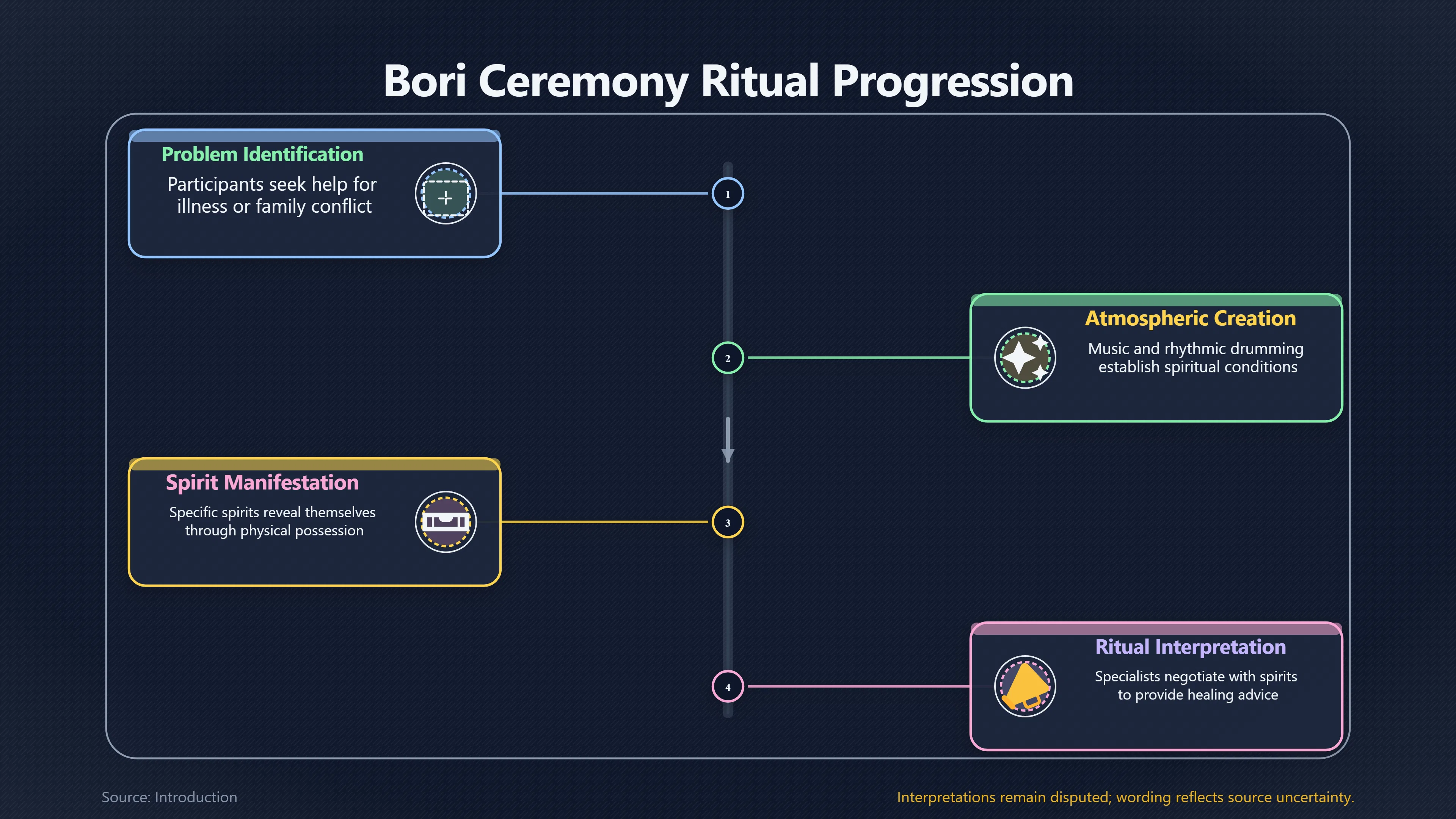
A Bori ceremony is neither simply theatrical performance nor a gathering driven by fear. Participants seek help for problems that may include persistent illness, infertility, emotional distress, family conflict, economic hardship or unexplained misfortune. Music, rhythmic drumming, singing and dancing gradually create the conditions in which particular spirits are believed to reveal themselves through possession.
Experienced ritual specialists do not treat possession as random chaos. Different spirits are understood to have distinct personalities, preferences, movements and ways of communicating. Those leading the ceremony interpret behaviour, negotiate with the spirits and advise participants about obligations, healing or changes that may restore balance. In this sense, possession becomes a recognised language through which suffering can be expressed and interpreted rather than hidden or ignored.[jstor.org]jstor.orgPrayer Has Spoiled Everything: Possession, Power, and Identity in an Islamic Town of Niger on JSTOR…
Anthropologists working in Niger have repeatedly noted that ceremonies combine religious belief with practical social functions. They bring together extended networks of relatives, neighbours and ritual experts, creating opportunities for care, advice and mutual support that extend beyond the possession event itself.[Duke University Press]dukeupress.eduOpen source on dukeupress.edu.
Why women and marginalised people joined
One reason Bori attracted suspicion was precisely the reason many people valued it: it created recognised spaces for those with limited authority elsewhere.
Women often occupied central ritual roles as spirit mediums, healers and organisers. In societies where public religious leadership was frequently male, Bori offered women opportunities to gain prestige through specialist knowledge and recognised ritual competence. The tradition also provided ways to discuss difficult subjects—including unhappy marriages, infertility, domestic tensions or emotional suffering—through the culturally accepted language of spirit relationships rather than direct confrontation.[jstor.org]jstor.orgPrayer Has Spoiled Everything: Possession, Power, and Identity in an Islamic Town of Niger on JSTOR…
This did not mean participants escaped ordinary responsibilities. Research by Adeline Masquelier shows that becoming a spirit medium could actually increase obligations. Mediums acquired new ritual duties, financial commitments and moral expectations alongside the authority associated with communicating with spirits. Possession therefore complicated lives rather than offering an easy escape from them.[Africabib]africabib.orgAfrica Bib | From hostage to host: Confessions of a spirit medium in NigerAfricaBib | From hostage to host: Confessions of a spirit medium in Niger…
Bori also appealed to people experiencing social uncertainty. Anthropologists argue that rituals helped participants make sense of rapid economic change, shifting family relationships and the pressures created by poverty and social marginalisation. The ceremonies offered shared explanations and collective support at moments when individuals might otherwise face isolation.[Duke University Press]dukeupress.eduOpen source on dukeupress.edu.
How reformers turned ritual into a moral threat
The greatest controversy surrounding Bori did not arise because observers believed participants were experiencing contagious delusions. Instead, the conflict centred on religious legitimacy.
As Islamic reform movements expanded across Niger during the twentieth century, many reformist scholars criticised practices that blended older spirit traditions with Islamic belief. From their perspective, appeals to spirits competed with exclusive devotion to God and represented unacceptable religious innovation. The issue therefore became one of religious purity rather than psychological abnormality.[JSTOR]jstor.orgPrayer Has Spoiled Everything: Possession, Power, and Identity in an Islamic Town of Niger on JSTOR…
Bori’s visibility also made it an easy target. Public ceremonies involving music, dance and female ritual leadership contrasted sharply with reformist ideals that emphasised stricter religious discipline and more narrowly defined forms of worship. Critics portrayed ceremonies as signs of moral decline or lingering paganism, even though many practitioners considered themselves Muslims and saw no contradiction between Islamic faith and spirit healing.[theses.fr]theses.frQuand les génies cohabitent avec Allah et partagent le travail avec les tradithérapeutes: anthropologie du rituel de possession Bo…
Masquelier’s research in Dogondoutchi illustrates how these tensions affected everyday life. As reformist Islam gained influence, some residents viewed Bori with increasing embarrassment or suspicion, while practitioners defended it as an essential part of local identity and communal wellbeing. The conflict was therefore as much about changing ideas of respectability as about theology itself.[JSTOR]jstor.orgPrayer Has Spoiled Everything: Possession, Power, and Identity in an Islamic Town of Niger on JSTOR…
Why outsiders often misunderstood Bori
Older colonial administrators and some early researchers frequently described Bori as a “possession cult”. In historical anthropology this term often meant little more than an organised body of ritual centred on spirit possession. Modern readers, however, usually associate “cult” with manipulation, isolation, coercive leadership and psychological control.
Those characteristics do not fit the evidence from Niger. Bori has no single founder, no central authority controlling all practitioners and no universal organisation directing belief. Practices differ between communities, and participation generally remains embedded within ordinary family and village life rather than separated from it.[Africabib]africabib.orgAfricaBib | Bori: aspects d'un culte de possession hausa dans l'Ader et le Kurfey (Niger)…
Modern scholarship instead approaches Bori as a religious and therapeutic tradition whose meaning depends heavily on local social context. Researchers increasingly emphasise everyday practice, healing, embodiment and community relationships instead of treating possession as evidence of irrationality or pathology.[Theses]theses.frQuand les génies cohabitent avec Allah et partagent le travail avec les tradithérapeutes: anthropologie du rituel de possession Bo…
Does Bori represent mass hysteria?
The evidence suggests no.
Mass psychogenic illness or mass hysteria usually involves symptoms spreading through groups without an underlying medical cause, often driven by social contagion and anxiety. Bori ceremonies differ in important ways:
- Participation is intentional rather than involuntary.
- Possession follows recognised cultural expectations rather than sudden unexplained outbreaks.
- Ritual specialists actively interpret and manage experiences.
- Ceremonies serve continuing religious, therapeutic and social purposes rather than disappearing once panic subsides.[jstor.org]jstor.orgPrayer Has Spoiled Everything: Possession, Power, and Identity in an Islamic Town of Niger on JSTOR…
This does not mean every individual experience can be explained in the same way. Anthropologists deliberately avoid reducing possession either to supernatural fact or to mental illness. Instead, they examine how participants themselves understand these experiences and how rituals organise suffering, identity and social relationships in culturally meaningful ways.[Africabib]africabib.orgAfrica Bib | From hostage to host: Confessions of a spirit medium in NigerAfricaBib | From hostage to host: Confessions of a spirit medium in Niger…

Why Bori remains culturally important
Bori continues to matter because it reveals an enduring debate about who has the authority to define legitimate religion in Niger.
For practitioners, ceremonies have offered healing, belonging and ways of interpreting difficult experiences. For critics, the same rituals have symbolised religious compromise or moral disorder. That disagreement has persisted through colonial rule, Islamic reform and modern social change, making Bori a window onto wider questions of gender, authority and cultural continuity.
Its history therefore illustrates an important distinction within Niger’s history of collective belief. The most significant controversy was not an epidemic of irrational fear but a long-running moral debate over whether an established healing tradition should be respected, reformed or rejected.[jstor.org]jstor.orgPrayer Has Spoiled Everything: Possession, Power, and Identity in an Islamic Town of Niger on JSTOR…
Amazon book picks
Further Reading
Books and field guides related to Was Bori a Cult or a Healing Tradition?. Use these as the next step if you want deeper reading beyond the article.

The Spirit Catches You and You Fall Down
Shows respectful engagement with culturally grounded healing.

African Religions A Very Short Introduction
Explains indigenous belief systems often misunderstood by colonial authorities.

Religion and the Making of Nigeria
Explains religion, politics and identity in the Hausa region.
Endnotes
1.
Source: jstor.org
Link:https://www.jstor.org/stable/j.ctv1134dsp
Source snippet
Prayer Has Spoiled Everything: Possession, Power, and Identity in an Islamic Town of Niger on JSTOR...
2.
Source: africabib.org
Link:https://www.africabib.org/rec.php?RID=05744028X
Source snippet
AfricaBib | Bori: aspects d'un culte de possession hausa dans l'Ader et le Kurfey (Niger)...
3.
Source: africabib.org
Title: Africa Bib | From hostage to host: Confessions of a spirit medium in Niger
Link:https://www.africabib.org/rec.php?RID=I00008674
Source snippet
AfricaBib | From hostage to host: Confessions of a spirit medium in Niger...
4.
Source: theses.fr
Link:https://theses.fr/2008EHES0324
Source snippet
Quand les génies cohabitent avec Allah et partagent le travail avec les tradithérapeutes: anthropologie du rituel de possession Bo...
5.
Source: africabib.org
Link:https://www.africabib.org/rec.php?RID=W00084348
6.
Source: africabib.org
Link:https://africabib.org/rec.php?RID=123901219
7.
Source: africabib.org
Link:https://www.africabib.org/rec.php?RID=115064052
9.
Source: africabib.org
Link:https://www.africabib.org/rec.php?DB=i&RID=189569395
10.
Source: dukeupress.edu
Link:https://www.dukeupress.edu/prayer-has-spoiled-everything
Additional References
11.
Source: youtube.com
Title: The Divine River Trailer Sublime Frequencies Film Hisham Mayet Sahel Niger Mali
Link:https://www.youtube.com/watch?v=qWj3xnl87PQ
Source snippet
The first and second videos capture the actual rhythmic dances, drumming, and spirit-possession rituals of the Hausa Bori tradition. The...
12.
Source: samorini.it
Title: Il Bori fra gli Hausa del Niger | Giorgio Samorini Network
Link:https://samorini.it/antropologia/africa/culto-di-possessione-bori-hausa-niger/
Source snippet
May 24, 2025 — IL BORI FRA GLI HAUSA DEL NIGER Il Bori fra gli Hausa del Niger updated: 2025-05-24T21:07:49:00 by giorgio The Bori posses...
Published: May 24, 2025
13.
Source: youtube.com
Link:https://www.youtube.com/watch?v=bwgMPAEj0T8
Source snippet
Adeline Masquelier, 'Girling Development in Niger'...
14.
Source: youtube.com
Title: Bori Niger, spirit possession ceremonies in Hausa land
Link:https://www.youtube.com/watch?v=uCL2VuMMPHA
Source snippet
SHIRI NA MUSAMMAN KAN WASAN BORI KASHI NA (SPIRIT POSSESSION, TRANCE DANCING, AND RHYTHMIC DRUMMING)...
15.
Source: academic.oup.com
Link:https://academic.oup.com/edited-volume/61663/chapter-abstract/553494058
Source snippet
Religion in West Africa | Oxford Research Encyclopedia of African History | Oxford AcademicMarch 20, 2024 — Thomas Spear (editor in chief...
Published: March 20, 2024
16.
Source: academic.oup.com
Link:https://academic.oup.com/edited-volume/61663/chapter-abstract/553494058?login=false
Source snippet
Religion in West Africa | Oxford Research Encyclopedia of African History | Oxford AcademicMarch 20, 2024 — Kari B Henquinet Kari B Henqu...
Published: March 20, 2024
17.
Source: youtube.com
Title: “CHAKIRARI” AKAZAMA DE DOGONDOUTCHI
Link:https://www.youtube.com/watch?v=XG5X8h-F3Wc
Source snippet
The Divine River Trailer Sublime Frequencies Film Hisham Mayet Sahel Niger Mali...
18.
Source: researchgate.net
Link:https://www.researchgate.net/publication/236817201_When_Spirits_Start_Veiling_The_Case_of_the_Veiled_She-Devil_in_a_Muslim_Town_of_Niger
19.
Source: degruyterbrill.com
Link:https://www.degruyterbrill.com/document/doi/10.1515/9780822380559-008/html?lang=en
20.
Source: persee.fr
Link:https://www.persee.fr/doc/assr_0335-5985_1992_num
Topic Tree