Within Iceland Panics
How Suspects Came to Remember Murders
Six convictions grew from isolation, repeated questioning and contaminated confessions despite the absence of bodies or forensic evidence.
On this page
- The disappearances and the murder theory
- Isolation, interrogation and memory distrust
- Why the convictions eventually collapsed
Page outline Jump by section
Introduction
The Reykjavík Confessions are now regarded as one of the most striking examples of how intense interrogation can distort memory and produce false confessions. The case grew from the 1974 disappearances of two young Icelandic men, Guðmundur Einarsson and Geirfinnur Einarsson. Despite the absence of bodies, murder scenes, forensic evidence or reliable eyewitnesses, six people were convicted after months of isolation and repeated questioning. Their confessions became the prosecution’s central evidence, even though many of those involved repeatedly changed their accounts and admitted they could not genuinely remember the alleged crimes. Decades later, the convictions largely collapsed, transforming the case from a celebrated police success into a landmark miscarriage of justice and an internationally studied example of “memory distrust” under extreme pressure.[University of Iceland]iris.hi.isUniversity of IcelandThe role of memory distrust in cases of internalised false confession - University of Iceland…
The disappearances and the murder theory
The investigation began with two separate disappearances in 1974. Eighteen-year-old Guðmundur Einarsson vanished after leaving a night out in January. Ten months later, thirty-two-year-old Geirfinnur Einarsson disappeared after driving to Keflavík harbour to meet someone who had telephoned him unexpectedly. Neither man was found, and investigators had no physical evidence establishing that either had been murdered.[University of Iceland]iris.hi.isUniversity of IcelandFalse confessions in the Nordic countries: Background and current landscape - University of Iceland…
As the investigation stalled, police increasingly worked from the assumption that both disappearances were homicides connected to the same criminal circle. Rather than uncovering evidence that independently demonstrated murder, questioning gradually shifted towards obtaining admissions that would support the developing theory. The resulting case depended overwhelmingly on statements extracted from suspects rather than on corroborating physical proof.[University of Iceland]iris.hi.isUniversity of IcelandFalse confessions in the Nordic countries: Background and current landscape - University of Iceland…
Six people were eventually convicted. The verdicts rested principally on their confessions, despite the continued absence of bodies, murder weapons, forensic traces or independent witnesses capable of confirming the alleged events. The case therefore became unusual even by false-confession standards because the confessions themselves effectively created the narrative that the courts accepted.[University of Iceland]iris.hi.isUniversity of IcelandFalse confessions in the Nordic countries: Background and current landscape - University of Iceland…
Isolation, interrogation and memory distrust
The Reykjavík Confessions became internationally significant because they demonstrated how psychological pressure can undermine confidence in personal memory.
Several suspects spent extraordinarily long periods in solitary confinement while undergoing repeated interrogation. Interviews stretched over many months, suspects were repeatedly confronted with inconsistencies, and investigators supplied details that could later reappear in subsequent statements. Modern psychologists describe this as “contamination”: information introduced during questioning becomes woven into an individual’s own recollection until the boundary between memory and suggestion becomes blurred.[University of Iceland]iris.hi.isUniversity of IcelandThe role of memory distrust in cases of internalised false confession - University of Iceland…
Research led by Icelandic psychologist Gísli Hannes Guðjónsson argues that many of those questioned developed profound memory distrust. Instead of insisting that they knew they were innocent because they remembered nothing, they gradually came to believe that their own memories might be unreliable. Once that confidence had been eroded, suggestions from investigators appeared more trustworthy than the suspects’ own recollections. The process did not necessarily involve knowingly lying. Some suspects came to think they may have committed crimes they genuinely could not remember.[University of Iceland]iris.hi.isUniversity of IcelandThe role of memory distrust in cases of internalised false confession - University of Iceland…
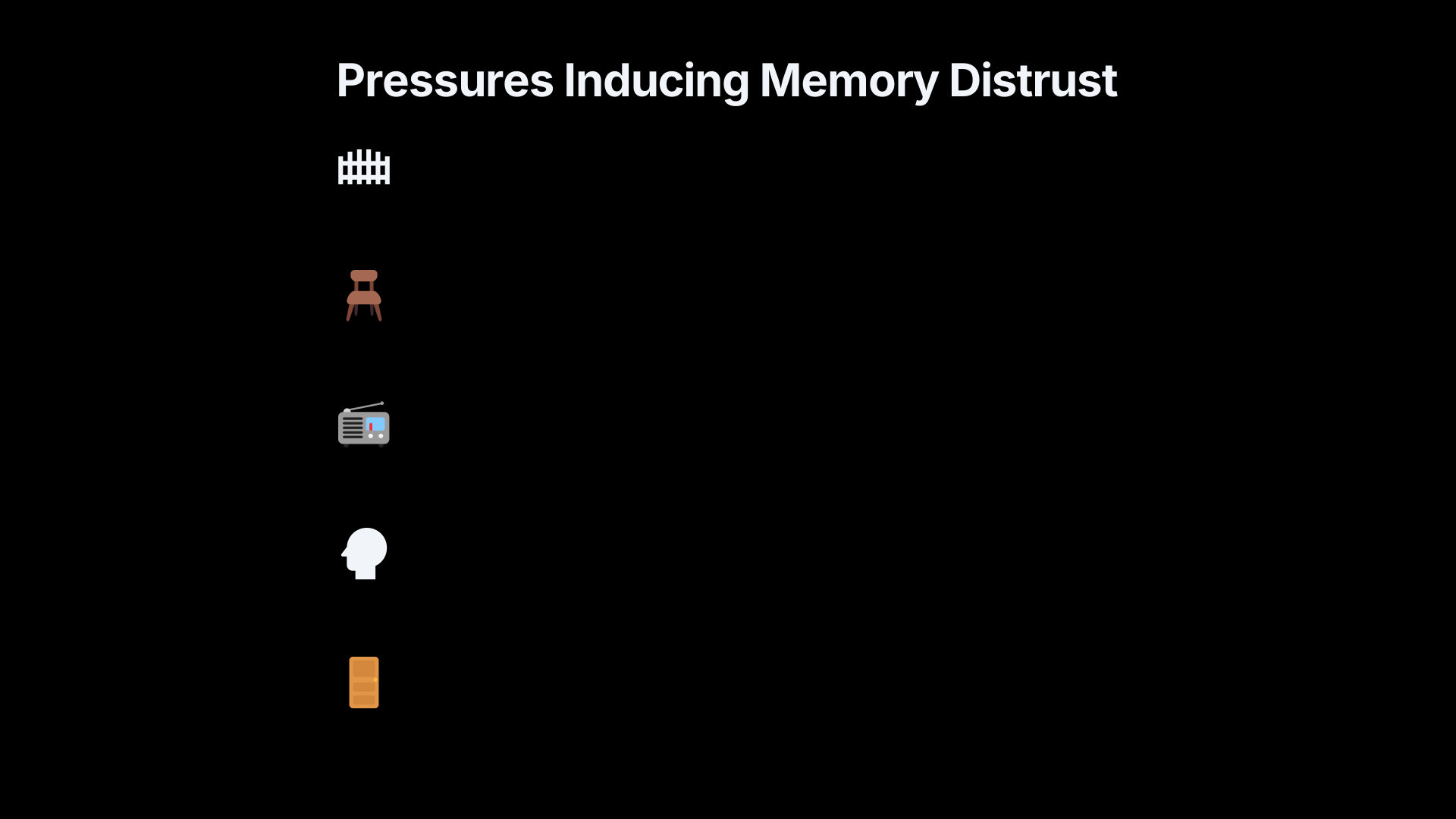
The research identifies several interacting pressures that contributed to this process:
- prolonged solitary confinement and social isolation;
- repeated, highly suggestive interviewing;
- contamination through information supplied during questioning;
- psychological vulnerabilities, including poor confidence in memory;
- a growing desire to satisfy investigators or bring questioning to an end;
- lack of independent emotional support while under interrogation.[University of Iceland]iris.hi.isUniversity of IcelandThe role of memory distrust in cases of internalised false confession - University of Iceland…
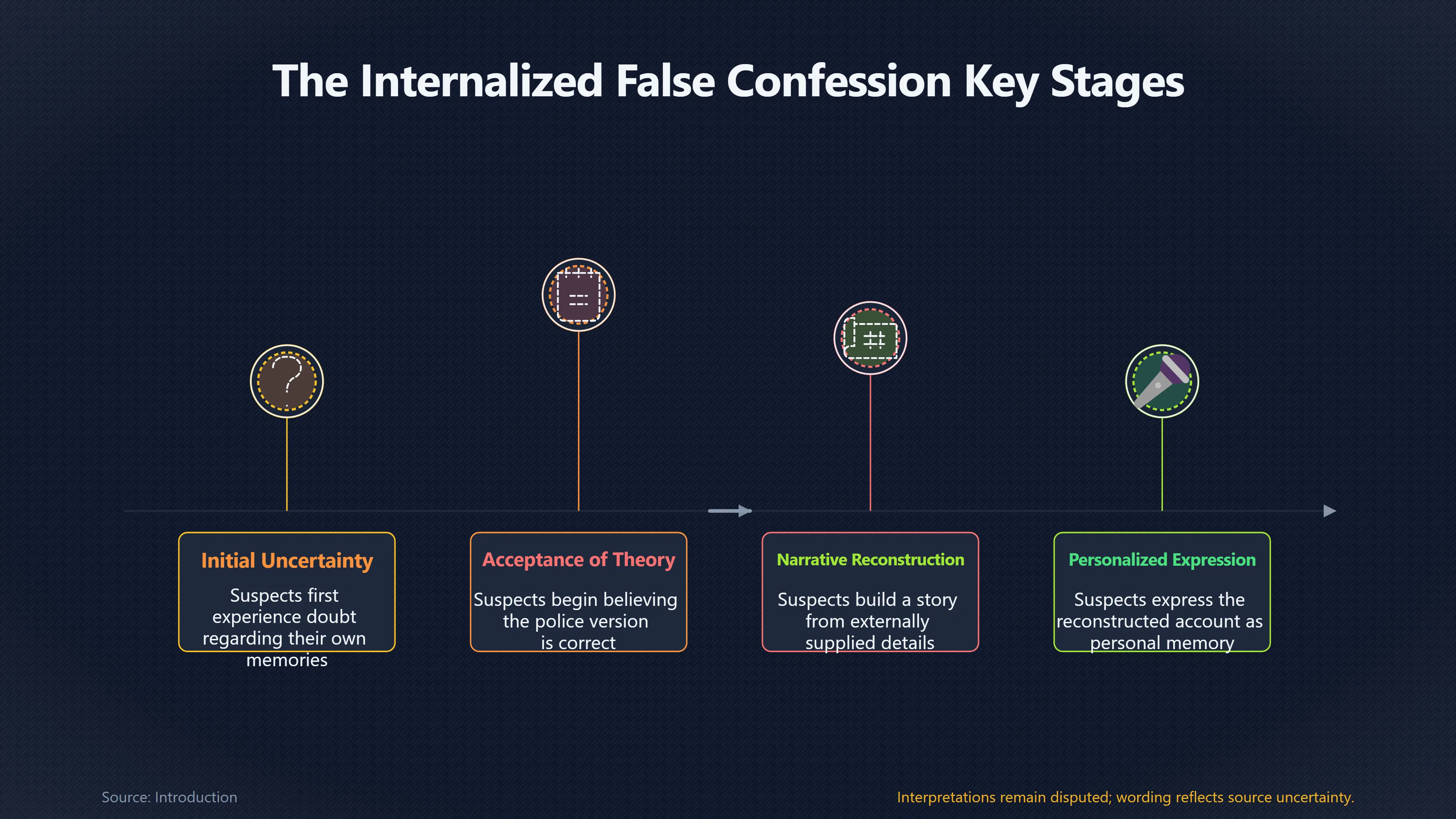
Rather than viewing false confession as a single decision, Guðjónsson and colleagues describe a sequence in which a suspect first experiences uncertainty, then begins accepting that the police version might be correct, reconstructs a narrative from externally supplied details, and finally comes to express that reconstructed account as if remembering it personally. This model has become influential well beyond Iceland in research on coerced and internalised false confessions.[University of Iceland]iris.hi.isUniversity of IcelandThe role of memory distrust in cases of internalised false confession - University of Iceland…
Why the convictions eventually collapsed
Public confidence in the convictions weakened gradually rather than suddenly. Journalists, lawyers and family members continued questioning how murder convictions could stand without any physical evidence. As psychological research into false confessions expanded internationally, the interrogation methods used in Iceland increasingly attracted criticism.[University of Iceland]iris.hi.isUniversity of IcelandFalse confessions in the Nordic countries: Background and current landscape - University of Iceland…
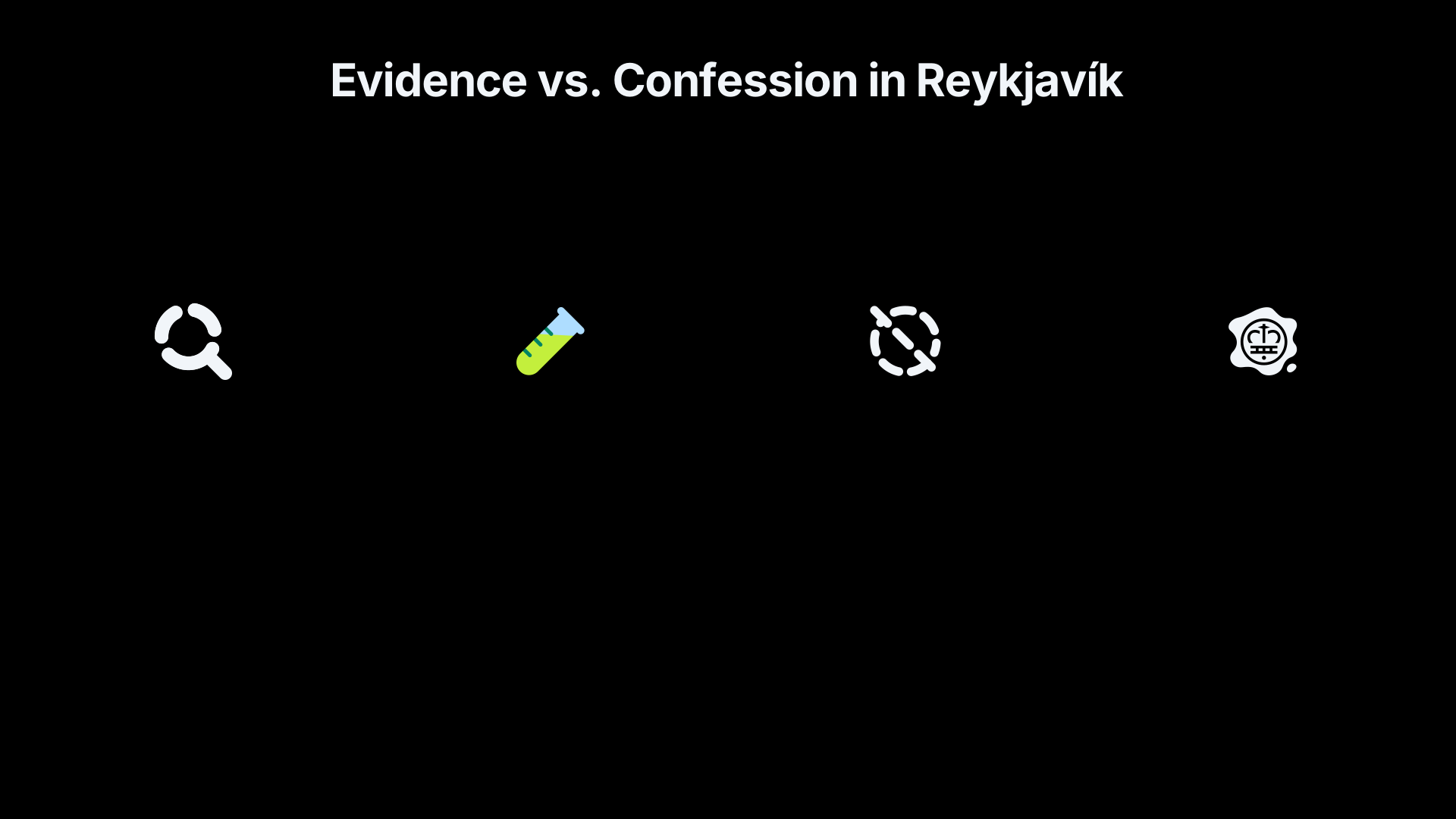
Official reviews eventually re-examined both the evidence and the interviewing practices. The reviews concluded that the reliability of the confessions had been fundamentally undermined by the interrogation process itself. In 2018, Iceland’s Supreme Court acquitted five of the six convicted individuals. The conviction of Erla Bolladóttir for perjury was left in place because it concerned her statements to investigators rather than participation in murder, but the central murder convictions collapsed. The Icelandic government later issued a formal apology to the acquitted men and to the families of those who had died before their names were cleared.[University of Iceland]iris.hi.isUniversity of IcelandFalse confessions in the Nordic countries: Background and current landscape - University of Iceland…
The disappearances themselves remain unsolved. The acquittals did not establish what happened to Guðmundur or Geirfinnur; instead, they recognised that the convictions could no longer be regarded as safe because the evidence supporting them had proved unreliable.[University of Iceland]iris.hi.isUniversity of IcelandFalse confessions in the Nordic countries: Background and current landscape - University of Iceland…
Why the case still matters
Within Iceland’s history of collective belief and social fear, the Reykjavík Confessions occupy a distinctive place. They were not a moral panic in the classic sense, nor were they a case of mass psychogenic illness. Instead, they illustrate how institutional certainty can become self-reinforcing when investigators, suspects and courts all come to accept a single explanation despite weak independent evidence.
The case has become a standard example in psychology, criminology and legal studies because it demonstrates that memory is not a fixed recording of past events. Under prolonged isolation, repeated suggestion and sustained pressure, people may lose trust in their own recollections and become vulnerable to constructing detailed but false narratives. The Reykjavík Confessions therefore helped reshape international discussion about police interviewing, the dangers of contamination during questioning, and the need for corroborating evidence beyond confession alone.[University of Iceland]iris.hi.isUniversity of IcelandThe role of memory distrust in cases of internalised false confession - University of Iceland…

Endnotes
1.
Source: iris.hi.is
Link:https://iris.hi.is/en/publications/the-role-of-memory-distrust-in-cases-of-internalised-false-confes/
Source snippet
University of IcelandThe role of memory distrust in cases of internalised false confession - University of Iceland...
2.
Source: iris.hi.is
Link:https://iris.hi.is/en/publications/false-confessions-in-the-nordic-countries-background-and-current-/
Source snippet
University of IcelandFalse confessions in the Nordic countries: Background and current landscape - University of Iceland...
3.
Source: iris.hi.is
Title: is The role of memory distrust in cases of internalised false confession
Link:https://iris.hi.is/is/publications/the-role-of-memory-distrust-in-cases-of-internalised-false-confes/
Source snippet
role of memory distrust in cases of internalised false confession - Háskóli ÍslandsTHE ROLE OF MEMORY DISTRUST IN CASES OF INTERNALISED F...
4.
Source: iris.hi.is
Title: is The criminal history of ‘false confessors’ and other prison inmates
Link:https://iris.hi.is/en/publications/the-criminal-history-of-false-confessors-and-other-prison-inmates/
Source snippet
criminal history of 'false confessors' and other prison inmates - University of IcelandTHE CRIMINAL HISTORY OF 'FALSE CONFESSORS' AND OTH...
5.
Source: iris.hi.is
Title: is False confessions in the Nordic countries: Background and current landscape
Link:https://iris.hi.is/is/publications/false-confessions-in-the-nordic-countries-background-and-current-/
Source snippet
confessions in the Nordic countries: Background and current landscape - Háskóli ÍslandsFALSE CONFESSIONS IN THE NORDIC COUNTRIES: BACKGRO...
Additional References
6.
Source: iris.landsbokasafn.is
Link:https://iris.landsbokasafn.is/is/publications/the-role-of-memory-distrust-in-cases-of-internalised-false-confes/
Source snippet
role of memory distrust in cases of internalised false confession -THE ROLE OF MEMORY DISTRUST IN CASES OF INTERNALISED FALSE CONFESSION...
7.
Source: iris.rais.is
Link:https://iris.rais.is/en/publications/the-role-of-memory-distrust-in-cases-of-internalised-false-confes
Source snippet
role of memory distrust in cases of internalised false confession -THE ROLE OF MEMORY DISTRUST IN CASES OF INTERNALISED FALSE CONFESSION...
8.
Source: iris.landsbokasafn.is
Title: is The role of memory distrust in cases of internalised false confession
Link:https://iris.landsbokasafn.is/en/publications/the-role-of-memory-distrust-in-cases-of-internalised-false-confes
Source snippet
role of memory distrust in cases of internalised false confession - Rannsóknargáttin IRIS / The Iceland Research Information SystemTHE RO...
10.
Source: iris.landsbokasafn.is
Title: is The criminal history of ‘false confessors’ and other prison inmates
Link:https://iris.landsbokasafn.is/en/publications/the-criminal-history-of-false-confessors-and-other-prison-inmates/
Source snippet
criminal history of 'false confessors' and other prison inmates - Rannsóknargáttin IRIS / The Iceland Research Information SystemTHE CRIM...
11.
Source: sciencedirect.com
Title: Memory distrust syndrome, confabulation and false confession
Link:https://www.sciencedirect.com/science/article/pii/S0010945216301678
Source snippet
(2014) provides a heuristic model of memory distrust that describes the antecedents and processes involved in producing internalized fals...
12.
Source: youtube.com
Link:https://www.youtube.com/watch?v=NMisL_A08FE
Source snippet
People Convicted Of Murder Even Though A Body Was Never Found...
13.
Source: youtube.com
Title: OUT OF THIN AIR
Link:https://www.youtube.com/watch?v=eyK0t8UPW44
Source snippet
Ep #91 Out of Thin Air with Hannah George and Taylor Glenn from Drunk Women Solving Crime podcast...
14.
Source: youtube.com
Title: The Reykjavik Confessions: A case of false memories
Link:https://www.youtube.com/watch?v=dfipCqxa210
Source snippet
OUT OF THIN AIR - Trailer - Gimli Film Festival 2017...
15.
Source: youtube.com
Title: The Suspicious Case Of The Reykjavik Confessions
Link:https://www.youtube.com/watch?v=nR7XoejxsGo
Source snippet
The Reykjavik Confessions: A case of false memories...
Topic Tree