Within North Macedonia
Were North Macedonia's Pupils Really Poisoned?
The Kumanovo and Gostivar incidents show how real symptoms can become entangled with rumours, ethnic memory and disputed evidence.
On this page
- What happened in Kumanovo and Gostivar
- What medical and forensic inquiries found
- Why competing explanations endured
Page outline Jump by section
Introduction
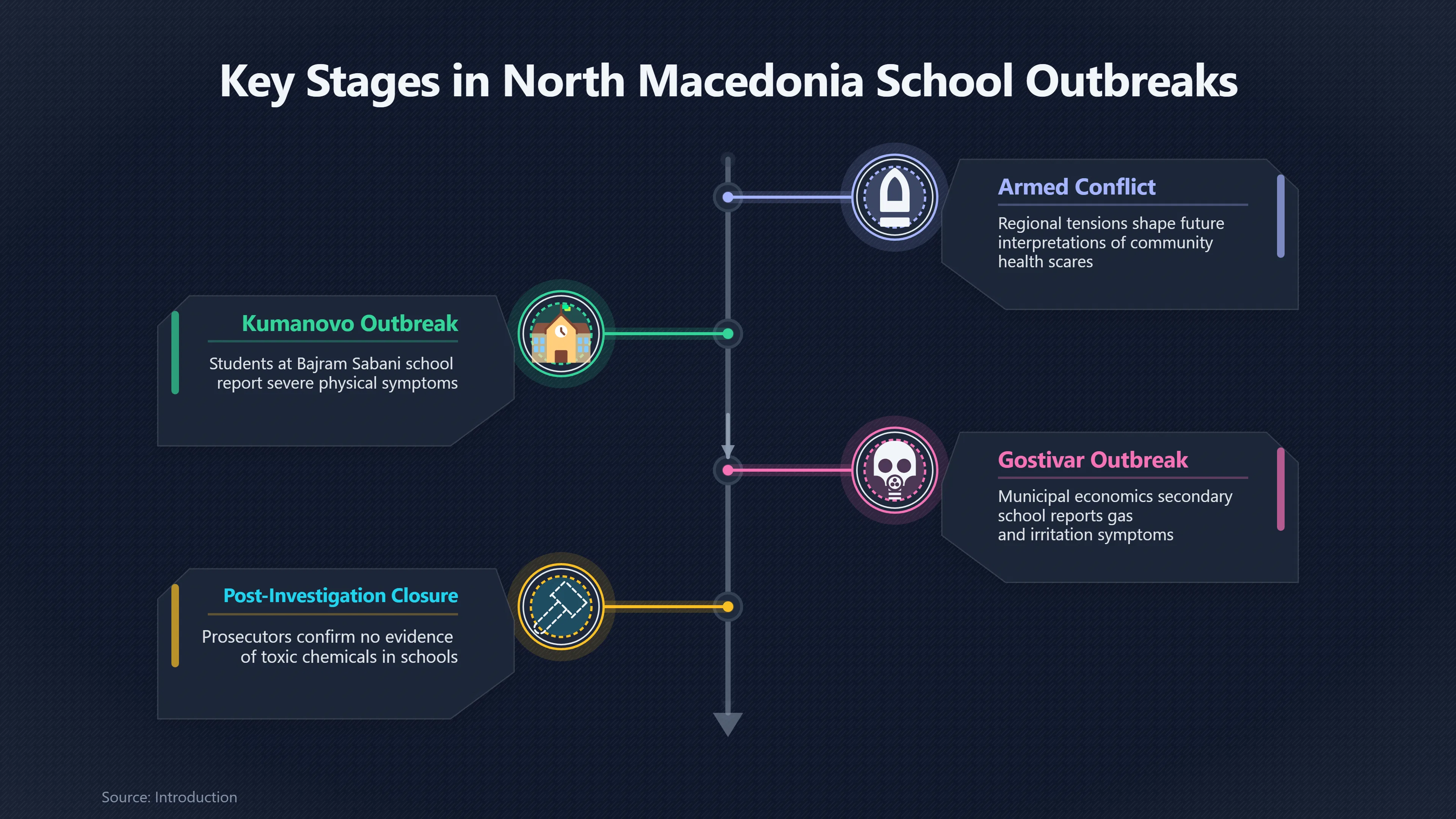
Two unexplained school illness outbreaks, in Kumanovo in 2005 and Gostivar in 2014, became some of North Macedonia’s most controversial public health incidents. In both cases, pupils and staff reported symptoms consistent with poisoning, including nausea, dizziness, breathing difficulties and fainting. Emergency services treated the events as potential chemical incidents, yet investigators were unable to identify a toxic substance that could explain the outbreaks. That gap between alarming symptoms and inconclusive forensic evidence allowed competing explanations to flourish. For some families, the illnesses reflected a real but undetected poisoning. For others, they were examples of mass psychogenic illness, in which genuine physical symptoms spread through a group without an identifiable toxic cause. Because both incidents occurred in communities marked by ethnic tension and low trust in state institutions, the debate became about far more than medicine.
What happened in Kumanovo and Gostivar?
Kumanovo, 2005
The Kumanovo incident began when pupils at the Bajram Sabani secondary school, most of them ethnic Albanian, suddenly complained of headaches, dizziness, stomach pain, breathing problems and fainting. Within days, similar reports emerged from another nearby school, prompting widespread alarm. More than 200 students were eventually reported ill, while dozens required hospital treatment and some were transferred to the Toxicology Clinic in Skopje. Parents withdrew their children from school and demanded an explanation, convinced that some form of poison had been released.[Institute for War & Peace Reporting]iwpr.netInstitute for War & Peace ReportingMacedonia: Albanian Students in Poisoning Scare | Institute for War and Peace ReportingSeptember 6, 2005…
Doctors carried out blood tests, urine analyses and other examinations but reported that they could not demonstrate poisoning. According to clinicians quoted at the time, laboratory investigations failed to detect evidence of toxic exposure, even though the students’ symptoms were real enough to require medical attention. Health officials nevertheless continued investigating because they acknowledged that the available laboratory capacity might not detect every possible chemical agent.[Institute for War & Peace Reporting]iwpr.netInstitute for War & Peace ReportingMacedonia: Albanian Students in Poisoning Scare | Institute for War and Peace ReportingSeptember 6, 2005…
The controversy quickly acquired an ethnic dimension. The affected schools primarily served ethnic Albanian pupils, and the incident occurred only a few years after the 2001 armed conflict in North Macedonia. International organisations, including representatives of the European Union, NATO and the Organization for Security and Co-operation in Europe, publicly warned against speculation that might inflame inter-ethnic relations before evidence had been established.[Institute for War & Peace Reporting]iwpr.netInstitute for War & Peace ReportingMacedonia: Albanian Students in Poisoning Scare | Institute for War and Peace ReportingSeptember 6, 2005…
Gostivar, 2014
Nearly a decade later, a similar emergency unfolded at the municipal economics secondary school in Gostivar. Students and staff reported eye irritation, nausea, breathing difficulties and dizziness after rumours spread that an unknown gas had entered the building. Around thirty pupils and several teachers or other employees were treated locally, while the most seriously affected were transferred to the Toxicology Clinic in Skopje for observation. Police sealed the school and opened a criminal investigation into the possibility of deliberate poisoning.[Радио Слободна Европа]slobodnaevropa.mkРадио Слободна ЕвропаСо гас затруени средношколци и професори од ГостиварFebruary 14, 2014…
As in Kumanovo, the initial response assumed that a hazardous substance might have been released. Toxicological testing, forensic examinations and police inquiries followed. Months later, however, the public prosecutor announced that investigators had found no evidence that a toxic chemical had been present in the school and that there was no basis for criminal proceedings over deliberate poisoning.[PORTALB]arkiv.portalb.mkProkuroria konfirmon raportet: Nuk pati helmimeProkuroria konfirmon raportet: Nuk pati helmime - PORTALBSeptember 20, 2014…
What medical and forensic inquiries found
Both incidents followed a similar investigative pattern. Authorities treated the reports seriously, because unexplained illness in schools demands an immediate response regardless of the eventual diagnosis. Hospitals examined patients, toxicologists searched for chemical explanations and police investigated the possibility of deliberate release of hazardous substances.
The crucial point is that neither investigation produced convincing forensic evidence of poisoning.
In Kumanovo:
- Medical examinations reportedly found no laboratory evidence confirming toxic exposure.
- Hospital staff acknowledged the students’ symptoms while concluding that poisoning could not be demonstrated using available testing.
- No confirmed environmental source was identified.[Institute for War & Peace Reporting]iwpr.netInstitute for War & Peace ReportingMacedonia: Albanian Students in Poisoning Scare | Institute for War and Peace ReportingSeptember 6, 2005…
In Gostivar:
- Toxicological and forensic investigations likewise failed to identify a poisonous substance.
- The Public Prosecutor concluded that there was no evidence of an unknown toxic material within the school.
- The investigation ended without identifying offenders or establishing a criminal poisoning event.[PORTALB]arkiv.portalb.mkProkuroria konfirmon raportet: Nuk pati helmimeProkuroria konfirmon raportet: Nuk pati helmime - PORTALBSeptember 20, 2014…
These findings did not prove that every symptom had a psychological origin. Rather, they established a narrower conclusion: investigators could not demonstrate exposure to a toxic agent despite extensive inquiry.
Why competing explanations endured
The persistence of disagreement reflected several overlapping factors rather than a single scientific dispute.
First, the symptoms themselves were genuine. Students experienced distress serious enough to seek hospital treatment, and many required observation. Modern research on mass psychogenic illness stresses that the absence of a toxin does not imply that sufferers were pretending or imagining their illness. Psychological and social processes can produce real physical symptoms, especially in groups experiencing acute anxiety. Studies of similar outbreaks internationally have shown that reports of unusual smells, seeing others become ill and heightened concern about contamination can all contribute to rapidly spreading symptoms in schools.[New England Journal of Medicine]nejm.orgNew England Journal of MedicineMass Psychogenic Illness Attributed to Toxic Exposure at a High School | New England Journal of MedicineJa…
Second, many families considered poisoning a more convincing explanation than official reassurances because of longstanding distrust of state institutions. Among ethnic Albanians in particular, memories of discrimination and previous unresolved incidents shaped how new events were interpreted. Medical uncertainty therefore became inseparable from political memory.
Third, the incidents echoed the still-contested Kosovo school illness outbreak of 1990, in which thousands of ethnic Albanian pupils became ill under Yugoslav rule. That earlier episode remains disputed decades later. Serbian authorities characterised it as mass hysteria or political manipulation, while many Albanian doctors, victims and community leaders maintained that poisoning had occurred. Because no explanation achieved universal acceptance, the Kosovo episode became a powerful historical reference point whenever similar school illnesses occurred elsewhere in Albanian communities.[Institute for War & Peace Reporting]iwpr.netInstitute for War & Peace ReportingMacedonia: Albanian Students in Poisoning Scare | Institute for War and Peace ReportingSeptember 6, 2005…
Finally, uncertainty itself encouraged rumours. When investigators cannot identify either a toxic agent or a definitive alternative explanation, different groups often fill the gap with interpretations that fit their existing experiences and expectations.
What these cases show about evidence and belief
The Kumanovo and Gostivar incidents illustrate why unexplained illness outbreaks are so difficult to interpret. Public health investigations must answer two separate questions:
- Were the reported symptoms genuine? In both cases, the answer is clearly yes. Students and staff experienced symptoms that warranted medical evaluation.
- Was there evidence of poisoning? Investigations did not establish the presence of a toxic substance capable of explaining the outbreaks.[Institute for War & Peace Reporting]iwpr.netInstitute for War & Peace ReportingMacedonia: Albanian Students in Poisoning Scare | Institute for War and Peace ReportingSeptember 6, 2005…
Those conclusions leave room for continued debate but also define its limits. The available evidence does not support confidently asserting that deliberate poisoning occurred, yet neither does it justify dismissing those affected as inventing or exaggerating their illness.

Why the incidents remain culturally important
These school illness episodes continue to matter because they reveal how collective fear develops in societies where trust is fragile. Medical evidence, forensic investigation and community memory all influenced public understanding, but they did not point in the same direction. For many observers, the absence of proof of poisoning was persuasive. For others, the inability to identify a toxin did not outweigh personal experience or historical memory.
Within North Macedonia’s wider history of social scares, the Kumanovo and Gostivar cases therefore stand as examples of how genuine illness, uncertainty, ethnic politics and rumour can become tightly intertwined. They are best understood not as solved mysteries or proven conspiracies, but as episodes in which contested evidence allowed competing narratives to survive long after the immediate medical emergency had ended.
Amazon book picks
Further Reading
Books and field guides related to Were North Macedonia's Pupils Really Poisoned?. Use these as the next step if you want deeper reading beyond the article.
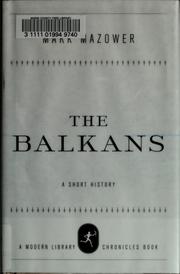
Extraordinary Popular Delusions and the Madness of Crowds
Rating: 4.0/5 from 5 Google Books ratings
Relevant to disputed poisoning scares.

Endnotes
1.
Source: arkiv.portalb.mk
Title: Brenda javës do të zbardhen detajet e helmimit të nxënësve në Gostivar
Link:https://arkiv.portalb.mk/33890-brenda-javes-do-te-zbardhen-detajet-e-helmimit-te-nxenesve-ne-gostivar/
Source snippet
Brenda javës do të zbardhen detajet e helmimit të nxënësve në Gostivar - PORTALB...
2.
Source: arkiv.portalb.mk
Title: Prokuroria konfirmon raportet: Nuk pati helmime
Link:https://arkiv.portalb.mk/109515-prokuroria-konfirmon-raportet-nuk-pati-helmime/
Source snippet
Prokuroria konfirmon raportet: Nuk pati helmime - PORTALBSeptember 20, 2014...
Published: September 20, 2014
3.
Source: arkiv.portalb.mk
Title: mk Analizat: Nxënësit e Gostivarit nuk ishin helmuar
Link:https://arkiv.portalb.mk/34047-analizat-nxenesit-e-gostivarit-nuk-ishin-helmuar/
4.
Source: arkiv.portalb.mk
Title: mk Sot priten rezultatet e para për helmimin në Gostivar
Link:https://arkiv.portalb.mk/33981-sot-priten-rezultatet-e-para-per-helmimin-ne-gostivar/
5.
Source: iwpr.net
Link:https://iwpr.net/global-voices/macedonia-albanian-students-poisoning-scare
Source snippet
Institute for War & Peace ReportingMacedonia: Albanian Students in Poisoning Scare | Institute for War and Peace ReportingSeptember 6, 2005...
Published: September 6, 2005
6.
Source: slobodnaevropa.mk
Link:https://www.slobodnaevropa.mk/a/25264622.html
Source snippet
Радио Слободна ЕвропаСо гас затруени средношколци и професори од ГостиварFebruary 14, 2014...
Published: February 14, 2014
7.
Source: nejm.org
Link:https://www.nejm.org/doi/full/10.1056/NEJM200001133420206
Source snippet
New England Journal of MedicineMass Psychogenic Illness Attributed to Toxic Exposure at a High School | New England Journal of MedicineJa...
8.
Source: nejm.org
Link:https://www.nejm.org/doi/abs/10.1056/NEJM200001133420206
9.
Source: iwpr.net
Link:https://iwpr.net/sr/global-voices/makedonija-albanski-ucenici-veruju-da-su-otrovani
10.
Source: hero.epa.gov
Link:https://hero.epa.gov/reference/11895/
Additional References
11.
Source: sciencedirect.com
Link:https://www.sciencedirect.com/science/article/pii/S0736467915010598
Source snippet
February 1, 2016 — THE JOURNAL OF EMERGENCY MEDICINE Volume 50, Issue 2, February 2016, Pages e47-e52 Outbreak of Mysterious...
Published: February 1, 2016
12.
Source: slobodenpecat.mk
Link:https://www.slobodenpecat.mk/en/ojo-ispituva-dali-samoubistvoto-na-13-godishnoto-devojche-e-povrzano-so-sekta/
Source snippet
BPPO investigates whether the suicide of a 13-year-old girl is related to a sect - Free PressDecember 12, 2019 — Image: prosecution ojo T...
Published: December 12, 2019
13.
Source: koha.mk
Title: Vedat Ademi’s case, Kumanovo Prosecution Office has completed the investigations
Link:https://koha.mk/en/rasti-i-vedat-ademit-prokuoria-e-kumanoves-ka-perfunduar-hetimet/
Source snippet
March 2, 2026 — Image: Kumanovo prosecutor's office Top Story Less than min.READING VEDAT ADEMI'S CASE, KUMANOVO PROSECUTION OFFICE H...
Published: March 2, 2026
14.
Source: errc.org
Link:https://www.errc.org/roma-rights-journal/private-lawsuit-filed-after-public-prosecutor-ended-investigation-into-police-brutality-in-kicevo
15.
Source: netpress.com.mk
Link:https://netpress.com.mk/mvr-so-veshtachenjata-ne-e-konstatirano-prisustvo-na-toksichna-materija-vo-gostivarskoto-uchilishte/
16.
Source: radiomof.mk
Link:https://www.radiomof.mk/sudska-meditsina-gostivarskite-srednoshkoltsi-ne-bile-otrueni-so-hemiska-supstantsa/
17.
Source: a1on.mk
Title: ojo gostivar sluchajot truenje vo gostivarskoto ekonomsko uchilishte e zatvoren
Link:https://a1on.mk/macedonia/ojo-gostivar-sluchajot-truenje-vo-gostivarskoto-ekonomsko-uchilishte-e-zatvoren/
18.
Source: kanal5.com.mk
Title: profesorite i srednoshkolcite od gostivar negiraat deka lazhirale truenje
Link:https://kanal5.com.mk/articles/197539/profesorite-i-srednoshkolcite-od-gostivar-negiraat-deka-lazhirale-truenje
19.
Source: youtube.com
Title: The Razor-Thin Line Between Contagion and Connection
Link:https://www.youtube.com/watch?v=u0fFIJapsRY
Source snippet
Teens' uncontrollable mystery illness...
20.
Source: macedoniantruth.org
Title: 5261 poisonings or power plays patrick buchanan 2003
Link:https://www.macedoniantruth.org/forum/forum/macedonian-truth-forum/news-and-politics/5261-poisonings-or-power-plays-patrick-buchanan-2003
Topic Tree